
There are political decisions that change a nation’s trajectory, and then there are political decisions that change the clock on the microwave twice a year.
British Columbia’s long-gestating move to end seasonal time changes belongs to the second category. And yet, like so many small administrative reforms, it reveals more about governance, coordination, and federalism than its modest subject suggests.
When David Eby says the issue is about “making life easier for families” and “reducing disruptions for businesses,” he is not wrong. Twice a year, millions of people reset schedules, disrupt sleep cycles, confuse meeting times, and briefly destabilize routines. The economic cost is diffuse but real. The human irritation is universal.
But the British Columbia story is not simply about clocks. It is about interdependence.
A Province Ready, A Continent Not
British Columbia passed legislation in 2019 to adopt permanent daylight saving time. The public consultation showed strong support. The mechanics were prepared. The legal framework exists. Yet implementation stalled because BC tied its decision to the U.S. Pacific Northwest, particularly Washington, Oregon, and California.
Why? Because Vancouver and Seattle function less like distant cities and more like adjacent economic zones. A two-hour time gap for part of the year would complicate trade, transportation, markets, and daily cross-border life. So BC waited on American congressional action that never arrived.
That is the quiet absurdity of modern federalism. A provincial legislature can pass a law. A neighbouring state legislature can pass a similar law. And both remain inert because a third legislative body, thousands of kilometres away in Washington, D.C., controls the clock.
BC’s renewed political framing signals impatience with that paralysis.
Canada’s Patchwork Time Regime
Canada does not have a single national time policy. Provinces decide.
Saskatchewan effectively does not change clocks. Yukon moved to permanent time in 2020. Ontario passed legislation that would end seasonal changes, but only if Quebec and New York follow suit. Nova Scotia has debated similar moves.
In other words, the legislative scaffolding already exists across multiple provinces. What is missing is synchronization.
This is the core tension. Canadians dislike changing clocks. Legislatures have responded. Yet every province that is economically entangled with a neighbour hesitates to move unilaterally.
BC’s decision, if implemented regardless of U.S. action, would break that coordination norm. It would demonstrate that a province can absorb the temporary inconvenience of cross-border time divergence in exchange for internal consistency.
That matters.
The Real Policy Question No One Likes to Debate
There is also a deeper issue that remains politically underexplored. Ending clock changes is popular. Choosing which time to keep is less so.
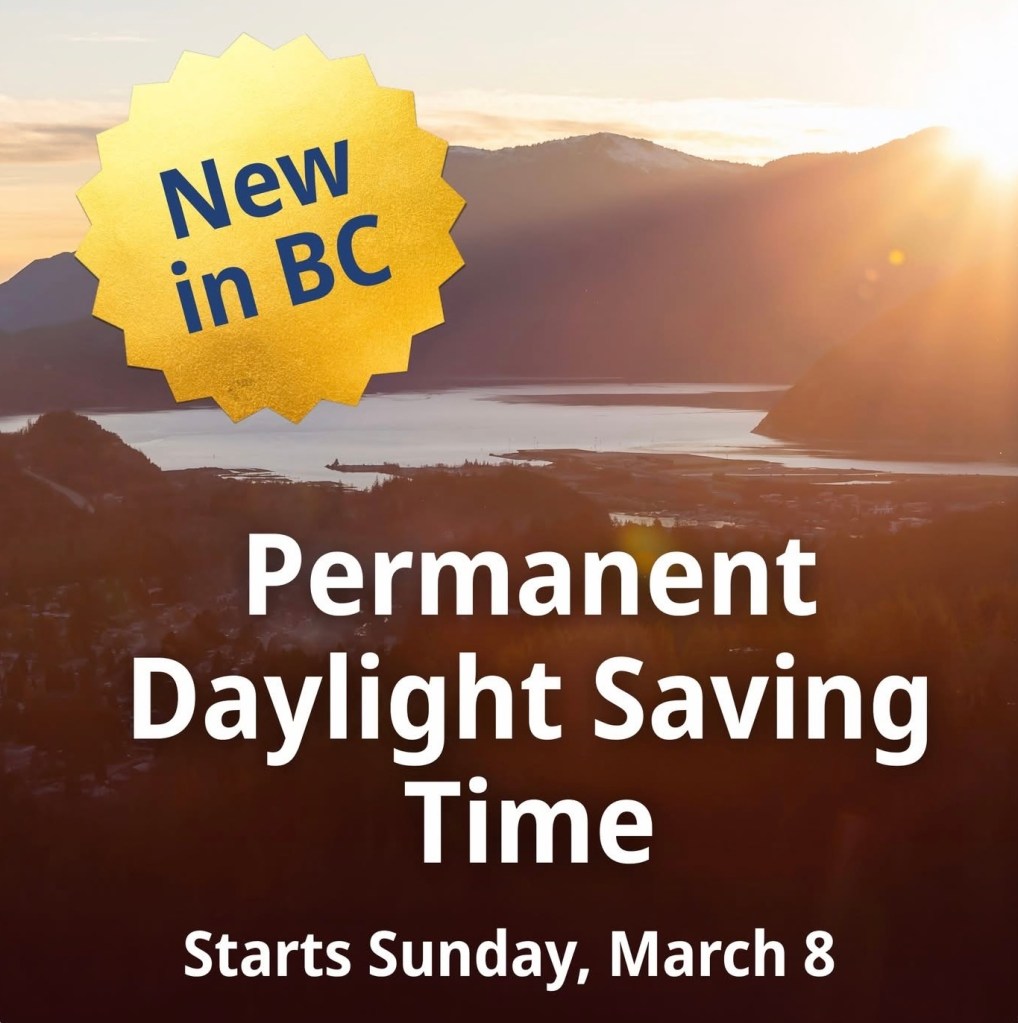
Permanent daylight saving time means brighter winter evenings and darker winter mornings. In northern latitudes, those mornings become very dark indeed. Sleep researchers often argue permanent standard time aligns better with human circadian rhythms. Politicians prefer the marketing appeal of longer evening light.
BC chose permanent daylight saving time.
The choice is not trivial. It reflects a cultural preference for after-work daylight over morning biological alignment. It favours consumer time over solar time.
That debate is barely visible in the political messaging, but it exists beneath the surface.
What This Means for Canada
If BC proceeds, several things follow.
First, Ontario’s conditional legislation becomes harder to justify. The argument that “we must wait for everyone” weakens once one major province decides not to.
Second, public debate will intensify in provinces that have already prepared legislative tools but lack political momentum.
Third, the federal government may find itself facing pressure for coordination, even if timekeeping remains a provincial power. A national conversation could emerge not because Ottawa initiated it, but because provincial asymmetry forces it.
Will the rest of Canada follow immediately? No.
Will BC’s move increase the probability of broader change within five years? Very likely.
Clock policy is rarely transformative. But it is revealing. It exposes how deeply integrated provincial economies are with the United States. It demonstrates the limits of legislative autonomy in a continental marketplace. And it shows that even mundane administrative reforms require geopolitical choreography.
In the end, this is not about daylight. It is about governance friction.
And as with so many small reforms, once one jurisdiction proves that the sky does not fall when the clocks stop changing, others tend to follow.
 The Rowanwood Chronicles