The Cherrys Books: Family, Adventure, and Imagination

William Matthew Scott, better known by his pen name Will Scott, was a British writer born in 1893 in Leeds, Yorkshire, and active as a novelist, playwright, short-story writer, and children’s author until his death in 1964 in Herne Bay, Kent. In his earlier career he wrote detective novels and plays including The Limping Man, and is said to have contributed around 2,000 short stories to magazines and newspapers, which was considered a record in the United Kingdom during his lifetime. His shift into children’s fiction came relatively late and was inspired by his own grandchildren, for whom he began inventing stories that eventually became The Cherrys series.  

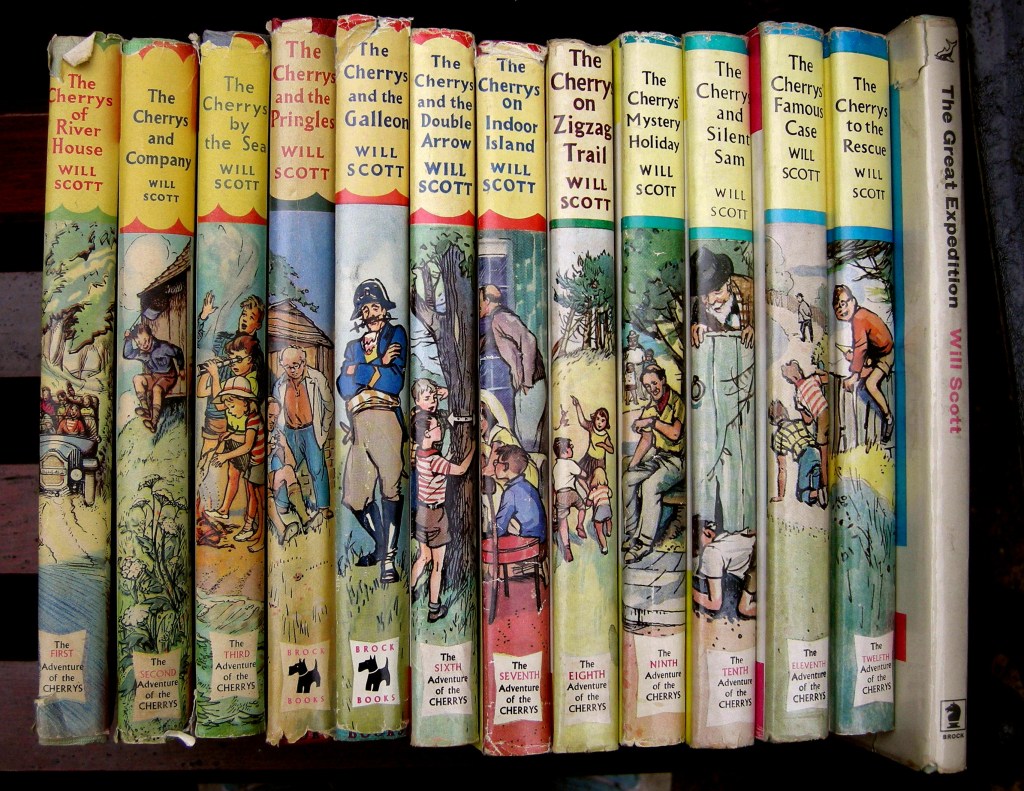
Published between 1952 and 1965The Cherrys consists of 14 books aimed at children around ten years old. These books are set in a series of fictional English villages and bays, often around the Kentish coast, and centre on a single extended family: Captain and Mrs Cherry and their four children, Jimmy, Jane, Roy, and Pam. The family’s unusual animal companions, a monkey named Mr Watson and a parrot called Joseph, add to the charm of the stories.  
At the heart of The Cherrys is a simple but powerful idea: childhood is an adventure to be nurtured by imagination and shared experience. Rather than portraying children operating independently of adults, as was common in much children’s fiction of the era, these books emphasize active parental involvement, especially through the father figure, Captain Cherry. A retired explorer, he delights in creating games, puzzles, treasure hunts, mystery trails, and “happenings” that turn ordinary days into extraordinary quests. These events span coastlines, forests, gardens, and even indoor spaces transformed by imagination into jungles, deserts, or deserted islands.  

The recurring concept of a “happening” – a structured, imaginative adventure, is one of the defining features of the series. Whether decoding maps, tracking mysterious figures, solving puzzles, or embarking on seaside explorations, each book presents a series of linked episodes that encourage curiosity, teamwork, problem-solving, and play. Scott’s approach reflects a belief in the value of learning through play, where the boundaries between fantasy and reality are fluid but always grounded in cooperative activity with family and friends.  

Another important theme in The Cherrys is engagement with the natural and built environment. Scott often provided maps of the stories’ fictional settings , such as Market Cray or St Denis Bay, and used them as stages for the characters’ activities. This emphasis on place encourages readers to see their own landscapes as rich with potential for discovery. The stories also reflect a positive view of the mid-century British countryside and coast, celebrating local topography and community life.  

Because Scott was writing at a time when much of children’s literature featured independent adventures without adults, The Cherrys stood out in its portrayal of grown-ups as co-adventurers rather than obstacles. This inclusive structure bridges the generational gap, showing children and adults working together, learning from one another, and finding joy in shared challenges.  

Despite their popularity in their day, these books are no longer in print, making them a somewhat forgotten gem of 1950s and 1960s British children’s literature. Yet for those who discover them today, the series offers a window into a world where imagination, family bonds, adventure, and everyday wonder are woven seamlessly into the narrative fabric. 
Fantasy as Memory: The Historical Imagination of Guy Gavriel Kay

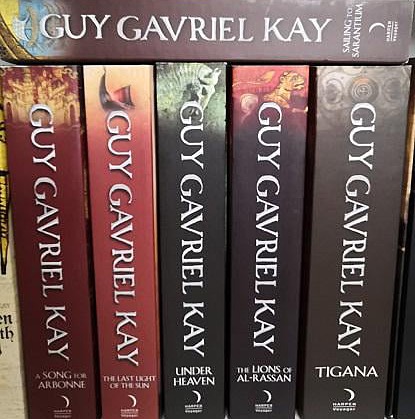
One of my favourite fiction authors, Guy Gavriel Kay has shaped my reading life from his debut series “The Fionavar Tapestry”, published in the mid-1980s, to his most recent novel “Written on the Dark”, released earlier this year.

Kay does not write fantasy as spectacle or escape, but as remembrance. His work is concerned less with heroes than with consequence, asking what endures after ambition, love, and loss. That focus, and his habit of listening closely to history rather than reshaping it for comfort, is what sets his writing apart from others in the genre.

Guy Gavriel Kay’s writing style is often described as lyrical, restrained, and morally attentive, and that combination is very Canadian in the best sense of the word. His prose is elegant without being ornamental, emotionally resonant without tipping into melodrama, and deeply concerned with how history presses on individual lives.

Lyrical clarity rather than baroque fantasy
Kay’s sentences are musical, but they are rarely flashy. He favours cadence, balance, and carefully chosen imagery over density or excess. Unlike much epic fantasy, he does not bury the reader in invented terminology or ornate description. The beauty of the prose comes from rhythm and precision, not spectacle. This gives his work a reflective, almost classical feel, closer to historical fiction than to high fantasy in the Tolkienian tradition.

History refracted, not replicated
One of Kay’s defining stylistic traits is his use of “quarter-turn” history. His worlds are clearly inspired by specific historical periods and places, Byzantium, medieval Iberia, Tang-era China, Renaissance Italy, but they are never direct analogues. Stylistically, this allows him to write with the emotional authority of history without being constrained by factual retelling. The prose carries a sense of inevitability, consequence, and loss that feels historical, even when the setting is invented.

Melancholy as a narrative tone
Kay’s work is suffused with a quiet melancholy. Triumphs are provisional. Victories are costly. Even moments of joy are shadowed by what will be lost. Stylistically, this appears in his frequent use of memory, foreknowledge, and reflective distance. Characters often understand, sometimes too late, what a moment meant. This gives the writing a sense of adult seriousness and emotional depth that distinguishes him from more action-driven fantasy authors.

Moral complexity without cynicism
Kay is interested in moral ambiguity, but he is not cynical. His style allows multiple perspectives to coexist without collapsing into relativism. Characters act from loyalty, love, fear, faith, and ambition, often all at once. The prose is careful to see people rather than judge them. Even antagonists are given interiority and dignity. This ethical attentiveness is part of what makes his work feel humane and grounded.

Dialogue as character and culture
His dialogue is formal without being stiff, shaped by the social worlds his characters inhabit. People speak with restraint, implication, and subtext. Emotion is often conveyed by what is not said. This stylistic choice reinforces themes of honour, obligation, and social constraint, particularly in courtly or religious settings.

A Canadian sensibility
Although Kay’s settings are global and historical, his sensibility feels distinctly Canadian. There is a preference for understatement, for listening rather than declaring, for complexity over absolutes. Power is treated warily. Empire is examined with sadness rather than nostalgia. The writing resists grand national mythmaking and instead focuses on human cost, compromise, and quiet endurance.

Guy Gavriel Kay writes fantasy for readers who care about language, history, and moral weight. His style is not about escape so much as reflection. He invites the reader to slow down, to attend to memory and consequence, and to sit with beauty that is inseparable from loss. That combination, lyrical restraint, historical gravity, and ethical seriousness, is what makes his voice unmistakable and enduring.

Frank McLynn: A Biographer Who Talks Back to History

“History is not a static record, and truth is not a simple story. It is a conversation, sometimes a quarrel, and always an argument well made.”

If you haven’t yet fallen into the work of Frank McLynn, consider this a gentle warning: once you do, history will never look quite the same. McLynn isn’t merely a writer of biographies; he is a thinker about biography itself, a historian who insists on a conversation with his peers even as he recounts the lives of figures long departed. His work is a masterclass in the art of writing history that is simultaneously rigorous, readable, and refreshingly candid.

Engaging with History, Not Just Telling It
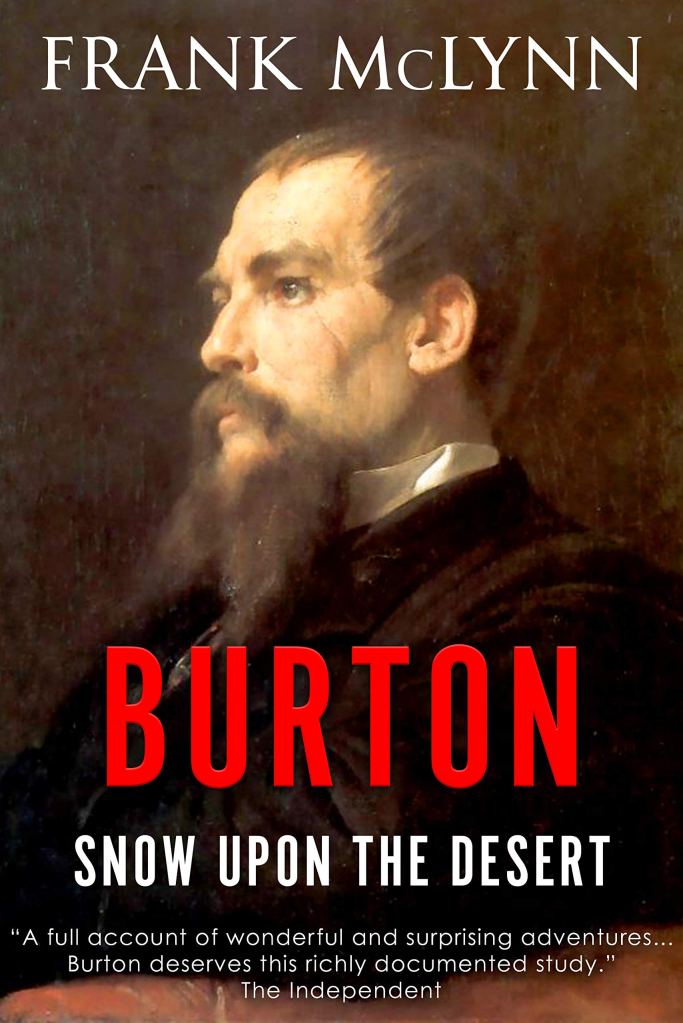
Take his monumental work on Richard Francis Burton. Most biographers, in approaching a figure like Burton: the explorer, linguist, orientalist, and provocateur would pick a path of reverence, sensationalism, or straightforward chronology. McLynn does none of these exclusively. Instead, he immerses himself in the entire scholarly conversation on Burton, dissecting assumptions, noting disagreements, and then calmly explaining why his own interpretation diverges. He doesn’t dismiss other historians; he engages with them, highlighting blind spots, overlooked evidence, or interpretive errors. The result is not just a biography, but a kind of intellectual conversation that readers can follow and participate in.

Version 1.0.0

This dialogic approach is rare in modern biography. Many writers simply present their research, leaving the reader to assume that their conclusions are self-evident. McLynn, by contrast, shows the intellectual gears turning behind the narrative: why he favors one interpretation over another, why certain sources carry more weight, and why some claims advanced by previous historians are problematic. In doing so, he educates as he narrates, giving readers insight into the historian’s craft as well as the subject’s life.

The Challenge of Burton’s Lost Papers
McLynn’s work on Burton becomes even more remarkable when one considers the obstacles he faced. Much of Burton’s personal material: letters, diaries, manuscripts was deliberately destroyed by his wife, Isabel, after his death. Earlier biographers often treated this loss as a barrier too high to surmount, leaving gaps in the narrative or filling them with speculation that blurred the line between evidence and invention.

McLynn confronts these gaps head-on. He does not pretend they do not exist, nor does he indulge in imaginative reconstruction disguised as fact. Instead, he reconstructs Burton’s world with meticulous care, using surviving letters, published works, contemporary accounts, and even indirect references to piece together a life both vivid and credible. The result is a biography that is as rigorous as it is lively, a rare balance in historical writing, especially given the fragmentary nature of the surviving sources.

What stands out is McLynn’s ethical sensitivity. He demonstrates that historical gaps do not justify careless inference. Rather, he shows how one can be faithful to the evidence while still producing an engaging narrative. Readers gain not only a sense of Burton himself, but also an appreciation for how historians navigate the tension between curiosity and respect, interpretation and invention.

The Ethics and Craft of Biography
This transparency is one of McLynn’s defining traits. He models intellectual honesty in every chapter, reminding readers that biography is as much about interpretation as it is about fact. He acknowledges the limits of sources, the biases of previous scholars, and the moral ambiguity of his subjects. By doing so, he invites readers to think critically, weigh evidence, and arrive at their own conclusions.

McLynn’s biographies are, in a sense, lessons in historiography. Through his work, we see how historical interpretation evolves, how scholars argue across time, and how personal and cultural biases shape the telling of any life. He makes these debates accessible, without ever oversimplifying them, allowing readers to witness the historian’s reasoning in action.

Themes Across McLynn’s Work
Across his wide-ranging oeuvre, from Napoleon Bonaparte to Genghis Khan, from Carl Jung to Marcus Aurelius, McLynn’s approach is consistent. He is drawn to figures who are morally complex, intellectually audacious, or too misunderstood to be captured by conventional narratives. He eschews hagiography and sensationalism alike, favoring instead a careful, nuanced exploration of character and context.

Another hallmark is his attention to cultural and historical environment. McLynn situates his subjects within the broader currents of their times, showing how context shapes decisions, ambitions, and legacies. In Genghis Khan: The Man Who Conquered the World, for example, he paints a rich picture of the Mongol steppe and tribal politics, helping readers understand the extraordinary achievements of a man often caricatured in previous accounts. Similarly, in his Napoleon biography, he balances the public image with the private complexities of the man, providing both strategic analysis and human insight.

Why McLynn Matters
For readers, engaging with McLynn is thrilling. You are not merely absorbing facts; you are witnessing a historian navigate a maze of interpretation, weighing evidence, and arguing with the ghosts of scholarship past. His biographies are immersive, yet intellectually rigorous, blending narrative excitement with careful reasoning.

In a publishing world awash with hagiography, sensationalism, and truncated life sketches, McLynn reminds us why biography matters. He shows that history is a living dialogue, shaped by questions as much as answers. And in every book, quietly but insistently, he is the biographer who talks back, both to his subjects, and to the historians who have preceded him.

“He writes not to canonize or condemn, but to illuminate, and in doing so, he reveals something equally compelling about the practice of history itself.”

For those willing to read closely, McLynn’s footnotes, source critiques, and occasional asides provide a secondary narrative: a conversation about scholarship itself. In this sense, reading McLynn is not just a journey through the lives of extraordinary figures; it is a lesson in how history is written, interpreted, and understood.

The Faded Sun Trilogy: A Story of Survival and Identity

Some books aren’t just read – they become companions, revisited as life shifts and perspectives deepen. For me, Frank Herbert’s Dune is one of those books, a story I reread every year, discovering something new as my own experiences reshape how I see it. But C.J. Cherryh’s The Faded Sun Trilogy holds a different kind of power. While I don’t revisit it annually, its well-worn spines tell the story of years spent returning to its rich, meditative exploration of culture, survival, and identity.

Published between 1978 and 1979, the trilogy – KesrithShon’jir, and Kutath – takes place in Cherryh’s Union-Alliance universe, where power struggles between species shape the galaxy. The Mri, a proud nomadic warrior culture, face extinction, betrayed by their former employers, the alien Regul, during a war with humanity. Once indispensable mercenaries, the Mri are now abandoned, eking out an existence on the desert planet Kesrith. It’s here that Sten Duncan, a human soldier, becomes entangled in their plight. His curiosity grows into something deeper as he immerses himself in their alien customs and traditions. Over the trilogy, Duncan evolves from an observer to a mediator, caught between the Mri and a universe determined to erase them.

The trilogy opens on Kesrith, a desert world as harsh and unrelenting as the Mri’s reality. Cherryh’s writing captures the desert as a living entity – a stark, intricate landscape mirroring the Mri’s fragile resilience. Humanity steps into the vacuum left by war, bringing complexities of expansion and conquest, while the Regul, bureaucratic and manipulative, operate from the shadows.

What makes Cherryh’s storytelling unforgettable is her refusal to romanticize the Mri. They are flawed, bound by an honor code that defines, but also constrains them. Their worldview, steeped in ritual and tradition, feels authentically alien, requiring both Duncan and the reader to adapt. Duncan’s transformation is central to the story, as he sheds the biases of his upbringing and immerses himself in the Mri’s culture. His journey reflects the trilogy’s larger questions: Can true understanding exist between fundamentally different peoples? And what is the cost of bridging that divide?

As the story unfolds in Shon’jir and Kutath, the stakes deepen. The surviving Mri flee Kesrith in search of a new home, grappling with the pressures to adapt or perish. Their destination, the ancestral world of Kutath, offers the promise of renewal, but also threatens irrelevance in a universe that has moved on without them. Cherryh captures this tension masterfully, forcing the Mri, and the reader, to confront the delicate balance between survival and transformation.

At its core, The Faded Sun Trilogy is a meditation on the fragility of cultural identity and the devastating impact of imperialism. The Mri’s plight echoes the experiences of countless displaced peoples, their traditions and way of life slowly eroded by conquest and assimilation. Cherryh critiques imperialism but avoids simple moral binaries. The Regul, manipulative and cold, and humanity, ambitious and expansionist, are driven by survival instincts rather than malice. This ambiguity forces the reader to grapple with the complexities of cultural dominance and erasure.

Environmental themes add another layer of depth. The desert of Kesrith is more than a setting; it embodies the Mri’s plight – beautiful yet unforgiving, resilient, but fragile. Cherryh draws subtle parallels between the destruction of ecosystems and the loss of cultures, reminding us that imperialism claims both land and people.

Cherryh’s prose is dense, her world-building meticulous, and her portrayal of alien perspectives unmatched. Yet this depth demands patience. The trilogy’s introspective tone and slow pacing, particularly in Shon’jir, may challenge readers, but those willing to engage with its complexities are richly rewarded.

This is not a story of grand battles or easy resolutions. It is a quiet masterpiece that explores identity, survival, and the cost of understanding. Its legacy is evident in modern science fiction, influencing works like The Expanse and A Memory Called Empire. Yet, it remains singular in its vision.

Returning to these books feels like standing in a vast desert – alone with the weight of history and the persistence of life. The truths Cherryh captures burn brightly, offering a story that transforms as deeply as it entertains.

Placing the works of EE “Doc” Smith into its Societal Context

I read a fair amount of science fiction, as can clearly be seen from the content of this blog.  My first introduction to speculative fiction, beyond C.S. Lewis, was the works of E.E. “Doc” Smith, loaned to me by a fellow classmate during my early teens. I devoured every book by this author I could find, reading without judgement, just enjoying the galactic adventure. Like I have said many times about my annual reading of Frank Herbert’s Dune, it’s not the story that changes, but the perspective that the additional year gives me.  

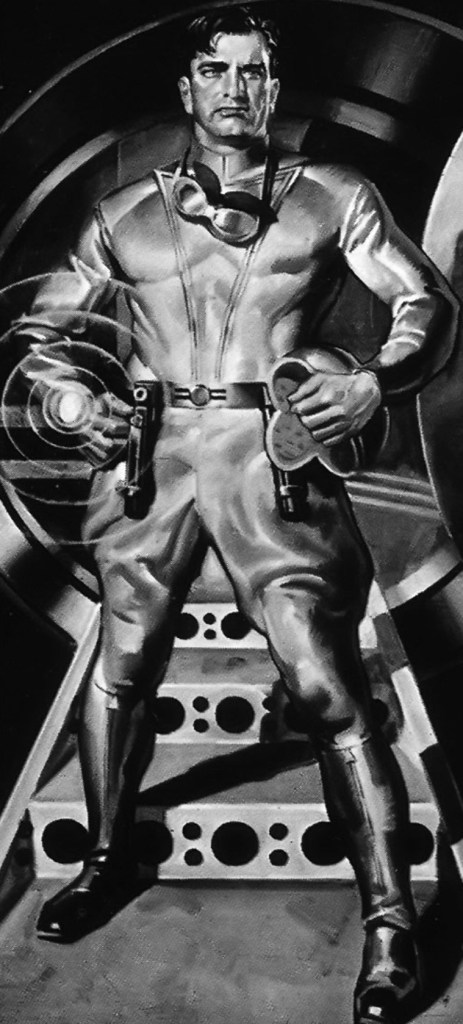
E.E. “Doc” Smith is an undeniable cornerstone of science fiction, particularly in shaping the grand, sweeping narratives of the space opera subgenre. His works, from the Lensman to the Skylark series, established many of the storytelling conventions that would define science fiction for generations. Yet, these same works are deeply entwined with the patriarchal and often misogynistic norms of their time, offering a fascinating lens through which to examine the cultural attitudes of the early-to-mid 20th century. Smith’s legacy is both a celebration of speculative ambition, and a study in the limitations of its era.

The Lensman series, perhaps Smith’s most iconic work, epitomizes the space opera’s blend of high-stakes interstellar conflict and moral idealism. Published between 1934 and 1950, these novels follow the genetically perfected heroes of the Galactic Patrol, led by the stalwart Kimball Kinnison, in their battle against the shadowy forces of Boskone. While the series broke ground in envisioning a universe of sprawling galactic civilizations, its treatment of gender roles reveals a narrower imagination. Female characters, such as Clarissa MacDougall, are largely confined to nurturing or supportive roles, their significance often framed in relation to male protagonists. Even Clarissa’s ascension to the ranks of the Lensmen – a notable exception – feels more like a narrative anomaly than a redefinition of gender dynamics. The series reflects its time, portraying men as protectors and leaders while relegating women to emotional or domestic spheres.

Similarly, the Skylark series, begun in 1928, offers an early blueprint for the modern space opera, chronicling the scientific and exploratory exploits of Richard Seaton and his morally ambiguous rival, Marc “Blackie” DuQuesne. Once again, women – characters like Dorothy Seaton and Margaret Spencer – are predominantly relegated to roles as love interests, hostages, or secondary figures. Though occasionally resourceful or intelligent, their contributions are overshadowed by the male protagonists’ heroics. These dynamics reinforce traditional gender hierarchies, with men as agents of innovation and action while women serve as symbols of emotional stability or moral guidance.

In the Family d’Alembert series, co-written with Stephen Goldin during the 1960s and 1970s, there is a slight shift in representation. Yvette d’Alembert, part of a circus-trained secret agent duo, emerges as a rare competent female protagonist. Yet even her capabilities are often contextualized by her physical appeal and partnership with her brother Jules. By this time, feminist movements were beginning to reshape societal norms, but science fiction, especially that rooted in the pulp tradition, lagged in reflecting these changes. Yvette’s portrayal, while an improvement, still clings to the vestiges of earlier patriarchal frameworks.

Smith’s later works, such as Subspace Explorers (1965), continue to explore grand themes like telepathy, space exploration, and societal advancement, but the underlying gender dynamics remain unchanged. Female characters with psychic abilities feature in the narrative, yet their roles are secondary, reinforcing the notion that leadership and innovation are male domains.

These patterns are not mere quirks of individual stories but reflections of a broader societal framework. Smith’s fiction mirrors the rigid gender roles of early-to-mid 20th-century society, a time when women were often confined to domestic or secondary positions. His male protagonists, embodying traits of strength, rationality, and dominance, contrast sharply with the nurturing and emotional roles assigned to women. While Smith does not explicitly demean women, the systemic sidelining of female characters speaks to the cultural misogyny of the era. His works helped establish many tropes that would define space opera, but they also reinforced a male-centric vision of the genre that took decades to challenge.

Despite these limitations, Smith’s influence on science fiction is profound. His imaginative depictions of intergalactic civilizations, advanced technologies, and epic storytelling inspired luminaries such as Isaac Asimov, Arthur C. Clarke, and even George Lucas. Modern readers, however, often critique his works for their outdated gender dynamics and lack of diversity. These critiques, while valid, do not diminish the historical significance of his contributions. Instead, they offer an opportunity to reevaluate his legacy in light of the genre’s ongoing evolution.

E.E. “Doc” Smith’s works remain a double-edged artifact of science fiction history: a testament to the boundless creativity of speculative fiction, and a reminder of the cultural constraints of its time. By recognizing these dual aspects, we can celebrate his role in shaping the genre while continuing to push for more inclusive and equitable narratives in speculative storytelling.