
Celebrating Two Giants of Science Communication: Bob McDonald and James Burke

In the world of public science education, Bob McDonald and James Burke stand as exceptional figures, each with a distinctive voice and approach that have resonated globally. Though separated by geography and generations, their work shares a profound impact: transforming science into a compelling story for the curious.

From Unlikely Beginnings to National Influence
Bob McDonald, born in Wingham, Ontario, in 1951, did not follow the traditional path of a scientist. He struggled in school, flunked Grade 9 and dropped out of York University after two years studying English, philosophy, and theatre. A serendipitous job at the Ontario Science Centre, earned through sheer enthusiasm, marked the start of a lifelong journey in public science communication. Without formal scientific training, McDonald has become Canada’s most trusted science voice, hosting CBC’s Quirks & Quarks since 1992, and serving as chief science correspondent on television. 

James Burke, born in Derry, Northern Ireland, in 1936, followed a more traditional academic route. He studied Middle English at Jesus College, Oxford, graduating with a BA and later MA. Between 1965 and 1971, Burke was a presenter on BBC’s Tomorrow’s World. He gained fame writing and hosting Connections (1978) and The Day the Universe Changed (1985), series that showcased his talent for tracing historical and technological threads. 

Education, Training, and Foundational Strengths
McDonald’s lack of formal scientific credentials is a central feature of his appeal. He studied the arts, which honed his gifts in storytelling and public speaking, skills that later became essential to his career. His journey underscores resilience and a capacity to translate complex ideas into accessible, journalistic narratives.

Burke’s Oxford education provided a structured foundation in research and critical thinking. While not trained as a scientist per se, he combined rigorous historical analysis with a broad intellectual curiosity. His RAF service and early career at the BBC developed his confidence and communication flair.

Contrasting Approaches to Science Communication
McDonald’s technique is rooted in clarity, practicality, and immediacy. Hosting Quirks & Quarks, he highlights current research, on climate, space, health, while prioritizing accuracy without jargon. His role as translator bridges the gap between scientific experts and everyday audiences: “Science is a foreign language, I’m a translator.”

Burke, by contrast, is the consummate systems thinker. His hallmark is showing how seemingly small innovations, like eyeglasses or the printing press, can trigger sweeping societal changes. Through richly woven narratives, he demonstrates how scientific ideas intertwine with culture and history, often leading to unpredictable outcomes. This interdisciplinary storytelling encourages deeper reflection on how technology shapes our world – and vice versa.

Media Styles: Radio vs. Television, News Today vs. History Forever
McDonald’s charm lies in his warm, unassuming tone on radio and television. He phrases dense topics through everyday analogies and stories from Canadian science, whether about the Arctic, Indigenous knowledge, or the cosmos. 

Burke’s on-screen style is brisk, witty, and expansive. His BBC documentaries – ConnectionsThe Day the Universe Changed, and recent work on CuriosityStream, are known for dramatic reenactments, conceptual models, and a playful yet authoritative narrative. Burke’s reflections on the acceleration of innovation continue to spark debate decades after their original broadcast. 

Enduring Impact and Legacy
McDonald’s legacy lies in his service to science literacy across Canada. From children’s TV (WonderstruckHeads Up!) to adult radio audiences, he’s been recognized with top honours: Officer of the Order of Canada, Gemini awards, Michael Smith Award, and having an asteroid named after him.  His impact endures in classrooms, public lectures, and the homes of everyday Canadians.

Burke’s legacy is rooted in innovation thinking and intellectual connectivity. Connections remains a cult classic; educators continue using its frameworks to teach history-of-science and systems thinking.  His predictions about information technology and society anticipated many 21st‑century developments. Though some critique his sweeping interpretations, his work has inspired generations to view scientific progress as a dynamic, interconnected web.

Shared Vision in Distinct Voices
Both communicators share an essential understanding: science is a human story, not a closed discipline. McDonald demystifies today’s science by translating research into personal, relatable narratives rooted in Canadian context. Burke invites audiences on a historical journey, spotlighting the domino effect of invention and the cultural echoes of discovery.

Their differences are complementary. McDonald equips the public with scientific knowledge needed to navigate contemporary issues, from climate change to pandemics. Burke provides a framework for understanding those issues within a broader historical and societal tapestry, helping audiences grasp unexpected consequences and future possibilities.

Bob McDonald and James Burke are two pillars of public science communication. McDonald’s art lies in translating contemporary science into accessible stories for mass audiences. Burke’s genius is in contextualizing those stories across centuries and societies, revealing the hidden architecture beneath technological change. Together, they showcase the power of clarity and connection, proving that science is not only informative, but deeply human and forever evolving. Their work continues to inspire curiosity, critical thinking, and a deeper appreciation for how science shapes, and is shaped by, our world.
Five Things We Learned This Week

Here’s the latest edition of “Five Things We Learned This Week” for June 21–27, 2025, featuring fresh global developments—no repeats, all within the seven-day window:

🌩️ 1. Massive Tornado & Derecho Outbreak Sweeps Northern U.S. & Canada

• Between June 19–22, a severe weather event delivered 26+ tornadoes and hurricane-force derechos across the northern U.S. and southern Canada   .

• The EF3 tornado near Enderlin, North Dakota, was the deadliest in the state since 1978, claiming three lives; overall, seven fatalities and numerous injuries were confirmed  .

• Canadian provinces, including Saskatchewan, recorded at least eight additional tornado touchdowns during the event  .

🔭 2. Vera C. Rubin Observatory Unveils First “First Light” Cosmic Images

• On June 23, the observatory released its inaugural ultra-high-resolution snapshot capturing the Virgo Cluster, Trifid and Lagoon Nebulae, and about 2,000 new asteroids  .

• This marks a major milestone in Earth’s most powerful digital telescope operations, offering a transformative look at deep-space science ().

🛰️ 3. ESA’s Solar Orbiter Reveals the Sun’s South Pole

• On June 11, images from the European Space Agency’s Solar Orbiter provided the first-ever detailed view of the Sun’s south pole  .

• The data sheds new light on solar magnetic dynamics and the mechanics of the solar cycle—opening avenues for better space weather forecasts  .

🤖 4. DeepMind’s AlphaGenome Accelerates DNA Sequencing

• Announced this week, AlphaGenome—an AI model by DeepMind—can analyze million-base-pair DNA sequences with single-base resolution, significantly advancing genetic diagnostics  .

• This leap forward holds huge potential for research into genetic disorders like spinal muscular atrophy  .

🎤 5. Glastonbury Festival Rocked by Historic Lineup Kicking Off June 25

• The Glastonbury Festival began on June 25, headlined by The 1975, Neil Young, and Olivia Rodrigo, with over 90 hours of coverage via BBC TV, radio, and iPlayer  .

• The festival preview included broadcasts of Pyramid Stage sets in UHD, accessibility services, and even children’s content on CBeebies  .

Each of these highlights occurred within June 21–27, 2025, and are completely new to our weekly summary; spanning weather, astronomy, solar science, AI genomics, and music festival culture. Would you like this week’s story links or deeper commentary?

Quantum Awakening: The Cat Steps Out

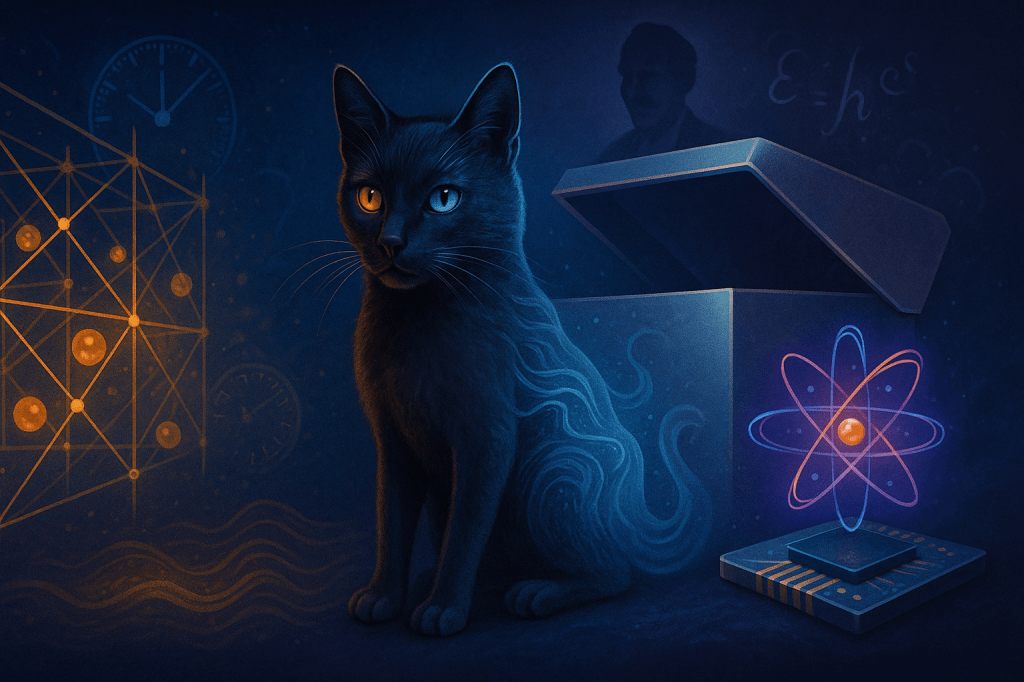
For nearly a century, Schrödinger’s cat has prowled the imagination of physicists and philosophers alike, half-alive, half-dead, trapped in a quantum box of uncertainty. It’s been a durable metaphor, capturing the mind-bending strangeness of quantum superposition, where particles can occupy multiple states at once, but only collapse into a definite reality when observed. Now, a series of new experiments have not only extended the cat’s mysterious life, they may well have cracked open the lid of that theoretical box.

In one breakthrough, researchers at the University of Science and Technology of China have managed to sustain a quantum superposition in a group of atoms for an unprecedented 1,390 seconds, over 23 minutes. To put that in perspective, most quantum states decay in milliseconds, collapsing under the weight of their environment. These scientists cooled ytterbium atoms to near absolute zero and suspended them in a laser-generated lattice, creating a sort of optical egg carton that isolated the atoms from external noise. The result? A stable, coherent quantum state that lasted longer than any yet recorded. If Schrödinger’s feline had been curled up in that lab, it might have been both alive and dead long enough to get bored.

The implications are profound. Quantum coherence over such extended periods could radically advance quantum computing, quantum communications, and even fundamental tests of the boundary between quantum and classical worlds. It also hints at the possibility of observing, and perhaps one day manipulating, quantum phenomena at larger, more tangible scales. The line between weird and real is getting thinner.

Yet, the story doesn’t end in China. Across the world in Sydney, engineers at the University of New South Wales have been tinkering with the quantum cat’s metaphorical whiskers in a different way. They’ve embedded an antimony atom with eight possible spin states into a silicon chip, creating a quantum bit (qubit) capable of holding significantly more information than the binary states of traditional bits. Each of these eight spin configurations acts like a tiny door into a different potential reality, giving rise to a computational system that can tolerate a degree of error, essential in the fragile world of quantum information.

This “hot Schrödinger’s cat,” as some have dubbed it, refers not just to the technical feat but to the strange warmth of the system, higher energy levels that challenge the traditional assumption that quantum systems must be deeply frozen. By designing systems that can operate at relatively warmer conditions, and still retain quantum coherence, scientists are inching toward scalable, real-world applications of quantum logic.

So what does this mean for the cat, and for us? It means we’re closer than ever to pulling that quantum feline out of abstraction and into the world of working tools. The cat is no longer just a paradox. It’s a partner, mysterious, elusive, but increasingly real. And in the glow of the lab’s lasers and chip circuits, it might even be purring.

Sources
• Wired: Scientists Have Pushed the Schrödinger’s Cat Paradox to New Limits
• Phys.org: Quantum Schrödinger’s Cat on a Silicon Chip

A Universe Without Time: Physics, Consciousness, and the Nature of Existence

If time were to happen all at once – where past, present, and future coexisted simultaneously – it would upend our understanding of reality, causality, and even consciousness itself. Our perception of time as a flowing sequence of events is deeply ingrained in both our experience and our scientific models, but what if that flow was an illusion? What if every moment simply existed, with no distinction between before and after?

One of the most immediate consequences of such a reality would be the breakdown of cause and effect. Our world operates on the principle that actions have consequences, that the past influences the present, which in turn shapes the future. If time were simultaneous, there would be no before or after – everything would simply be. In such a reality, would it even make sense to speak of events “happening”? Without sequence, there is no causality, and without causality, the entire structure of our decision-making and agency becomes questionable. Could free will exist in a reality where all choices have already unfolded in every possible way?

Our perception of time is not just a philosophical construct, but a deeply embedded feature of human consciousness. We process the world sequentially because our brains are wired to do so. If time were happening all at once, would we experience our entire lives simultaneously? Would we be both a newborn and an elderly person at the same time, fully aware of every moment we have ever lived? If that were the case, then identity itself might become meaningless, dissolving into an incomprehensible blur of every possible experience. Alternatively, it is possible that our consciousness would still only access one “slice” at a time, navigating an eternal landscape without truly perceiving its timeless nature.

This idea is not entirely foreign to physics. The “block universe” model in relativity suggests that time is a fixed, four-dimensional structure where the past, present, and future all exist equally. In this view, time does not “flow”; rather, it is a static dimension much like space, with our perception of movement through it being an emergent phenomenon. If this were true, the notion of “now” would be subjective, merely a point of reference chosen by an observer rather than a fundamental feature of the universe. This model sounds similar to how the fictional wormhole aliens in Star Trek: Deep Space 9 live, as they have no understanding of linear time, and the concept of consequences. 

Another major implication of a timeless reality is how it would affect the laws of physics themselves. Much of modern science relies on the assumption that time allows for entropy, the increase of disorder in a system. This principle explains why we remember the past but not the future and why systems evolve rather than remaining frozen in place. If time did not progress, but instead existed as a complete whole, then entropy might be an illusion, or at the very least, an incomplete way of understanding change. Could it be that what we perceive as time’s passage is simply our consciousness moving through an already-existent structure?

If time truly happened all at once, it would redefine the very nature of reality. Perhaps we are already living in such a universe but are unable to perceive its full nature due to the limitations of human cognition. What we call “the present” might just be a thin veil over a vast, timeless structure, one that we are only beginning to understand.