
Masked street mobilizations and online echo chambers are visible symptoms of a deeper shift in Canada’s political landscape. What once seemed like marginal groups have found renewed capacity to organize, recruit and intimidate through a blend of in-person rallies and social media amplification. The Niagara rally reported by CBC is not an isolated curiosity, but part of a pattern of small, local actions that feed a national ecosystem of grievance, identity politics and conspiratorial narratives.
The scale of the problem can be measured in public data. Police-reported hate crimes reached 4,777 incidents in 2023, an increase of 32 percent from 2022 and more than double the level recorded in 2019. These statistics do not merely count crimes. They indicate a widening public space in which targeted hostility against religious, racial and sexual minorities has become more frequent and more visible. The sharp rise in antisemitic and sexual orientation motivated incidents stands out as evidence that certain communities are being disproportionately affected.
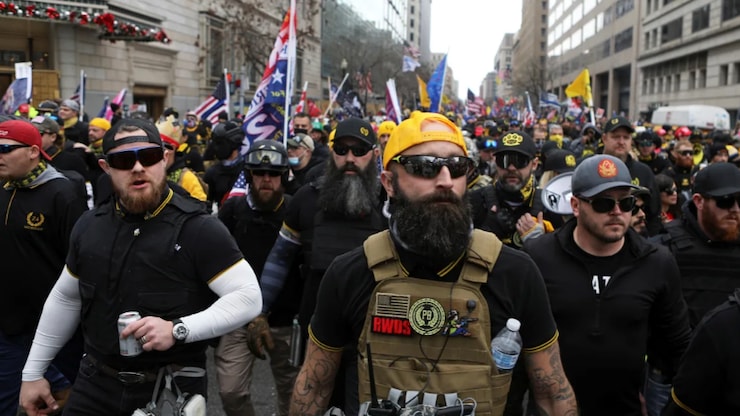
National security agencies have also sounded alarms. Recent public reporting from the Canadian Security Intelligence Service documents the diversification of extremist threats within Canada and the real-world harms that can emerge from online radicalization. Analysts point to a mosaic of actors including white supremacists, ethnonationalists, militia-style adherents and anti-government networks. That heterogeneity makes a single policy response insufficient. Effective mitigation requires coordinated law enforcement, targeted community supports and a sharper focus on the digital platforms that enable cross-jurisdictional recruitment.
Transnational influences matter. Ottawa’s 2021 decision to list the U.S. Three Percenters militia as a terrorist entity underscores how American militia culture and extremist flows cross the border. That decision was an acknowledgement that ideological currents and organizational tactics are not constrained by national boundaries. Canadian actors borrow symbols, rhetoric and operational playbooks from movements abroad, complicating the domestic security picture and raising questions about how best to disrupt international networks without undermining civil liberties.
Civil society research highlights the central role of online environments in the recent resurgence. Scans of social media and fringe platforms document how recruitment, normalization and coordination occur through memes, influencers and algorithmic suggestion. Those processes create local nodes of activity that can quickly translate into physical gatherings, harassment campaigns or worse. The internet does not create grievances, but it accelerates their spread and lowers the cost of mobilization.
Policy responses must be pragmatic and evidence based. Better resourcing for hate crime reporting and victim support will improve data quality and community resilience. Transparent intelligence-public safety engagement can help identify violent plots early without casting suspicion across entire communities. Digital literacy initiatives and platform accountability will reduce the fertile ground on which extremist recruiters thrive. Above all, elected leaders must use language that reduces polarization rather than stokes it, because political rhetoric shapes both perception and legitimacy in the public square.
Sources:
CBC report on the Niagara rally https://www.cbc.ca/news/canada/hamilton/second-sons-rally-in-niagara-1.7628162
Statistics Canada Police-reported hate crime in Canada, 2023 https://www150.statcan.gc.ca/n1/daily-quotidien/250325/dq250325a-eng.htm
CSIS Public Report 2024 https://www.canada.ca/content/dam/csis-scrs/images/2024publicreport/newest/Public_Report_2024-ENG.pdf
Reuters on Three Percenters terrorist listing https://www.reuters.com/world/americas/canada-puts-us-right-wing-three-percenters-militia-group-terror-list-2021-06-25/
ISD An Online Environmental Scan of Right-wing Extremism in Canada https://www.isdglobal.org/wp-content/uploads/2020/06/An-Online-Environmental-Scan-of-Right-wing-Extremism-in-Canada-ISD.pdf







 The Rowanwood Chronicles