Backroom Ontario: How the Ford Government Governs in the Shadows

The Ford government’s recent actions paint a troubling portrait of a leadership increasingly comfortable with obfuscation, procedural shortcuts, and performative consultation. Across multiple files, from environmental policy to Indigenous relations, Queen’s Park has displayed a consistent pattern of backhanded governance, marked by secrecy, evasion, and a disregard for both democratic norms and legal obligations.

The Greenbelt scandal exemplifies this tendency in sharp relief. Ontario’s Information and Privacy Commissioner recently condemned the Ford government for deliberately making it difficult to track internal decision-making on land development. Staff used code words such as “GB,” “special project,” and most egregiously, “G*” in email subject lines, deliberately sabotaging searchability within the government’s own filing systems. Coupled with the use of private email accounts and a notable absence of meeting minutes or documentation, the evidence suggests not mere carelessness, but a concerted effort to obscure deliberations over one of the province’s most politically explosive issues.
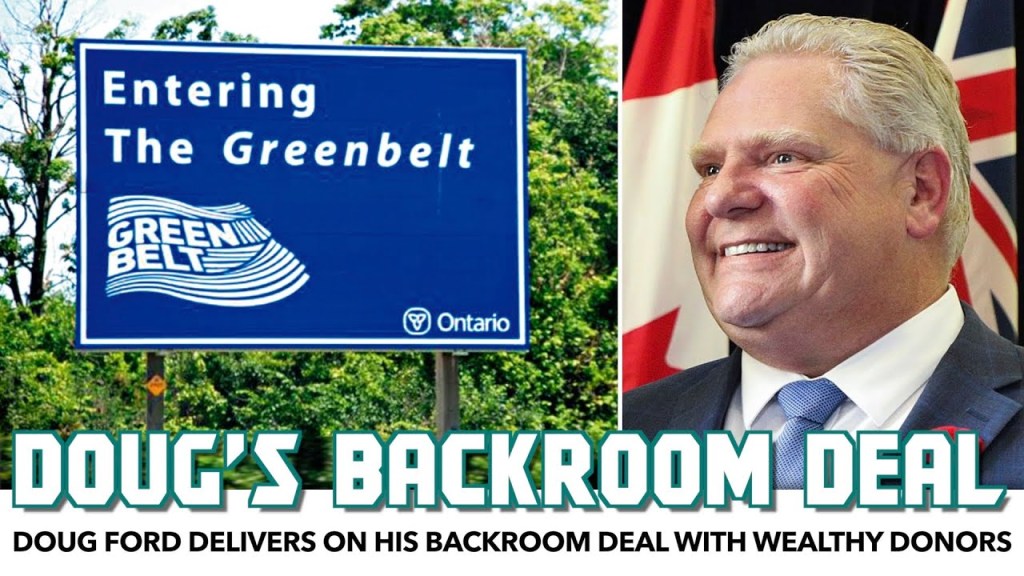
This level of secrecy isn’t just bureaucratic mismanagement, it’s political damage control in real time. The government’s reversal of Greenbelt development plans did little to reassure the public, especially in the absence of any credible explanation or documentation as to how those decisions were made in the first place. When even watchdogs with statutory authority can’t access the paper trail, public accountability becomes a hollow phrase.

Meanwhile, Bill 5, part of the so-called “Unleashing the Economy Act”, reveals an equally unsettling willingness to bypass consultation and oversight in the name of economic development. This omnibus legislation fast-tracks industrial and mining projects across northern Ontario, including the ecologically sensitive Ring of Fire region, by reducing or eliminating requirements for municipal and environmental approvals. Most critically, it sidelines the constitutional duty to consult Indigenous communities.

First Nations leaders, particularly in Treaty 9 territory, were quick to denounce the bill. Chiefs burned environmental documents in protest and staged rallies in Thunder Bay, accusing the province of engaging in “consultation theatre”, informing communities of decisions only after they were made. Even a last-minute amendment to include optional post-passage consultations did little to mollify concerns. The government’s approach sends a clear message: consultation is something to be endured, not engaged.

What ties the Greenbelt and Bill 5 controversies together is not just their shared disregard for transparency and inclusion, but the mechanisms used to enforce that disregard. Whether through technical manipulation of record-keeping systems, suppression of documentation, or legislative sleight-of-hand, the government repeatedly avoids open debate and sidesteps legal and ethical responsibilities. It’s a governance style rooted in control, not collaboration.

These are not isolated incidents. The Ford administration has shown a consistent pattern of centralizing power through Minister’s Zoning Orders (MZOs), a tool meant for rare and urgent cases. Since 2019, the Premier has issued MZOs at an unprecedented rate, frequently overriding municipal decisions, and benefiting well-connected developers. Auditor General reports have raised red flags, and opposition parties have warned that such orders erode local democracy and set dangerous precedents. Still, the pattern continues, unimpeded.

Other examples confirm the trend. In 2018, the Ford government launched a controversial “snitch line” encouraging parents to report teachers who used an updated sex-ed curriculum, a move widely condemned as punitive and authoritarian. In 2019, sudden changes to autism services blindsided thousands of families, leading to mass protests and eventual policy reversals. Yet, even in those reversals, the government refused to acknowledge fault, framing retreats as “adjustments” rather than admissions of flawed policy-making.

This is politics by backchannel, a deliberate erosion of democratic norms dressed in the language of efficiency. Public engagement is reduced to afterthought; opposition voices are ignored or demonized; and when watchdogs raise the alarm, they are met with silence or spin. In each case, the common denominator is the Ford government’s willingness to weaponize the machinery of governance against transparency.

The implications are serious. Trust in institutions erodes when those in power show contempt for the very mechanisms designed to hold them accountable. The duty to consult Indigenous communities is not an optional courtesy, it is a constitutional requirement. Environmental stewardship and municipal autonomy are not bureaucratic hurdles, they are democratic protections. To dismiss them is not just arrogant, but reckless.

Unless reined in, this mode of governance threatens to become normalized. The lesson emerging from Queen’s Park is clear: when political expedience trumps process, communities lose their voice, environmental safeguards are gutted, and Indigenous sovereignty is sidelined. This should alarm all Ontarians, regardless of political stripe.

The Ford government’s backhanded approach may win short-term headlines or developer applause, but the long-term costs, to transparency, legitimacy, and public trust, are steep. If Ontario is to retain even the appearance of responsible government, it must reject this cynical model and restore meaningful consultation, clear record-keeping, and respect for constitutional obligations as non-negotiable principles of provincial governance. Anything less is a betrayal of public service.


Albertans Choose Stability Over Separation: What the Pension Rejection Really Means

When the Alberta government finally released the long-awaited results of a commissioned survey on the Alberta Pension Plan (APP), the findings spoke volumes. Nearly two-thirds of Albertans (63%), rejected the idea of replacing the Canada Pension Plan with a provincial version. The number supporting an APP? Just 10%. That’s not just a policy rejection; it’s a political reality check.

For all the heated rhetoric around Alberta’s place in Confederation, this result reinforces what many longtime observers have suspected: Albertans may be frustrated, but they’re not fools. They know a good thing when they see it, and the CPP, with its portability, investment scale, and intergenerational reliability, is exactly that. The pensions issue cuts across partisan lines and ideological bluster. It’s not about Trudeau or equalization. It’s about people’s futures, and the people have spoken.

What’s more striking is how this undercuts the oxygen feeding Alberta separatism. The idea of a provincial pension plan was floated not just as fiscal policy, but as a marker of provincial autonomy, even sovereignty. It was pitched as a way to “keep Alberta’s money in Alberta.” Yet, when the chips were down, Albertans didn’t bite. The same population that occasionally flirts with separation talk has no appetite for tearing up foundational institutions like the CPP.

Even Premier Danielle Smith, no stranger to courting Alberta-first narratives, quickly distanced herself from the APP following the release of the data. There’s no referendum planned, no legislative push, just a quiet shelving of an unpopular idea. It’s a clear sign that even among the UCP leadership, there’s recognition that the political capital required to pursue this agenda simply doesn’t exist.

The APP result also aligns with a broader trend we’re seeing in regional sentiment polling. Despite pockets of separatist energy, especially in reaction to federal climate policy, most Albertans prefer reform within Canada to rupture. A recent Angus Reid survey found that only 19% of Albertans would “definitely” vote to leave Canada, while three-quarters believed a referendum would fail. The rhetoric is louder than the resolve.

This doesn’t mean western alienation is a myth. Far from it. Economic frustrations, federal-provincial disputes, and the sense of being politically outvoted still resonate deeply in Alberta. But the reaction isn’t revolution, it’s recalibration. What Albertans appear to want is a stronger voice in a better Canada, not a lonely march toward the exits.

There’s a deeper lesson here, too. Identity politics and economic nationalism may be good for stirring the base, but when policies collide with kitchen-table concerns, like pensions, voters choose the pragmatic over the symbolic. Separatism, in Alberta’s case, has become less of a movement and more of a mood. And moods change when the numbers hit home.

At its core, the rejection of the APP is a reaffirmation of Canadian federalism. Not the perfect, polished version dreamed of in civics classes, but the messy, functional, deeply embedded version that shows up in every paycheque and retirement plan. That version still has teeth. And Albertans, whatever else they may say about Ottawa, just voted to keep it.

When the Witness Holds the Gavel: The Constitutional Perils of Reverse Disclosure

Canada’s lower courts are now bearing the brunt of an ill-conceived and constitutionally fraught innovation in sexual assault law: reverse disclosure. Introduced under Bill C‑51 in 2018, this legislative regime forces accused persons to disclose in advance any private communications; such as texts, emails, or social media messages, they intend to use in cross-examination of the complainant. The complainant, in turn, is granted full participatory rights and legal representation to argue against the admissibility of such evidence. While politically expedient and publicly palatable in the wake of the Ghomeshi trial, the legal architecture of reverse disclosure has proven to be unstable, incoherent, and in many cases, plainly unconstitutional.

Trial courts across the country have issued sharply divergent rulings on how these provisions should operate. In some decisions, judges have deemed the mandatory timelines imposed on the defence to be incompatible with the fair-trial rights guaranteed by section 7 of the Charter. Others have questioned the very foundation of the regime, arguing that it unjustly burdens the accused with obligations that reverse the presumption of innocence and compromise the right to full answer and defence. Nowhere else in Canadian criminal procedure is a complainant, essentially a Crown witness, granted standing to challenge what evidence may be used in their own cross-examination. It is a distortion of the adversarial system.

The concept of reverse disclosure is not merely controversial; it is structurally flawed. The defence is no longer free to mount a case in the manner required by the facts and theory of the defence, but is instead placed under the supervision of the court and the complainant’s counsel, long before trial. This undermines not only trial strategy, but also the accused’s right to test the Crown’s case without disclosing defence evidence in advance. Worse still, it creates an asymmetry in which the complainant is effectively briefed on what the defence intends to argue, giving them an opportunity, conscious or not, to shape their testimony accordingly.

This problem is compounded by the legislative vagueness surrounding what constitutes a “private record” and how relevance, prejudice, and privacy should be weighed. The result has been legal uncertainty and procedural chaos. Judges are left to interpret a vague and often contradictory set of provisions, and defence counsel must navigate a landscape where each courtroom may yield different rules and interpretations. This is not how constitutional criminal law is meant to function.

Some courts have gone so far as to strike down portions of the reverse disclosure regime altogether, citing fundamental Charter violations. These judgments are not aberrations, they are warnings. When a regime designed to protect complainants ends up jeopardizing the constitutional rights of the accused, the entire framework must be re-evaluated. The criminal trial must remain a place where the presumption of innocence is more than a platitude, and where the right to a fair trial is not subject to the political winds of the day.

Until the Supreme Court addresses these concerns decisively, lower courts will continue to struggle with reverse disclosure. And in that struggle, justice itself hangs in the balance.

Public Drinking: A Study in Trust, Culture, and Control – Ottawa vs. Germany

Public drinking reveals much about how societies balance freedom, responsibility, and trust. The stark contrast between Ottawa’s tentative, tightly-controlled 2025 pilot program for alcohol consumption in municipal parks and Germany’s longstanding acceptance of public drinking illustrates deeper social and cultural divides. In short, while Germans operate under a framework of collective behavioral expectations and trust, Canadians, at least in Ottawa, approach public behavior through a lens of institutional caution and control.

In Germany, it is not only legal, but culturally unremarkable to walk through a park or down a street sipping beer or wine. Public drinking is allowed in virtually all spaces: parks, streets, public transport, so long as behavior remains respectful. There is no need for signage, restricted hours, or opt-in zones. Instead, the rules are social: keep your voice down, clean up after yourself, and don’t cause a disturbance. The assumption is that most people, most of the time, can be trusted to enjoy alcohol in public without devolving into chaos. Enforcement is minimal and focused on conduct rather than consumption. The legal framework reflects this confidence in citizens’ capacity for self-regulation.

Ottawa, by contrast, is poised to take a small, hesitant step into public drinking territory. The 2025 summer pilot, if passed by full council, will allow alcohol in select municipal parks during restricted hours and away from certain facilities. Local councillors must “opt in” their parks, and enforcement mechanisms, signage, and safety protocols are emphasized. The premise is that public drinking is potentially risky, necessitating detailed restrictions and contingency planning. The policy does not presume that residents can handle this responsibility; rather, it cautiously tests whether they might.

This divergence is not simply legal, it is philosophical. German norms lean on a social compact that assumes citizens will behave decently in shared spaces. Canadians, or at least Canadian policymakers, appear to lack such confidence. Public drinking is imagined not as an ordinary act, but as a behavior to be fenced in, bounded, and watched. Ottawa’s delay in launching even a pilot underscores a broader cultural tendency: one that privileges regulation over trust, institutional control over social cohesion.

Underlying this is a question of what kind of public life a society envisions. In Germany, a Feierabendbier (after-work beer) on a park bench is an extension of civil society, part of a shared public realm. In Ottawa, such an act still falls outside acceptable norms, even as urban life becomes denser and more diverse. This points to a lingering paternalism in Canadian municipal governance: the belief that citizens must be managed rather than trusted.

Ultimately, the Ottawa-Germany contrast reveals a deeper social reality. Where Germans assume the public is capable and socialized, Canadians assume the public needs structure and limits. That divergence shapes not just laws, but the very character of public space, and what we are allowed to do within it. Public drinking, then, becomes a proxy for how much a society trusts its own people.

Patients Are Not Property: Time to Rethink How We Regulate the Sale and Retention of Primary Care Rosters

In the midst of Canada’s growing primary care crisis, it’s time we take a hard look at how patient rosters are handled, or mishandled, when physicians transition or leave their practices. Across the country, millions of Canadians are without a family doctor. Against this backdrop, we can no longer tolerate a system in which doctors purchase entire rosters of patients only to turn around and drop half of them, not based on clinical need, but lifestyle preference.

This is not a matter of gender. It is a matter of professional accountability and ethical stewardship. Patients are not chattel. They are people, often elderly, immunocompromised, managing multiple chronic conditions, who place their trust in a system that is supposed to protect their continuity of care. When a physician acquires a patient list, they are not buying a gym membership or a book of business. They are assuming responsibility for the long-term health of hundreds, sometimes thousands, of human beings.

Let’s be clear: physicians have every right to structure their practice in a way that supports their well-being. Burnout is real, and work-life balance matters, but that personal balance cannot come at the expense of vulnerable patients being systematically cast adrift.

Professional colleges, including the College of Physicians and Surgeons of Ontario (CPSO), do provide formal mechanisms for a doctor to reduce their patient list. These guidelines exist to allow flexibility, but they were never meant to be a loophole for roster triage based on convenience. If the intention was always to serve only a part-time practice, why was the entire roster purchased? Why was the community not informed in advance? And why are regulatory bodies permitting what amounts to a public harm, wrapped in private contractual terms?

These are not just hypothetical concerns. The abandonment of patients, especially those without alternatives, has ripple effects throughout the entire healthcare system. Walk-in clinics become overwhelmed. Emergency rooms fill with non-emergency cases. Preventable conditions go unmanaged until they become acute, and meanwhile, the public’s trust in the integrity of primary care continues to erode.

If physicians wish to buy a practice, that is a valid path to establishing their career; but there must be clear, enforceable rules to ensure that patient care is not commodified in the process. A few policy options worth considering:

  • Conditional licensing of roster transfers: Require binding disclosure of the incoming physician’s intended working hours and patient capacity before the sale is finalized, with oversight by a neutral third party such as the local health authority.
  • Mandatory transition plans: If a physician intends to offload more than 10% of a newly acquired roster, they should be required to demonstrate how those patients will be supported in finding alternate care – not simply left to fend for themselves – meaning that there is actually an alternative primary caregiver available who is willing and able to add them to their existing roster.
  • Public-interest reviews of large roster changes: Just as utility companies can’t hike rates without justification, physicians shouldn’t be able to restructure public-facing services without transparent public reasoning.

Ultimately, the issue is not about lifestyle choices. It’s about stewardship. Every doctor, upon licensing, accepts a social contract with the people they serve. That contract includes not just the right to treat patients, but the responsibility to do so with equity, consistency, and integrity.

We wouldn’t accept it if a public school principal took over a school and expelled half the students because they only wanted to work mornings. We shouldn’t accept it in primary care either.

Canada’s Strategic Shift: Weighing the Costs and Benefits of Joining Europe’s ReArm Program

Canada’s decision to signal its intention to join Europe’s ReArm initiative marks a significant pivot in its strategic and procurement priorities, with implications that extend well beyond the defense sector. This pan-European effort, catalyzed in the wake of Russia’s invasion of Ukraine and the shifting tenor of transatlantic politics, aims to coordinate defense procurement, scale industrial capacity, and strengthen European security autonomy. For Canada, a non-European NATO member with strong ties to both the U.S. and Europe, alignment with ReArm offers both substantial opportunity and strategic complexity.

At the forefront of the appeal is diversification. Canada has long relied on the United States for upwards of 75% of its military procurement. While the U.S. – Canada defense relationship, particularly through NORAD, remains indispensable, the risks of a politically volatile or inward-focused Washington have grown. Europe’s response, particularly Germany’s ramped-up defense commitments, and the €800 billion EU proposal to stimulate continental arms production, presents an alternative axis of reliability. Canada’s participation could signal to both NATO allies and global partners that it seeks greater resilience in its defense posture.

One of the most concrete areas of cooperation could lie in the domain of submarine procurement. The CBC reports that Canada is exploring options for the German-Norwegian Type 212CD submarine, a next-generation conventional submarine being co-developed by ThyssenKrupp Marine Systems and Kongsberg. This class boasts extended underwater endurance through air-independent propulsion and quiet operation ideal for Arctic patrols, long a capability gap in Canadian naval strategy. The possibility of Canada becoming a formal partner in the 212CD project would not only address its aging Victoria-class fleet but also create industrial synergies through potential domestic assembly and technology transfer agreements.

Beyond submarines, ReArm opens the door to collaborative fighter jet production. Canada’s inclusion in discussions around final assembly of Swedish Saab Gripen fighters suggests that Ottawa is seeking industrial offset opportunities beyond its existing Lockheed Martin F-35 commitments. These talks, while preliminary, reflect a desire to reassert domestic defense manufacturing after years of outsourcing.

Still, the risks are considerable. Aligning procurement strategies with European standards could create friction in interoperability with American systems, particularly relevant given NORAD modernization and Canada’s Arctic commitments. There is also the question of cost. Canada’s new defense policy promises to increase military spending to 1.76% of GDP by 2030, a notable jump, but still short of NATO’s 2% target. Adding ReArm investments could strain the federal budget, and force trade-offs in domestic priorities.

Geopolitically, joining a European initiative risks being interpreted in Washington as a soft decoupling. While this may be overstated, managing the optics with U.S. defense officials will require careful diplomacy. At the same time, any major procurement projects pursued under ReArm would need to be justified as both value-for-money, and strategically essential in a Canadian context.

ReArm represents a chance for Canada to assert greater agency in its defense strategy, while leveraging European innovation and industrial momentum, but this is no risk-free proposition. Ottawa will need to walk a careful line: embracing new partnerships without compromising old ones, and ensuring that each procurement project is grounded in long-term strategic logic, not simply in search of novelty.

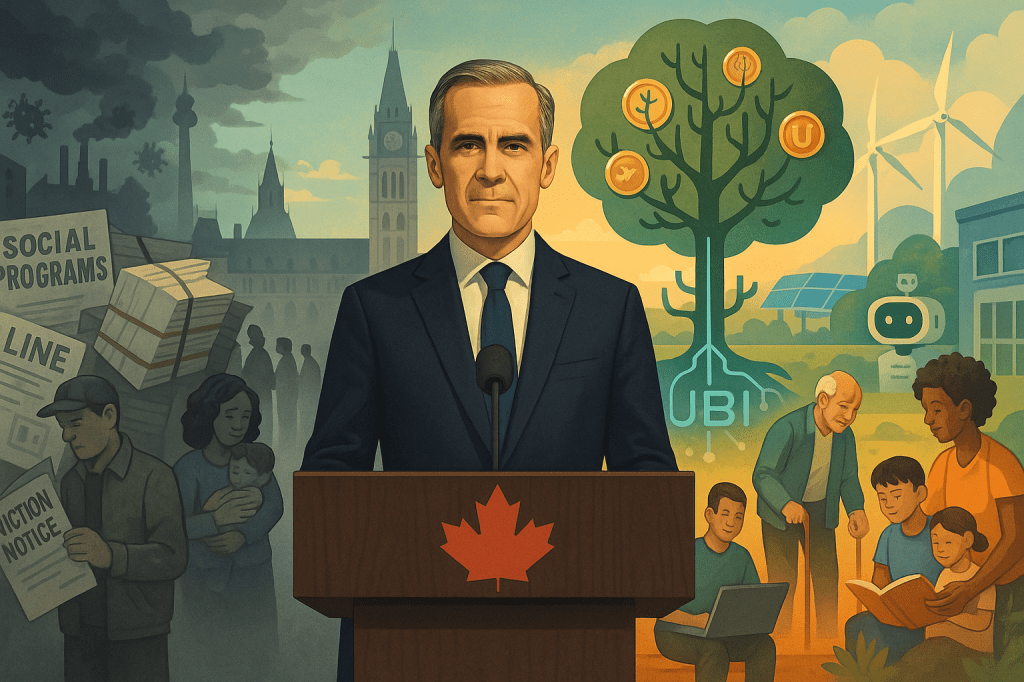
Mr. Carney, Let’s Be Bold and Smart: A Revenue-Neutral Universal Basic Income Is Within Reach

The election of Mark Carney as Canada’s new Prime Minister marks more than a changing of the guard, it signals a chance to transform how we think about economic justice, social policy, and the role of government in a post-pandemic, post-carbon, AI-disrupted world. Yet, if this new Liberal administration wants to do more than manage decline or tinker at the edges, it must champion Universal Basic Income (UBI), and it must do so within this first term.

To skeptics, the usual pushback is cost. “We can’t afford it.” But what if I told you we can, without adding a cent to the deficit?

A bold, revenue-neutral UBI is not only possible, it’s the smart, responsible, and forward-thinking choice. It would simplify our bloated patchwork of social programs, reduce inequality, and stabilize the economy, all while respecting fiscal realities. Carney, with his reputation for monetary prudence and social conscience, is uniquely positioned to make this happen.

The Case for UBI, Now More Than Ever
We live in precarious times. AI and automation are displacing jobs once thought secure. The gig economy has redefined work for an entire generation, offering flexibility but no stability. Climate change is reshaping our industries, economies, and communities. And regional inequalities, from rural depopulation to urban housing crises, are deepening social division.

UBI provides a powerful, simple solution: a no-strings-attached income that ensures every Canadian can meet their basic needs, make real choices, and live with dignity. No complex eligibility criteria. No stigma. Just a stable foundation for all.

This isn’t a call for endless spending. This is a plan for smart reinvestment, one that replaces outdated, fragmented systems with a coherent, efficient, and humane approach.

Revenue-Neutral UBI: A Practical Path
The key to political and economic viability is fiscal neutrality. Here’s how we get there:

Streamline the Social Safety Net
Our current welfare architecture is costly, overlapping, and often punitive. We propose replacing core income support programs, provincial social assistance, EI for low-wage workers, and a range of targeted income-tested tax credits, with a single, universal UBI. This simplification reduces administrative duplication and restores dignity to recipients.

Rethink OAS and GIS
These seniors’ programs already operate as a basic income for the elderly. By integrating them into a universal model, with UBI replacing these benefits for most, but supplemented by needs-based top-ups for seniors with unique medical or housing costs, we ensure fairness without duplication.

Restructure (Not Eliminate) CPP
CPP remains essential as a pension earned through contribution, but some recalibration of contribution thresholds and benefit tiers, alongside UBI, can reduce reliance on inflated public pensions to cover basic needs, while preserving the contributory principle.

Modest, Targeted Tax Reform
To close the revenue loop, introduce a small surtax (e.g., 2%) on individual incomes over $150,000, and slightly increase capital gains inclusion rates. These are not radical measures, they simply ask the wealthiest Canadians to help ensure every citizen has a secure foundation. For 95% of taxpayers, no increase would be necessary.

Numerous economic models (including work by Evelyn Forget, UBC’s Kevin Milligan, and CCPA researchers) show that a well-designed UBI can be nearly or entirely self-funding when paired with smart policy adjustments like these.

Political Opportunity and Liberal Legacy
Prime Minister Carney doesn’t need to look far for historical inspiration. Universal healthcare, bilingualism, the Charter, these were all ambitious Liberal achievements once considered politically risky and fiscally daunting, yet they reshaped Canada.

UBI can be his legacy. It would resonate across voter blocs: rural Canadians seeking stability, urban millennials burdened by debt and housing costs, women and caregivers locked out of full-time work, and gig workers with no safety net. It’s a unifying policy in a fragmented nation.

Moreover, by leading with a revenue-neutral model, Carney can neutralize opposition from deficit hawks and centrists, while winning support from social democrats, Indigenous leaders, environmentalists, and the entrepreneurial class alike.

A Step-by-Step Roadmap

  • Launch a National UBI Task Force in the first 100 days, chaired by experts in economics, social policy, and Indigenous governance.
  • Table a UBI White Paper by the end of Year 1, outlining fiscal models, legal changes, and implementation scenarios.
  • Pilot the program in a representative region (e.g., Northern Ontario, Atlantic Canada, or an urban-rural mix) with independent evaluation.
  • Introduce legislation in Year 3, with phased implementation beginning before the 2029 election.

This is not pie-in-the-sky. This is responsible governance meeting bold vision.

The Values We Must Uphold
UBI is about more than money, it’s about modernizing our social contract. It says to every Canadian: you matter. You are not a cost, a case file, or a problem to manage. You are a citizen with rights, worth, and potential.

Mr. Carney, you’ve spoken eloquently about “values-based capitalism” and “inclusive transitions.” UBI is the policy vehicle that delivers on those values. And by designing it to be fiscally neutral, you can bring the skeptics along without compromising ambition.

Now is the time to lead not just with caution, but with courage. We can afford Universal Basic Income, not in spite of economic constraints, but because of them.

Let’s stop managing poverty. Let’s start guaranteeing security. Let’s build a Canada where no one is left behind.

F-35A vs Gripen E: Why Canada Needs a Mixed Air Fleet

Canada is finalizing a long-term commitment to its next-generation fighter fleet. While the Lockheed Martin F-35A Lightning II has dominated the headlines and procurement process, many analysts and defence strategists continue to argue for a more balanced approach that reflects Canada’s non-aggressive, defence-oriented military posture. Enter the JAS 39 Gripen E, Sweden’s cost-effective and resilient multirole fighter.

In this article, we compare the F-35A and Gripen E across key domains, and propose a strategic mixed-fleet solution tailored to Canada’s unique geography, alliances, and policy values.

F-35A vs Gripen E: A Comparative Analysis

FeatureF-35A Lightning IIJAS 39 Gripen E
OriginUnited StatesSweden
RoleStealth multirole strike & ISRAgile, cost-effective air defense
Stealth5th-gen stealth with internal weapons baysLow-observable 4.5-gen fighter; external weapons only
SensorsFusion: AESA radar, DAS, EOTS, HMDAESA radar, IRST, electronic warfare suite
Speed & AgilityMach 1.6, less agileMach 2.0, supercruise, high agility
Operating Cost~$35,000/hr~$8,000 – $10,000/hr
MaintenanceComplex, centralized logisticsModular, road-capable, easy maintenance
InteroperabilityDeep NATO/NORAD integrationFlexible, sovereign-capable system
Best Suited ForHigh-end coalition warfareDomestic sovereignty & intercept missions

The F-35A excels in stealth, sensor fusion, and networked warfare. It’s optimized for first-strike and multi-domain operations in complex allied theatres. The Gripen E, by contrast, is designed for national airspace protection, low-cost deployment, and high survivability through speed and agility.

For most countries, the choice between them is binary. But for Canada, a mixed fleet provides the best of both worlds.

Canada’s Defence Posture: Defence, Not Offence

Canada’s 2017 defence policy, Strong, Secure, Engaged (source), emphasizes:

  • Sovereignty protection, particularly in the Arctic
  • Fulfillment of NORAD and NATO responsibilities
  • Commitment to peacekeeping and allied security, not aggression or projection

This makes a single-type, stealth-heavy force both expensive and strategically limiting. The F-35A’s sophistication comes with high costs and logistical burdens. The Gripen’s versatility and affordability make it ideal for Canada’s domestic priorities, especially Arctic response and cost-effective patrols.

The Ideal Fleet Mix: 48 F-35A + 36 Gripen E

A proposed balanced force of 84 aircraft could look like this:

  • 48 F-35A Lightning II – Two combat squadrons for NATO/NORAD + First-strike SEAD missions
  • 36 JAS 39 Gripen E – Two intercept/sovereignty squadrons for Cold Lake & Bagotville + Pilot training

This mix satisfies Canada’s allied obligations while keeping operational costs under control and increasing resilience and redundancy.

Mission-by-Mission Alignment

Mission TypeAircraft Best Suited
NATO expeditionary combatF-35A
Arctic sovereignty patrolsGripen E
NORAD interceptsGripen E (routine), F-35A (high threat)
Peacekeeping air policingGripen E
First-strike SEAD missionsF-35A
Pilot trainingGripen E (cost-effective)

Additional Benefits of a Mixed Fleet

  • Economic efficiency: Gripen costs 3–4x less to operate, allowing more flying hours and Arctic readiness.
  • Strategic autonomy: Saab offers greater technology transfer and offset potential, unlike the F-35 program.
  • Operational resilience: Gripens can operate from rural or improvised runways in the North.
  • Supplier diversification: Reduces geopolitical and logistical risk from relying on a single supplier (U.S.).

Potential Challenges & Mitigations

ConcernMitigation
Dual logistics systemsSegmented basing and dedicated maintenance crews
InteroperabilityGripen is NATO-compatible and can integrate via standard datalinks
Training duplicationGripen used for advanced pilot training and tactical development

Final Word

A dual-fighter strategy is neither nostalgic nor redundant, it is forward-thinking. By balancing cutting-edge stealth with efficient sovereignty defence, Canada can build an air force that is:

  • Strategically aligned with its defensive posture
  • Economically sustainable over decades
  • Technologically capable of high-end conflict
  • Operationally flexible across vast geography

This isn’t just a compromise, it’s a model of how Canada can lead by example in blending technology, sovereignty, and peacekeeping into a cohesive air defence strategy.

Sources

Tags: #CanadianDefence #F35 #Gripen #NORAD #NATO #ArcticDefence #MilitaryPolicy #Peacekeeping #AirPower

Alberta, the Treaties, and the Illusion of Secession

It is a curious feature of Canadian political discourse that every few years, the spectre of Alberta separatism re-emerges, driven largely by feelings of Western alienation or perceived federal overreach. Yet few of its proponents seem to understand the constitutional, historical, and moral terrain on which they stake their claims.

Most glaringly, the notion that Alberta could legally or legitimately secede from Canada ignores the foundational reality that this province exists entirely upon Indigenous treaty land: Treaties 6, 7, and 8, signed decades before Alberta was even established.

Treaty Obligations: The Legal Bedrock
Treaties 6 (1876), 7 (1877), and 8 (1899) are not quaint relics of the colonial past. These were solemn nation-to-nation agreements made between the British Crown and various Indigenous nations; primarily Cree, Dene, Blackfoot, Saulteaux, Nakota, and others. The Crown, not the provinces, is the party to these treaties. This distinction matters enormously: Alberta, created in 1905, was superimposed upon lands already bound by legal and moral obligations that persist to this day.

Treaty nations agreed to share the land, not to surrender it to a future province. Indigenous consent was given to the Crown, not to the provincial governments that came later. As such, Alberta’s claims to land, resources, and governance are valid only to the extent that they flow through the Crown’s treaty responsibilities, not through any inherent sovereignty.

The Supreme Court Speaks: Secession Is Not a Unilateral Act
This legal landscape was sharply clarified in the Supreme Court of Canada’s landmark Reference re Secession of Quebec (1998). The Court ruled decisively that no province has a unilateral right to secede. Any attempt at secession would require negotiations with the federal government and with other provinces and, crucially, with Indigenous peoples.

The Court emphasized that Indigenous peoples have rights protected under Section 35 of the Constitution Act, 1982, and that their consent is a necessary component of any major constitutional change. As the ruling states:

“The continued existence of Aboriginal peoples, as well as their historical occupancy and participation in the development of Canada, forms an integral part of our constitutional fabric.” (Secession Reference, [1998] 2 S.C.R. 217)

This is not simply a legal technicality. It is a reaffirmation of the reality that Canada is a nation founded not just through British and French settler traditions, but through treaties with Indigenous peoples, treaties that are still very much alive in constitutional law.

Indigenous Sovereignty and the Fallacy of Secession
The idea that Alberta could leave Canada while continuing to govern Indigenous treaty land is untenable. Indigenous peoples were never consulted in the creation of Alberta, and any attempt by the province to secede would, by necessity, face resistance from Indigenous governments asserting their own sovereignty.

During the Quebec referendum in 1995, the Cree and other First Nations asserted that they would remain in Canada regardless of Quebec’s decision. They argued, correctly, that their treaty relationships were with the Crown, not the province of Quebec. The same principle applies here: Treaty First Nations in Alberta are under no obligation to follow a secessionist provincial government. In fact, they would have a powerful legal and moral claim to reject it.

Furthermore, the United Nations Declaration on the Rights of Indigenous Peoples (UNDRIP), which Canada has committed to implement, recognizes the inherent right of Indigenous peoples to self-determination. Any secession that disregards that right would contravene both domestic and international law.

No Secession Without Consent
In short, Alberta cannot separate from Canada without first navigating the constitutional reality of treaties, Indigenous sovereignty, and the Supreme Court’s own binding interpretation of secession. The land on which Alberta stands is not Alberta’s to take into independence. It is treaty land, Indigenous land, shared under solemn agreement with the Crown.

Alberta exists because those treaties allowed Canada to exist in the West. To attempt secession without Indigenous consent is to ignore the very foundations of the province itself.

If separatist advocates wish to have a serious conversation about Alberta’s future, they must first understand its past, and the enduring obligations it entails.

Sources:
Supreme Court of Canada. Reference re Secession of Quebec, [1998] 2 S.C.R. 217
Constitution Act, 1982, Section 35
United Nations Declaration on the Rights of Indigenous Peoples (UNDRIP), 2007
Indigenous and Northern Affairs Canada. “Treaties 6, 7, and 8.”
Royal Commission on Aboriginal Peoples, Volume 1 (1996)
Borrows, John. Recovering Canada: The Resurgence of Indigenous Law (2002)

Quiet Competence: The Technocratic Leadership of Mark Carney and Keir Starmer

In an era marked by political turmoil, populism, and polarized electorates, the emergence of two distinctly technocratic leaders, Canada’s Mark Carney and the United Kingdom’s Keir Starmer, signals a subtle, but significant shift in governance. Both men have stepped into their roles as Prime Ministers in the last year, bringing with them a pragmatic, policy-driven style that eschews grandstanding for steady, results-oriented leadership.

Mark Carney’s ascension to the Canadian premiership in March 2025 was, by many measures, unconventional. Known primarily for his extraordinary track record as an economic steward, having helmed two of the world’s most influential central banks, Carney entered politics without prior elected office experience. Yet this outsider status may be his greatest asset. Carney’s approach is quintessentially technocratic: data-driven, nuanced, and focused on long-term stability rather than short-term political gain.

Early in his tenure, Carney moved decisively, but quietly to abolish the consumer carbon tax, a move that was politically contentious, but signaled his willingness to recalibrate policies based on public sentiment and economic realities. Simultaneously, he maintained other industrial carbon levies, showing a measured balancing act between environmental priorities and economic concerns. His focus on national sovereignty, especially in the context of complex geopolitical pressures from the United States, demonstrates his comfort in navigating both domestic and international arenas with calculated precision.

Across the Atlantic, Keir Starmer’s rise to UK Prime Minister in mid-2024 was accompanied by a return to a more traditional, sober style of governance after over a decade of Conservative rule. Starmer’s background as a human rights lawyer and former Director of Public Prosecutions clearly informs his methodical and legalistic approach to leadership. His government has tackled thorny domestic challenges, from public sector strikes to immigration policy reform, without resorting to populist rhetoric or headline-grabbing gestures.

Starmer’s pragmatism is evident in his recent reforms: ending winter fuel payments for millions, launching an early prisoner release scheme to reduce overcrowding, and instituting new border security measures. These decisions, while controversial, reflect a focus on institutional reform and social justice framed within achievable policy frameworks. Unlike more flamboyant predecessors, Starmer projects a sense of quiet competence, aiming to rebuild public trust through consistency and fairness rather than drama.

What unites Carney and Starmer is their shared embrace of technocratic governance, an approach that values expertise, incremental progress, and policy refinement over ideological battles or media theatrics. Both leaders seem intent on “getting on with the job,” navigating complex political landscapes with a steady hand. This approach is particularly noteworthy given the current political climate, where many leaders lean heavily on spectacle or populist appeals.

Their quiet competence is not without risks. Technocratic leaders can be perceived as detached or insufficiently charismatic, which can make it challenging to galvanize broad popular enthusiasm. Yet, for electorates fatigued by volatility and crisis, Carney and Starmer offer a reassuring alternative: governance that promotes substance over style and incremental progress over sweeping promises.

The early months of Mark Carney’s and Keir Starmer’s premierships illustrate the power of quiet, data-driven leadership in modern politics. Their technocratic approaches may not dominate headlines, but they offer a compelling model for steady, pragmatic governance in an era that sorely needs it.