A Tale of Two Nations: Why Canada Celebrates Differences While America Seeks Sameness

For over a century, the United States has proudly embraced the metaphor of the “melting pot,” a vision in which immigrants from all over the world come together to form a singular American identity. This idea suggests that while people may arrive with distinct languages, customs, and traditions, they are expected to assimilate into a common culture; one that prioritizes English, democratic values, and a shared national ethos. The melting pot is often framed as a symbol of unity, a place where differences dissolve in the service of a greater whole. However, this model has its critics, who argue that it pressures immigrants to abandon their unique cultural heritage in order to conform.

The roots of the melting pot concept can be traced back to Israel Zangwill, a British playwright whose 1908 play The Melting Pot romanticized America as a land where old ethnic divisions would fade away, forging a new, united people. While Zangwill gave the concept its famous name, the push for assimilation had been shaping U.S. policy and attitudes long before. Theodore Roosevelt, the 26th president, was one of its most vocal proponents, arguing that immigrants must fully adopt American customs, language, and values to be considered truly American. The early 20th century saw the rise of the Americanization movement, which reinforced these ideas through public education, labor policies, and civic initiatives. By mid-century, the expectation of cultural conformity had become deeply embedded in American identity, influencing everything from language policies to popular media portrayals of immigrant life.

Canada, on the other hand, has cultivated a different metaphor, that of a “cultural mosaic.” Rather than seeking to merge all cultures into one, Canada actively encourages its people to maintain and celebrate their distinct identities. This approach is not just a social philosophy, but an official policy, first enshrined in 1971 with the introduction of the Multiculturalism Policy by Prime Minister Pierre Elliott Trudeau. Unlike the American melting pot, which emphasizes assimilation, Trudeau’s vision was one of inclusion without erasure. His government recognized that Canada’s growing diversity, particularly from non-European immigration, required a shift in how the country defined itself.

The passage of the Canadian Multiculturalism Act in 1988, under Prime Minister Brian Mulroney, further reinforced this philosophy by guaranteeing federal support for cultural communities, anti-discrimination measures, and the preservation of minority languages. Unlike the U.S., where English is seen as a central marker of national identity, Canada has long embraced bilingualism, officially recognizing both English and French. Additionally, Canada has extended support for Indigenous and immigrant languages in education and public services, further emphasizing its commitment to cultural pluralism.
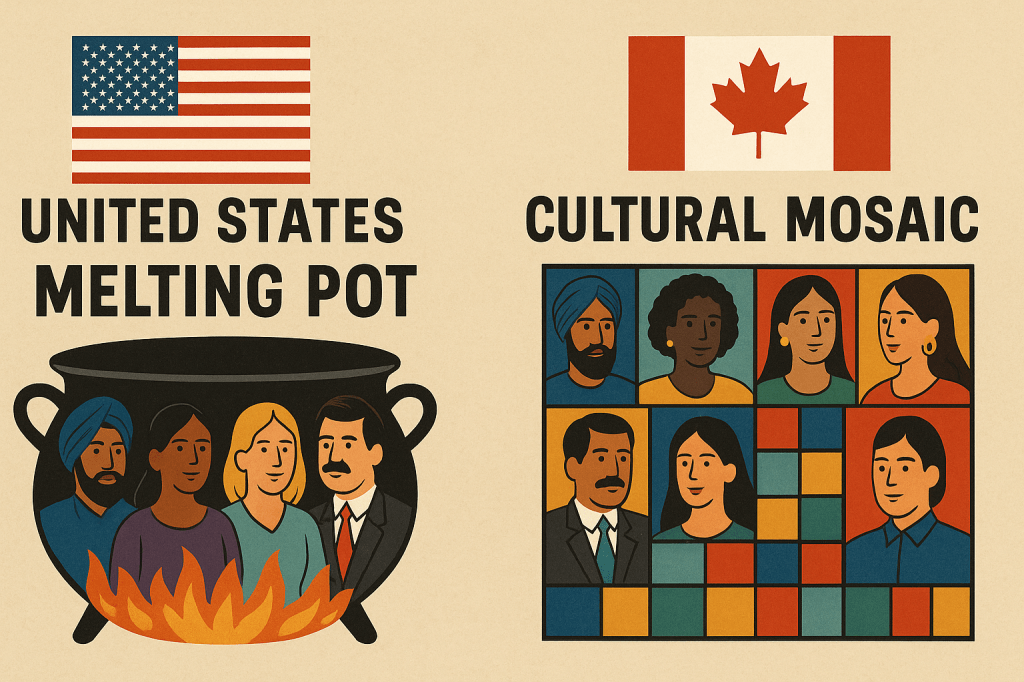
The differences between these two models of integration are profound. In the United States, the expectation is often that newcomers will embrace “Americanness” above all else, whether that means speaking only English, adopting mainstream American customs, or minimizing their ethnic identity in public life. While the U.S. does recognize and celebrate diversity in some respects; Black History Month, Indigenous Peoples’ Day, and the popularity of international cuisines all attest to this, there remains a strong undercurrent that to be truly American, one must fit within a specific cultural framework.

Canada’s approach, by contrast, views multiculturalism as a strength rather than a challenge to national unity. Cities like Toronto, Vancouver, and Montreal are known for their ethnic neighborhoods, where different cultures not only survive, but thrive. Unlike the American approach, which often treats diversity as something to be managed or assimilated, Canada has built institutions that actively encourage it. Government funding for cultural festivals, multilingual public services, and policies that allow dual citizenship all reflect a belief that preserving one’s cultural roots does not weaken Canadian identity, but enriches it.

This difference is especially clear in the way both countries handle language. In the U.S., English is often seen as the primary marker of integration, with political debates regularly emerging over whether Spanish speakers should make greater efforts to assimilate linguistically. Canada, meanwhile, has long recognized both English and French as official languages, and has even extended support for Indigenous and immigrant languages in education and public services.

Ultimately, the American melting pot and the Canadian cultural mosaic reflect two very different visions of national identity. While the U.S. values unity through assimilation, Canada finds strength in diversity itself. Neither model is without its challenges, but the contrast between them speaks to fundamental differences in how these two North American nations define what it means to belong.

The Prime Minister’s New Home: A National Symbol Reimagined

For nearly a decade, 24 Sussex Drive has sat in dignified decay; its halls silent, its windows dark. Once the official residence of Canada’s Prime Ministers, it has become a symbol not of leadership, but of limbo. The questions of what to do with 24 Sussex, renovate, rebuild, repurpose, have lingered without resolution, weighed down by political caution and public ambivalence. But perhaps we’ve been asking the wrong question. Instead of struggling to salvage a mid-century home with outdated systems and looming asbestos, it’s time we recognized that this moment calls for vision, not nostalgia. Canada deserves not only a new residence for its Prime Minister, but a bold reimagining of what leadership looks like, and where it lives.

Imagine this, a purpose-built complex that serves as both the official residence and the working headquarters of the Prime Minister of Canada, located on the sprawling grounds of Rideau Hall. This would not be a fortress, nor a vanity project. It would be a national institution, designed for transparency, diplomacy, and sustainability. It would reflect not just the occupant of the office, but the country they serve. Here is a rare opportunity to commission a project that shows the world who we are: a country of bold ideas, architectural excellence, Indigenous respect, recognition of the provinces and territories, and ecological consciousness.

Placing the Prime Minister’s residence and office at Rideau Hall makes both symbolic and logistical sense. It is already the site of Canada’s vice-regal presence and home to state ceremonies, visiting dignitaries, and national celebrations. Integrating the Prime Minister’s quarters into this historic landscape would bring coherence to the ceremonial heart of the nation. It would also enhance security, reduce inefficiencies, and allow for shared infrastructure between the Governor General’s operations and the Prime Minister’s Office. More than that, it would physically express Canada’s model of constitutional democracy: a Prime Minister, not as a distant executive, but as a visible, engaged steward of public trust.

This would be no private enclave. The new complex could feature public spaces: gardens, galleries, viewing areas, where Canadians and visitors could witness history in the making. Designed through an open national competition, the project would draw upon the talents of Canadian architects, builders, and artists. It would foreground Indigenous perspectives, perhaps through partnerships with First Nations designers and knowledge keepers, making reconciliation a structural and aesthetic principle. It could be built to the highest environmental standards, net-zero energy, carbon neutral, and climate resilient, setting a global benchmark for how democratic institutions can lead by example in a warming world.

As for 24 Sussex, it too deserves a future, not as a personal residence, but as a public place. Rather than disappearing behind construction tarps or bureaucratic indecision, it could be reborn as The Museum of Canadian Prime Ministers. There, the lives and legacies of the country’s leaders, visionary and flawed alike, could be explored with nuance and depth. Imagine rooms restored to reflect different eras, immersive exhibits about the crises and triumphs that unfolded within its walls, and interactive installations that encourage civic learning and debate. It would be a museum not of personalities alone, but of ideas and institutions, a place where Canadians could come to better understand the machinery of government, and their role in shaping it.

The cost of doing nothing is not zero. Every year we stall, the price of restoring 24 Sussex climbs, while the image of our national leadership suffers from association with crumbling plaster and political fearfulness. This isn’t about extravagance. It’s about pride, coherence, and nation-building. Other countries, Australia, Germany, the Nordic nations, have constructed modern official residences that reflect their identity and values. Canada can and should do the same.

We’re standing at the threshold of a generational opportunity. Let’s stop asking whether we can afford to build something worthy of our Prime Minister, and start asking what kind of country we want to present, to ourselves and the world. A new residence and office at Rideau Hall, paired with a museum at 24 Sussex, would tell a story of continuity and progress, of humility and ambition. It would turn a political liability into a cultural legacy. And it would say, without apology: this is Canada, and this is what we stand for.

Beyond Free Market Myths: Why Canada Needs the EU’s Stability

Mark Carney’s approach, alongside the broader European Union model, represents a forward-thinking vision that prioritizes long-term economic stability, environmental responsibility, and social equity; values that are increasingly crucial in a world facing climate change, global financial shifts, and geopolitical instability. Contrary to the claim, that these policies have led to economic and social decline, the EU has consistently ranked among the world’s largest and most stable economic blocs, demonstrating resilience in the face of global crises. Canada, by aligning with the EU’s principles, positions itself for a more sustainable and equitable future rather than shackling itself to the short-term volatility of unregulated free-market capitalism.

Economic Resilience Over Deregulated Instability
The argument against Carney relies on a false dichotomy; that Canada must choose between European-style economic management and a purely free-market U.S.-oriented model. However, the 2008 financial crisis demonstrated the perils of unchecked capitalism, particularly in the U.S., where financial deregulation led to one of the worst economic collapses in history. In contrast, Carney’s leadership at the Bank of Canada helped the country navigate that crisis more effectively than most, avoiding the catastrophic failures seen elsewhere. Similarly, his tenure at the Bank of England reinforced the importance of prudent regulatory oversight.

The EU, despite criticism, remains a powerhouse. It is the world’s third-largest economy, behind only the U.S. and China, and has consistently maintained a high standard of living, strong labor protections, and a more balanced wealth distribution than laissez-faire models allow. Canada benefits from closer ties with such an entity, particularly as economic nationalism rises in the U.S., where protectionist trade policies under both Democratic and Republican administrations have shown a clear shift away from open-market ideals.

Climate Leadership as an Economic Advantage
Critics of Carney’s climate policies fail to acknowledge that global markets are increasingly rewarding sustainable investments. Major institutional investors, including BlackRock and major European banks, are shifting towards green finance, recognizing that the transition away from fossil fuels is not just an environmental imperative, but a financial necessity. Canada’s economy, still heavily reliant on resource extraction, must evolve rather than double down on outdated industries.

The EU’s leadership in climate policy is not an economic burden; it is an opportunity. The European Green Deal has set the standard for sustainable economic transformation, spurring innovation in renewables, clean technology, and advanced manufacturing. Canada, with its vast natural resources and technological expertise, is well-positioned to benefit from this shift rather than clinging to an increasingly obsolete model of oil dependency.

A Stronger Canada Through Strategic Alliances
The portrayal of the EU as an anti-democratic bureaucracy ignores the reality that it is a collection of sovereign states voluntarily participating in a shared economic and political framework. The EU has been a stabilizing force, promoting peace, economic integration, and democratic norms across the continent. Canada’s engagement with such an entity strengthens its global influence, diversifies its economic relationships, and reduces over-reliance on any single partner, such as the increasingly unpredictable U.S.

Aligning with the EU does not mean abandoning national sovereignty but rather embracing a model of cooperative governance that has proven effective in mitigating economic shocks and geopolitical tensions. Given the uncertainty surrounding U.S. policies, including isolationist tendencies and shifting trade dynamics, Canada’s strategic interest lies in expanding partnerships rather than limiting them.

Carney’s vision is not a step towards economic decline, but a necessary evolution towards a more resilient, sustainable, and balanced economy. The argument for unregulated capitalism ignores the lessons of past crises, dismisses the realities of climate-driven economic transformation, and underestimates the benefits of diversified global partnerships. Rather than resisting European-style policies, Canada should embrace them as part of a modern, forward-looking strategy that ensures long-term prosperity, environmental sustainability, and social stability.

Manufactured Crisis? How Manning’s Separation Rhetoric Boosts Poilievre’s Leadership Image

Preston Manning’s recent comments suggesting that Mark Carney’s political positions might drive Western Canada toward separatism seem to serve a dual purpose: first, they reinforce long-standing Western alienation narratives, and second, they may act as a strategic setup for Pierre Poilievre to position himself as a national unifier ahead of the next federal election.

Western alienation has been a recurring theme in Canadian politics, particularly under conservative figures who have used it as a rallying point. Manning, as a former leader of the Reform Party, has deep roots in this movement. By framing Carney, who is associated with the Liberals and seen as a potential successor to Trudeau, as a threat to Western unity, Manning effectively stokes regional frustrations. However, the timing and messaging of his comments raise questions about whether they are part of a broader conservative strategy.

If Western separation is framed as an impending crisis, Poilievre can step in as the “voice of reason” advocating for national unity, all while reinforcing his commitment to Western interests. This allows him to attack both the Liberals and Carney while appearing above the fray as a leader who can keep the country together. This tactic, raising the specter of division to later present a preferred leader as the solution, is a classic political maneuver.

Additionally, such rhetoric creates a convenient contrast between Poilievre and Carney. Carney is often positioned as a technocratic elite with strong international credentials, whereas Poilievre appeals to populist, anti-establishment sentiments. By invoking Western alienation, Manning shifts the conversation away from policy and toward identity-based politics, an area where Poilievre has excelled.

Ultimately, whether this is a deliberate “red flag” operation or simply a reflection of Manning’s personal beliefs, the effect is the same: it benefits Poilievre by giving him a crisis to “solve,” reinforcing his national leadership image while deepening the perception of Liberal detachment from Western concerns.

Carney’s First Move as Prime Minister: A Smaller, More Focused Cabinet

Mark Carney was sworn in as Canada’s 24th Prime Minister during March 2025, taking over from Justin Trudeau at a time of economic uncertainty, and escalating trade tensions with the United States. Carney, the former governor of both the Bank of Canada and the Bank of England, is widely seen as a steady hand in financial matters. His first major move as leader was to restructure the Liberal cabinet, streamlining its size and refocusing its priorities to address the most pressing issues facing the country.

One of the defining characteristics of Carney’s new government is efficiency. The cabinet has been reduced in size, reflecting longstanding calls within the Liberal Party for a more effective governance structure. With no more than 20 ministers, the streamlined approach is meant to improve coordination and decision-making. A key figure in this reshaped cabinet is Dominic LeBlanc, who takes on the powerful role of Minister of International Trade and Intergovernmental Affairs, while also serving as President of the King’s Privy Council. His extensive political experience positions him as a central player in both trade negotiations and federal-provincial relations, two areas where stability will be crucial.

Mélanie Joly retains her role as Minister of Foreign Affairs, but with an expanded focus on international development. At a time of growing global instability, Canada’s diplomatic relationships will be under close scrutiny, particularly as tensions with the United States continue to simmer. Meanwhile, François-Philippe Champagne steps into the critical position of Minister of Finance. His background in trade and innovation makes him well suited to tackle Canada’s economic challenges, especially as the government navigates the fallout of trade disputes, and seeks to bolster domestic investment.

Another notable appointment is Anita Anand, who assumes the role of Minister of Innovation, Science, and Industry. With Canada needing a competitive edge in technology and research, her portfolio will play a key role in shaping the country’s economic future. Bill Blair moves into National Defence, bringing his experience in emergency preparedness and public safety to an increasingly complex security environment. With global conflicts intensifying and Canada’s military commitments under review, Blair’s role will be one of the most closely watched in the new cabinet.

On the domestic front, Carney has signaled a renewed emphasis on Indigenous relations and social equity. Patty Hajdu remains in charge of Indigenous Services, reinforcing the government’s commitment to reconciliation and improved support for Indigenous communities. Jonathan Wilkinson, whose portfolio has been expanded to include both Energy and Natural Resources, will be tasked with balancing Canada’s economic interests with environmental sustainability—a challenge that has long been a point of contention in federal politics.

Chrystia Freeland, one of the government’s most experienced ministers, has taken on the role of Minister of Transport and Internal Trade. Her ability to manage complex negotiations will be key as the government looks to strengthen internal trade and infrastructure development. Meanwhile, Steven Guilbeault has been given a new role overseeing Canadian culture, heritage, and national parks. His appointment suggests a renewed effort to promote national identity and environmental conservation as part of the government’s broader agenda.

Overall, Carney’s cabinet reshuffle reflects a clear strategy: economic resilience, strengthened trade relationships, national security preparedness, social equity, and environmental sustainability. By bringing together experienced political veterans and streamlining decision-making, the new Liberal government is positioning itself to navigate both domestic and global challenges with a renewed sense of purpose. Whether this strategy will prove effective remains to be seen, but for now, Carney’s government appears focused and ready to tackle the road ahead.

Abandoned Sovereignty: How Canada Gave Up on Its Own Defence Industry

I began writing this piece over a year ago, and now it seems time to publish. I have seen first hand, during my time working for the UK feds, the way most members of NATO, not just Canada, have purchased U.S. military equipment, often under political pressure, and to the detriment of their own defence industries.  NATO interoperability standards should mean that any compatible equipment should be a viable option, considered through open competitive bidding, yet the geopolitical reality is something completely different. 

Canada has long faced intense pressure—political, economic, and social—to purchase U.S. military equipment for its armed forces, a reality that has shaped its defense procurement decisions for decades. This pressure is deeply rooted in history, from Cold War-era alliances to modern-day trade dependencies, and it has left Canada with little choice, but to align its military acquisitions with American interests. The consequences of this alignment go beyond procurement choices; they have also played a role in the erosion of Canada’s own defense research and development capabilities.

The political pressure to buy American is most evident in Canada’s commitment to joint defense initiatives, particularly NORAD and NATO. From the early days of the Cold War, Canada’s defense policies have been deeply entwined with those of the United States. The integration of North American air defense under NORAD meant that Canada’s fighter aircraft, radar systems, and missile defense strategies had to be compatible with those of the U.S. When Canada scrapped its own Avro Arrow fighter program in 1959, ostensibly for cost reasons, it conveniently cleared the way for the adoption of American aircraft like the CF-101 Voodoo, locking the Royal Canadian Air Force (RCAF) into a reliance on U.S. technology that continues to this day.

This trend persisted throughout the latter half of the 20th century. Canada’s navy, which once built world-class destroyers and anti-submarine vessels, saw its shipbuilding industry decline, and by the 1990s, the country was purchasing used British submarines while remaining dependent on American-built weapons and sensors. Similarly, Canada’s decision to buy the CF-18 Hornet fighter in the 1980s followed a pattern of choosing U.S. aircraft over European or domestic alternatives. While the CF-18 has served well, it locked Canada into the U.S. military supply chain for parts, upgrades, and replacements. Now, with the planned acquisition of F-35 stealth fighters, that dependence is only deepening.

Economically, Canada’s military procurement is heavily influenced by its integration with the U.S. defense industrial base. The Defense Production Sharing Agreement (DPSA), signed in 1956, allowed Canadian defense firms to bid on U.S. military contracts, but it also cemented Canada’s role as a supplier of components rather than a leader in weapons development. This effectively sidelined Canadian military research and engineering projects, making it far more difficult to revive independent initiatives. When the Arrow was canceled, it wasn’t just a single aircraft project that was lost—it was an entire aerospace industry that could have positioned Canada as a technological leader rather than a perpetual customer of American defense contractors.

The economic argument for buying American is always framed in terms of cost-effectiveness and interoperability, but the reality is that it often comes with trade-offs. The purchase of American equipment frequently involves hidden costs—maintenance contracts, dependency on U.S. technology, and restrictions on modifications. The recent push to buy American-made submarines, replacing the troubled British-built Victoria-class boats, is another example of how Canada’s choices are limited by its reliance on U.S. and NATO systems. In many cases, American weapons systems are the only viable option simply because Canada has not maintained the capability to produce its own alternatives.

Public sentiment in Canada is often skeptical of major military purchases, and this can create social and political tensions. Many Canadians are uncomfortable with high military spending, particularly when it benefits American defense giants like Lockheed Martin or Boeing. This unease has been reinforced by past procurement scandals, such as the costly and controversial EH-101 helicopter cancellation in the 1990s, which resulted in years of delays in replacing Canada’s aging Sea Kings. Yet, despite public resistance, successive Canadian governments—Liberal and Conservative alike—have found it almost impossible to escape the gravitational pull of American defense procurement.

Interoperability with U.S. forces is the most frequently cited justification for this dependence, and in some cases, it is a valid one. Canadian troops often train and deploy alongside U.S. forces, making shared equipment a practical necessity. However, this argument is often overstated to justify buying American even when other options exist. The recent decision to acquire P-8 Poseidon maritime patrol aircraft from Boeing, rather than exploring alternatives like the Airbus C295 or continuing to develop Canadian-built options, reflects this bias. The same was true with the decision to buy Sikorsky CH-148 Cyclone helicopters, a troubled program that has suffered significant delays and technical issues.

Over time, Canada’s ability to independently design and produce advanced military hardware has been systematically dismantled. The cancellation of the Arrow was just the first in a series of decisions that saw Canadian innovation sacrificed in favor of American procurement. The loss of the CF-105 program, the shelving of independent drone development efforts, and the abandonment of domestic tank production have left Canada as a nation that buys rather than builds. While there are still areas of strength—such as armored vehicle production through General Dynamics Land Systems Canada—the overall trajectory has been one of increasing dependence on the U.S.

The reality is that Canada’s defense procurement strategy is shaped as much by geopolitics as by practical military needs. The U.S. is both Canada’s closest ally, and its largest trading partner, and any significant deviation from American military procurement norms risks diplomatic and economic fallout. The fear of upsetting Washington is a powerful deterrent against seeking alternatives, whether from European manufacturers or through domestic production.

In the end, Canada’s military procurement is not just a matter of choosing the best equipment—it is a strategic and political decision that reflects the country’s place in the global order. Until Canada makes a concerted effort to rebuild its defense research and production capabilities, it will remain at the mercy of U.S. military priorities. Whether that is an acceptable trade-off is a question that Canadian policymakers—and the public—must continue to grapple with.

Update
Since writing the core of this piece, there has been some signs that Canada is trying to rekindle its own defence industry with its ship building program for the new River class destroyers, the conversation about purchasing European designed and built submarines, and early discussions regarding reducing the F-35 purchase program, in favour of the Swedish Saab Gripen. The Swedish proposal, which promised that aircraft assembly would take place in Canada, and that there would be a transfer of intellectual property, which would allow the aircraft to be maintained in this country, was very different from the U.S. F-35 program, where major maintenance, overhaul and software upgrades would happen in the States. The second Trump administration might just be the catalyst that Canada needs to seek alternative solutions rather than the business as usual approach we have seen over the last 75 years.  

America’s Arrogance Knows No Bounds: Trump’s 51st State Fantasy as repeated by Rubio is an Insult to Canadian Sovereignty

Marco Rubio, speaking after the G7 foreign ministers’ summit in Charlevoix, had the gall to suggest that Trump’s annexation fantasy was just an “economic argument” that “stands for itself.” Really? An economic argument? As if Canada’s entire existence hinges on whether the U.S. slaps a few tariffs on our exports.

When pressed about Trump’s repeated claims that the Canada-U.S. border is an “artificial line,” Rubio shrugged it off. According to him, there’s merely a “disagreement” between Trump and the Canadian government. No, Marco, it’s not a “disagreement.” It’s an outrageous, imperialist insult that no Canadian should tolerate.

Apparently, this all started back in December 2024 when then-Prime Minister Justin Trudeau met with Trump at Mar-a-Lago. Rubio claims Trudeau said Canada couldn’t survive if the U.S. imposed tariffs, and Trump, ever the megalomaniac, took that as an opening to suggest annexation. Now, let’s be clear: Trudeau has never confirmed saying anything remotely like that. But Trump, in his usual dishonest fashion, took it and ran – repeating the “51st state” nonsense so many times that even Trudeau, at first dismissing it as a joke, was forced to take it seriously.

Fast forward to today, and we have Trump sitting in the Oval Office with NATO Secretary-General Mark Rutte, once again declaring that Canada “only works as a state.” And what did Rutte, representing one of the world’s most powerful alliances, say? Nothing. Not a word. That’s NATO for you – silent when it comes to one of its founding members being treated like an American colony-in-waiting.

Thankfully, our new Prime Minister, Mark Carney, didn’t mince words. His response? “We will never, ever in any way, shape, or form be part of the United States.” Simple, direct, and exactly what needed to be said.

The sheer arrogance of Trump and his lackeys is breathtaking. Canada is a sovereign nation. We are not some economic vassal of the United States, nor are we waiting around for Washington to “save” us. The idea that our country exists only at the whim of American economic policy is an insult to everything we stand for.

Germany’s Foreign Minister, Annalena Baerbock, voiced strong support for Canada in response to U.S. President Donald Trump’s economic threats and remarks about making Canada an American state. She emphasized that sovereign borders must be respected, including those of Ukraine, Greenland, and Canada, and reaffirmed Germany’s close friendship with Canada. 

Make no mistake – this is not about economics. It’s about power, control, and America’s delusional belief that it can swallow up anything it wants. Canada has fought too hard, for too long, to let some washed-up real estate con artist and his yes-men dictate our future.

America can keep its chaos, its dysfunction, and its toxic brand of politics. Canada is, and always will be, its own nation. And the sooner Washington gets that through its thick skull, the better.

Elbows Up, Canada! 

Ah, Canada. The land of politeness, poutine, and apparently perfectly timed political drama. If you’ve been paying attention over the last month, you know it’s been a real doozy for us Canucks. First, Mark Carney, the economist-turned-political-messiah, officially stepped onto the national stage. Then, Mother Nature decided to remind us who’s boss with a wild mix of warm spells, deep freezes, and sudden dumps of snow. And finally, as if the week wasn’t Canadian enough, we got a new rallying cry: Elbows Up!

Mark Carney’s entry into federal politics has been long expected, but still managed to cause a stir. Here’s a guy who made central banking look—well, not exciting, exactly, but at least important enough that people pretended to care. He kept Canada’s economy steady through the 2008 financial crisis, under the Harper government, jetted off to the UK to help them through Brexit, and now he’s back, seemingly ready to steer this country through whatever economic storm comes next. He’s got the calm, measured tone of a man who has witnessed financial meltdowns up close, and the kind of charisma that makes fiscal policy sound almost appealing; but politics is a different beast altogether. Managing currency fluctuations is one thing—handling Question Period is another. I wasn’t really looking forward to yet another grey-haired white guy leading the country, but we’ll see if Canada buys what he’s selling. For now, we know Mark Carney is officially in charge of the Liberals, and almost the new Prime Minister.

Meanwhile, the weather has been reminding Canadians why March is the cruelest month. The classic fake spring arrived in full force, tricking people into putting their winter boots away—only for reality to come slamming back with an ice storm, a deep freeze, or a snow dump, depending on where you live. Ottawa, as always, seemed to be experiencing three different seasons at once, with the added insult of a wind chill so sharp it felt personal. And yet, like every year, we go through the same ritual; the brief moment of hope, the inevitable betrayal, and then the begrudging acceptance that we are, in fact, still in Canada.

And then there’s Elbows Up. What started as a phrase to describe Connor Bedard’s determined return to hockey after a brutal injury has quickly taken on a life of its own. There’s something deeply Canadian about it—it’s tough, practical, and just a little bit scrappy. It’s the perfect metaphor for how we handle everything. Snowstorm? Elbows up. Hockey fight? Elbows up. Trying to squeeze past someone in a Tim Hortons without knocking over their double-double? Elbows up—politely, of course.

It’s a reminder that we don’t back down easily in this country. We don’t go looking for trouble, but if it comes, we brace ourselves and push through—sometimes with a bit of force, but always with the unspoken agreement that we’ll say sorry afterward. So whether you’re trying to navigate Carney’s political future, survive the next swing in temperature, or just make it through the day without slipping on the ice, one thing is clear; keep your elbows up, Canada. It’s what we do best.

And not one mention of the Pumpkin Spice Palpatine!

The Alto Project: A New Era for Canadian Public Transportation

The Canadian government’s announcement of Alto, a new high-speed rail network linking Toronto and Quebec City, marks a watershed moment in the nation’s transportation history. This 1,000-kilometer electrified corridor will connect major urban centers while slashing travel times, with trains reaching speeds of up to 300 km/h. The journey from Toronto to Montreal, currently a grueling five-hour trip by rail, will be cut to just three hours, making it a direct competitor to short-haul flights. More than just a transportation project, Alto represents a long-overdue commitment to sustainable, efficient public infrastructure—one that could reshape how Canadians move between their largest cities.

Canada has been here before, at least in theory. The dream of high-speed rail has surfaced repeatedly over the decades, only to be shelved due to shifting political priorities, economic downturns, or a lack of public and private investment. In the 1960s, CN’s TurboTrain attempted to bring high-speed service to the Montreal-Toronto corridor, but despite its impressive top speed of 225 km/h, it was plagued by technical challenges and ultimately discontinued. Later, in the 1980s, Bombardier proposed a high-speed link between Quebec City and Windsor, but enthusiasm waned in the face of funding concerns and political inertia. Meanwhile, other nations surged ahead. France launched the TGV in 1981, Japan’s Shinkansen had already been running since 1964, and China rapidly built the world’s most extensive high-speed rail network. Canada, with its vast geography and car-dependent culture, lagged behind, leaving VIA Rail to struggle with aging rolling stock and shared freight tracks that made reliable service nearly impossible.

The Alto project signals a long-overdue course correction. The government has committed $3.9 billion over six years to develop the project, covering environmental assessments, land acquisition, Indigenous consultations, and detailed engineering work. The project’s scale makes it the largest infrastructure investment in Canadian history, with an estimated 51,000 jobs created during construction and a projected annual boost of $35 billion to the national GDP. The selected consortium, Cadence, brings together some of the most experienced transportation and infrastructure firms in the world, including CDPQ Infra, AtkinsRéalis, Keolis Canada, SYSTRA Canada, SNCF Voyageurs, and, notably, Air Canada. With SNCF’s involvement, Alto benefits from France’s decades of expertise operating one of the world’s most successful high-speed rail networks.

Air Canada’s participation in the Alto consortium is a strategic move that acknowledges the inevitable disruption high-speed rail will bring to the lucrative Toronto-Montreal air corridor. As one of the busiest short-haul routes in North America, this segment has long been a key profit driver for the airline, particularly in the premium business travel market. However, with Alto set to offer a three-hour city-center-to-city-center journey—eliminating the hassles of airport security, boarding delays, and weather disruptions—many travelers, especially corporate clients, may shift their loyalty to rail. Rather than resisting this change, Air Canada is positioning itself within the Alto project to maintain influence over intercity travel dynamics, potentially leveraging its expertise in ticketing, loyalty programs, and intermodal connectivity. By integrating rail service into its broader network, Air Canada can remain a key player in the evolving transportation landscape, offering seamless connections between domestic, international, and rail-based travel. This approach mirrors strategies seen in Europe and Asia, where major airlines partner with high-speed rail operators rather than compete head-on, ensuring they remain relevant as travel preferences evolve.

Beyond the economic and technical aspects, Alto represents a fundamental shift in how Canada approaches public transit. For decades, intercity travel has been dominated by cars and airplanes, both of which contribute heavily to congestion and carbon emissions. The Toronto-Ottawa-Montreal corridor is one of the busiest in North America, yet for years, travelers have been forced to endure overcrowded highways, unreliable train schedules, or expensive, inconvenient air travel. High-speed rail changes the equation. Electrified trains eliminate the carbon footprint of regional flights, reducing overall transportation emissions in line with Canada’s climate goals. At the same time, by shifting travelers from cars to rail, Alto can alleviate highway congestion, making regional mobility smoother for everyone.

Connectivity is another major advantage. The Alto corridor isn’t just about linking Toronto, Ottawa, Montreal, and Quebec City—it’s also about providing a reliable transit spine for smaller communities like Peterborough and Trois-Rivières. For decades, these towns have struggled with limited or non-existent rail service, forcing residents to rely on personal vehicles or slow, infrequent buses. With high-speed rail, these regions stand to gain new economic opportunities, easier access to larger job markets, and increased tourism. Countries like France, Spain, and Japan have seen firsthand how high-speed rail can transform regional economies, bringing prosperity to areas once considered too remote to thrive.

At its core, the Alto project is a declaration that public transit is not just an afterthought, but a national priority. Efficient, well-funded public transportation is a hallmark of modern, forward-thinking societies, reducing economic inequality by making mobility accessible to everyone, not just those who can afford cars or flights. It also offers a more comfortable, humane travel experience—one where passengers can relax, work, or enjoy the scenery instead of navigating traffic or enduring the frustrations of airport line ups, and security checks. 

Of course, the road ahead is not without obstacles. As my regular readers will know, I am not a fan of Public-Private Partnerships.  Large-scale infrastructure projects in Canada have a history of delays, cost overruns, and political roadblocks. Public support, political will, and careful management will be critical in ensuring that Alto doesn’t become another shelved idea. If the government and its private-sector partners can deliver on their promises, however, Alto has the potential to redefine travel in Canada for generations to come.

For too long, Canadians have watched as other countries invested in the kind of fast, efficient, and sustainable transportation systems that make daily life easier. Now, with Alto, Canada finally has the chance to catch up. If done right, this project could mark the beginning of a new era—one where public transportation is recognized not just as a necessity, but as an engine of economic growth, environmental responsibility, and national connectivity.

Partisan Outrage: Conservatives’ Double Standards on Prorogation

This week, the Federal Court is hearing a constitutional challenge against Prime Minister Justin Trudeau’s decision to prorogue Parliament until March 24, 2025. The applicants, David MacKinnon and Aris Lavranos, argue that this move is unconstitutional, claiming it undermines Parliament’s ability to hold the government accountable – especially in the face of pressing issues like recent U.S. tariff threats. They contend that while the Prime Minister has the authority to advise the Governor General on prorogation, this power is not absolute and must be exercised with reasonable justification.

Federal lawyers, however, insist that Trudeau’s decision aligns with constitutional conventions and falls outside the scope of judicial review. They argue that the government remains accountable to voters, and prorogation is a legitimate tool within Canada’s parliamentary system. The court’s ruling could set a significant precedent, determining whether prime ministers have unchecked authority to suspend legislative scrutiny or whether limits must be imposed.

Amid this legal battle, conservative politicians and business leaders have been vocal in their calls to end prorogation, claiming it damages democracy and disrupts economic stability. But their outrage is as selective as it is hypocritical. When Conservative Prime Minister Stephen Harper twice prorogued Parliament – once in 2008 to dodge a confidence vote, and again in 2009 to stall inquiries into his government – many of these same voices either defended the move or remained conspicuously silent. Their sudden concern for democratic norms now suggests that their stance depends entirely on who is in power.

Business leaders, too, have taken up the cry, arguing that prorogation creates uncertainty that harms investment and economic confidence. Yet these same figures have backed policies that introduce far greater instability – aggressive deregulation, tax cuts that balloon deficits, and budget standoffs that delay essential government funding. Their selective outrage makes it clear: they aren’t worried about economic disruption in principle, only about the inconvenience of a temporary legislative pause that may slow down policies they favor.

Conservatives have long weaponized procedural arguments to suit their political needs. When in opposition, they decry any government move that limits their ability to grandstand. When in power, they are quick to use the same tools to stifle criticism and control the political narrative. Harper’s use of prorogation to shut down inquiries into the Afghan detainee scandal is a prime example. Back then, the argument was that Parliament needed a “break” to focus on governance. Now, with Trudeau at the helm, they claim a temporary pause is an attack on democracy itself. The double standard could not be clearer.

Ultimately, the conservative push to end prorogation isn’t about principle – it’s about power. Their calls for accountability and stability ring hollow when contrasted with their own history of procedural manipulation. This is not a stand for democracy; it is political opportunism, plain and simple.