
The Politics of Distraction: Why Alberta’s Complaints Matter Less Than They Appear

A fair reading is that a significant share of Alberta’s current complaints function as sideshows, but not empty ones. They are distractions with a purpose, and that purpose is political rather than policy-driven.

At the federal level, the Carney government’s real files are structural and unforgiving: restoring long-term productivity, managing a fragile transition to a low-carbon economy without regional collapse, stabilizing housing and infrastructure finance, and navigating a volatile global trade and security environment. None of those problems yield to symbolic confrontation. They require boring competence, capital discipline, and political stamina. Against that backdrop, disputes over judicial appointments, equalization rhetoric, or procedural grievances are comparatively low-impact on Canada’s material trajectory.

From Alberta’s perspective, however, these conflicts are useful theatre. They re-center politics on identity, grievance, and sovereignty rather than on questions where provincial governments have fewer clean answers of their own. A public argument about judges, Ottawa elites, or federal overreach is easier to sustain than a hard conversation about Alberta’s economic diversification, fiscal exposure to commodity cycles, or long-term labour force constraints. These fights allow provincial leaders to frame themselves as defenders rather than managers.
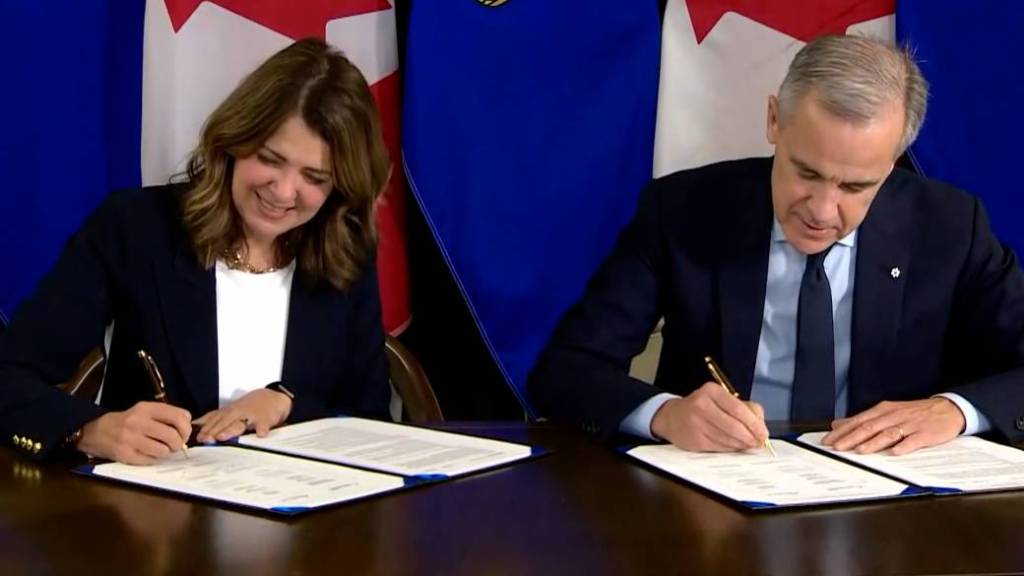
For the Carney government, the danger is not that these complaints derail core policy, but that they consume political oxygen. Every hour spent responding to performative ultimatums is an hour not spent building coalitions around housing finance reform or industrial strategy. The risk is cumulative. A steady drip of constitutional agitation can distort the agenda, forcing Ottawa into a reactive posture that favours short-term messaging over long-term statecraft.

That said, dismissing the disputes entirely would be a mistake. Sideshows still shape public mood. They erode trust in institutions, normalize the idea that core democratic guardrails are negotiable, and create a climate where substantive reform becomes harder to explain and sell. The judicial appointment fight matters less for what it changes immediately than for what it signals: a willingness to challenge institutional norms to score political points.

In the bigger picture, then, Alberta’s complaints are not the main story of Canada’s moment, but they are part of the background noise that can either be managed or allowed to metastasize. The test for the Carney government will be whether it can keep its focus on the genuinely consequential files while refusing to let performative conflict define the national agenda. Governments lose momentum not when they face opposition, but when they mistake noise for substance.

Canada and the CUSMA Crossroads: Policy Recommendations for Ottawa

As whispers from Washington grow louder about replacing the trilateral CUSMA with two separate bilateral trade agreements, one with the United States, one with Mexico, Canada finds itself at a pivotal moment. How Ottawa responds over the next eighteen months could determine not just near-term economic outcomes, but the resilience and global standing of the Canadian economy for decades to come.

The U.S. sees bilateral deals as a way to tighten rules of origin, enforce labour and environmental standards more aggressively, and gain leverage on regulatory issues. While these measures might appear to offer Canada the chance for a “customized” agreement, they also carry serious risks: fractured supply chains, diminished investment, and reduced bargaining power on the global stage. Canada cannot afford to approach this negotiation as a passive actor.

Policy Recommendations

1. Protect Integrated Supply Chains
Canada should insist on provisions that preserve existing supply-chain networks spanning Canada, the U.S., and Mexico. Standstill clauses and grandfathering mechanisms should ensure that Canadian investments in autos, aerospace, electronics, and agriculture are not penalized under stricter U.S. bilateral rules.

2. Negotiate Realistic Rules of Origin
Ottawa should push for rules that recognize Canada’s production capacities and global sourcing realities. Overly restrictive thresholds would damage competitiveness; instead, the agreement should balance protection of U.S. interests with Canada’s need to remain a hub of North American manufacturing.

3. Secure Trade Policy Autonomy
A bilateral agreement must not lock Canada into U.S.-imposed restrictions on third-party trade. Canada needs the freedom to deepen relationships with the EU, Asia-Pacific, and emerging markets. Ottawa should insist on explicit clauses preserving this sovereignty.

4. Embed Environmental and Labour Standards Strategically
Canada should leverage the negotiation to advance shared values on environmental protection and labour rights. By including enforceable, mutually beneficial standards, Canada can turn compliance obligations into a competitive advantage for Canadian businesses, particularly in clean energy, forestry, and high-value manufacturing.

5. Diversify Market Access
The U.S. will always be Canada’s largest trading partner, but Ottawa must use this moment to accelerate diversification. Strong bilateral terms with the U.S. should complement, not replace, agreements with other regions. This strategy will reduce vulnerability to U.S. policy swings and strengthen Canada’s global economic resilience.

6. Maximize Leverage on Strategic Resources
Canada possesses energy, critical minerals, and clean-tech assets of global significance. Ottawa should use the bilateral framework to secure access to U.S. markets without ceding control or undervaluing these resources, ensuring that Canada retains long-term strategic advantage.

7. Prepare for Transition and Communication
Any shift from CUSMA to bilateral arrangements will create uncertainty for businesses. Ottawa should implement a clear, phased transition plan and communicate proactively with domestic industries. Providing certainty and guidance can prevent disruption, maintain investment confidence, and reinforce Canada’s reputation as a stable, reliable partner.

8. Protect Agricultural Supply Management Sectors as Part of Food Security Strategy
Canada’s supply-managed sectors — dairy, poultry, and eggs — are vital not only to farmers’ livelihoods but to national food security. Any bilateral agreement must safeguard these systems against excessive U.S. pressure or forced liberalization. This will ensure that Canadians maintain stable domestic production, buffer against global market volatility, and preserve a cornerstone of rural economic resilience.

Conclusion
The U.S. drive toward bilateral deals presents both danger and opportunity. Canada must approach negotiations not as a defensive exercise in preservation, but as a chance to reshape its trade strategy for a new global environment. By insisting on supply-chain continuity, flexible rules of origin, strategic autonomy, market diversification, and protection for food security, Ottawa can turn potential disruption into a springboard for long-term economic strength.

Canada’s response will signal whether it remains a reactive participant in North American trade or assumes the role of confident, sovereign actor capable of shaping its own destiny. This is not a time to defer to Washington. It is a time to plan boldly, negotiate shrewdly, and safeguard Canada’s future.