Five Things We Learned This Week

Here is the latest edition of “Five Things We Learned This Week” for May 17–23, 2025, highlighting significant global developments across various sectors.

🛑 1. UN Warns of Escalating Humanitarian Crisis in Gaza

UN Secretary-General António Guterres described the current stage of the Gaza conflict as possibly its “cruellest phase,” with Palestinians facing immense suffering amid escalating Israeli military operations. He warned that the entire population is at risk of famine and criticized the limited humanitarian aid reaching Gaza, citing that only a fraction of permitted aid trucks have reached those in need due to insecurity. In the past 24 hours, at least 60 people were killed, including strikes on Khan Younis, Deir al-Balah, and Jabaliya, with over 50 people still buried under rubble. UN agencies and aid groups have raised alarms about inadequate food and medical supplies, with over 9,000 children treated for malnutrition and the healthcare system near collapse—94% of hospitals are damaged or destroyed. Israeli airstrikes have also targeted hospitals, further straining emergency services. Despite easing an 11-week blockade, aid remains minimal, far below pre-war levels. International criticism of Israel’s military actions continues, with leaders calling for a ceasefire and increased humanitarian access. Meanwhile, discussions are underway among Western nations about formally recognizing the state of Palestine, adding a new diplomatic dimension to the ongoing crisis. 

💉 2. NHS England Launches World’s First Gonorrhoea Vaccine

On May 21, NHS England introduced the world’s first gonorrhoea vaccine, demonstrating an efficacy of 30–40%. This development aims to combat the rising rates of gonorrhoea infections and represents a significant advancement in public health efforts to control sexually transmitted infections. 

📉 3. Trump’s New Tariff Threats Shake Global Markets

President Donald Trump’s evolving trade policies continue to send shockwaves through global markets. After a brief period of de-escalation in the U.S.-China trade war, markets were rattled on May 23, 2025, when Trump threatened to impose a 25% tariff on Apple iPhones not manufactured in the U.S. and a 50% tariff on EU goods starting June 1. These moves undermined recent optimism following tariff reductions between the U.S. and China, which had reignited S&P 500 gains and stabilized investor sentiment. However, concerns about tariffs resurfaced alongside rising inflation, tepid economic growth, and persistent federal debt nearing 100% of GDP. Despite some temporary relief—such as tariff pauses and incentives for auto and tech firms—Trump’s unpredictable trade tactics, especially his criticism of Apple’s offshore manufacturing and pressure on trading partners like the UK and India, have reintroduced uncertainty. Furthermore, even with promising AI infrastructure investments from the Middle East, the U.S.-China relationship is strained by export restrictions and sanctions tied to Huawei’s semiconductor use. Economists warn these erratic policies could spur stagflation and erode S&P 500 earnings growth, highlighting the risks of Trump’s tariff-heavy strategy amid widening fiscal deficits and global trade tensions. 

🧬 4. Discovery of New Dwarf Planet Candidate in Outer Solar System

Astronomers have reported the discovery of 2017 OF201, a new dwarf planet candidate located in the outer reaches of the Solar System. This celestial body adds to our understanding of the Solar System’s composition and the diversity of objects within it. 

🎭 5. Hay Festival of Literature and Arts Commences in Wales

The Hay Festival of Literature and Arts began on May 22 in Hay-on-Wye, United Kingdom. This annual event is one of the largest literary festivals globally, attracting authors, thinkers, and readers to celebrate literature, arts, and ideas through various talks, readings, and performances. 

Stay tuned for next week’s edition as we continue to explore pivotal global developments.

AUKUS: Australia’s Submarine Mirage and the Real Estate Windfall for the US and UK

This is the third in a series of posts discussing U.S. military strategic overreach. 

By any sober assessment, the AUKUS agreement is fast revealing itself not as a bold leap forward for Australian sovereignty or security, but rather as a strategic sleight of hand that gifts the United States and United Kingdom a plum prize: a deep-water Pacific base on a silver platter, without any credible assurance that Australia will ever take possession of a single operational nuclear-powered submarine.

At the heart of the matter is the glaring asymmetry in commitments. Australia is shoveling billions of taxpayer dollars, $4.6 billion and counting, into American shipyards and infrastructure while simultaneously preparing HMAS Stirling to host a rotating force of U.S. and British attack submarines as early as 2027. This “Submarine Rotational Force West” isn’t a sovereign fleet, it’s a permanent allied presence on Australian soil, marketed as “partnership,” but shaped overwhelmingly to suit U.S. Pacific ambitions.

Meanwhile, the so-called promise that Australia will receive at least three Virginia-class submarines from the United States remains riddled with legal escape hatches. Congressional legislation passed in 2023 mandates that the U.S. President must provide certification, a full nine months in advance of any transfer, that the move won’t compromise American naval readiness or foreign policy interests. Let’s be clear: this is not a contractual obligation; it’s a political permission slip, one that can be revoked, postponed, or buried under the weight of domestic American priorities at any time. With the U.S. submarine industrial base already overstretched and multiple U.S. senators flagging their concern that sending boats to Australia would weaken the American fleet, the odds are increasingly stacked against Canberra ever seeing these vessels.

Even former Australian Prime Minister Malcolm Turnbull has voiced sharp criticism of the deal, warning that it hands over operational control and strategic autonomy without receiving tangible capability in return. He’s right. As it stands, Australia’s “fleet of the future” is a geopolitical ghost, plausible on paper, dependent on Washington’s whim, and potentially decades away from delivery, if ever.

What Australia is getting, whether it asked for it or not, is an expanding foreign military footprint. The infrastructure being developed in Western Australia will support not Australian submarines, but American and British ones. It’s a curious form of defense procurement when the hardware arrives with foreign flags, foreign crews, and foreign command structures.

And let’s not forget the strategic optics: the U.S. has long wanted a more secure western Pacific presence, particularly as tensions with China escalate. With AUKUS, Washington gets a fortified naval hub in the Indian Ocean gateway without needing to build one from scratch or navigate the domestic pushback that would come with establishing such a base on U.S. territory.

In effect, Australia is underwriting the expansion of U.S. power projection in the Indo-Pacific while receiving, in return, little more than a handshake and a set of talking points about “interoperability” and “shared values.” This is not sovereign defense policy, it’s strategic dependency by design.

Until firm, non-revocable delivery timelines and control guarantees are put in place, AUKUS remains a masterclass in one-sided alliance politics. And unless Canberra wakes up to the hard truths of this arrangement, we may look back on this as the moment Australia paid handsomely to give away a base and got nothing but promises in return.

Sources
• ABC News Australia. “AUKUS legislation passes US Congress.” https://www.abc.net.au/news/2023-12-15/aukus-legislation-passes-us-congress-house-senate/103232048
• PS News. “US Congress approves AUKUS submarine technology transfer.” https://psnews.com.au/us-congress-approves-transfer-of-aukus-submarine-technology-to-australia/124954
• Sky News. “US Senators warn AUKUS deal is zero-sum game for US Navy.” https://www.skynews.com.au/world-news/us-senators-warn-joe-biden-that-submarine-aukus-deal-is-zerosum-game-for-us-navy/news-story/d74767e519b13602bc35d5a0717f2704
• Reuters. “US starts to build submarine presence on strategic Australian coast.” https://www.reuters.com/business/aerospace-defense/us-starts-build-submarine-presence-strategic-australian-coast-under-aukus-2025-03-16/
• News.com.au. “Malcolm Turnbull’s savage AUKUS takedown.” https://www.news.com.au/national/politics/former-prime-minister-malcolm-turnbull-says-aukus-deal-unfair-to-australia/news-story/6c3dcce602bb751fece0f8e4ef856054

Five Things We Learned This Week

Here is the latest edition of “Five Things We Learned This Week” for May 3–9, 2025, highlighting significant global developments across various sectors.

🌋 1. Volcanic Eruption in Iceland Disrupts Tourism

The Sundhnúkur volcanic system in Iceland erupted this week, leading to increased seismic activity near Grindavík. The Icelandic Meteorological Office reported the eruption and registered accompanying earthquakes. As a precaution, popular tourist destinations like the Blue Lagoon were evacuated, impacting the country’s tourism sector.  

💰 2. India’s Forex Reserves Decline After Eight Weeks of Gains

India’s foreign exchange reserves fell by $2.07 billion to $686.06 billion as of May 2, 2025, ending an eight-week streak of gains. The decline was primarily due to a decrease in gold reserves, which dropped from $84.37 billion to $81.82 billion. During the same week, the Indian rupee experienced volatility, appreciating by about 1% due to increased foreign inflows and optimism surrounding a potential U.S.-India trade agreement, but later depreciated by 0.9% amid geopolitical tensions between India and Pakistan.  

🧪 3. Scientists Develop Method to Generate Electricity from Rainwater

Researchers have reported a new method of generating electricity from falling rainwater using plug flow in vertical tubes. This technique converts over 10% of the water’s energy into electricity, producing enough power to light 12 LEDs. The innovation holds promise for sustainable energy solutions, especially in regions with high rainfall.  

📉 4. Consumer Goods Prices Expected to Rise Amid Tariff Pressures

Following President Trump’s introduction of steep tariffs on imports, notably a 145% tariff on Chinese goods, major consumer goods companies like Procter & Gamble, Nestlé, and Unilever anticipate raising prices. These increases add to consumer strain after three years of inflation and declining confidence, especially in the U.S., where shoppers face job uncertainty and potential recession. While some companies are attempting to pass costs to consumers, retailers and supermarkets are pushing back, warning that consumers are reaching their financial limits.  

⚔️ 5. Escalation in South China Sea Territorial Disputes

China has seized the disputed Sandy Cay Reef in the Spratly Islands of the South China Sea, intensifying territorial disputes in the region. The move has raised concerns among neighboring countries and the international community about escalating tensions and the potential for conflict in the strategically important area.  

Stay tuned for next week’s edition as we continue to explore pivotal global developments.

The Desert Reactor That Could Power the Future

I’ve spent decades watching promising nuclear technologies come and go; from breeder reactors to pebble beds to compact fusion dreams. Most end up in the “what might have been” pile, but something different is stirring in the Gobi Desert, and for once, the promise feels within reach. China’s recent success with a small thorium-fueled molten salt reactor (MSR) might just be the beginning of the nuclear renaissance we’ve all been waiting for.

It’s not just that they got the reactor running, that’s impressive in itself. What’s groundbreaking is that China’s researchers, operating under the Chinese Academy of Sciences, didn’t just fire up the experimental two-megawatt reactor. They ran it at full power and, in a world first, reloaded it while it was still running. That kind of feat is only possible with molten salt designs, where the fuel is dissolved in a hot liquid and circulates through the reactor like lifeblood. That fluid nature allows for continuous refueling, which not only boosts efficiency, but also sidesteps many of the safety risks that haunt traditional pressurized water reactors.

Molten salt reactors have long been the “what if” of nuclear design. The U.S. tried this back in the ‘50s at Oak Ridge, looking for ways to power nuclear bombers. But once uranium became the fuel of choice, and the Cold War demanded weapons-grade material, thorium was shelved. China dusted off those old reports (many of which were openly published), studied them carefully, and got to work. Now, they’re ahead of everyone else in a race that could redefine what nuclear power looks like in the 21st century.

And it’s not just about the molten salt. Thorium, the element at the heart of this reactor, is a game-changer. It’s far more abundant than uranium,  about three to four times as common in the Earth’s crust, and it doesn’t carry the same baggage. While uranium reactors inevitably produce plutonium-239 (which can be used for bombs), thorium reactors don’t. In fact, the byproducts of the thorium fuel cycle are notoriously hard to weaponize. It’s nuclear energy with a built-in disarmament clause.

Safety, too, is baked in. Unlike conventional reactors that operate under enormous pressure, molten salt reactors run at atmospheric pressure. There’s no steam explosion risk. If things start overheating, a freeze plug at the base of the reactor melts, draining the fuel into a safe containment tank. The fuel simply stops reacting. This isn’t theory, China’s demonstration shows it works.

We’re talking about a reactor that produces less waste, can’t easily be weaponized, runs more efficiently, and might even be paired with renewables or used to generate clean hydrogen. Add in the fact that thorium is cheap and widely available, and you start to wonder: why didn’t we do this sooner?

The answer, of course, is politics, economics, and inertia, but that may be changing. China’s quiet, but steady march toward thorium MSRs has now captured global attention. If this tiny desert reactor is scaled up, it could provide a path toward carbon-free baseload power, without the nightmares of Fukushima, or the baggage of Cold War proliferation. It’s not just a technological breakthrough. It’s a glimpse of a world powered differently.

And for once, that’s a world I believe we can build.

Sources:
South China Morning Post: “China’s experimental molten salt reactor project achieves major milestone” (https://www.scmp.com/news/china/science/article/3247984)
Nuclear Engineering International: “China achieves online refuelling with MSR” (https://www.neimagazine.com/news/newschina-achieves-online-refuelling-with-msr-11607915)
World Nuclear Association: “Molten Salt Reactors” (https://world-nuclear.org/information-library/current-and-future-generation/molten-salt-reactors.aspx)
Oak Ridge National Laboratory archives on MSR development (https://info.ornl.gov/sites/publications/files/Pub29596.pdf)
National Academies of Sciences, Engineering, and Medicine: “Thorium Fuel Cycle — Potential Benefits and Risks” (https://nap.nationalacademies.org/catalog/13368/thorium-fuel-cycle-potential-benefits-and-risks)

The New Silk Spine: How the INSTC Is Redrawing Global Trade Maps

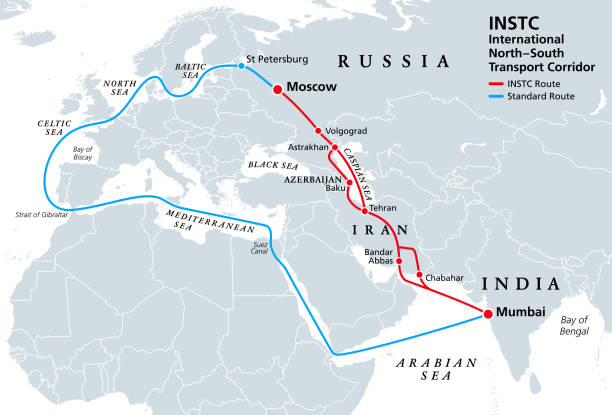
A quiet revolution in global logistics is underway, and it’s not coming from Beijing or Washington. It’s emerging from the heart of Eurasia, led by a consortium of countries who have historically occupied the margins of global trade narratives. The International North-South Transport Corridor (INSTC), a sprawling multimodal freight route linking India to Northwest Europe via Iran, Azerbaijan, and Russia, is reshaping both the geography and politics of trade.

The INSTC is more than just a 7,200-kilometre link between Mumbai and St. Petersburg. It’s a strategic recalibration, a corridor of asphalt, rails, and sea routes that bypasses the traditional maritime choke points like the Suez Canaland offers a faster, cheaper, and more resilient alternative. Cargo that once took 40 days to traverse via Suez may now move in under 25 days, with costs slashed by up to 40%. For countries like India, long constrained by maritime dependency and geopolitical roadblocks like Pakistan, the INSTC represents autonomy, reach, and leverage. By anchoring investments in Iran’s Chabahar Port and pushing road and rail links through the Caucasus into Russia, India is not just moving goods, it’s asserting presence.

Russia, reeling from Western sanctions, views the corridor as a vital artery to keep its economy tethered to global markets. With access to Europe constrained and pipelines of trade to Asia opening up, Moscow is embracing the INSTC as part of a broader pivot eastward. Iran, too, has seized its role as a key junction with zeal, positioning its territory as the bridge between warm water ports and the heart of Eurasia. Though battered by sanctions, Tehran is pushing infrastructure upgrades with a clear eye toward regional transit supremacy.

Europe is beginning to take notice. Countries like Germany and Finland are assessing the corridor’s potential to stabilize and diversify their supply chains, especially as global shipping lanes grow riskier and more expensive. Yet as enthusiasm grows in Eurasia, apprehension is mounting in the United States. The INSTC threatens U.S. strategic control over global commerce by undermining the relevance of the Panama and Suez canals, long cornerstones of American naval and economic dominance. It also boosts BRICS, a grouping increasingly seen as a challenger to the Western-led order.

Washington’s response has been twofold: diplomatic containment and competitive investment. The India-Middle East-Europe Corridor (IMEC), announced as part of the G7’s Build Back Better World initiative, is in part a direct counterweight to the INSTC. At the same time, U.S. policymakers are pressuring allies to tread carefully around Iran and Russia’s involvement, while watching closely how India—a key U.S. partner—manages its balancing act between the West and BRICS.

What is unfolding is not just a redrawing of trade routes, but a redrawing of power. The INSTC may not have the headline flash of China’s Belt and Road Initiative, but it is modular, strategic, and increasingly influential. It marks the emergence of a new Eurasian logic, one that connects the Indian Ocean to Northern Europe, not through blue-water naval lanes, but across land and short-sea corridors, driven by the very nations that were once bypassed. If the remaining gaps in infrastructure and policy can be bridged, this corridor will be more than a route, it will be a lasting statement.

The Dragon at the Gate: China’s Quiet Reversal of the Peking Accord

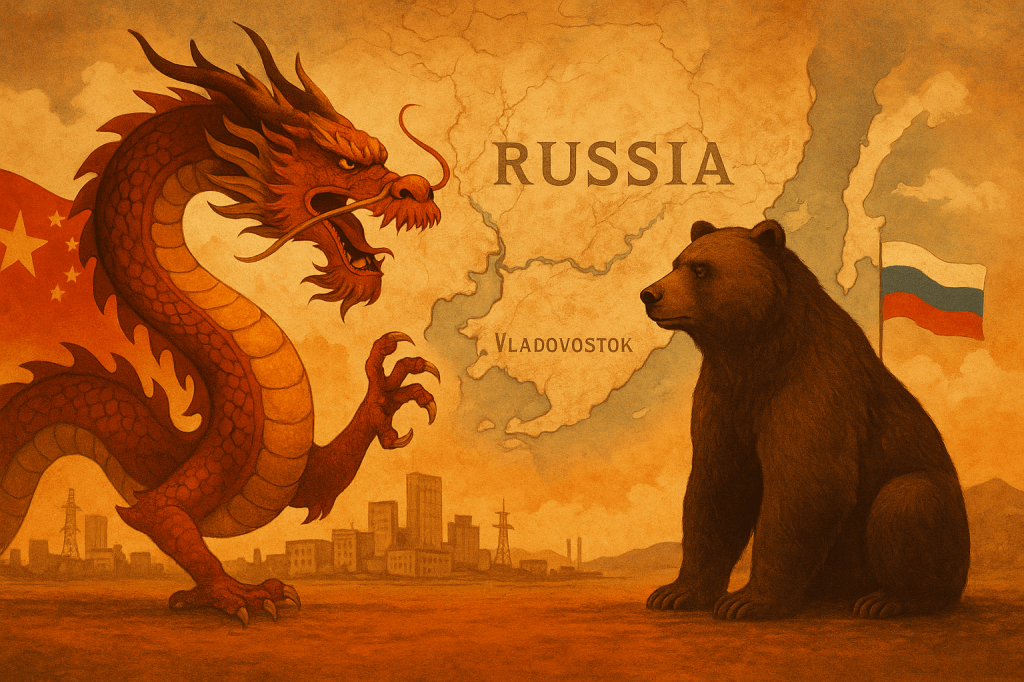
It’s a strange sight to behold – the old bear, once feared across continents, now leaning heavily on the dragon, who circles with a slow, calculating grace. Russia, once the hammer of the East, has been brought to heel by a grinding war in Ukraine, and while the West cuts ties and imposes sanctions, China, with the patience of a millennia-old civilization, sees opportunity, not just to profit, but perhaps to reshape history.

There’s a sense of irony that hangs over this moment. In 1860, the Qing dynasty signed the Peking Accord under duress, ceding vast swathes of land to the Russian Empire. That territory, now known as the Russian Far East, includes strategic regions like Vladivostok and the Amur Basin, lands that had once been part of China’s imperial periphery. The Chinese state, pragmatic in diplomacy, but deeply historical in self-conception, has never fully forgotten these losses. While official maps no longer lay claim to those regions, nationalist narratives in China occasionally whisper about redrawing what was once erased.

Fast forward to today, and the tables have turned. The war in Ukraine has battered Russia’s economy, and severed its connections to Europe. In desperation, Moscow has tilted eastward, selling gas, oil, and influence to Beijing at discount prices. This is not a partnership of equals. Russia needs Chinese markets, Chinese currency, and Chinese technology. China, meanwhile, gains leverage with every shipment of discounted crude, and every signed memorandum that ties the Russian economy tighter to the yuan. Where once they competed in Central Asia and the Arctic, now Russia finds itself the junior partner in a relationship it once dominated.

But China’s strategy isn’t conquest, it’s saturation. In the underpopulated stretches of Siberia and the Russian Far East, Chinese traders, laborers, and companies are embedding themselves quietly, but firmly. Towns along the border increasingly do their business in yuan, and many look more to Harbin or Heihe, cities in China’s Heilongjiang Province, than to Moscow. Infrastructure projects, often funded with Chinese capital, and executed by Chinese firms, are weaving a new economic fabric, one that binds these regions more to Beijing than to the Kremlin.

This isn’t a territorial war. China doesn’t need tanks to reverse the Peking Accord. It just needs time, capital, and a weakened Russia with few other friends. What we may be witnessing is not the formal return of lost lands, but something more subtle and enduring; a slow-motion annexation by way of economy, trade, and cultural seepage. A kind of imperial inversion, done not with gunboats, but with invoices and supply chains.

In geopolitics, history never dies, it just waits for the moment when the balance tilts. With every sanctioned ruble, and every Chinese-funded deal, the echoes of the 19th century grow louder. Russia may not yet realize it, but the dragon is already at the gates. Not to conquer, but to reclaim, softly, surely, and without ever having to fire a shot.

BRICS Rising: The Challenge to Western Dominance in a Multipolar World

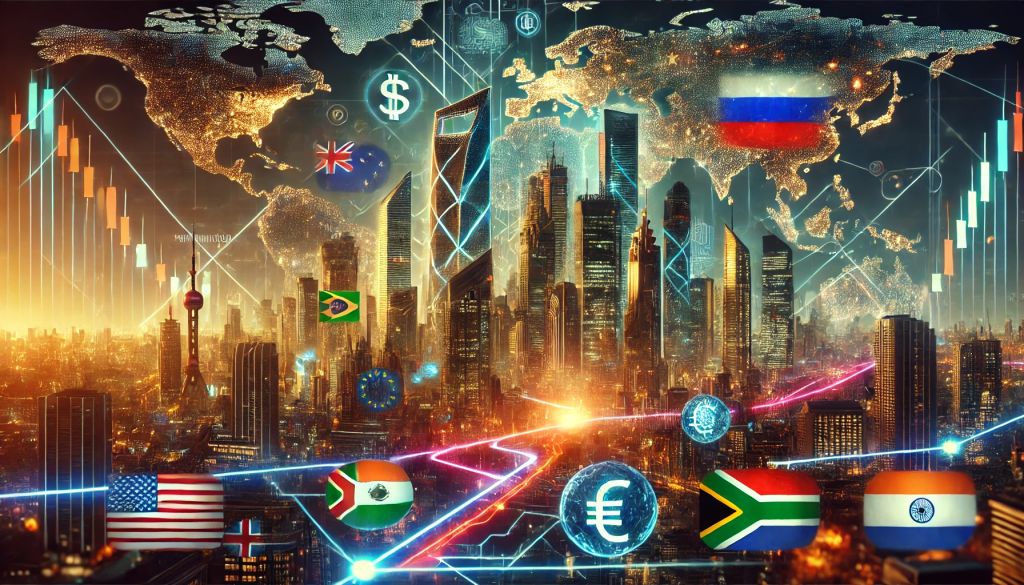
BRICS has evolved from an economic alliance into a geopolitical force challenging Western dominance. Originally conceived as a framework for cooperation among emerging markets, the bloc now pursues a strategic agenda that threatens the global order long shaped by Europe and North America. By fostering economic interdependence, promoting financial independence, and expanding its diplomatic influence, BRICS is positioning itself as a counterweight to Western-led institutions like the IMF, World Bank, and NATO. Its rise signals a shift toward a multipolar world where U.S. and European dominance is no longer assured.

At the core of BRICS’ strategy is economic cooperation aimed at reducing reliance on Western markets and financial institutions. Trade agreements and joint investment projects among Brazil, Russia, India, China, and South Africa strengthen internal resilience while offering developing nations an alternative to the West’s economic model. The New Development Bank (NDB) plays a key role, financing infrastructure and sustainability projects without the political conditions often attached to Western aid. This economic realignment is further reinforced by BRICS’ push to de-dollarize global trade, insulating its members from U.S. financial influence and sanctions. By increasing the use of local currencies and developing alternatives to SWIFT, BRICS is actively undermining the dollar’s global dominance. If oil-producing nations like Saudi Arabia shift toward BRICS’ financial system, the petrodollar system could face serious disruption, weakening the U.S. economy and limiting Washington’s ability to leverage economic power as a foreign policy tool.

For Europe, BRICS represents a different kind of challenge. While not as dependent on the dollar, the EU’s economic model relies on stable access to global markets, raw materials, and energy. BRICS’ growing control over critical resources—such as rare earth minerals, oil, and food supplies—poses risks to European industry. Russia and China have already demonstrated a willingness to use trade as a geopolitical weapon, and as BRICS strengthens its economic ties, European access to these resources could become more costly and politically conditional. Additionally, BRICS’ growing influence in Africa, Latin America, and the Middle East threatens Europe’s traditional soft power approach in these regions. By providing loans and investments without Western-style conditions, BRICS is offering an appealing alternative to nations wary of IMF-imposed austerity. This shift weakens Europe’s ability to shape international policies and erodes its influence in regions it has long considered strategic.

Beyond economics, BRICS is reshaping global diplomacy by advocating for a multipolar world. The bloc frequently aligns its positions in the UN, G20, and WTO, pushing for reforms that reduce Western dominance. By expanding its membership to include emerging economies across the Global South, BRICS is creating a parallel alliance network that enables countries to resist Western pressure. The potential inclusion of Iran and other anti-Western regimes raises concerns about a new axis of influence that could counterbalance NATO and other Western-led security alliances. While BRICS is not yet a military pact, growing defense cooperation—particularly between Russia and China—suggests that security coordination could become more structured over time.

Technology is another battleground where BRICS threatens Western leadership. China and India are emerging as global tech powerhouses, while Russia excels in cybersecurity and artificial intelligence. If BRICS nations successfully develop independent digital ecosystems—ranging from payment systems to semiconductor industries—Western tech companies may lose access to key markets. The push for BRICS-led internet infrastructure could also fragment global digital governance, reducing the West’s ability to shape online policies and monitor cyber threats. Meanwhile, BRICS’ emphasis on state sovereignty and non-interference in domestic affairs provides an ideological alternative to the Western model of governance. As more nations align with this approach, the ability of the U.S. and Europe to promote democracy, human rights, and free-market policies could diminish.

BRICS is not just an economic alliance, but a structural challenge to the Western-led world order. By advancing financial independence, expanding geopolitical influence, and fostering technological self-sufficiency, the bloc is steadily eroding the dominance of Western institutions. While internal divisions and logistical hurdles remain, BRICS’ trajectory suggests that Europe and North America must adapt to a world where their influence is no longer guaranteed. Whether the West engages with BRICS on more equal terms or resists and risks further global fragmentation will determine the shape of international relations in the years to come.