The House That Pierre Built

There is a faint creak coming from the blue house on Parliament Hill these days. Nothing as dramatic as a collapse. It is more like the weary sigh of old beams shifting under new weather. The Conservative caucus, still licking its wounds from a disappointing election, has begun to sound like that: restless, adjusting, unsure whether to stay or start packing boxes.

This week’s events made the sound louder. On Monday, Chris d’Entremont, MP for Nova Scotia’s Acadie–Annapolis, announced he was leaving the Conservatives to sit with Prime Minister Mark Carney’s Liberals. By Friday, Matt Jeneroux of Edmonton Riverbend revealed he would resign his seat in the spring. Two moves in five days would be noteworthy in any week. Coming before a leadership review, they ring like the snap of dry timber.

The facts are plain. D’Entremont said he could work more effectively for his region within government than in opposition. Jeneroux cited family and personal reasons, but the timing spoke volumes. Both men belong to the moderate, results-first wing of the party, the same wing that has looked increasingly uncomfortable under Pierre Poilievre’s sharply populist and combative leadership.

Poilievre remains a gifted communicator and fundraiser. A party is not built on charisma alone. The post-election landscape has left his caucus divided between those who want to double down on grievance politics and those who long for the days when Conservatives prided themselves on competence and calm. The upcoming January 2026 leadership review will force everyone to pick a side. Until then, MPs are doing the math on loyalty, re-election odds, and what they can still stomach.

There is arithmetic of another kind. Each defection moves the Liberals closer to a working majority and signals to uneasy Conservatives that crossing the floor might not mean political exile. It might mean relevance. Carney has left the door visibly ajar.

Beyond the chamber, Canadians watching from their kitchen tables may not feel much sympathy for inside-Ottawa melodrama, but they understand this much. When politicians start talking about family reasons, something larger is usually stirring in the walls.

So yes, the house still stands. But its timbers are talking. More MPs will listen to those creaks in the night and wonder whether to stay in a room where the wallpaper no longer feels like their colour.

Three possible tunes

If the past week is the prelude, the coming months could bring one of three tunes. The first is modest renovation. Poilievre steadies his leadership, wins the review, and a few more moderates quietly retire. The second is a managed reshuffle, with new leadership emerging after further defections. The third, less likely but not impossible, is a structural split. Red Tories in one wing, populists in another.

For now, the tea is still warm, the windows hold against the wind, and the Prime Minister has his recruitment list open. The rest of us can only keep an ear to the rafters and note how often the floorboards sigh.

Background and watchlist

The table below presents the verifiable facts we have, short background on each item, and why these MPs or groups are worth watching right now.

MP or GroupProvince or RidingStatus or FactsWhy to WatchSource Highlights
Chris d’EntremontNova Scotia · Acadie–AnnapolisCrossed the floor to the Liberals on November 4 2025First visible defection and the catalytic event. Cited alignment with government priorities.AP News November 4 2025 · Politico Canada November 4 2025
Matt JenerouxAlberta · Edmonton RiverbendAnnounced resignation effective spring 2026Timing fuels speculation of wider caucus unrest and coincides with a looming leadership review.Global News November 5 2025
Michael ChongOntario · Wellington–Halton HillsSenior moderate MP currently in caucusLong record of institutional moderation. Profile suggests potential isolation under combative leadership.Parliament of Canada profile · Hill Times analysis November 2025
Scott AitchisonOntario · Parry Sound–MuskokaFormer leadership candidate in 2022Advocates collegial tone and pragmatic policy. Leadership tone mismatch makes him a watchlist name.Leadership race records · CBC archives
Michelle Rempel GarnerAlberta · Calgary regionProminent independent Conservative voicePublicly critical on tone and culture issues. Could opt for retirement, re-alignment, or become a focal point for dissent.Policy Magazine profiles · Angus Reid commentary
Atlantic moderate MPsNova Scotia New Brunswick NewfoundlandGroup with regional pragmatic recordsRegionally pragmatic centrists who may feel alienated by Ottawa populism. The first defection came from this region.AP News November 2025 · Hill Times November 2025
Urban and suburban Ontario MPsGreater Toronto area and surrounding suburbsVarious MPs in ridings with narrow marginsIf local voters reject leader tone, re-election prospects dim and MPs may pre-emptively retire or seek other paths.Angus Reid Institute polling October 2025
Cross party pragmatistsVariousBackbenchers with a history of cross-party workThose who prefer cooperation to confrontation may choose to step away rather than remain in an increasingly combative caucus.Policy Magazine October 2025 · parliamentary reporting
Andrew Scheer and institutional figuresNationalSenior caucus roles and institutional influenceMore likely to organize a leadership challenge or delegate push than to cross the floor themselves.Hill Times November 2025 inside reporting

Speculation, modestly poured

If another resignation comes before Christmas, the pattern will be undeniable. The party’s centrist wing would be peeling away. A quiet exodus of three or four MPs could change committee balances and morale. Whether Poilievre can steady his caucus before the January review will decide if the blue house merely needs a new coat of paint or if the tenants start looking for a different address altogether.

Sources

  • AP News November 4 2025
  • Politico Canada November 4 2025
  • Global News November 5 2025
  • The Hill Times November 2025
  • Policy Magazine October 2025
  • Angus Reid Institute polling October 2025
  • Parliament of Canada public profiles and records

Unforced Errors: How the Conservatives Undermined Their Own Campaign

The Conservative Party of Canada (CPC) faced a significant defeat in the 2025 federal election, despite early leads in the polls. Several factors related to their platform and campaign strategy contributed to this outcome.

Ideological Ambiguity and Policy Reversals
Under Pierre Poilievre’s leadership, the CPC attempted to broaden its appeal by moderating positions on key issues. This included adopting a more serious stance on climate change and proposing policies aimed at working-class Canadians. However, these shifts led to confusion among voters about the party’s core principles. The rapid policy changes, especially during the short campaign period, made the party appear opportunistic and inconsistent.  

Alienation of the Conservative Base
The CPC’s move towards the center alienated a portion of its traditional base. This disaffection contributed to the rise of the People’s Party of Canada (PPC), which saw its vote share increase significantly. Many former CPC supporters shifted to the PPC, attracted by its clear stance on issues like vaccine mandates and opposition to carbon taxes. This vote splitting weakened the CPC’s position in several ridings.    

Controversial Associations and Rhetoric
Poilievre’s perceived alignment with hard-right elements and reluctance to distance himself from controversial figures, including former U.S. President Donald Trump, raised concerns among moderate voters. Trump’s antagonistic stance towards Canada, including economic threats and inflammatory rhetoric, made the election a referendum on Canadian sovereignty for many voters, pushing them towards the Liberals.   

Ineffective Communication and Messaging
The CPC’s campaign suffered from inconsistent messaging. While initially focusing on pressing issues like housing, the campaign later shifted to a more negative tone, attacking Liberal policies without offering clear alternatives. This lack of a cohesive and positive message failed to inspire confidence among undecided voters.  

Structural and Demographic Challenges
The CPC continued to struggle with regional disparities, particularly between conservative-leaning western provinces and liberal-dominated urban centers in the east. The party’s inability to appeal to urban and suburban voters, coupled with changing demographics, hindered its ability to secure a national majority.  

Foreign Interference Concerns
Post-election analyses indicated that foreign interference, particularly from Chinese government-linked entities, may have influenced the election outcome. Disinformation campaigns targeted CPC candidates, especially in ridings with significant Chinese-Canadian populations, potentially costing the party several seats.  

The CPC’s defeat in the 2025 federal election can be attributed to a combination of ideological shifts that alienated core supporters, associations with controversial figures, inconsistent messaging, structural challenges, and external interference. These factors undermined the party’s ability to present a compelling and cohesive alternative to the electorate.

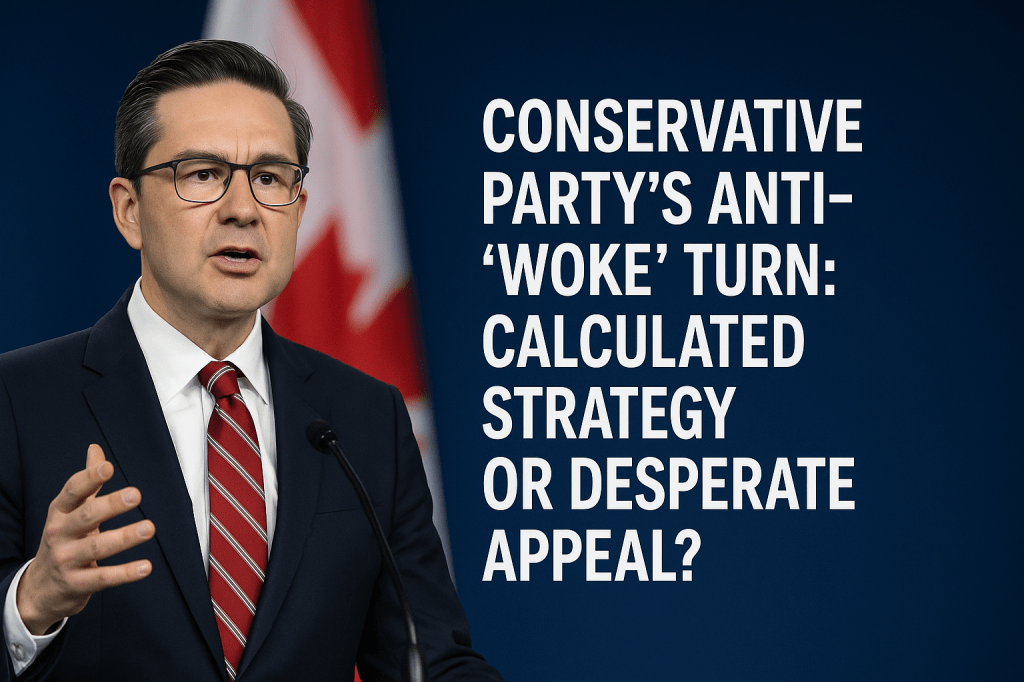
Conservative Party’s Anti-“Woke” Turn: Calculated Strategy or Desperate Appeal?

The Conservative Party of Canada has quietly republished the English-language version of its platform to reinsert a plank that had been conspicuously absent; a pledge to crack down on so-called “woke ideology” within the federal public service, and in university research funding. Described as a “publishing oversight,” this addition raises far more questions than it answers, particularly about Pierre Poilievre’s political calculus as the next election draws closer.

First, let’s interrogate the substance. “Woke ideology,” while undefined in the platform, is often shorthand on the political right for progressive stances on diversity, inclusion, gender identity, anti-racism, and decolonization efforts. To include language targeting these frameworks suggests the Conservatives are not just passively uncomfortable with current equity-focused public policy, they’re actively preparing to dismantle it. But why now?

One possible explanation is strategic: this is a deliberate overture to Canada’s emergent far-right electorate. While still fringe in some parts of the country, this voter segment has grown increasingly vocal, particularly on social media, and within alternative media ecosystems. By tapping into their grievances, against public sector DEI programs, gender-inclusive language, or research funding tied to Indigenous reconciliation, the Conservatives may be attempting to consolidate a reliable, energized bloc of voters.

Another interpretation is more inward-facing: Poilievre is shoring up his base, not for the election, but for what comes after. Should the Conservatives form government, he may face internal fractures between establishment conservatives and newer ideological hardliners. This platform language signals allegiance to the latter, potentially ensuring his continued leadership in a post-election caucus that could be divided on everything from fiscal policy to foreign affairs.

There’s also the broader issue of timing. The re-publication came after criticism that the party had been “softening” to appeal to moderate or urban voters, many of whom are uncomfortable with overt culture war rhetoric. By reaffirming this pledge, the party might be trying to reassure its core that the campaign’s centrist gestures are mere optics, not policy commitments.

But this move is not without risks. Canada’s public service is one of the most diverse and professionalized in the world. Federal civil servants are unlikely to respond positively to a government that frames their professional values as ideological threats. Likewise, university researchers who rely on federal grants will see this as a chilling signal that academic freedom could be compromised by political litmus tests.

And then there’s the broader electorate. While “anti-woke” politics have gained traction in the U.S. and U.K., Canadian voters have historically been more moderate. The risk for Poilievre is that in appealing to a narrow base, he alienates the swing voters he’ll need to actually win. Recent polling shifts, driven in part by U.S. President Donald Trump’s aggressive new tariffs on Canadian goods and Liberal leader Mark Carney’s boost in credibility, suggest the tide may already be turning against Poilievre’s hard-right gambit.

The re-insertion of this controversial language into the Conservative platform isn’t a glitch, it’s a signal. The question now is whether it’s a strategic masterstroke aimed at cementing a new ideological alignment in Canada, or a desperate hedge against the possibility that Poilievre wins the election, but loses control of his own party.