
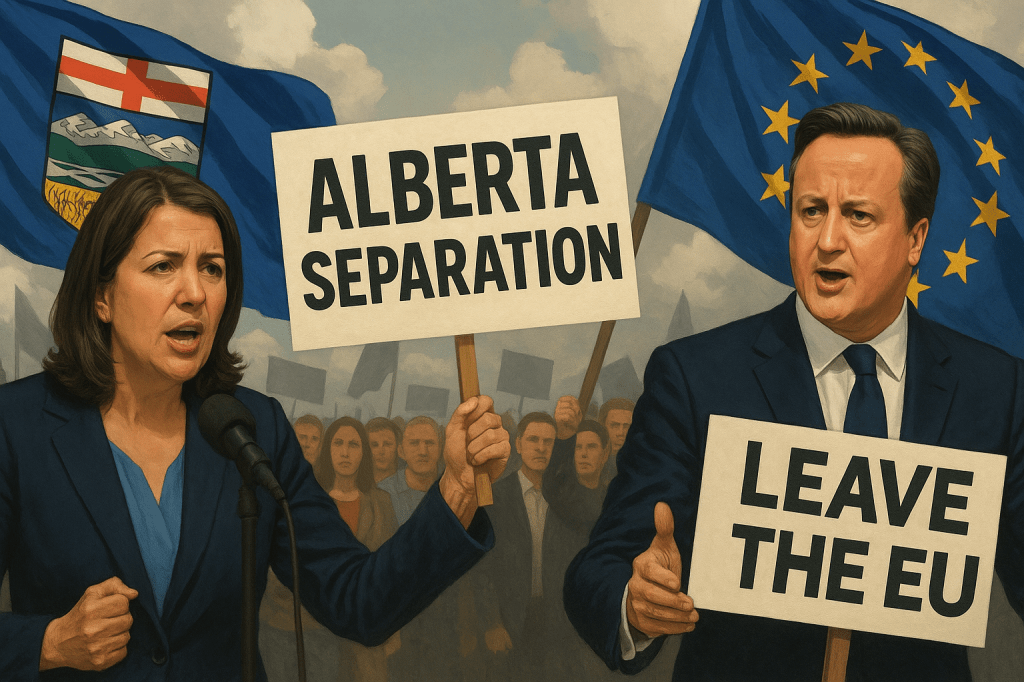
It began with a simple yet startling poll result: one‑third of Albertans said they would consider leaving Canada if the next federal government were Liberal, a figure up from 25 percent in 2001 and drawn from a 219 Ipsos survey that found 33 percent of respondents believing Alberta would be better off as a separate country. In the same year, an Angus Reid Institute study reported that half of Albertans saw separation as a “real possibility,” even if the practical likelihood was judged low. Other surveys have shown support fluctuating between 23 percent and 33 percent, but the headline number – one in three – captured the public imagination, and became shorthand for a deep provincial malaise.
That malaise has its roots in a storied history of perceived federal overreach. Albertans, and Western Canadians more broadly, still speak in hushed tones of the National Energy Program of 1980, when Ottawa’s sudden push to capture a greater share of oil revenues felt like an economic and cultural assault. Recent Liberal governments, with their emphasis on carbon pricing (the “carbon tax”), tighter environmental assessments through Bill C‑69, and tanker bans under Bill C‑48, have reawakened memories of Pierre Trudeau’s NEP and convinced many that, once again, the province’s lifeblood industry is under siege.
Yet the idea of actually breaking away faces almost insurmountable constitutional and practical barriers. The Supreme Court of Canada’s 1998 Reference re Secession of Quebec made clear that any province seeking to leave must first secure a “clear expression” of the popular will through a referendum on a clear question, and then negotiate terms of separation with Ottawa, and the other provinces, no small feat under Canada’s amending formula, which generally requires approval by Parliament plus seven provinces representing at least 50 percent of the national population. Indigenous nations in Alberta, whose treaty rights are with the Crown, would also have to be brought into the process, introducing further complexity and potential legal challenges.

Contrasting sharply with this looming constitutional labyrinth is the decade of Stephen Harper’s Conservative government (2006–2015), celebrated in Alberta as “our decade.” Under Harper who, though born in Ontario, was politically shaped in Calgary, Alberta’s oil patch felt valued rather than vilified. Pipelines advanced, carbon pricing was minimal, and fiscal transfers were viewed as fair. When Harper left office, Alberta enjoyed low unemployment, a booming energy sector, and a sense of national relevance seldom felt under Liberal administrations.
That stark contrast helps explain why talk of a fourth Liberal mandate elicits such fury. It’s not just a change of political party, but a reopening of old wounds. Many Albertans feel that, under Liberal governments, their province unwittingly subsidizes federal programs and public services elsewhere, amid equalization debates, even as Ottawa imposes restraints on drilling and export infrastructure. Yet when Alberta needs federal support, whether for pipeline approvals through British Columbia, bailouts of orphaned wells (some $1.7 billion in 2020), or trade negotiations, it turns to the very same system it denounces.
At the heart of this contradiction lies a fundamental misunderstanding on both sides of the debate. Constitutionally, Alberta does own the oil and gas beneath its soil: Section 92A of the Constitution Act, 1982 grants provinces exclusive resource management powers. But that ownership comes with responsibilities and shared consequences. Oil and gas development contributes to national greenhouse‑gas targets, affects international trade obligations (e.g., under CUSMA), and relies on pipelines, rail lines, and workforce mobility that cross provincial boundaries and fall under federal jurisdiction.
This “siege mentality” sees only extraction and profit, ignoring that Alberta’s prosperity is woven into the Canadian federation: workers from Ontario and the Maritimes staff the oil sands; revenues fund national research and infrastructure; federal courts enforce property and contract law; and Ottawa’s diplomatic channels open markets abroad. The province’s economy is both “ours” and “Canada’s,” yet too often the narrative paints Alberta as a cash cow and Ottawa as a meddling bureaucrat.
Should Albertans ever find themselves voting for separation, they would quickly learn that the question is only the beginning. A referendum, no matter how decisive, would simply trigger constitutional negotiations. Debates over dividing federal debts and assets, the fate of interprovincial infrastructure, the status of Indigenous treaties, and even Canada’s seat at the United Nations would follow, all under the watchful eyes of domestic courts and foreign governments skeptical of a rump Canada and a new oil‑rich microstate.
In this light, the polling spikes in separatist sentiment reflect more than a serious bid for nationhood, they signal profound alienation. Up to 33 percent talking of leaving, up to 50 percent seeing separation as possible, and around 23 percent saying they would vote “yes” in a referendum are metrics of anger rather than blueprints for new borders. They underscore a demand for respect, recognition, and real partnership with the federal government, an insistence that Alberta’s economic contributions be matched with political influence and cultural validation.
Ultimately, Alberta’s future lies not in walking away from Canada, but in finding a new equilibrium within it. That requires:
1. Acknowledging interdependence: Alberta must recognize that its resource wealth, workforce, and infrastructure exist because of—and for—the Canadian market and legal framework.
2. Embracing diversification: Beyond oil and gas, investments in hydrogen, clean technology, and critical minerals can reduce the economic anxiety that fuels separatist talk.
3. Renewing federalism: Ottawa needs to move beyond top‑down policies and engage province‑by‑province on environmental and economic goals, respecting regional realities while upholding national standards.
The story woven by those polls, legal analyses, and emotional testimonies is not one of imminent breakup but of a province at a crossroads. The choice before Alberta, and Canada, is whether to deepen the divide into a chasm of mistrust, or to build new bridges of collaboration that honor both provincial autonomy and federal unity.
 The Rowanwood Chronicles