
Washington likes to believe it understands itself. Staffers stride through hallways with the old confidence that policy, power, and predictable alliances still define the town. But yesterday the city felt like it had been tipped on its side. The familiar landmarks were still there, the marble still gleaming, the security lines still long, yet the political gravity had shifted. Something in the air made even the most seasoned observers pause. The rhythms were off. The choreography was wrong. The script had been changed without warning.
It began with the House vote. A resolution denouncing the supposed horrors of socialism sailed through with 285 votes. Eighty-six Democrats joined Republicans in an act that looked, to many, like a public renunciation of their own party’s progressive wing. Senior Democrats who had once embraced the energy of their younger socialists suddenly stood at the podium to praise a line of rhetoric that could have been lifted from a mid-century anticommunist tract. It was symbolic and it was safe, yet it carried the unmistakable sting of disloyalty. In a political moment defined by economic anxiety, this vote felt like an attempt to distance the party from the very language that had helped fuel its grassroots revival.
Then came the Oval Office.
Within hours of the anti-socialism vote, Zohran Mamdani, the democratic socialist mayor-elect of New York City, walked through the gates of the White House. Cameras rolled as Donald Trump, the man who had built years of rallies on the promise of defeating socialism, suddenly praised Mamdani as rational and pragmatic. The same leader who had weaponized the word socialism now spoke about affordability, collaboration, and even the possibility of making a life in Mamdani’s New York. Reporters searched for context, staffers searched for talking points, and the city searched for its footing.
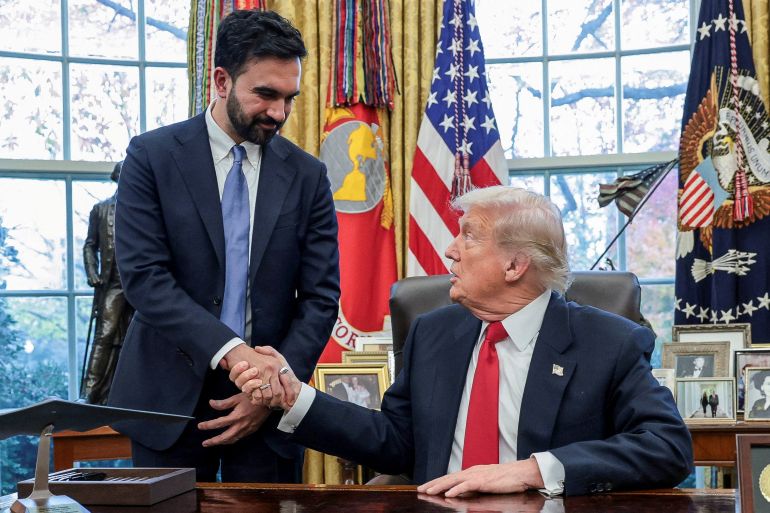
It was the kind of contradiction Washington hates because it cannot be easily spun. Democrats had voted to distance themselves from socialism while Trump offered the socialist of the hour a political embrace. Progressives stared at their own leadership in disbelief. Conservatives stared at Trump in confusion. Centrists stared at both sides and wondered whether anyone was still playing by recognizable rules. By late afternoon, Washington felt like it had been rewritten by a novelist with a sense of humor and a taste for irony.
Meanwhile Mamdani himself appeared untouched by the chaos swirling around him. He brushed off the congressional vote and spoke instead about affordability and governance. He treated the Oval Office meeting not as a political earthquake but as a practical encounter with a president who happened, on this particular day, to be in a generous mood. His calmness only amplified the surreal tone of the day. The city was upside down. The socialist was steady. The partisans were unmoored.
By evening, analysts were already scrambling to interpret the meaning of it all. Was Trump repositioning himself. Were Democrats attempting to signal caution to suburban voters. Was this simply political theater without consequence. Or had Washington revealed something deeper. The sense of an old order losing its predictability. The sense that ideological labels no longer behave as they are expected to. The sense that alliances can flip in the space of an afternoon.
For a brief moment, the capital looked like a place where the usual logic had cracked. The marble buildings and polished floors remained, but the stories being told within them no longer lined up with the roles each character was supposed to play. It was a day that left Washington blinking in the light, unsure of whether it had witnessed a temporary disruption or an early sign that the political axis itself is beginning to tilt.
 The Rowanwood Chronicles