The BRICS Strategy in 2025: From Dialogue to Direction

In July 2025, the BRICS nations – Brazil, Russia, India, China, South Africa, and an expanded circle now including Egypt, Ethiopia, Iran, Saudi Arabia, the UAE, and Indonesia, met in Rio de Janeiro for their 17th annual summit. The gathering marked a decisive shift from rhetorical ambition to institutional strategy, as the bloc attempts to redefine global governance, build financial alternatives to the West-led systems, and frame itself as the political voice of the Global South. While the summit was shaped by ongoing geopolitical crises and internal contradictions, it revealed a maturing vision that extends far beyond its original economic coordination mandate.

At the core of this year’s summit was a demand for structural reform in global governance. BRICS leaders called for the United Nations Security Council to be expanded and for the voting structure of institutions such as the International Monetary Fund (IMF) and World Bank to be reweighted to better reflect the global South’s demographic and economic realities. This long-standing frustration with Western-dominated institutions has now sharpened into a diplomatic agenda. What was once a diffuse critique has evolved into coordinated proposals, particularly on the economic front.

One of the summit’s central themes was the steady progress toward de-dollarization. While calls for a BRICS common currency were conspicuously downplayed in Rio, leaders focused instead on more pragmatic steps: local-currency trade settlements, expanded use of central bank digital currencies (CBDCs), and the interoperability of national payment systems through the still-developing BRICS Pay infrastructure. A new cross-border clearing and settlement framework, informally called BRICS CLEAR, was introduced to complement these efforts. These initiatives are designed not only to bypass the U.S. dollar in bilateral and multilateral trade, but also to shield BRICS economies from the volatility and political conditionality associated with Western sanctions and SWIFT-based systems.

To support these ambitions, the New Development Bank (NDB), already capitalized with billions of dollars from member states, is being repurposed. A guarantee facility is in development, modeled loosely on the World Bank’s Multilateral Investment Guarantee Agency (MIGA), to underwrite public and private projects across member states. This is particularly relevant for emerging markets seeking infrastructure finance without the governance conditions typically imposed by the IMF or World Bank. With these tools, the bloc seeks to develop its own version of Bretton Woods-style architecture, updated for multipolar geopolitics.

Climate and sustainability also featured heavily on the summit agenda. Brazil, as host, proposed the “Tropical Forest Forever Facility,” a $125 billion climate financing mechanism aimed at conserving rainforest regions across Latin America, Africa, and Asia. The proposal is a direct challenge to Western narratives that have often placed environmental responsibility solely on the shoulders of developing nations without matching financial commitments. The initiative also serves as a preview of the Global South’s priorities heading into COP30, which will also be hosted by Brazil.

Sustainable development received structural attention beyond climate. The BRICS Business Council and Women’s Business Alliance jointly launched a 2025–2030 action plan focused on strengthening small and medium-sized enterprises (SMEs) across member states. This includes access to digital markets, cross-border licensing, and gender-equity strategies in entrepreneurship. The bloc appears intent on grounding its geopolitical ambitions in concrete developmental outcomes at the community and enterprise level.

Notably, the summit also launched a framework for artificial intelligence governance. Although still in early stages, the agreement seeks to establish common principles around transparency, ethical use, and protection against algorithmic bias. This aligns with recent UN discussions and serves to position BRICS as a rule-setting body rather than just a rule-taking coalition. With China and India both advancing in AI development, and with Brazil and South Africa playing increasing roles in data regulation, this initiative represents an important test of cross-ideological cooperation in technology governance.

Despite these achievements, internal tensions were evident. Neither President Xi Jinping nor President Vladimir Putin attended in person. India’s leadership walked a diplomatic tightrope, supporting reformist language while resisting deeper integration that might conflict with its ties to the West. Brazil, under President Lula, tempered the bloc’s anti-Western tone, particularly around tariffs and NATO criticism, wary of provoking trade retaliation. These divergences underscore the coalition’s central contradiction: it is an alliance of ambition, not ideology.

Nonetheless, BRICS continues to expand. Indonesia became a full member in January 2025, joining Iran, Egypt, Ethiopia, and others admitted in the prior year. Observers note that the group’s size risks diminishing its coherence, yet the appeal of a multipolar forum remains strong. As the G7 struggles with internal disunity and the Western alliance faces political upheaval, BRICS offers a platform that aligns with the aspirations of many developing nations, even if it cannot yet match Western institutions in capacity or cohesion.

Looking ahead, the bloc’s short-term focus will be on operationalizing its financial and development tools, settlement systems, climate funds, SME supports, and asserting diplomatic pressure for reform in global governance bodies. Over the medium term, its success will depend on the extent to which it can balance economic pragmatism with political heterogeneity. While its vision of a multipolar world is not universally embraced, BRICS has matured into a serious force in global affairs, one increasingly capable of setting its own agenda.

Billionaires Shouldn’t Exist – And Here’s Why That’s Not Radical

When New York State Assemblymember Zohran Mamdani recently declared, “I don’t believe we should have billionaires,” he wasn’t indulging in empty populism, he was articulating a moral position whose time has come. The existence of billionaires, in an era defined by mass homelessness, food insecurity, and climate collapse, is not merely unfortunate, it is an ethical indictment of the systems that allowed them to exist in the first place.

Mamdani joins a growing chorus of progressive thinkers, economists, and ethicists who argue that no individual should have the right, or the capacity, to accumulate and hoard a billion dollars or more. This isn’t about envy or political expediency. It’s about the increasingly clear understanding that billionaire wealth isn’t just excessive, it’s extractive, destabilizing, and morally indefensible.

Billionaire Wealth Is Built on Exploitation
To amass a billion dollars, one must either inherit extreme wealth or systematically profit from the undervalued labour of others. Most billionaires, especially those in tech and finance, profit not through invention or hard work, but through ownership of capital, tax avoidance, and labor suppression. As economist Thomas Piketty demonstrated in Capital in the Twenty-First Century, returns on capital consistently outpace economic growth, meaning that wealth accumulates faster than wages rise, thus enriching the few while immiserating the many (Piketty, 2014).

This is not a bug in capitalism; it’s a feature. While billionaires build personal rockets and collect rare yachts, tens of millions lack clean water, reliable housing, or access to medical care. The wealthiest 1% of the global population now owns nearly half of the world’s wealth, while the bottom 50% hold just 2% (Credit Suisse Global Wealth Report, 2022).

Morality Demands Redistribution, Not Charity
Some argue that billionaires are philanthropists who “give back.” But ethical redistribution is not about generosity, it’s about justice. Charity, even when well-intentioned, is discretionary. It allows the wealthy to decide which causes are “worthy,” often with tax write-offs and public accolades. It is fundamentally undemocratic.

As philosopher Peter Singer wrote in his essay Famine, Affluence, and Morality, if we can prevent something bad from happening without sacrificing anything of comparable moral importance, we are morally obligated to do so (Singer, 1972). Billionaires could eradicate global hunger, fund universal education, and fight climate change many times over. That they do not is a moral failure, one built into the very logic of their class interests.

The Billionaire Class Undermines Democracy
More than just a matter of inequality, billionaires represent a profound threat to democracy. They use their wealth to shape elections, control media narratives, lobby governments, and suppress movements that challenge their power. As Mamdani put it, they spend “millions of dollars” to influence outcomes that serve their continued dominance. That’s not civic participation, it’s oligarchy.

This is evident in the staggering political spending from figures like Elon Musk, Jeff Bezos, and the Koch brothers, whose influence often counters popular will on issues like climate regulation, taxation, and labor rights. When money becomes speech, those with the most money speak loudest, and everyone else is drowned out.

Making Billionaires Illegal Is Not Extremism – It’s Ethics
To say that billionaires should be “illegal” is not to suggest rounding them up and seizing their mansions. It means creating systems in which it is structurally impossible to accumulate wealth beyond a certain point. This might include steeply progressive taxation, strict inheritance limits, and aggressive corporate regulation. As proposed by economists like Gabriel Zucman and Emmanuel Saez, a global wealth tax would not only generate trillions in public funds, but also dismantle the foundations of permanent wealth aristocracy (Zucman & Saez, 2019).

When Mamdani says billionaires “shouldn’t exist,” he invites us to imagine a society where wealth is shared, not hoarded; where innovation is public, not privatized; and where dignity isn’t auctioned to the highest bidder. This vision isn’t utopian, it’s already partly realized in countries with higher levels of equality and lower poverty rates, such as Norway, Denmark, and the Netherlands.

A Future Without Billionaires Is a Future With Hope
We are standing at a crossroads: ecological collapse looms, fascism festers, and inequality grows by the hour. Allowing the existence of billionaires in this context is more than complacent, it’s complicit. As the climate crisis worsens and democratic institutions strain under the weight of elite influence, we must ask: how much longer can we afford billionaires?

The answer, increasingly, is: not one more day.

Sources
• BBC News. (2025). Zohran Mamdani says he doesn’t believe that we should have billionaires. https://www.bbc.com/news/articles/cvge57k5p4yo
• Piketty, T. (2014). Capital in the Twenty-First Century. Harvard University Press.
• Credit Suisse. (2022). Global Wealth Report 2022. https://www.credit-suisse.com/about-us/en/reports-research/global-wealth-report.html
• Singer, P. (1972). Famine, Affluence, and Morality. Philosophy & Public Affairs.
• Zucman, G., & Saez, E. (2019). The Triumph of Injustice: How the Rich Dodge Taxes and How to Make Them Pay. W.W. Norton & Company.

Five Things We Learned This Week

Here’s the latest edition of “Five Things We Learned This Week” for June 28–July 4, 2025, showcasing five entirely new global developments—each occurring in the past seven days:

🧭 1. Trump Signs Sweeping Tax & Spending Bill

• On July 4, President Trump signed a landmark tax-and-spending package into law, following its narrow passage in Congress  .

• This $3.3 trillion bill includes large tax cuts and federal spending boosts, with analysts warning of significant long-term increases in national debt  .

🌍 2. Japan Warms for Possible Quakes, Authorities Calm Public

• On July 4, Japan’s disaster agency alerted residents of potential strong aftershocks off the southwest coast, though downplaying doomsday fears  .

• Authorities emphasized preparedness over panic, urging early warning systems remain active.

🇨🇳 3. China Signals Investment in Brazil‑Led Forest Fund

• At the end of the week, Reuters reported that China plans to back the “Tropical Forests Forever” fund led by Brazil—marking a strategic shift toward joint environmental efforts  .

• This move is viewed as a rare diplomatic gesture amid global climate partnerships.

📈 4. Global Equity Funds See Largest Inflows in 8 Months

• Global equity funds recorded a massive $43.15 billion inflow for the week ending July 2, driven by U.S. stock highs and surging interest in AI and tech sectors  .

• U.S. equity funds accounted for $31.6 billion, with robust gains also seen in European and Asian markets  .

🇲🇩 5. Moldova Leaders Emphasize EU Integration Ahead of Election

• On July 4, Moldova’s President Maia Sandu declared that citizens hold the future of the EU bid in their own hands as the country nears parliamentary elections  .

• Her appeal underscores Moldova’s ongoing push for formal European Union membership.

These five developments span U.S. fiscal policy, earthquake readiness, international environmental funding, global investment trends, and Eastern European geopolitics—all fresh this week. Want source links or deeper insights? Let me know!

Why Canada’s Digital Services Tax Is Poking the Bear – And Why Australia and New Zealand Are Still Holding the Stick

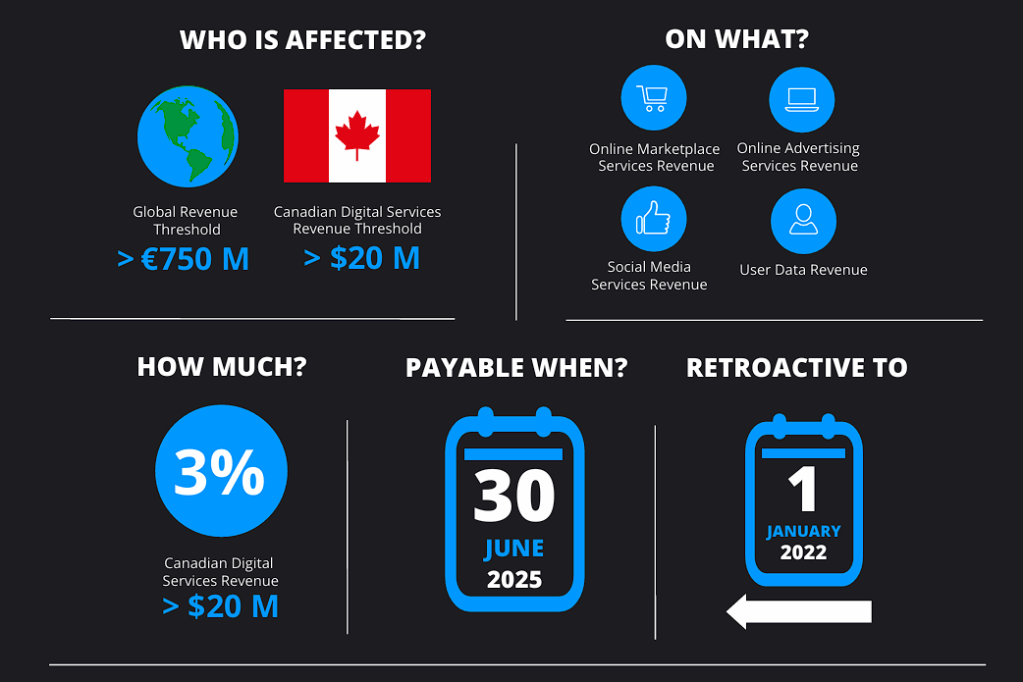
It was only a matter of time before Canada threw its toque into the ring on the global debate over taxing tech giants. After years of polite patience, Ottawa finally said enough is enough and committed to implementing a Digital Services Tax (DST), retroactively, no less, dating back to January 1, 2022. The goal? To make Big Tech pay its fair share for the billions they earn from Canadians’ online clicks, swipes, and searches. Predictably, this move hasn’t exactly gone down well south of the border, especially with Donald Trump, who’s already threatening retaliatory tariffs faster than you can say “Google it.”

Canada’s DST is a 3% levy on revenues from digital services; think online marketplaces, advertising platforms, and social media, that target Canadian users. The tax only kicks in for companies making over €750 million globally and more than $20 million in Canadian digital revenues. So, yes, this is about Amazon, Google, Meta, and Apple. Not your cousin’s Shopify side hustle.

The reasoning behind the move is, frankly, hard to argue with. For years, digital multinationals have made huge profits in countries where they have lots of users but no physical offices. Since our tax codes were written in the days of rotary phones, these companies have legally side-stepped corporate taxes in places like Canada while hoovering up data and ad dollars with industrial-grade efficiency. The DST is intended as a band-aid solution until a global fix comes together, though that band-aid is now being applied with an increasingly firm hand.

In truth, the global tide may finally be turning on Silicon Valley’s long, tax-free world tour. For over a decade, Big Tech has surfed a wave of international growth, scaling into nearly every market on Earth without paying local dues. Armed with sophisticated tax avoidance schemes, usually routed through Ireland or the Netherlands, the giants of the digital economy have profited handsomely while governments watched domestic retailers struggle to compete. But now, faced with growing public backlash and creaking public coffers, countries from France to India to Canada are drawing a line. The message is clear: if you make money off our citizens, you’re going to help fund the roads, schools, and social programs that keep them clicking.

The global fix in question is the OECD’s “Two-Pillar” solution, a diplomatic marathon attempting to modernize international tax rules. Pillar One aims to reallocate taxing rights to market countries (like Canada), while Pillar Two would establish a global minimum corporate tax of 15%. Canada has said it would delay DST collection if the OECD deal is implemented, but with the U.S. dragging its heels on ratification, Ottawa is preparing to go it alone.

That’s where Trump comes in. Never one to let a perceived slight slide, he’s treating Canada’s DST as a direct assault on U.S. interests. After all, the companies getting dinged are almost entirely American. Trump’s threats to slap retaliatory tariffs on Canadian exports are classic “America First” bluster, but they’re not without precedent. The U.S. already opened Section 301 investigations into several other countries’ DSTs, accusing them of unfairly targeting American firms. Biden’s administration cooled the rhetoric, but the sentiment remains.

Of course, Canada isn’t the only country to stick its neck out on this. France was the pioneer, pushing ahead with a 3% DST despite fierce U.S. pushback. Italy, Spain, and the UK followed suit. Even India got into the act with its “equalisation levy,” predating many Western attempts. Each of these nations, like Canada, grew tired of waiting for multilateral action while Silicon Valley giants dodged their tax nets with Olympic-level agility.

Interestingly, not everyone in the Anglosphere has been quite so bold. Take Australia. A few years back, it flirted with a DST, there were consultations, white papers, and worried glances toward Washington. But ultimately, Canberra decided to give the OECD process a shot and beefed up its anti-avoidance laws instead. Its Multinational Anti-Avoidance Law and Diverted Profits Tax now let the tax office go after digital firms that try to shuffle profits offshore. It’s the equivalent of hiring a tough new accountant rather than inventing a new tax altogether.

New Zealand, meanwhile, has taken a “just in case” approach. Legislation for a 3% DST was passed in 2023, but it’s sitting in a drawer for now, ready to go if the OECD talks collapse. The Kiwis have been clear they don’t want to pull the trigger unless absolutely necessary, probably because they’d prefer not to find themselves on the receiving end of a tweetstorm or tariff tantrum from the next American administration.

So here we are: Canada, gloves off and calculator in hand, is forging ahead, determined to claw back a fair share from the tech titans. Australia and New Zealand, pragmatic as ever, are hedging their bets and keeping trade relationships intact, at least for now. But even their patience has limits. The longer the OECD deal stalls, the more tempting it becomes to follow Canada’s lead.

In the end, this is a fight not about code or commerce, but about fairness in the digital age. The world’s tax systems were built for an era of railroads and oil refineries, not cloud storage and influencer revenue. Until the global rules catch up, expect more countries to test their own digital tax solutions. Whether that means poking the American bear or just poking around in policy drawers remains to be seen. But one thing’s certain: tech giants might finally be running out of places to hide.

A Strategic Reset: Is the UK’s 12-Year Deal with the EU a Trial Run for Rejoining?

In a move that may mark the beginning of a new chapter, or even a slow reversal, in post-Brexit Britain, Prime Minister Keir Starmer’s government has signed a sweeping 12-year deal with the European Union. Spanning trade, fisheries, defense, energy, and youth mobility, the agreement is being sold as a pragmatic step toward economic stability. Yet, for keen observers of European geopolitics and domestic UK policy, this isn’t just about cutting red tape or smoothing customs formalities. It’s about direction, intent, and trajectory; a trajectory, some might argue subtly, but surely points back toward Brussels.

Let’s be clear – this is not rejoining the EU. The UK retains its formal sovereignty, its independent trade policy, and its seat at the World Trade Organization. Yet, in practical terms, this agreement represents a partial realignment with the European regulatory and political sphere. It’s a détente, but one that many suspect could serve as a trial run for re-entry.

Trade and Regulatory Alignment: Quiet Integration
The most immediate impacts will be felt in trade. The deal includes a new sanitary and phytosanitary (SPS) agreement that significantly eases checks on animal and plant products, long a point of friction for exporters. British sausages and cheeses can once again cross the Channel with ease, and exporters have been granted breathing room after years of customs chaos.

The price? The UK will align dynamically with EU food safety rules and standards. Not only that, but the European Court of Justice (ECJ) will have an oversight role in this domain. It’s a politically delicate concession that the previous Conservative government would have balked at, but it is one that Starmer is positioning as an economic necessity rather than a political capitulation.

This kind of soft alignment, regulatory cooperation without full membership, mirrors the arrangements held by countries like Norway and Switzerland. The UK isn’t there yet, but it’s moving in that direction, and the economic benefits are likely to reinforce the case.

Fisheries: Symbolism and Compromise
Few sectors embody the emotion of Brexit like fisheries. The 2016 Leave campaign made maritime sovereignty a powerful symbol of national self-determination. Now, the UK has agreed to extend EU access to its waters for another 12 years, hardly the full “taking back control” once promised.

However, the government insists that the deal does not grant additional quotas to EU vessels, and preserves the right to annual negotiations. To offset the political fallout, £360 million is being invested into modernizing the UK fishing industry, a sweetener aimed at skeptical coastal communities.

Yet symbolism matters. This agreement effectively freezes the reassertion of full UK control over its fisheries until 2038. That’s long enough for an entire generation of voters to become accustomed to a cooperative status quo.

Energy, Climate, and Economic Integration
Perhaps the most telling element of the deal is its ambition in energy and carbon market integration. The UK and EU will link their Emissions Trading Systems (ETS), smoothing the path for cross-border carbon credit trading, and exempting British companies from the EU’s incoming Carbon Border Adjustment Mechanism (CBAM). This could save UK firms an estimated £800 million annually.

In strategic terms, it brings the UK closer to the EU’s climate governance framework, and represents a quiet, but firm repudiation of the “Global Britain” fantasy that post-Brexit Britain could thrive on deregulated free-market exceptionalism.

Security and Mobility: A Return to Practical Cooperation
Defense is also back on the table. The UK will participate in the EU’s PESCO initiative for military mobility, signifying renewed cooperation on troop and equipment movements. Intelligence sharing and sanctions alignment are also included, moves that suggest an increasingly coordinated foreign policy framework, even outside EU structures.

Meanwhile, UK travelers will soon regain access to EU e-gates, reducing airport queues, and negotiations are underway for a youth mobility scheme. The return to the Erasmus+ student exchange programme, in particular, is a major symbolic step, reconnecting young Britons with continental Europe in a way that had been severed post-2020.

A Trial Run for Rejoining?
Viewed in isolation, each element of the deal appears pragmatic and limited. Viewed together, however, they amount to a re-entangling of the UK within EU institutions and standards. The length of the deal, 12 years, is conspicuous. It places a review just past the midpoint of what could be two Labour governments, opening a window in the 2030s for a possible reapplication for membership.

Critics argue that Starmer is “Brexit in name only,” effectively undoing much of the substance of the 2016 vote. Proponents counter that he is offering economic stability, and international credibility without rekindling the divisive debate of formal re-entry, but no one should be under any illusions: this is a serious recalibration. For a generation of younger voters who never supported Brexit, it might just feel like the first step toward righting a historic wrong.

In this light, the 12-year deal may be best understood as a proving ground. It allows both the UK and the EU to rebuild trust, test cooperation mechanisms, and create the legal and political scaffolding that could one day support full re-accession. Starmer may deny it, and Brussels may downplay it, but history has a way of turning such “interim measures” into new norms.

For now, the UK is not rejoining the EU, but the doors, long thought closed, are no longer locked. And the steps taken in this agreement may well be remembered as the start of the long walk back in.

Sources
• BBC News: https://www.bbc.com/news/articles/czdy3r6q9mgo
• Sky News: https://news.sky.com/story/uk-eu-trade-deal-what-is-in-the-brexit-reset-agreement-13370912
• Al Jazeera: https://www.aljazeera.com/news/2025/5/21/will-eu-deal-make-food-cheaper-add-12bn-to-the-uk-economy
• Financial Times: https://www.ft.com/content/66763def-d141-465d-ba96-31399071bf3b
• The Times: https://www.thetimes.co.uk/article/starmers-done-no-better-with-the-eu-than-may-8l37jm2sf

Five Things We Learned This Week

Here is the latest edition of “Five Things We Learned This Week” for May 3–9, 2025, highlighting significant global developments across various sectors.

🌋 1. Volcanic Eruption in Iceland Disrupts Tourism

The Sundhnúkur volcanic system in Iceland erupted this week, leading to increased seismic activity near Grindavík. The Icelandic Meteorological Office reported the eruption and registered accompanying earthquakes. As a precaution, popular tourist destinations like the Blue Lagoon were evacuated, impacting the country’s tourism sector.  

💰 2. India’s Forex Reserves Decline After Eight Weeks of Gains

India’s foreign exchange reserves fell by $2.07 billion to $686.06 billion as of May 2, 2025, ending an eight-week streak of gains. The decline was primarily due to a decrease in gold reserves, which dropped from $84.37 billion to $81.82 billion. During the same week, the Indian rupee experienced volatility, appreciating by about 1% due to increased foreign inflows and optimism surrounding a potential U.S.-India trade agreement, but later depreciated by 0.9% amid geopolitical tensions between India and Pakistan.  

🧪 3. Scientists Develop Method to Generate Electricity from Rainwater

Researchers have reported a new method of generating electricity from falling rainwater using plug flow in vertical tubes. This technique converts over 10% of the water’s energy into electricity, producing enough power to light 12 LEDs. The innovation holds promise for sustainable energy solutions, especially in regions with high rainfall.  

📉 4. Consumer Goods Prices Expected to Rise Amid Tariff Pressures

Following President Trump’s introduction of steep tariffs on imports, notably a 145% tariff on Chinese goods, major consumer goods companies like Procter & Gamble, Nestlé, and Unilever anticipate raising prices. These increases add to consumer strain after three years of inflation and declining confidence, especially in the U.S., where shoppers face job uncertainty and potential recession. While some companies are attempting to pass costs to consumers, retailers and supermarkets are pushing back, warning that consumers are reaching their financial limits.  

⚔️ 5. Escalation in South China Sea Territorial Disputes

China has seized the disputed Sandy Cay Reef in the Spratly Islands of the South China Sea, intensifying territorial disputes in the region. The move has raised concerns among neighboring countries and the international community about escalating tensions and the potential for conflict in the strategically important area.  

Stay tuned for next week’s edition as we continue to explore pivotal global developments.

The New Silk Spine: How the INSTC Is Redrawing Global Trade Maps

A quiet revolution in global logistics is underway, and it’s not coming from Beijing or Washington. It’s emerging from the heart of Eurasia, led by a consortium of countries who have historically occupied the margins of global trade narratives. The International North-South Transport Corridor (INSTC), a sprawling multimodal freight route linking India to Northwest Europe via Iran, Azerbaijan, and Russia, is reshaping both the geography and politics of trade.

The INSTC is more than just a 7,200-kilometre link between Mumbai and St. Petersburg. It’s a strategic recalibration, a corridor of asphalt, rails, and sea routes that bypasses the traditional maritime choke points like the Suez Canaland offers a faster, cheaper, and more resilient alternative. Cargo that once took 40 days to traverse via Suez may now move in under 25 days, with costs slashed by up to 40%. For countries like India, long constrained by maritime dependency and geopolitical roadblocks like Pakistan, the INSTC represents autonomy, reach, and leverage. By anchoring investments in Iran’s Chabahar Port and pushing road and rail links through the Caucasus into Russia, India is not just moving goods, it’s asserting presence.

Russia, reeling from Western sanctions, views the corridor as a vital artery to keep its economy tethered to global markets. With access to Europe constrained and pipelines of trade to Asia opening up, Moscow is embracing the INSTC as part of a broader pivot eastward. Iran, too, has seized its role as a key junction with zeal, positioning its territory as the bridge between warm water ports and the heart of Eurasia. Though battered by sanctions, Tehran is pushing infrastructure upgrades with a clear eye toward regional transit supremacy.

Europe is beginning to take notice. Countries like Germany and Finland are assessing the corridor’s potential to stabilize and diversify their supply chains, especially as global shipping lanes grow riskier and more expensive. Yet as enthusiasm grows in Eurasia, apprehension is mounting in the United States. The INSTC threatens U.S. strategic control over global commerce by undermining the relevance of the Panama and Suez canals, long cornerstones of American naval and economic dominance. It also boosts BRICS, a grouping increasingly seen as a challenger to the Western-led order.

Washington’s response has been twofold: diplomatic containment and competitive investment. The India-Middle East-Europe Corridor (IMEC), announced as part of the G7’s Build Back Better World initiative, is in part a direct counterweight to the INSTC. At the same time, U.S. policymakers are pressuring allies to tread carefully around Iran and Russia’s involvement, while watching closely how India—a key U.S. partner—manages its balancing act between the West and BRICS.

What is unfolding is not just a redrawing of trade routes, but a redrawing of power. The INSTC may not have the headline flash of China’s Belt and Road Initiative, but it is modular, strategic, and increasingly influential. It marks the emergence of a new Eurasian logic, one that connects the Indian Ocean to Northern Europe, not through blue-water naval lanes, but across land and short-sea corridors, driven by the very nations that were once bypassed. If the remaining gaps in infrastructure and policy can be bridged, this corridor will be more than a route, it will be a lasting statement.

The Quiet Leader: Alberta’s Hidden Role in North America’s Prosperity

In an era of mounting economic uncertainty, geopolitical tension, and post-pandemic recovery, Alberta has quietly emerged as North America’s top subnational performer in a critical and often overlooked metric: the Human Development Index (HDI). For policy watchers and socio-economic analysts, this isn’t just a number to file under “interesting trivia.” Alberta’s position at the top of the HDI rankings among all Canadian provinces, American states, and Mexican territories marks a significant case study in the relationship between natural resource wealth, public policy, and long-term human development outcomes.

As of the most recent figures, Alberta boasts an HDI score of 0.947, narrowly edging out perennial Canadian leaders like British Columbia and Ontario, and standing shoulder to shoulder with wealthy U.S. states like Massachusetts (0.956). The HDI, developed by the United Nations, is a composite measure of life expectancy, education, and per capita income. It is often used as a more holistic gauge of prosperity than GDP alone, as it reflects not only how much wealth a region generates, but how that wealth translates into actual well-being.

Alberta’s strong showing may come as a surprise to some, especially given the narrative often pushed about the province being overly reliant on fossil fuels or politically out of step with the rest of the country, but the truth is more nuanced. Alberta’s prosperity, particularly in the past two decades, has allowed it to make significant investments in healthcare, education, and infrastructure. Its high-income levels have supported strong public services, when policy has aligned with long-term development goals, and its young, well-educated workforce has given the province a demographic advantage. This is not to ignore Alberta’s volatility or the challenges of a boom-and-bust economy, but rather to acknowledge that, when things align, the outcomes can be extraordinary.

Education is a particular strength. Alberta consistently ranks among the top in Canada, and even internationally, in literacy, math, and science scores, according to the OECD’s PISA results. Its public healthcare system, while strained like others across Canada, remains broadly effective and accessible. Meanwhile, high wages, especially in the energy and trades sectors, boost the per capita income metric significantly, even when adjusted for cost of living.

Of course, HDI doesn’t capture everything. Alberta’s Indigenous communities, rural populations, and recent immigrants often experience very different outcomes than the provincial average. Income inequality, climate vulnerability, and questions around economic diversification remain pressing concerns, but as an overall measure of human potential realized, Alberta’s HDI score offers a compelling counter-narrative to those who dismiss it as a one-note petro-state.

The implications of Alberta’s top-tier HDI rating should not be understated. For federal policymakers, it underscores the importance of regional economic engines in lifting national development indicators. For other provinces and territories, it poses a question: what mix of resources, governance, and vision leads to sustained human flourishing? And for Alberta itself, it’s a reminder that the province’s legacy need not be only pipelines and politics, it can also be about how to build a society where people truly thrive.

Beyond Free Market Myths: Why Canada Needs the EU’s Stability

Mark Carney’s approach, alongside the broader European Union model, represents a forward-thinking vision that prioritizes long-term economic stability, environmental responsibility, and social equity; values that are increasingly crucial in a world facing climate change, global financial shifts, and geopolitical instability. Contrary to the claim, that these policies have led to economic and social decline, the EU has consistently ranked among the world’s largest and most stable economic blocs, demonstrating resilience in the face of global crises. Canada, by aligning with the EU’s principles, positions itself for a more sustainable and equitable future rather than shackling itself to the short-term volatility of unregulated free-market capitalism.

Economic Resilience Over Deregulated Instability
The argument against Carney relies on a false dichotomy; that Canada must choose between European-style economic management and a purely free-market U.S.-oriented model. However, the 2008 financial crisis demonstrated the perils of unchecked capitalism, particularly in the U.S., where financial deregulation led to one of the worst economic collapses in history. In contrast, Carney’s leadership at the Bank of Canada helped the country navigate that crisis more effectively than most, avoiding the catastrophic failures seen elsewhere. Similarly, his tenure at the Bank of England reinforced the importance of prudent regulatory oversight.

The EU, despite criticism, remains a powerhouse. It is the world’s third-largest economy, behind only the U.S. and China, and has consistently maintained a high standard of living, strong labor protections, and a more balanced wealth distribution than laissez-faire models allow. Canada benefits from closer ties with such an entity, particularly as economic nationalism rises in the U.S., where protectionist trade policies under both Democratic and Republican administrations have shown a clear shift away from open-market ideals.

Climate Leadership as an Economic Advantage
Critics of Carney’s climate policies fail to acknowledge that global markets are increasingly rewarding sustainable investments. Major institutional investors, including BlackRock and major European banks, are shifting towards green finance, recognizing that the transition away from fossil fuels is not just an environmental imperative, but a financial necessity. Canada’s economy, still heavily reliant on resource extraction, must evolve rather than double down on outdated industries.

The EU’s leadership in climate policy is not an economic burden; it is an opportunity. The European Green Deal has set the standard for sustainable economic transformation, spurring innovation in renewables, clean technology, and advanced manufacturing. Canada, with its vast natural resources and technological expertise, is well-positioned to benefit from this shift rather than clinging to an increasingly obsolete model of oil dependency.

A Stronger Canada Through Strategic Alliances
The portrayal of the EU as an anti-democratic bureaucracy ignores the reality that it is a collection of sovereign states voluntarily participating in a shared economic and political framework. The EU has been a stabilizing force, promoting peace, economic integration, and democratic norms across the continent. Canada’s engagement with such an entity strengthens its global influence, diversifies its economic relationships, and reduces over-reliance on any single partner, such as the increasingly unpredictable U.S.

Aligning with the EU does not mean abandoning national sovereignty but rather embracing a model of cooperative governance that has proven effective in mitigating economic shocks and geopolitical tensions. Given the uncertainty surrounding U.S. policies, including isolationist tendencies and shifting trade dynamics, Canada’s strategic interest lies in expanding partnerships rather than limiting them.

Carney’s vision is not a step towards economic decline, but a necessary evolution towards a more resilient, sustainable, and balanced economy. The argument for unregulated capitalism ignores the lessons of past crises, dismisses the realities of climate-driven economic transformation, and underestimates the benefits of diversified global partnerships. Rather than resisting European-style policies, Canada should embrace them as part of a modern, forward-looking strategy that ensures long-term prosperity, environmental sustainability, and social stability.

Carney’s Distinction: Spending vs Investing

Mark Carney’s recent remarks at the housing development announcement have sparked an intriguing debate on fiscal responsibility that could well shape our nation’s political discourse this election season. In a climate where every policy decision is scrutinized, Carney’s clear differentiation between mere spending and genuine investment stands out as both a pragmatic and visionary approach.

At the event, Carney took the podium with a measured resolve, declaring, “This is not merely spending.” The announcement, a multi-billion-dollar initiative aimed at creating thousands of affordable homes, was not just a government outlay but, as Carney argued, a strategic investment in the country’s future. He reminded us that spending provides short-term relief, a temporary boost that often fades without leaving a lasting impact. In contrast, investing builds physical assets, from homes that shelter citizens to infrastructure that drives long-term economic growth.

During the press conference, a journalist pressed Carney for clarity: “But what exactly distinguishes spending from investing, especially in these turbulent economic times?” Carney’s response was incisive. “Consider this housing initiative. If we were simply spending, we’d be issuing subsidies or providing temporary relief. That money would dissipate, leaving us to confront the same issues a year or two down the line. What we’re doing here is building assets that not only meet immediate needs, but also stabilize our market for decades to come.” His explanation resonated, emphasizing that when the government borrows money for tangible investments, it’s laying the groundwork for future prosperity, rather than just adding to the current debt burden.

Critics have raised valid concerns about increasing deficits, asking, “But what about government deficits? Isn’t this just adding to our debt load?” Carney acknowledged the worry, noting that borrowing for short-term fixes often leads to a perilous cycle of debt. However, he argued, borrowing to invest in enduring assets, such as new housing, yields dividends in the form of job creation, improved living standards, and a robust, resilient economy. “Debt for spending is dangerous because it leaves nothing behind,” he stated. “Debt for investment, however, is different. When we invest in projects that drive economic growth, we’re not just managing debt, we’re transforming it into a catalyst for long-term stability.”

As someone who has witnessed countless policy debates, I find Carney’s distinction particularly refreshing. In an era dominated by immediate solutions, and short-lived political gains, his perspective challenges leaders to think beyond the next election cycle. The choice, as Carney laid it out, is stark: Will our policymakers continue to opt for fleeting spending that merely masks underlying problems, or will they embrace investments that secure a prosperous future?

This is more than a fiscal debate, it’s a much needed, fundamental question about our nation’s priorities. As voters and citizens, Canadians must demand that our leaders consider the long-term impacts of their decisions. The current housing development initiative, if executed wisely, is a testament to the power of strategic investment over transient spending, such as tax cuts for the rich, or removing the carbon tax. It promises to deliver not just immediate relief, but a foundation upon which a stronger, more resilient economy can be built. Again, this goes beyond the usual election cycle promises, and short-term thinking, that politicians usually indulge in, to get the votes they need to stay in power. 

In these uncertain times, Carney’s message is a timely reminder that every dollar spent should be scrutinized for its future value. As the election nears, his call to invest in our collective future rather than merely spending for today is one that deserves our full attention, and, perhaps, our support.