Empowering Homeowners for a Resilient, Clean Energy Future

As climate change accelerates, extreme weather events are no longer a distant threat, they are a pressing reality affecting our homes, our communities, and our energy systems. Power outages during heat waves, ice storms, or high winds are becoming more frequent and severe. In response, it is time for local government to actively encourage homeowners and cottage owners to take control of their energy future by installing solar panels, small wind turbines, and battery storage.

Distributed generation, the ability for households to produce and store their own electricity, is not just an environmental choice. It is a resilience strategy. When power lines fail during storms, homes with solar panels and batteries can maintain critical functions and even contribute power back to the grid. This reduces stress on centralized utilities and helps keep neighborhoods safe and functional during emergencies. Communities that embrace decentralized energy are less vulnerable and more self-sufficient.

Critics often argue that increasing local generation threatens the revenue of traditional utility companies. While it is true that utilities rely on steady consumption to fund infrastructure, this concern overlooks an opportunity: utilities can evolve by integrating distributed energy into their business models. Programs that pay homeowners for excess energy exported to the grid, time-of-use pricing, and community battery projects all allow utilities to remain profitable while supporting a more resilient and cleaner energy system. Resistance rooted in short-term financial interests should not stand in the way of long-term public benefit.

Encouraging household renewable energy is also an economic investment in our communities. Solar panel and small wind turbine installations create local jobs in manufacturing, installation, and maintenance. Money saved on electricity bills stays in the local economy, supporting small businesses and families. Municipal incentives, such as property tax credits, grants, or low-interest loans, can lower the initial cost barrier, making clean energy accessible to more residents. Over time, these measures pay for themselves in reduced infrastructure strain and a healthier, more sustainable environment.

Practical policy steps can make this vision a reality. Local governments can streamline permitting processes for solar and wind installations, adopt bylaws that encourage battery storage, and explore bulk purchase programs to reduce costs. Public education campaigns can inform residents about how to safely integrate renewable technologies into their homes. Together, these measures signal that the municipality is committed to both climate action and community resilience.

The transition to clean, distributed energy is not optional; it is necessary. By supporting homeowners and cottage owners in adopting solar, small wind, and battery storage, local governments can protect communities, strengthen the economy, and reduce greenhouse gas emissions. The tools are available, the climate urgency is clear, and the time to act is now. Empowering residents to generate and store their own electricity is one of the most effective steps a municipality can take toward a safer, cleaner, and more resilient future.
The Promise of Sand Batteries: A New Frontier in Thermal Energy Storage

In the global push toward a clean energy future, battery technology has taken centre stage. Yet not all energy needs to be stored as electricity. Enter the sand battery: a simple, scalable, and surprisingly elegant solution to the problem of storing renewable energy as heat. While lithium and flow batteries dominate headlines, sand-based thermal storage may quietly become one of the most important tools in the transition to net zero, especially in colder climates and industrial sectors.

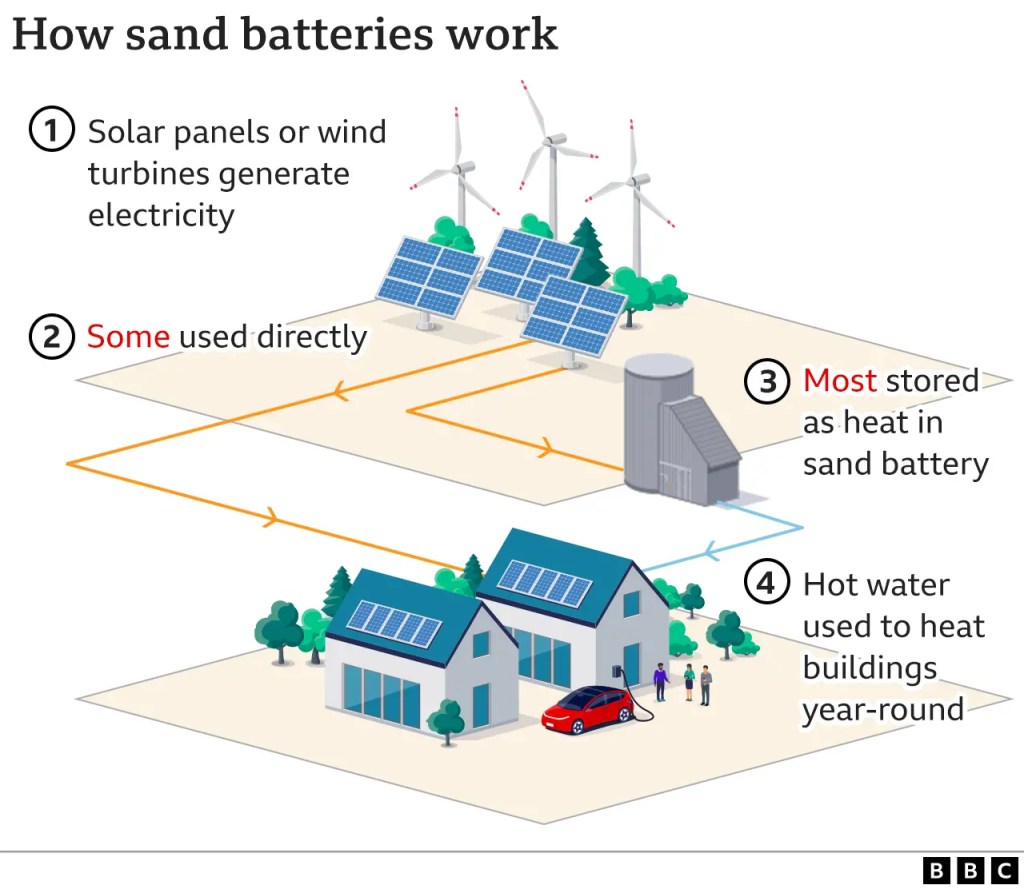
At its heart, a sand battery is a thermal energy storage system. It uses resistive heating elements to convert surplus renewable electricity into heat, which is then stored in a large mass of sand. Sand is cheap, abundant, non-toxic, and capable of withstanding extremely high temperatures – up to 1000°C in some designs. Once heated, the sand is housed in a well-insulated steel or concrete silo, where it can retain thermal energy for days, weeks, or even months. The stored heat can later be extracted and used directly in heating systems or, in some cases, converted back into electricity.

The real beauty of sand batteries lies in their efficiency and affordability. When used for heating applications, such as district heating networks or industrial processes, they achieve thermal round-trip efficiencies of 80 to 95 percent. This puts them in a strong position compared to chemical batteries, especially where the end-use is heat rather than electricity. Converting heat back into electricity is less efficient, often below 40 percent, which limits their utility as pure power storage. Yet, for countries with long, cold winters, and industries dependent on high-temperature heat, sand batteries could be revolutionary.

In Finland, the town of Kankaanpää is already home to the world’s first commercial sand battery, developed by startup Polar Night Energy. The battery stores excess wind and solar power during the summer and discharges it in winter to supply district heat. It’s a practical, real-world demonstration of what this technology can do: provide seasonal storage at a fraction of the cost of chemical alternatives. Think of Canada’s northern and remote coastal communities storing wind and solar energy during the summer, then operating their community heating facilities using sand batteries throughout the winter.  

The potential applications extend well beyond district heating. Many industrial processes: textiles, paper, chemicals, and food production, rely heavily on thermal energy. Today, most of that heat comes from burning fossil fuels. Sand batteries offer a clean alternative, especially when paired with renewables. They’re also ideal for off-grid and remote locations, where reliable heat can be hard to come by.

Compared to other storage technologies, sand batteries stand out for their low cost and long-duration potential. They’re not a replacement for lithium batteries or pumped hydro, but are a crucial complement. As more nations seek to decarbonize not just electricity, but also heating and industry, sand batteries will likely find a permanent place in the energy landscape.

Simple, scalable, and rooted in abundant natural materials, sand batteries remind us that sometimes the most advanced solutions are also the most grounded. In the race toward a sustainable energy future, this humble pile of sand might just be one of our best bets.

Public Consultation or Box-Ticking Exercise? A Critical Look at a Local Battery Storage Project

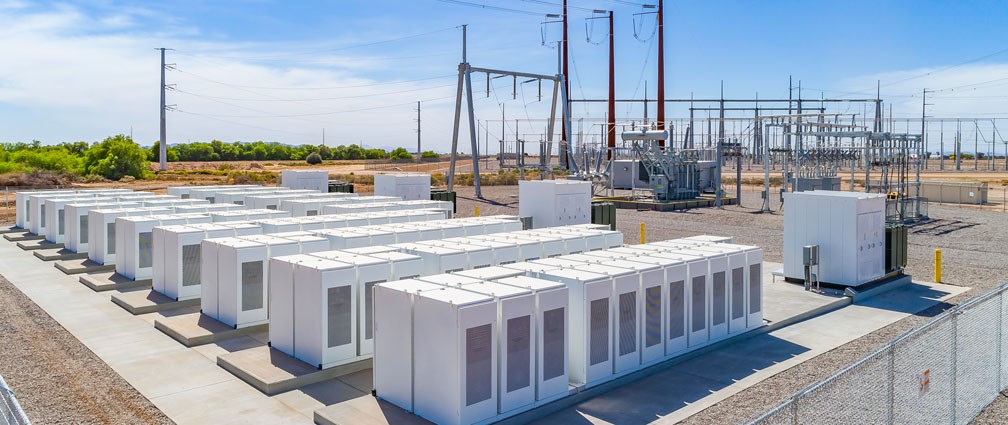
Last week, I attended a public consultation in my township concerning the proposed development and operation of a battery storage facility. While I support the idea of more distributed energy systems; including local generation, storage, and distribution, I left the session with more concerns than confidence.

The generational divide in the room was striking. The corporate representatives were mostly in their late 20s or early 30s, while the attending community members were primarily in their 50s and 60s. That’s not a critique of age, but it did highlight a gap in understanding and communication. One representative I spoke with didn’t even know the name of our village or the township they were in, and confused our location with the nearest city. That lack of local awareness is troubling.

When it came to questions about employment, the answers were just as vague. There are no local jobs being created by this facility. Pressed on this point, the company conceded that construction would likely be contracted out to a large regional firm. So much for community economic development.

Technically, this consultation was part of the process required to secure project approval. But calling it a “consultation” is generous. In practice, it was an information session for a project that already has funding and, by all appearances, a green light, once the required Environmental Assessment has been completed and approved. Input from residents was neither requested nor meaningfully incorporated. That’s not consultation—that’s optics.

There was discussion of the township gaining a $300,000 gift from the business, yet when this was explored further, it turns out that the gift is over the 20 year projected life of the facility; so by my calculations that’s $15,000/year for a township with an annual budget of around $4.5 million. 

I also learned that the company developing this project, which is ultimately owned by a private corporation through a series of businesses, partnered with a local First Nation to qualify for the contract. On paper, this is a positive step. I strongly support Indigenous involvement in provincial development, but I couldn’t help but ask: beyond a share of the profits, what is the First Nation partner actually gaining from this deal? Meaningful involvement? Job creation? Capacity building? Those questions went largely unanswered.

Many of the company reps struggled to answer even basic questions. When challenged, they became defensive, admitting they were not properly briefed or that statements about local benefits were merely “possibilities.” That kind of unpreparedness doesn’t inspire public trust.

Let me be clear: I’m not opposed to the project itself. I believe in the need for renewable energy infrastructure, and support the transition to a more decentralized grid. I have no “Not In My Backyard” objections here. My issue is with the process, and with the privatization of what should be a public utility. This kind of infrastructure should be owned and operated by the province for the benefit of its citizens, not by private firms whose primary accountability is to shareholders.

If this is the future of our energy system, we need a better framework, one rooted in public ownership, transparent processes, and genuine community engagement.

The Desert Reactor That Could Power the Future

I’ve spent decades watching promising nuclear technologies come and go; from breeder reactors to pebble beds to compact fusion dreams. Most end up in the “what might have been” pile, but something different is stirring in the Gobi Desert, and for once, the promise feels within reach. China’s recent success with a small thorium-fueled molten salt reactor (MSR) might just be the beginning of the nuclear renaissance we’ve all been waiting for.

It’s not just that they got the reactor running, that’s impressive in itself. What’s groundbreaking is that China’s researchers, operating under the Chinese Academy of Sciences, didn’t just fire up the experimental two-megawatt reactor. They ran it at full power and, in a world first, reloaded it while it was still running. That kind of feat is only possible with molten salt designs, where the fuel is dissolved in a hot liquid and circulates through the reactor like lifeblood. That fluid nature allows for continuous refueling, which not only boosts efficiency, but also sidesteps many of the safety risks that haunt traditional pressurized water reactors.

Molten salt reactors have long been the “what if” of nuclear design. The U.S. tried this back in the ‘50s at Oak Ridge, looking for ways to power nuclear bombers. But once uranium became the fuel of choice, and the Cold War demanded weapons-grade material, thorium was shelved. China dusted off those old reports (many of which were openly published), studied them carefully, and got to work. Now, they’re ahead of everyone else in a race that could redefine what nuclear power looks like in the 21st century.

And it’s not just about the molten salt. Thorium, the element at the heart of this reactor, is a game-changer. It’s far more abundant than uranium,  about three to four times as common in the Earth’s crust, and it doesn’t carry the same baggage. While uranium reactors inevitably produce plutonium-239 (which can be used for bombs), thorium reactors don’t. In fact, the byproducts of the thorium fuel cycle are notoriously hard to weaponize. It’s nuclear energy with a built-in disarmament clause.

Safety, too, is baked in. Unlike conventional reactors that operate under enormous pressure, molten salt reactors run at atmospheric pressure. There’s no steam explosion risk. If things start overheating, a freeze plug at the base of the reactor melts, draining the fuel into a safe containment tank. The fuel simply stops reacting. This isn’t theory, China’s demonstration shows it works.

We’re talking about a reactor that produces less waste, can’t easily be weaponized, runs more efficiently, and might even be paired with renewables or used to generate clean hydrogen. Add in the fact that thorium is cheap and widely available, and you start to wonder: why didn’t we do this sooner?

The answer, of course, is politics, economics, and inertia, but that may be changing. China’s quiet, but steady march toward thorium MSRs has now captured global attention. If this tiny desert reactor is scaled up, it could provide a path toward carbon-free baseload power, without the nightmares of Fukushima, or the baggage of Cold War proliferation. It’s not just a technological breakthrough. It’s a glimpse of a world powered differently.

And for once, that’s a world I believe we can build.

Sources:
South China Morning Post: “China’s experimental molten salt reactor project achieves major milestone” (https://www.scmp.com/news/china/science/article/3247984)
Nuclear Engineering International: “China achieves online refuelling with MSR” (https://www.neimagazine.com/news/newschina-achieves-online-refuelling-with-msr-11607915)
World Nuclear Association: “Molten Salt Reactors” (https://world-nuclear.org/information-library/current-and-future-generation/molten-salt-reactors.aspx)
Oak Ridge National Laboratory archives on MSR development (https://info.ornl.gov/sites/publications/files/Pub29596.pdf)
National Academies of Sciences, Engineering, and Medicine: “Thorium Fuel Cycle — Potential Benefits and Risks” (https://nap.nationalacademies.org/catalog/13368/thorium-fuel-cycle-potential-benefits-and-risks)

Canada’s Role in Advancing Single-Crystal Technology for a Sustainable EV Future

Single-crystal batteries represent a significant advancement in lithium-ion technology, particularly for electric vehicles (EVs). Unlike traditional polycrystalline cathodes, which are composed of multiple crystalline particles, single-crystal cathodes consist of a uniform crystalline structure. This design enhances durability and performance, potentially transforming the lifecycle of EV batteries.

Traditional polycrystalline cathodes are prone to cracking and degradation over time, leading to reduced battery capacity and lifespan. In contrast, single-crystal cathodes exhibit greater resistance to such mechanical stresses. Research indicates that single-crystal lithium-ion batteries can retain 80% of their capacity after 20,000 charge-discharge cycles, compared to approximately 2,400 cycles for conventional cells.

David Stobbe / Stobbe Photography

The uniform structure of single-crystal cathodes contributes to more efficient ion flow, enhancing battery performance. Additionally, these cathodes are more resistant to thermal degradation, improving the safety profile of the batteries. Studies have shown that single-crystal cathode materials provide remarkable performance and safety characteristics.

The adoption of single-crystal battery technology could significantly extend the operational lifespan of EVs. Longer-lasting batteries reduce the frequency of replacements, lowering maintenance costs and enhancing the overall value proposition of electric vehicles. Furthermore, increased battery durability can alleviate concerns related to battery degradation, a common barrier to EV adoption. Ongoing research focuses on optimizing the synthesis of single-crystal cathode materials to enhance their durability and efficiency. For instance, researchers have developed methods to synthesize durable single-crystal cathode materials, potentially extending battery life and efficiency. 

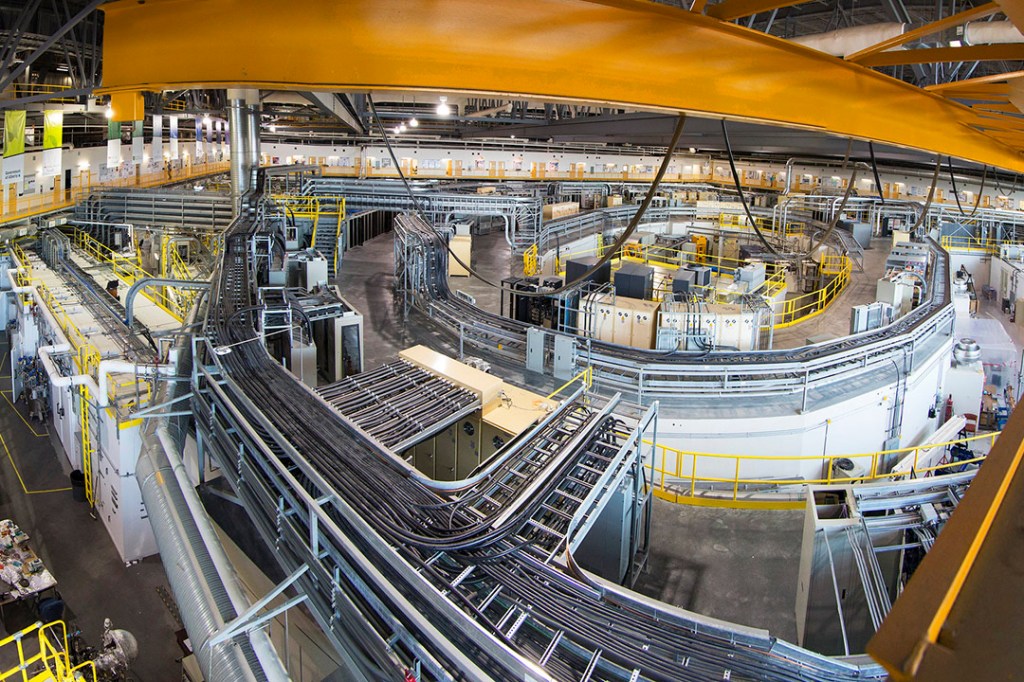
Canada has been instrumental in advancing single-crystal battery technology, with significant contributions from its academic institutions and research facilities. Researchers at Dalhousie University in Halifax have conducted extensive studies on single-crystal lithium-ion batteries. Utilizing the Canadian Light Source (CLS) at the University of Saskatchewan—a national synchrotron light source facility—they analyzed a single-crystal electrode battery that underwent continuous charging and discharging for over six years. Their findings revealed that this battery endured more than 20,000 cycles before reaching 80% capacity, equating to an impressive lifespan of approximately eight million kilometers in driving terms.  This research underscores Canada’s pivotal role in developing durable and efficient battery technologies that could significantly enhance the lifecycle of electric vehicles.

Single-crystal batteries offer promising improvements in durability, performance, and safety for electric vehicles. Their widespread adoption could lead to longer-lasting EVs, reduced maintenance costs, and increased consumer confidence in electric mobility.