Europe 2040 – Military Power Without Full Federation

Introduction
By 2040, Europe remains a politically and militarily fragmented continent. Despite holding one of the largest combined economies globally, the lack of a fully federated European model constrains its ability to project independent military power. While selective nations—France, Germany, and the United Kingdom—maintain significant capabilities, structural fragmentation, divergent national priorities, and complex governance systems limit Europe’s strategic autonomy. This essay examines the interplay of structural, economic, and political factors that define Europe’s military posture in 2040, assessing both its achievements and persistent limitations.

Fragmented Military Capabilities
Europe’s military architecture remains characterized by a multiplicity of national forces operating independently. France continues to maintain its nuclear triad and expeditionary capability, Germany fields technologically advanced armored and air units, and Italy projects regional influence in the Mediterranean. Other nations, such as Poland, Sweden, and Spain, contribute niche capabilities, particularly in cyber operations, rapid reaction forces, and intelligence. Smaller states provide specialized units, maritime patrol, or logistics support, creating a patchwork network of competencies rather than a unified force.
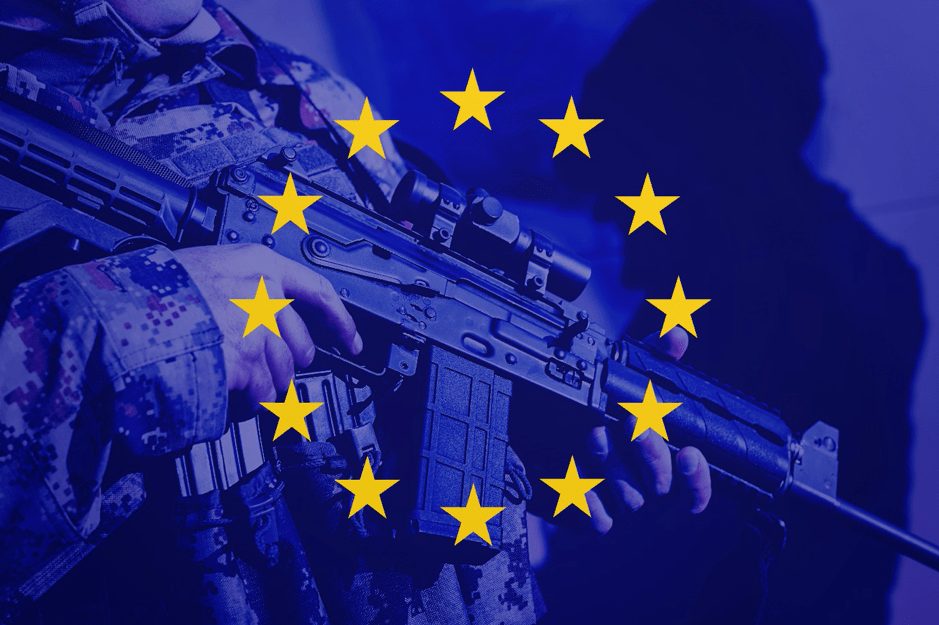
Coordination among these forces relies heavily on NATO and EU initiatives, such as PESCO and the European Defence Fund. While these programs enable some joint projects—like the Franco-German Main Ground Combat System or European satellite constellations—they remain voluntary, unevenly funded, and constrained by national political approval processes. Interoperability challenges persist. Differences in equipment, standards, and doctrines limit joint deployments, and multinational exercises rarely achieve the cohesion seen in fully unified forces like the U.S. military. Duplication of expensive programs—such as fifth-generation fighter jets, armored vehicles, and naval platforms—absorbs resources that could otherwise be used for operational readiness or strategic reach.

Reliance on Alliances
By 2040, Europe’s military security remains deeply intertwined with NATO, and by extension, the United States. U.S. nuclear and conventional capabilities continue to provide the ultimate deterrent, filling the strategic gaps that fragmented European forces cannot address independently. Europe has developed limited rapid-reaction forces, capable of responding to crises in Eastern Europe or North Africa. Yet sustained expeditionary operations beyond the continent’s periphery remain rare, and the logistical complexity of multinational operations constrains Europe’s ability to project power unilaterally.

The reliance on alliances introduces both opportunities and vulnerabilities. While NATO provides shared capabilities, it reinforces a strategic dependence that limits Europe’s ability to act independently, particularly in regions where U.S. interests diverge from European priorities. Additionally, coordination across multiple nations slows decision-making, delaying responses in rapidly evolving crises.

Political and Social Constraints
Europe’s military fragmentation reflects deep-seated political and social realities. National governments prioritize sovereignty, historical sensitivities, and domestic public opinion over centralized military integration. France maintains a strong independent nuclear posture, but attempts to build multinational European forces are constrained by reluctance among smaller states to cede influence. Germany, constrained by post-World War II norms and public skepticism about military engagements, limits its willingness to commit forces beyond NATO obligations. Smaller EU nations often prefer reliance on U.S. security guarantees rather than costly investments in expeditionary capabilities.

Demographic trends exacerbate these challenges. Aging populations across much of Western Europe reduce the pool of active-duty personnel, forcing militaries to rely increasingly on technology, automation, and private contractors. Recruitment shortfalls in countries like Italy, Spain, and Greece create gaps in capability, while wealthier states such as France and Germany struggle to integrate conscript-aged populations into modern, technologically advanced forces. Social constraints—such as skepticism about European military engagement—also influence political willingness to commit forces to conflicts outside Europe.

Technological and Strategic Achievements
Despite structural limitations, Europe in 2040 has achieved selective strategic successes. Investments in high-tech military domains—cyber defense, satellite-based intelligence, precision-guided long-range weapons, and autonomous systems—allow certain nations to exert disproportionate influence relative to conventional troop numbers. French and German space-based reconnaissance and missile capabilities, for example, provide leverage in regional security operations, particularly in Africa and Eastern Europe. Similarly, European cyber defense networks, though fragmented, are capable of coordinated responses to hybrid threats and disinformation campaigns.

Regional interventions have become more effective through voluntary coalition formations. French-led operations in North Africa and combined European deployments in Eastern Europe demonstrate the potential of pooled capabilities, even in the absence of federalized command structures. Nevertheless, these interventions remain short-term and limited in scale, reflecting political caution and resource constraints.

Europe in 2040 demonstrates the limits of military power without political federation. While individual nations retain significant capabilities, and regional coalition efforts allow for selective influence, fragmentation, political caution, and logistical inefficiency prevent Europe from achieving true global strategic autonomy. Economic wealth and technological sophistication partially offset these limitations, but Europe remains a secondary global military actor, capable of defending its interests and projecting influence regionally, but dependent on alliances for comprehensive global security. The trajectory suggests that without deeper political and military integration, Europe will remain influential but constrained, unable to rival the global reach of the United States or China.

After Primacy: The Reordering of Alliances in a Post-American Western Bloc

The crisis imagined in Greenland is not important because of the territory itself. Its significance lies in what it would force into the open. The assumption that the West is synonymous with the United States has quietly structured global politics since 1945. Once that assumption breaks, the system does not collapse. It rebalances.

What follows is not a retreat from collective security, but its redistribution.

A reshaped NATO would emerge not through formal rupture, but through functional adaptation.

NATO’s defining feature has always been military integration under American leadership. In the post primacy phase, leadership would fragment without disappearing. The alliance would increasingly resemble a federation of security clusters rather than a single hierarchy. European command capacity would deepen. Arctic security would be governed through multilateral frameworks that deliberately limit unilateral dominance. Intelligence sharing would persist, but no longer assume uniform trust.

The United States would remain inside NATO, but no longer at its center of gravity.

This would not weaken deterrence. It would diversify it. Deterrence would rely less on the promise of overwhelming force and more on the certainty that aggression triggers coordinated exclusion, denial of access, and long term strategic isolation. NATO would become less reactive, less sentimental, and more conditional.

Security would be preserved not by loyalty, but by enforceable norms.

Parallel to this shift, a stronger economic alliance between the European Union and Canada would begin to take shape.

The logic is structural. Canada is economically integrated with the United States, but politically aligned with Europe on regulation, multilateralism, and rule based governance. As US reliability declines, Canada’s incentive to diversify deepens. Trade agreements would expand beyond goods to include energy coordination, industrial policy, research, and critical minerals. Arctic infrastructure would become a shared strategic priority rather than a bilateral vulnerability.

This would not be anti American. It would be post dependent.

The return of the United Kingdom to the European Union, while politically complex, becomes more conceivable in this environment.

Brexit was premised on a world in which the United States remained a stable anchor and global trade rules remained predictable. In a fragmented order, isolation loses its appeal. Economic gravity, regulatory coherence, and strategic relevance would pull London back toward Brussels. The argument would no longer be emotional or historical. It would be practical.

Outside the EU, the UK is exposed. Inside it, the UK is amplified.

Reintegration would not restore the pre Brexit EU. It would reshape it. A more security conscious, geopolitically assertive Europe would emerge, one less reliant on American mediation and more comfortable exercising power collectively.

As the Western bloc decentralizes, BRICS would evolve in response.

BRICS has never been a coherent alliance. It is a convergence of dissatisfaction rather than a shared project. Its internal contradictions are substantial. India and China remain strategic competitors. Brazil oscillates politically. South Africa balances aspiration with constraint. Russia has relied on confrontation to maintain relevance.

What changes in a post American West is not BRICS unity, but BRICS opportunity.

Without a US dominated Western bloc to react against, BRICS members gain room to maneuver independently. Economic experimentation increases. Regional leadership ambitions sharpen. Cooperation becomes more transactional and less ideological. The group shifts from rhetorical counterweight to pragmatic platform.

This does not produce a new bipolar order. It produces a looser multipolar field.

Russia and China, in particular, would recalibrate.

For decades, both have oriented strategy around resisting American dominance. Sanctions, military posture, and diplomatic narratives have been built on that axis. If the West ceases to function as a US proxy, that logic weakens. Europe becomes a distinct actor. Canada and parts of the Global South become independent centers of gravity.

China benefits most from this shift. Its preference has always been fragmentation over confrontation. A West that argues internally, but enforces norms collectively, is harder to demonize but easier to engage selectively. Economic statecraft replaces ideological struggle.

Russia faces a more constrained future.

Its leverage has depended on division within the West combined with American overreach. A Europe capable of autonomous defense and economic coordination leaves Moscow with fewer pressure points. Energy leverage erodes. Military intimidation loses marginal effectiveness. Russia remains disruptive, but increasingly regional rather than systemic.

The rebalancing does not eliminate conflict. It redistributes responsibility.

The defining feature of this new order is adulthood. Alliances cease to function as shelters and begin to function as contracts. Power remains uneven, but impunity is reduced. Legitimacy becomes a strategic asset rather than a rhetorical one.

The United States does not disappear from this system. It is repositioned.

It becomes a powerful participant rather than an unquestioned arbiter. When it cooperates, it is welcomed. When it coerces, it is constrained. This is not punishment. It is normalization.

The long arc of this transformation bends away from dominance and toward equilibrium.

The Greenland crisis, in this context, is remembered not as a territorial dispute, but as the moment when the post war order finally accepted what it had long resisted. Stability does not require a single center. It requires shared limits.

Once those limits are enforced, even the strongest actors must adapt.

After the Shock: Deterrence, Realignment, and the End of Assumed Leadership – Reshaping the West (Part 3) 

Once containment without war is attempted, the central question is no longer how allies respond to American aggression, but what follows if that response holds. Alliances are shaped as much by expectation as by capability. When expectations change, behavior follows.

The most immediate effect would be the collapse of assumed American indispensability.

For decades, NATO has operated on a quiet contradiction. European and Canadian allies publicly affirmed shared leadership while privately assuming that, in extremis, Washington would always anchor the system. A successful, coordinated effort to constrain a US administration would shatter that assumption. Not rhetorically, but operationally. Planning would proceed without default deference. Initiative would move outward rather than upward.

This would not mark the end of US power. It would mark the end of US exemption.

Deterrence would begin to function differently.

Traditional deterrence relies on the credible threat of force. What this crisis would demonstrate is the growing importance of denial deterrence and legitimacy deterrence. The message to future US administrations would be unambiguous. Military superiority does not guarantee political freedom of action. Aggression against allies triggers isolation, loss of access, and long term strategic diminishment.

This form of deterrence is slower, but it is cumulative. It does not require battlefield victories. It requires consistency.

Over time, American institutions themselves would begin to respond.

The United States is not monolithic. Power is distributed across federal agencies, courts, markets, states, corporations, and voters. Sustained external pressure, coupled with internal economic and diplomatic costs, would widen fractures between an aggressive executive and the broader system that depends on stability. Foreign policy isolation would bleed into domestic consequences. Investment would hesitate. Cooperation would thin. Elite consensus would fracture.

History suggests that empires rarely change course because they are defeated. They change course when the costs of dominance exceed the benefits.

For NATO and its partners, the longer term result would be structural diversification.

European defense integration would cease to be aspirational and become routine. Arctic governance would move toward multilateral control frameworks that deliberately dilute unilateral leverage. Intelligence and command structures would evolve to ensure continuity even if a major member becomes unreliable. None of this would require formal exits or dramatic declarations. It would occur through parallelism and redundancy.

The alliance would survive by becoming less centralized and less sentimental.

Globally, the signal would be unmistakable.

Russia and China would lose the ability to credibly argue that Western rules are merely instruments of American convenience. The moment allies demonstrate that those rules apply even to Washington, the narrative shifts. The claim to a rules based order becomes less rhetorical and more demonstrable. Power blocs would still compete, but the terms of legitimacy would tighten.

This would not produce harmony. It would produce constraint.

The most profound shift, however, would be psychological.

Once allies act decisively without waiting for American permission or rescue, the post Cold War era quietly ends. Not with collapse, but with maturation. The transatlantic relationship would no longer be defined by protection and gratitude, but by reciprocity and boundaries.

The United States would remain a critical partner when it chooses cooperation. It would cease to be treated as the system itself.

That distinction is the difference between alliance and dependency.

In that sense, a crisis triggered by Greenland would not simply test NATO. It would complete its evolution. From a structure built to contain an external threat, into one capable of enforcing norms internally without resorting to war.

The real question is not whether such a transformation is possible. The mechanisms exist. The capacity exists. The question is whether allies are willing to accept the discomfort that comes with adulthood in international politics.

Because once impunity is withdrawn, it cannot be restored without consent. And once consent is made conditional, power must finally learn restraint.

Containment Without War: Ending Alliance Impunity in the Twenty First Century – Reshaping the West (Part 2) 

If Part One exposes the fiction of automatic alliance protection, Part Two must confront a harder truth. The absence of a military response does not require submission. This is not 1938, and restraint need not mean appeasement.

A United States move against Greenland under a Trump administration would demand a response designed not to soothe Washington, but to constrain it. The tools exist. What has been lacking is the willingness to use them against an ally that behaves as though alliance membership confers impunity.

The first step would be political isolation, executed collectively and without ambiguity.

NATO members, alongside key non NATO partners, would need to suspend routine diplomatic engagement with the US administration itself. Not the American state. Not American civil society. The administration. This distinction matters. Ambassadors would be recalled for consultations. High level bilateral visits would cease. Joint communiqués would be frozen. Washington would find itself formally present in institutions, but substantively sidelined.

This is not symbolic. Modern power depends on access, legitimacy, and agenda setting. Denying those channels turns raw power into blunt force, costly and inefficient.

The second step would be economic containment, targeted and coordinated.

The mid twentieth century model of blanket sanctions is outdated. Today’s leverage lies in regulatory power, market access, and standards. European states, Canada, and aligned partners would move to restrict US firms closely tied to the administration’s political and financial ecosystem. Defense procurement would be restructured. Technology partnerships would be paused. Financial scrutiny would intensify under existing anti corruption and transparency frameworks.

None of this would require new treaties. It would require resolve.

The message would be clear. Aggression inside the alliance triggers costs that cannot be offset by military dominance alone.

Third, alliance structures themselves would need to adapt in real time.

NATO decision making, already consensus based, would be deliberately narrowed. US participation in strategic planning, intelligence fusion, and Arctic coordination would be curtailed on the grounds of conflict of interest. Parallel European led and transatlantic minus one mechanisms would emerge rapidly, not as an ideological project, but as operational necessity.

This would mark a shift from alliance dependence to alliance resilience.

The fourth pillar would be legal and normative escalation.

Denmark, backed by partners, would pursue coordinated legal action across international forums. Not in the expectation that courts alone would reverse an annexation, but to delegitimize it relentlessly. Every ruling, every advisory opinion, every formal objection would build a cumulative case. The objective would not be immediate reversal, but long term unsustainability.

Occupation without recognition is expensive. Annexation without legitimacy corrodes from within.

Finally, and most critically, allies would need to speak directly to the American public over the head of the administration.

This is not interference. It is alliance preservation. The distinction between a government and a people becomes essential when one diverges sharply from shared norms. Clear, consistent messaging would emphasize that cooperation remains available the moment aggression ceases. The door would not be closed. It would be firmly guarded.

The aim of this strategy is not punishment for its own sake. It is containment without war.

The twentieth century taught the cost of appeasing expansionist behavior. The twenty first century demands something more precise. Not tanks crossing borders, but access withdrawn. Not ultimatums, but coordinated exclusion. Not moral outrage alone, but structural consequences.

A United States that chooses coercion over cooperation cannot be met with nostalgia for past alliances. It must be met with a clear boundary. Power inside a system does not grant license to dismantle it.

The survival of NATO, and of the broader rules based order it claims to defend, would depend on allies finally acting as though that principle applies to everyone. Including the strongest member of the room.

The Numbers Whisper, the Politicians Yell, and Europe Shrugs

Spend enough time listening to the current administration in Washington and you might come away believing Europe has one foot in the grave and the other sliding toward irrelevance. The story is familiar by now. The United States is strong. Europe is weak. The United States is vigorous. Europe is in decline. And the European Union, that sprawling project of integration and compromise, is painted as little more than an exhausted bureaucracy staggering toward collapse.

It is an effective political story. It is not an accurate economic one.

What the data show is far more nuanced. The United States is indeed outpacing Europe on headline growth. That part is real. Quarter after quarter, American GDP numbers look stronger. In one recent comparison the US economy grew eight times faster than the eurozone, which managed a tenth of a percent while the United States beat that figure with ease. This difference is not an illusion created by currency shifts or accounting tricks. It reflects higher productivity growth in the United States, stronger investment, and a demographic profile that remains more favourable than Europe’s. These are material advantages and they reveal real structural gaps.

Yet to jump from those facts to grand claims about European “civilizational decline” is to turn analysis into theatre. The United States is growing more quickly, but the European Union is still one of the largest and most advanced economic regions on the planet. Its labour markets remain stable. Inflation is drifting toward target levels. Living standards across much of Europe remain globally competitive and, in many sectors, outperform American norms once cost and purchasing power are accounted for. A slower growth profile does not equal economic illness. It equals a different model with different strengths and different vulnerabilities.

Why then the drama. Because it serves a purpose. The administration’s own national security strategy now speaks of Europe as a continent on the verge of losing itself, a place where current trends will render the region unrecognizable in twenty years. It warns that internal EU policies are eroding sovereignty and liberty and it openly states an intention to cultivate political resistance inside European nations. Such language is not a neutral economic assessment. It is political positioning wrapped in the clothing of economic diagnosis.

And that positioning does not fall on deaf ears. Nationalist movements in Europe hear the signal clearly. Parties like the AfD in Germany have seized on Washington’s rhetoric as validation and have used it to bolster their own claims about a European project supposedly in decay. The administration’s framing becomes a feedback loop. A strong America. A weak Europe. A proud nationalist revival sweeping the continent. It is a narrative that simplifies complex economic realities for political advantage on both sides of the Atlantic.

The truth sits somewhere far less dramatic. Europe is not collapsing. It is not unravelling. It is navigating a period of slow growth, productivity challenges, and regulatory debates that are real but hardly apocalyptic. The gaps between the EU and the United States are partly economic and partly structural, but the story of a dying Europe is a rhetorical construction, not an economic fact.

That story will continue to circulate because it is useful. It creates a contrast that flatters American power. It energises nationalist movements in Europe that reject Brussels and prefer bilateral dealings with Washington. And it gives political actors in the United States an external example to point toward when arguing that their own model is not only stronger but morally superior.

Economic data rarely shout. They whisper. And what they whisper today is simple. Europe is slower than the United States, yes. Europe is wrestling with productivity and demographic pressures, yes. But Europe is not on the brink. The rhetoric is doing the heavy lifting, not the numbers.

Sources:
euronews.com
courthousenews.com
economy-finance.ec.europa.eu
reuters.com
theguardian.com

The EU as a Cultural Confederation: How Brussels Empowers Regional Voices Across Europe

When discussing the European Union, especially in British or nationalist-leaning media, the usual tropes are economic red tape, democratic deficits, and faceless bureaucrats imposing uniformity. What is strikingly underappreciated is the EU’s role as a tireless and strategic supporter of Europe’s regional cultures: its languages, music, visual arts, literature, and festivals. Far from being a homogenising force, the EU acts as a cultural confederation, empowering the peripheries and amplifying diversity through centralised frameworks and substantial funding.

The legal foundation for this approach is enshrined in Article 167 of the Treaty on the Functioning of the European Union, which commits the EU to respect its members’ national and regional diversity, and to promote the common cultural heritage. This commitment is not symbolic, it’s operationalised through policies and investment tools that strengthen cultural ecosystems often neglected by national governments. A striking example is the Creative Europeprogramme, with a budget of over €2.44 billion for 2021–2027. This fund supports regional festivals, translation projects, heritage preservation, and artistic mobility, placing local cultures on a continental stage.

Let’s consider some examples. In the north of Sweden, Sámi artists and musicians have received EU support to maintain traditional music forms like joik, while also experimenting with modern fusion styles. In the Basque Country, EU funding has gone into language revitalisation efforts, helping schools, theatres, and broadcasters produce content in Euskara, a language that for decades was banned under Franco’s Spain. In Friesland, the Netherlands, similar funding has supported children’s books, cultural programming, and visual arts in the Frisian language – another minority tongue that survives today in part because of EU cultural policy.

Beyond the arts, the EU’s European Regional Development Fund (ERDF) and European Social Fund (ESF) have proven vital in building cultural infrastructure in economically disadvantaged areas. For example, in Maribor, Slovenia, once a declining industrial town, ERDF funds helped regenerate derelict buildings into art spaces and performance venues during its tenure as European Capital of Culture in 2012. This led to a flourishing of local art initiatives, job creation in the creative sector, and a renewed sense of community identity. Similar transformations have occurred in Plzeň, Czech Republic and Matera, Italy, cities that gained international cultural status thanks to EU support.

One of the EU’s most visionary initiatives is the European Capitals of Cultureprogramme. This initiative does more than bring tourism; it energises local traditions and gives underrepresented regions international attention. Košice, a Slovak city with a rich but lesser-known cultural history, used its 2013 designation to invest in a multicultural arts centre in a former barracks, host Roma music festivals, and highlight the region’s Jewish and Hungarian heritage. Galway, in Ireland, similarly used its 2020 status to foreground Irish-language poetry, traditional music, and storytelling – even if the pandemic altered some of its plans. In each case, the EU served as both patron and platform.

Language diversity is another cornerstone of EU cultural engagement. Though language policy is largely a national prerogative, the EU reinforces regional and minority languages through programmes linked to the European Charter for Regional or Minority Languages. While this charter operates under the Council of Europe, EU institutions work to align policies that protect language rights and support educational initiatives. The Multilingualism Policy, the Erasmus+ programme, and Creative Europe’s translation grants all contribute to preserving Europe’s linguistic diversity.

Furthermore, the EU promotes intercultural exchange and mobility. Through Culture Moves Europe and Erasmus+, thousands of young artists, musicians, writers, and curators have studied, collaborated, and performed across borders. A young fiddler from Brittany can now collaborate with an Estonian folk singer or a Roma dancer from Hungary. These encounters not only enrich the individuals involved but also build cultural bridges that counter xenophobia and nationalist retrenchment.

Critics argue that the EU’s involvement in culture infringes on national sovereignty or encourages a superficial “Euro-culture.” But this misunderstands the structural genius of the EU’s approach. Rather than imposing cultural norms, the EU centralises support mechanisms while decentralising access, ensuring local actors are the ones defining, producing, and showcasing their culture. In effect, the EU empowers regions to bypass national gatekeepers and express their identities on their own terms.

This model has also proven resilient in times of crisis. Following Russia’s invasion of Ukraine, the EU mobilised cultural solidarity quickly, supporting Ukrainian artists and cultural heritage sites both inside and outside the country. Cross-border cooperation projects in Poland, Slovakia, and Romania sprang into action, demonstrating how EU cultural infrastructure can respond nimbly to geopolitical emergencies.

In a world where many nations are becoming more inward-looking and where minority cultures are under threat from political centralisation, the EU stands as a rare example of a supranational body committed to diversity in action, not just in rhetoric. It is not perfect. Bureaucratic hurdles remain, and access to funding can be unequal. But the direction of travel is clear: support local, fund the fringe, and celebrate the plural.

If the soul of Europe lies in its mosaics of culture, then the EU, quietly, consistently, and strategically, acts as its curator.

Sources:
European Commission – Creative Europe
European Commission – Regional Policy
Council of Europe – European Charter for Regional or Minority Languages
European Commission – European Capitals of Culture
European Commission – Culture Moves Europe
European Commission – Multilingualism and Language Policy

Allies Reclaiming Autonomy: The Growing Shift Away from U.S.-Made Military Equipment

Across NATO and allied nations, governments are increasingly rejecting U.S. defense options or cancelling long-term contracts, favoring domestic or European alternatives that offer control over manufacturing, maintenance, and upgrades.

For decades, the United States has dominated the global defense market, especially among NATO allies. Its model, sell advanced platforms, then tie buyers into decades of maintenance, upgrades, and proprietary service, has been remarkably profitable and politically influential. But that model is under pressure. Increasingly, U.S. allies are saying no: rejecting American options, cancelling planned contracts, or shifting to alternatives that offer greater operational and industrial autonomy.

Spain provides a recent example. While the country had previously considered U.S.-made platforms to modernize its air force, Madrid has turned toward European options such as the Eurofighter Typhoon and the Future Combat Air System. Officials cited cost, supply chain control, and the desire to retain domestic and European industrial participation as key drivers. Similar reasoning is guiding Portugal, which has reconsidered its replacement programs for aging aircraft, leaning toward European-built fighters rather than committing to U.S.-supplied F-35s.

Denmark illustrates the trend in air defense. In its largest-ever defense procurement, the Danish government opted for the Franco-Italian SAMP-T NG long-range system over the U.S.-made Patriot, citing both cost and delivery time. Denmark is also reviewing medium-range options from European manufacturers, emphasizing local or regional production and maintenance. This choice reflects the dual desire to strengthen European defense capabilities while reducing reliance on U.S.-based service contracts.

Other NATO members are making comparable moves. Switzerland, historically neutral, has expressed reservations about joining long-term U.S. programs, including the F-35, instead evaluating European alternatives that allow for national control over lifecycle management. Norway has similarly emphasized local assembly and domestic sustainment for fighter and patrol aircraft. The Netherlands, Belgium, and Greece have all shown interest in European or domestic solutions for naval, air, and missile systems, explicitly seeking contracts that do not lock them into decades-long U.S. maintenance agreements.

These choices reflect a broader strategic and economic calculation. U.S.-made systems, while technologically advanced, often require buyers to accept a near-perpetual dependency on American contractors for upgrades, parts, and service. Allies are increasingly reluctant to cede that control, recognizing that operational autonomy and local industrial development are critical to national security. European manufacturers, by contrast, are offering co-production, local assembly, and technology transfer that allow countries to maintain both sovereignty and economic benefit from defense programs.

The implications for the U.S. defense industry are substantial. Losing planned contracts or having allies cancel or decline U.S.-made systems threatens billions in revenue, particularly from the lucrative long-term service and maintenance components. Strategically, it reduces Washington’s leverage: allies that control their own equipment are less subject to subtle influence through supply and upgrade dependencies. Over time, the cumulative effect could reshape the defense-industrial landscape in Europe and beyond, challenging the assumption that U.S.-supplied hardware will dominate allied inventories.

Canada, with its submarine program and proposed Swedish fighter deal, stands as the most prominent example, but it is hardly alone. Across Europe and NATO, governments are asking whether reliance on U.S. contractors for decades-long service agreements is compatible with modern defense priorities. The answer increasingly appears to be “no.” Allies want control over manufacturing, maintenance, and upgrades, and they are willing to bypass traditional U.S. options to achieve it.

In short, the U.S. model of “buy once, pay forever” is losing favor. NATO members and other allies are embracing autonomy, local industrial participation, and diversified procurement, signaling a shift that could reverberate across global defense markets for decades. The message is clear: even America’s closest partners are no longer content to surrender operational control and economic benefit for decades-long contracts that primarily serve U.S. industry.

Beyond Free Market Myths: Why Canada Needs the EU’s Stability

Mark Carney’s approach, alongside the broader European Union model, represents a forward-thinking vision that prioritizes long-term economic stability, environmental responsibility, and social equity; values that are increasingly crucial in a world facing climate change, global financial shifts, and geopolitical instability. Contrary to the claim, that these policies have led to economic and social decline, the EU has consistently ranked among the world’s largest and most stable economic blocs, demonstrating resilience in the face of global crises. Canada, by aligning with the EU’s principles, positions itself for a more sustainable and equitable future rather than shackling itself to the short-term volatility of unregulated free-market capitalism.

Economic Resilience Over Deregulated Instability
The argument against Carney relies on a false dichotomy; that Canada must choose between European-style economic management and a purely free-market U.S.-oriented model. However, the 2008 financial crisis demonstrated the perils of unchecked capitalism, particularly in the U.S., where financial deregulation led to one of the worst economic collapses in history. In contrast, Carney’s leadership at the Bank of Canada helped the country navigate that crisis more effectively than most, avoiding the catastrophic failures seen elsewhere. Similarly, his tenure at the Bank of England reinforced the importance of prudent regulatory oversight.

The EU, despite criticism, remains a powerhouse. It is the world’s third-largest economy, behind only the U.S. and China, and has consistently maintained a high standard of living, strong labor protections, and a more balanced wealth distribution than laissez-faire models allow. Canada benefits from closer ties with such an entity, particularly as economic nationalism rises in the U.S., where protectionist trade policies under both Democratic and Republican administrations have shown a clear shift away from open-market ideals.

Climate Leadership as an Economic Advantage
Critics of Carney’s climate policies fail to acknowledge that global markets are increasingly rewarding sustainable investments. Major institutional investors, including BlackRock and major European banks, are shifting towards green finance, recognizing that the transition away from fossil fuels is not just an environmental imperative, but a financial necessity. Canada’s economy, still heavily reliant on resource extraction, must evolve rather than double down on outdated industries.

The EU’s leadership in climate policy is not an economic burden; it is an opportunity. The European Green Deal has set the standard for sustainable economic transformation, spurring innovation in renewables, clean technology, and advanced manufacturing. Canada, with its vast natural resources and technological expertise, is well-positioned to benefit from this shift rather than clinging to an increasingly obsolete model of oil dependency.

A Stronger Canada Through Strategic Alliances
The portrayal of the EU as an anti-democratic bureaucracy ignores the reality that it is a collection of sovereign states voluntarily participating in a shared economic and political framework. The EU has been a stabilizing force, promoting peace, economic integration, and democratic norms across the continent. Canada’s engagement with such an entity strengthens its global influence, diversifies its economic relationships, and reduces over-reliance on any single partner, such as the increasingly unpredictable U.S.

Aligning with the EU does not mean abandoning national sovereignty but rather embracing a model of cooperative governance that has proven effective in mitigating economic shocks and geopolitical tensions. Given the uncertainty surrounding U.S. policies, including isolationist tendencies and shifting trade dynamics, Canada’s strategic interest lies in expanding partnerships rather than limiting them.

Carney’s vision is not a step towards economic decline, but a necessary evolution towards a more resilient, sustainable, and balanced economy. The argument for unregulated capitalism ignores the lessons of past crises, dismisses the realities of climate-driven economic transformation, and underestimates the benefits of diversified global partnerships. Rather than resisting European-style policies, Canada should embrace them as part of a modern, forward-looking strategy that ensures long-term prosperity, environmental sustainability, and social stability.

The Brexit Quagmire: Britain’s Long March to Nowhere

I wrote this piece a while back when it became clear that the Labour government wasn’t going to acknowledge the mess that Brexit has left the country, and then planning on doing something about it.  

It’s been more than eight years since the UK voted to leave the European Union, and the country remains tangled in the wreckage of that decision. Those who championed Brexit—promising economic renewal, restored sovereignty, and an end to Brussels’ supposed meddling—have either slunk away from public life or now conveniently blame everything, but Brexit itself, for the country’s dismal state. Meanwhile, the UK economy limps along, its political class is in shambles, and its global standing is diminished.

Let’s start with the economy. The Office for Budget Responsibility (OBR) has repeatedly confirmed that Brexit has shaved at least 4% off the UK’s GDP—a staggering hit equivalent to the cost of COVID-19, but without the excuse of a global pandemic. Investment has stalled, businesses struggle with trade barriers, and the labour market is in disarray. The much-touted trade deals—supposedly the jewels of an independent Britain—have been underwhelming at best. The Australia deal, for example, was so lopsided that even its Conservative architect, George Eustice, admitted it was a mistake.

Meanwhile, Britain’s political leadership is paralysed by the Brexit-induced culture war that still defines Tory policy. Rishi Sunak, the latest in a conveyor belt of weak Conservative prime ministers, finds himself hostage to the hard-right fringes of his party, who still cling to Brexit as a nationalist totem. Labour, under Keir Starmer, tiptoes around the issue, unwilling to reopen old wounds but acutely aware that Brexit is a disaster.

And then there’s Northern Ireland. The supposed “solution” to the Brexit border dilemma—the Windsor Framework—hasn’t ended unionist resentment or calmed the waters. Businesses in Northern Ireland enjoy a unique advantage of dual access to UK and EU markets, but politically, the province remains deeply fractured. The Democratic Unionist Party (DUP) continues to throw tantrums over Brexit’s impact, while the broader UK-EU relationship remains one of managed hostility rather than genuine partnership.

In short, Britain is poorer, politically broken, and increasingly irrelevant on the world stage. The great post-Brexit “Global Britain” experiment has failed, leaving a country adrift, governed by a party unable to admit its mistakes and an opposition too cautious to offer real alternatives. And yet, despite mounting evidence of economic self-harm, Brexit remains a political third rail. No major party dares to say what most people now quietly accept: Brexit was a colossal error, and the UK is paying the price.