
Project Ontario and Project 2025: Parallel Conservative Blueprints

The emergence of Project Ontario marks a new phase in Canadian conservative politics. While Premier Doug Ford’s Progressive Conservatives hold a comfortable majority, a group of policy advocates, commentators, and activists argue that his government has strayed too far from conservative principles. Through Project Ontario, they are pressing for a return to fiscal discipline, smaller government, and freer markets. The initiative is not a political party but a policy and advocacy movement aimed at shaping the direction of Ontario’s right. In many ways, it mirrors the role of Project 2025 in the United States: a blueprint designed to realign governance around more ideologically driven goals.

Project Ontario made its debut with a call for an autumn assembly of conservative thinkers, strategists, and policy experts. Its agenda emphasizes cutting red tape, lowering or reforming taxes, encouraging school choice, and tackling Ontario’s lagging productivity. Health care reform and housing affordability also feature heavily, framed through the lens of efficiency and deregulation. The group’s intellectual backbone comes from figures like Ginny Roth, Josh Dehaas, and Adam Zivo, with ties to institutions such as the Macdonald-Laurier Institute and the National Citizens Coalition. While the initiative presents itself as grassroots, it is clearly embedded within conservative policy networks.

Doug Ford has publicly dismissed Project Ontario, branding its supporters as “radical right” and “yahoos.” His sharp rejection underlines the political tension: while Ford governs from a pragmatic, populist center-right position, Project Ontario represents conservatives dissatisfied with compromise, seeking to tighten the ideological screws.

South of the border, Project 2025 represents the same instinct at a far larger scale. Organized by The Heritage Foundation, it is a sweeping plan to prepare a conservative administration for 2025. The nearly 900-page Mandate for Leadership: The Conservative Promise lays out detailed proposals for reshaping the executive branch, replacing civil servants with political loyalists, rolling back climate regulation, and imposing more conservative positions on education, immigration, and social policy. Its ambition is not merely to influence but to structurally reengineer American governance.

Comparing the two reveals important similarities. Both initiatives arise from frustration within conservative ranks, demanding that governments lean harder into free markets, deregulation, and fiscal restraint. Both set out to pre-write the policy script, defining what conservative governance “should” look like. And both blur the line between advocacy and preparation, building networks of people and ideas ready to be deployed when political openings appear.

Yet the differences are just as telling. Project Ontario is provincial, modest, and reformist. It seeks to push an existing government rather than overturn governing structures. Project 2025 is national, well-funded, and radical in scope, proposing changes that critics argue threaten democratic safeguards. Ontario’s conservatives debate incrementalism versus ideology within the safe confines of provincial policy; the U.S. effort aims at wholesale transformation of federal power.

The rise of Project Ontario highlights the pressures facing conservative parties across democracies. Governing requires compromise, but ideological movements demand purity. Whether Project Ontario grows into a defining force or remains a niche critique will depend on how well it mobilizes supporters, attracts funding, and survives Ford’s dismissive pushback. What is clear is that this is only the opening chapter of a story likely to grow louder in Ontario’s political landscape.

Watchlist: What to Track Next
Leadership: Will Project Ontario name formal leaders or remain a loose network of policy advocates?
Funding: Who finances the initiative, and how transparent will it be about its backers?
• Government Response: Will Ford continue to dismiss them, or be forced to absorb parts of their agenda to maintain support on his right flank?
Media Coverage: Do they gain traction in mainstream debate, or stay confined to policy circles?
Public Reception: Will Ontarians respond positively to their calls for fiscal restraint, or view them as too ideological for provincial politics?
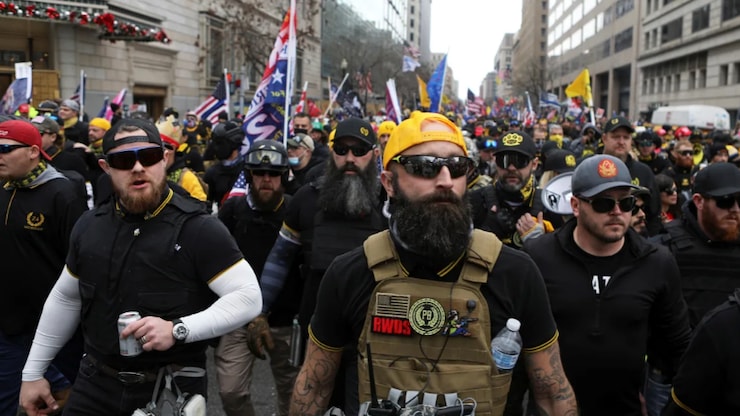
From Margins to Mainstream: Mapping Canada’s Extremist Surge

Masked street mobilizations and online echo chambers are visible symptoms of a deeper shift in Canada’s political landscape. What once seemed like marginal groups have found renewed capacity to organize, recruit and intimidate through a blend of in-person rallies and social media amplification. The Niagara rally reported by CBC is not an isolated curiosity, but part of a pattern of small, local actions that feed a national ecosystem of grievance, identity politics and conspiratorial narratives.  

The scale of the problem can be measured in public data. Police-reported hate crimes reached 4,777 incidents in 2023, an increase of 32 percent from 2022 and more than double the level recorded in 2019. These statistics do not merely count crimes. They indicate a widening public space in which targeted hostility against religious, racial and sexual minorities has become more frequent and more visible. The sharp rise in antisemitic and sexual orientation motivated incidents stands out as evidence that certain communities are being disproportionately affected.  

National security agencies have also sounded alarms. Recent public reporting from the Canadian Security Intelligence Service documents the diversification of extremist threats within Canada and the real-world harms that can emerge from online radicalization. Analysts point to a mosaic of actors including white supremacists, ethnonationalists, militia-style adherents and anti-government networks. That heterogeneity makes a single policy response insufficient. Effective mitigation requires coordinated law enforcement, targeted community supports and a sharper focus on the digital platforms that enable cross-jurisdictional recruitment.  

Transnational influences matter. Ottawa’s 2021 decision to list the U.S. Three Percenters militia as a terrorist entity underscores how American militia culture and extremist flows cross the border. That decision was an acknowledgement that ideological currents and organizational tactics are not constrained by national boundaries. Canadian actors borrow symbols, rhetoric and operational playbooks from movements abroad, complicating the domestic security picture and raising questions about how best to disrupt international networks without undermining civil liberties.   

Civil society research highlights the central role of online environments in the recent resurgence. Scans of social media and fringe platforms document how recruitment, normalization and coordination occur through memes, influencers and algorithmic suggestion. Those processes create local nodes of activity that can quickly translate into physical gatherings, harassment campaigns or worse. The internet does not create grievances, but it accelerates their spread and lowers the cost of mobilization.  

Policy responses must be pragmatic and evidence based. Better resourcing for hate crime reporting and victim support will improve data quality and community resilience. Transparent intelligence-public safety engagement can help identify violent plots early without casting suspicion across entire communities. Digital literacy initiatives and platform accountability will reduce the fertile ground on which extremist recruiters thrive. Above all, elected leaders must use language that reduces polarization rather than stokes it, because political rhetoric shapes both perception and legitimacy in the public square.

Sources:
CBC report on the Niagara rally https://www.cbc.ca/news/canada/hamilton/second-sons-rally-in-niagara-1.7628162
Statistics Canada Police-reported hate crime in Canada, 2023 https://www150.statcan.gc.ca/n1/daily-quotidien/250325/dq250325a-eng.htm
CSIS Public Report 2024 https://www.canada.ca/content/dam/csis-scrs/images/2024publicreport/newest/Public_Report_2024-ENG.pdf
Reuters on Three Percenters terrorist listing https://www.reuters.com/world/americas/canada-puts-us-right-wing-three-percenters-militia-group-terror-list-2021-06-25/
ISD An Online Environmental Scan of Right-wing Extremism in Canada https://www.isdglobal.org/wp-content/uploads/2020/06/An-Online-Environmental-Scan-of-Right-wing-Extremism-in-Canada-ISD.pdf

Cameron Davies and the Rise of Alberta’s Republican Right: An American Echo in Western Canada

The emergence of the Republican Party of Alberta (RPA) on the political stage is more than just another footnote in the long tale of Western alienation, it’s a calculated, ideologically driven attempt to redefine Alberta’s place not just within Canada, but in the broader North American political culture. At its centre stands Cameron Davies, a seasoned conservative strategist whose own political evolution mirrors the rightward lurch of the party he now leads.

The RPA was officially registered with Elections Alberta in January 2024, marking the latest effort to unite various hard-right and sovereigntist factions that have cycled through Alberta politics over the past decade. It inherited the legacy of groups like the Wildrose Independence Party and Wexit Alberta, which had captured the imagination of disillusioned voters but failed to sustain momentum. The new branding, “Republican” in name and nature, signals a stark ideological shift. It’s not just about independence anymore; it’s about importing the ethos of American-style conservatism, down to the MAGA-hued slogans and policy choices.

When Cameron Davies was acclaimed as leader in April 2025, the party’s intentions crystallized. Davies, a former backroom operator for the Wildrose and United Conservative Party (UCP), is best known for his role in the controversial “kamikaze” campaign during the 2017 UCP leadership race. That episode, which sought to undermine Brian Jean in favour of Jason Kenney, resulted in Davies being fined $15,000 for obstructing an election investigation. Though bruised by scandal, he remained a prominent figure in conservative circles until he publicly resigned from the UCP in 2025, accusing it of corruption, entitlement, and ideological betrayal.

His resignation letter read like a manifesto, a rejection of institutional politics in favour of what he described as grassroots conservatism, though critics might call it a hard-right insurgency. Davies’ departure was both strategic and symbolic. He positioned himself as the torchbearer of the “real right” in Alberta, unencumbered by the compromises of power that had come to define Danielle Smith’s increasingly centrist UCP government.

Under Davies’ leadership, the RPA has embraced a platform that reads like it was drafted in a red-state Republican think tank. There’s the call for a binding referendum on Alberta independence, followed by a non-binding vote on joining the United States. There’s strong rhetoric about parental rightsreligious freedom, and gun ownership, coupled with opposition to “woke” policies like diversity, equity, and inclusion (DEI) programs. Carbon taxes, public healthcare, federal immigration policies—these are all painted as signs of moral and fiscal decline, to be swept away by a new order rooted in faith, family, and “freedom.”

If this sounds familiar, it’s because it is. Davies has openly fashioned himself in the mold of American populist leaders. His social media presence references his military background (“Marine”), his patriotism, and his adherence to traditional values. He speaks of Canada, especially under Liberal governments, in the kind of dire terms more commonly heard on Fox News than in Canadian legislatures. For Davies, Ottawa is not just a political rival; it is a moral adversary, and Alberta must be rescued from its grasp.

There is no hard evidence yet of direct ties between Davies and the machinery of the American right, no funding pipelines, no visits to CPAC (yet), no endorsements from U.S. figures. But the ideological alignment is unmistakable. The RPA’s aesthetics, policy priorities, and culture-war messaging are all deeply influenced by the Make America Great Again (MAGA) movement. It is a party that sees itself less as a provincial player and more as a cultural movement, seeking to spark a broader populist awakening.

Davies’ recent moves show that this isn’t just rhetorical posturing. In May 2025, the RPA signed a Memorandum of Understanding with The Independence Party of Alberta, forming a loose coalition aimed at consolidating the separatist vote. The message is clear: there is no room anymore for fragmented protest parties. To mount a serious challenge to the UCP and, by extension, the federal order, the independence movement must speak with one voice, and Davies intends to be that voice.

The question now is whether the Republican Party of Alberta will become a formidable political force, or simply another flare in Alberta’s long-burning bonfire of right-wing discontent. The UCP has already learned, painfully, what happens when the right fractures. The Wildrose-PC split in the early 2010s handed the NDP a surprise victory in 2015. That memory is still fresh, and it was precisely what motivated the formation of the UCP as a big-tent conservative party in 2017.

Yet that tent is fraying. Many rural voters feel the UCP has compromised too much on issues like education, healthcare privatization, and provincial sovereignty. The RPA, with its unapologetically radical platform, offers them an alternative, a place where the message isn’t diluted by political pragmatism. Davies has a keen understanding of this tension, and he’s betting that enough Albertans are tired of half-measures and ready to blow the whole system up.

But winning a few headlines and gaining traction in the echo chamber of social media is one thing; winning seats is another. The RPA currently has no MLAs. Its organizational infrastructure is limited. Unless a high-profile defection occurs or it pulls off an upset in a by-election, the party remains on the fringe. Moreover, its overtly American positioning, especially the proposal to join the U.S., may strike even sympathetic voters as unserious or dangerously naive.

Canadians, after all, are not Americans. While cultural conservatism resonates in parts of Alberta, many still value universal healthcare, peacekeeping diplomacy, and the Charter of Rights and Freedoms. The RPA’s invocation of U.S.-style populism could ultimately alienate more voters than it attracts, especially if it becomes associated with the chaos and polarization of American politics.

Still, it would be unwise to dismiss Cameron Davies and the RPA out of hand. They are tapping into something very real: a deep and growing disillusionment with traditional politics, a sense of cultural siege, and a yearning for bold, even revolutionary change. Whether that can be translated into electoral success remains uncertain, but the message is loud and clear: the populist right in Alberta is no longer content to sit on the sidelines. And under Davies’ leadership, it’s ready to speak with an American accent.