The Cherrys Books: Family, Adventure, and Imagination

William Matthew Scott, better known by his pen name Will Scott, was a British writer born in 1893 in Leeds, Yorkshire, and active as a novelist, playwright, short-story writer, and children’s author until his death in 1964 in Herne Bay, Kent. In his earlier career he wrote detective novels and plays including The Limping Man, and is said to have contributed around 2,000 short stories to magazines and newspapers, which was considered a record in the United Kingdom during his lifetime. His shift into children’s fiction came relatively late and was inspired by his own grandchildren, for whom he began inventing stories that eventually became The Cherrys series.  

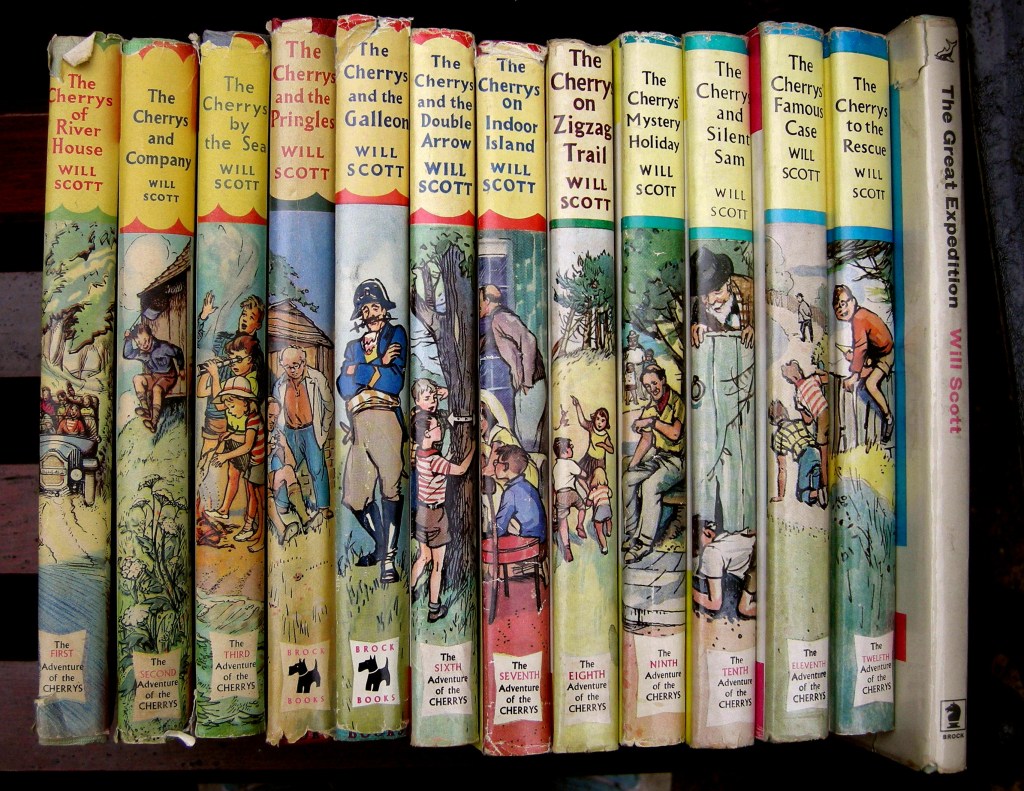
Published between 1952 and 1965The Cherrys consists of 14 books aimed at children around ten years old. These books are set in a series of fictional English villages and bays, often around the Kentish coast, and centre on a single extended family: Captain and Mrs Cherry and their four children, Jimmy, Jane, Roy, and Pam. The family’s unusual animal companions, a monkey named Mr Watson and a parrot called Joseph, add to the charm of the stories.  
At the heart of The Cherrys is a simple but powerful idea: childhood is an adventure to be nurtured by imagination and shared experience. Rather than portraying children operating independently of adults, as was common in much children’s fiction of the era, these books emphasize active parental involvement, especially through the father figure, Captain Cherry. A retired explorer, he delights in creating games, puzzles, treasure hunts, mystery trails, and “happenings” that turn ordinary days into extraordinary quests. These events span coastlines, forests, gardens, and even indoor spaces transformed by imagination into jungles, deserts, or deserted islands.  

The recurring concept of a “happening” – a structured, imaginative adventure, is one of the defining features of the series. Whether decoding maps, tracking mysterious figures, solving puzzles, or embarking on seaside explorations, each book presents a series of linked episodes that encourage curiosity, teamwork, problem-solving, and play. Scott’s approach reflects a belief in the value of learning through play, where the boundaries between fantasy and reality are fluid but always grounded in cooperative activity with family and friends.  

Another important theme in The Cherrys is engagement with the natural and built environment. Scott often provided maps of the stories’ fictional settings , such as Market Cray or St Denis Bay, and used them as stages for the characters’ activities. This emphasis on place encourages readers to see their own landscapes as rich with potential for discovery. The stories also reflect a positive view of the mid-century British countryside and coast, celebrating local topography and community life.  

Because Scott was writing at a time when much of children’s literature featured independent adventures without adults, The Cherrys stood out in its portrayal of grown-ups as co-adventurers rather than obstacles. This inclusive structure bridges the generational gap, showing children and adults working together, learning from one another, and finding joy in shared challenges.  

Despite their popularity in their day, these books are no longer in print, making them a somewhat forgotten gem of 1950s and 1960s British children’s literature. Yet for those who discover them today, the series offers a window into a world where imagination, family bonds, adventure, and everyday wonder are woven seamlessly into the narrative fabric. 

Beyond Raylan and Boyd: The Quiet Revolution of Justified’s Women

It is almost impossible to talk about Justified without the gravitational pull of Raylan Givens and Boyd Crowder. The lawman and the outlaw. The hat and the sermon. Their dynamic is electric, their scenes mesmerizing. But if we stop there, we miss something quieter, yet no less vital: the women of Harlan County. They are not background ornaments. They are architects, operators, and sometimes arbiters of the county’s power.

Justified is, at its core, a show about negotiation: of power, of survival, of legacy, and its women navigate that negotiation with courage, intelligence, and persistence. They do not always receive accolades for their choices. They are rarely celebrated in tidy narrative terms. But they endure. They plan. They adapt. And through them, the show demonstrates that influence in Harlan County is rarely a matter of brute force alone.

From the first season, Ava Crowder (Joelle Carter) establishes the stakes for women in this world. Killing Bowman Crowder, her husband’s brother, is an act of necessity, not spectacle. What follows is not freedom but responsibility. Ava spends the rest of the series managing consequences, trying to carve stability in a world that punishes female assertiveness. By the time she runs the bar, she is no longer reacting to Boyd’s schemes—she is shaping outcomes herself. Her story is not about redemption. It is about agency and the cost of holding it.

Winona Hawkins (Natalie Zea) embodies a different but equally compelling form of strength. She does not wield influence through violence. She wields it through clarity and boundaries. Winona sees Raylan for who he is and refuses to shrink herself to accommodate him. She plans for herself and her child, navigating danger without illusion. In a genre where women are often defined by attachment to men, Winona functions as a moral and strategic measure, someone whose decisions ripple outward, shaping the male protagonist as much as he shapes hers.

Mags Bennett (Margo Martindale) is the series’ most commanding female presence. Mags is authority incarnate, her power flowing from land, legacy, and an encyclopedic understanding of loyalty and leverage. She manipulates, protects, and threatens with equal grace. Her final act is not defeat but authorship. Through Mags, Justified demonstrates that women can embody menace and sophistication simultaneously, and that female power does not need narrative apology.

Loretta McCready (Kaitlyn Dever) represents the adaptive, forward-looking dimension of female agency. Starting as a teenager growing weed to survive in a county that offers her nothing, she inherits Mags’ fortune and invests it strategically, buying land and positioning herself for the future. Loretta anticipates change, particularly legalization, and adapts faster than the men around her. She is clever, deliberate, and allowed to grow without punishment, one of the quietest, but most revolutionary arcs on the show.

Ava and Loretta represent two sides of the same coin: inherited constraint and adaptive ambition. One negotiates consequences, the other seizes opportunity. Both highlight Justified’s commitment to showing women who act deliberately within systems that seek to contain them.

Rachel Brooks (Erica Tazel) offers another vision of female authority. Beginning as a competent U.S. Marshal and rising to lead the office, Rachel reins in Raylan not through theatrics, but through competence and moral authority. Her power is quiet, principled, and unassailable, demonstrating that leadership is not measured in gunfights or legend alone.

Even secondary figures contribute meaningfully. Ellen May survives through stubborn presence rather than dominance. Wendy Crowe navigates family chaos with foresight disguised as meekness. Katherine Hale exercises influence without violence, through strategy and capital. And Helen Givens, Raylan’s stepmother, though less visible on-screen, represents moral grounding and continuity. She shapes Raylan’s choices not through confrontation, but through the quiet weight of family and conscience, reminding viewers that influence in Justified often comes from wisdom, care, and endurance, not only action or ambition.

Taken together, these women redefine what it means to hold space in a crime drama. They are not there to soften male narratives. They are not props for mythology or morality. They negotiate survival, power, and legacy in ways subtle, sometimes morally ambiguous, and always consequential. Strength in Justified is not always loud or victorious. Sometimes it is simply the refusal to disappear.

Raylan and Boyd carry the mythic frame of the series. They give us the Western, the duel, the rhetoric. But the women carry its realism. They see clearly, act deliberately, and influence the county, the protagonists, and the story itself in ways that make Harlan feel lived-in, generational, and real. They are not secondary. They are operators, planners, and survivors. And in a show obsessed with consequence, that is nothing short of revolutionary.

Fantasy as Memory: The Historical Imagination of Guy Gavriel Kay

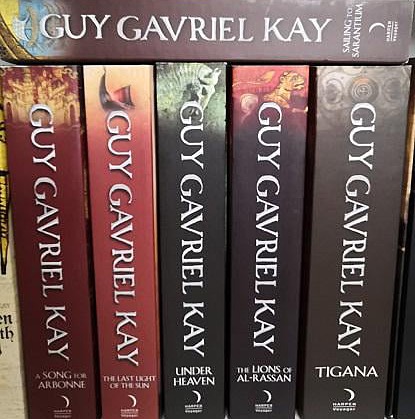
One of my favourite fiction authors, Guy Gavriel Kay has shaped my reading life from his debut series “The Fionavar Tapestry”, published in the mid-1980s, to his most recent novel “Written on the Dark”, released earlier this year.

Kay does not write fantasy as spectacle or escape, but as remembrance. His work is concerned less with heroes than with consequence, asking what endures after ambition, love, and loss. That focus, and his habit of listening closely to history rather than reshaping it for comfort, is what sets his writing apart from others in the genre.

Guy Gavriel Kay’s writing style is often described as lyrical, restrained, and morally attentive, and that combination is very Canadian in the best sense of the word. His prose is elegant without being ornamental, emotionally resonant without tipping into melodrama, and deeply concerned with how history presses on individual lives.

Lyrical clarity rather than baroque fantasy
Kay’s sentences are musical, but they are rarely flashy. He favours cadence, balance, and carefully chosen imagery over density or excess. Unlike much epic fantasy, he does not bury the reader in invented terminology or ornate description. The beauty of the prose comes from rhythm and precision, not spectacle. This gives his work a reflective, almost classical feel, closer to historical fiction than to high fantasy in the Tolkienian tradition.

History refracted, not replicated
One of Kay’s defining stylistic traits is his use of “quarter-turn” history. His worlds are clearly inspired by specific historical periods and places, Byzantium, medieval Iberia, Tang-era China, Renaissance Italy, but they are never direct analogues. Stylistically, this allows him to write with the emotional authority of history without being constrained by factual retelling. The prose carries a sense of inevitability, consequence, and loss that feels historical, even when the setting is invented.

Melancholy as a narrative tone
Kay’s work is suffused with a quiet melancholy. Triumphs are provisional. Victories are costly. Even moments of joy are shadowed by what will be lost. Stylistically, this appears in his frequent use of memory, foreknowledge, and reflective distance. Characters often understand, sometimes too late, what a moment meant. This gives the writing a sense of adult seriousness and emotional depth that distinguishes him from more action-driven fantasy authors.

Moral complexity without cynicism
Kay is interested in moral ambiguity, but he is not cynical. His style allows multiple perspectives to coexist without collapsing into relativism. Characters act from loyalty, love, fear, faith, and ambition, often all at once. The prose is careful to see people rather than judge them. Even antagonists are given interiority and dignity. This ethical attentiveness is part of what makes his work feel humane and grounded.

Dialogue as character and culture
His dialogue is formal without being stiff, shaped by the social worlds his characters inhabit. People speak with restraint, implication, and subtext. Emotion is often conveyed by what is not said. This stylistic choice reinforces themes of honour, obligation, and social constraint, particularly in courtly or religious settings.

A Canadian sensibility
Although Kay’s settings are global and historical, his sensibility feels distinctly Canadian. There is a preference for understatement, for listening rather than declaring, for complexity over absolutes. Power is treated warily. Empire is examined with sadness rather than nostalgia. The writing resists grand national mythmaking and instead focuses on human cost, compromise, and quiet endurance.

Guy Gavriel Kay writes fantasy for readers who care about language, history, and moral weight. His style is not about escape so much as reflection. He invites the reader to slow down, to attend to memory and consequence, and to sit with beauty that is inseparable from loss. That combination, lyrical restraint, historical gravity, and ethical seriousness, is what makes his voice unmistakable and enduring.

The Language of Trust: Decoding the Atreides Battle Tongue

Every culture in Dune speaks a language of power. The Bene Gesserit command with tone, the Fremen bind their tribes with oath and chant, and the Spacing Guild negotiates in silence and shadow. Yet among the great Houses, no language is more intimate, or more revealing of Frank Herbert’s ideas about information and control, than the Atreides battle language. Unlike the grandiose tongues of religion or empire, it is not meant for ceremony or persuasion. It is meant for survival, and for the quiet coordination of people who trust each other enough to speak without words.

Herbert never gives us a full lexicon or grammar. The battle language is not a “constructed language” like Tolkien’s Quenya or the Klingon of Star Trek. Instead, it is a tactical code, a system of micro-communication rooted in the fusion of military discipline and Bene Gesserit precision. It is as much muscle memory as speech. The Atreides use it to share orders under enemy watch, to signal in the dark, to compress entire strategies into a blink or the brush of a hand. Its existence hints at an entire dimension of human language that operates beneath conscious sound: the level of tone, rhythm, and gesture that Herbert, with his background in psychology and semantics, understood as the real field of control.

The first Dune novel treats the battle language like an invisible character. We never hear it directly, but we see its effect: a wordless exchange between Paul and Jessica as they flee into the desert; a silent understanding between Duncan Idaho and his troops in Arrakeen; a private bond between family members that even the Sardaukar cannot crack. Each moment underscores the difference between the Atreides and their enemies. The Harkonnens rely on fear and brute force; the Atreides rely on discipline and trust. Their language becomes the purest expression of that trust; a shared code that only functions when the users believe utterly in each other.

Herbert’s decision not to translate it is what gives the battle language its power. Readers sense that it exists in full but are never allowed to enter it. This mirrors how communication actually works in tight human groups. Soldiers, families, and lovers all develop shorthand that outsiders can’t decode. Herbert turns this natural phenomenon into a literary device: we understand that Paul and Jessica are communicating, but the details stay behind the curtain. The secrecy itself becomes world-building.

It is also a commentary on the politics of language. Dune constantly reminds us that words are weapons. The Bene Gesserit Voice manipulates obedience; the imperial court twists prophecy and bureaucracy into control systems. The Atreides battle language resists that. It is not designed to dominate others, but to coordinate equals. Within it there is no hierarchy, only mutual comprehension. When Jessica and Paul use it, the moment transcends rank; mother and son become co-conspirators in survival. That equality is what makes it dangerous in the feudal universe of Dune.

Modern readers might see parallels to real-world codes: the silent hand signals of special forces, the Navajo code talkers of World War II, or even the private gestures of people who have spent a lifetime together. In information-theory terms, it is a high-efficiency, low-bandwidth communication system; dense with meaning, resistant to interception, optimized for trust rather than volume. Herbert understood long before the digital age that the most powerful communications are not the loudest, but the most exclusive.

There’s also something profoundly spiritual about it. The battle language, like the Bene Gesserit Voice, reveals Herbert’s fascination with consciousness itself. To master it is to master attention, to choose every breath and movement deliberately. In a universe where empires fall to propaganda and faith, the Atreides preserve a private domain of meaning. They speak the language of intent, not ideology. Each signal, each inflection, is a small act of autonomy against the cacophony of the Imperium.

Later novels let the concept fade, but its DNA survives. The God Emperor’s measured speech, the Fremen’s ritual silence, even Leto II’s cryptic pronouncements all echo the idea that communication is the true battlefield. When Leto says, “I am not speaking to you, I am teaching your descendants,” he is still practicing the same philosophy, language as strategy, encoded for a specific audience. The Atreides battle language is simply the most literal form of that philosophy.

Science-fiction often builds worlds through grand architecture and invented vocabularies, but Herbert builds his through silence. The battle language is world-building by omission. We never learn its words because, like any code of loyalty, it only exists between those who earned it. Readers remain outside its circle, and that distance is part of its allure.

To understand the Atreides battle language is to see what Dune is really about. Beneath the sandworms, the spice, and the politics, it is a study of communication; how words, gestures, and even pauses can shape civilizations. The Atreides spoke with efficiency, empathy, and purpose. In a universe addicted to domination, that was their real heresy.

Sources:
Herbert, Frank. Dune. Chilton Books, 1965.
Herbert, Frank. Children of Dune. Putnam, 1976.
Herbert, Brian, and Kevin J. Anderson. Prelude to Dune series. Bantam Spectra, 1999–2001.
Platt, R. “Semiotics of Control in the Dune Universe.” Speculative Linguistics Review, 2017.
“Language and Power in Frank Herbert’s Dune.” Science Fiction Studies, vol. 28, no. 1, 2001.

The Comforting Cage: How Aldous Huxley Predicted Our Age of Distracted Control

In 1958, Aldous Huxley wrote a slender, but haunting volume titled Brave New World Revisited. It was his attempt to warn a generation already entranced by television, advertising, and early consumer culture that his 1932 dystopia was no longer fiction, it was unfolding in real time. Huxley believed that the most stable form of tyranny was not one enforced by fear, as in Orwell’s 1984, but one maintained through comfort, pleasure, and distraction. “A really efficient totalitarian state,” he wrote, “would be one in which the all-powerful executive…..control a population of slaves who do not have to be coerced, because they love their servitude.”

Huxley’s argument was not about overt repression, but about the subtle engineering of consent. He foresaw a world where governments and corporations would learn to shape desire, manage attention, and condition emotion. The key insight was that control could come wrapped in entertainment, convenience, and abundance. Power would no longer need to break the will, it could simply dissolve it in pleasure.

The Psychology of Voluntary Servitude
In Brave New World, the population is pacified by a combination of chemical pleasure, social conditioning, and endless amusement. Citizens are encouraged to consume, to stay busy, and to avoid reflection. The drug soma provides instant calm without consequence, while a system of engineered leisure: sport, sex, and spectacle keeps everyone compliant. Critical thought, solitude, and emotion are pathologized as “unnatural.”

In Revisited, Huxley warned that real-world versions of this society were forming through media and marketing. He recognized that advertising, propaganda, and consumer psychology had evolved into powerful instruments of social control. “The dictators of the future,” he wrote, “will find that education can be made to serve their purposes as efficiently as the rack or the stake.” What mattered was not to crush rebellion, but to prevent it from occurring by saturating people with triviality and comfort.

The result is a society of voluntary servitude, one in which citizens do not rebel because they do not wish to. They are too busy, too entertained, and too distracted to notice the shrinking space for independent thought.

From Propaganda to Persuasion
Huxley’s vision differed sharply from George Orwell’s. In 1984, the state controls through surveillance, fear, and censorship. In Huxley’s future, control is exercised through persuasion, pleasure, and distraction. Orwell feared that truth would be suppressed; Huxley feared it would be drowned in a sea of irrelevance. As Neil Postman put it in Amusing Ourselves to Death (1985), “Orwell feared those who would ban books. Huxley feared there would be no reason to ban a book, for there would be no one who wanted to read one.”

Modern societies have largely taken the Huxleyan path. The average person today is targeted by thousands of marketing messages per day, each designed to exploit cognitive bias and emotional need. Social media platforms fine-tune content to maximize engagement, rewarding outrage and impulse while eroding patience and depth. What Huxley described as a “soma” of distraction now takes the form of algorithmic pleasure loops and infinite scrolls.

This system is not maintained by coercion, but by the careful management of dopamine. We become self-regulating consumers in a vast behavioral economy, our desires shaped and sold back to us in a continuous cycle.

The Pharmacological and the Psychological
Huxley was also among the first to link chemical and psychological control. He predicted a “pharmacological revolution” that would make it possible to manage populations by adjusting mood and consciousness. He imagined a world where people might voluntarily medicate themselves into compliance, not because they were forced to, but because unhappiness or agitation had become socially unacceptable.

That world, too, has arrived. The global market for antidepressants, stimulants, and mood stabilizers exceeds $20 billion annually. These drugs do genuine good for many, but Huxley’s insight lies in the broader social psychology: a culture that prizes smooth functioning over introspection and equates emotional equilibrium with virtue. The line between healing and conditioning becomes blurred when the goal is to produce efficient, compliant, and content individuals.

Meanwhile, the tools of mass persuasion have become vastly more sophisticated than even Huxley imagined. Neuromarketing, data mining, and psychographic profiling allow advertisers and political campaigns to target individuals with surgical precision. The 2016 Cambridge Analytica scandal revealed just how easily personal data could be weaponized to shape belief and behavior while preserving the illusion of free choice.

The Politics of Distraction
What results is not classic authoritarianism but something more insidious: a managed democracy in which citizens remain formally free but existentially disengaged. Political discourse becomes entertainment, outrage becomes currency, and serious issues are reframed as spectacles. The goal is not to convince the public of a falsehood but to overwhelm them with contradictions until truth itself seems unknowable.

The philosopher Byung-Chul Han calls this the “achievement society,” where individuals exploit themselves under the illusion of freedom. Huxley anticipated this, writing that “liberty can be lost not only through active suppression but through passive conditioning.” The citizen who is perpetually entertained, stimulated, and comforted is not likely to notice that his choices have narrowed.

Resisting the Comforting Cage
Huxley’s warning was not anti-technology but anti-passivity. He believed that freedom could survive only if individuals cultivated awareness, attention, and critical thought. In Revisited, he proposed that education must teach the art of thinking clearly and resisting manipulation: “Freedom is not something that can be imposed; it is a state of consciousness.”

In an age where every click and scroll is monetized, the act of paying sustained attention may be the most radical form of resistance. To read deeply, to reflect, to seek solitude, these are not mere habits but acts of self-preservation in a culture that thrives on distraction.

Huxley’s world was one where people loved their servitude because it was pleasurable. Ours is one where servitude feels like connection: constant, frictionless, and comforting. Yet the essence of his message remains the same: the most effective form of control is the one we mistake for freedom.

Sources:
• Aldous Huxley, Brave New World (1932)
• Aldous Huxley, Brave New World Revisited (1958)
• Neil Postman, Amusing Ourselves to Death (1985)
• Shoshana Zuboff, The Age of Surveillance Capitalism (2019)
• Byung-Chul Han, The Burnout Society (2015)
• Christopher Lasch, The Culture of Narcissism (1979)

Highschool History Textbook from 2050

Today, I stumbled across an old Canadian high school history textbook from 2050 in a used bookstore. Chapter 14 tells the story of the Canada-US War of 2026–2028, what we now call The War for the North. I thought I’d share how, twenty years ago, young Canadians were being taught about the war I fought in to keep our country strong and free. – William McIntosh, July 2070

🇨🇦 Chapter 14: The War for the North (2026–2028) and the Rise of a New Canadian Identity

“We were underestimated. But we had history on our side, the land beneath our feet, and the will of a people who knew the difference between conquest and home.”
Élise Fontaine, Prime Minister of Canada, Address at the Treaty of Yellowknife, March 4, 2028.

🔍 Introduction

By the mid-2020s, the global order was under pressure from resource scarcity, climate change, cyber warfare, and political polarization. Few imagined that the world’s longest undefended border would become the front line of the first major conflict between two G7 democracies. The U.S. invasion of Canada in 2026 marked the most profound crisis since Confederation.

⚠️ 14.1 Preludes to Invasion: Political Tensions and Resource Nationalism

In 2024, the U.S. re-elected a nationalist populist government amid unrest and ecological collapse. Canada’s resources and Arctic stability became targets.

  • 💧 Resource envy: Canada held 20% of global freshwater, lithium reserves, and Arctic access.
  • 🔥 Domestic distraction: The U.S. struggled with protests and secessionist movements.
  • 📣 Militarized rhetoric: “Reunifying the continent” became a nationalist slogan.

The trigger event was a false-flag explosion near Sault Ste. Marie in June 2026, used to justify Operation Northern Unity.

💣 14.2 Invasion and Occupation: The First Six Months

July 4, 2026: U.S. airstrikes hit Canadian bases at Trenton, Bagotville, and Cold Lake. By day’s end:

  • 🛣️ Crossings in Ontario, Manitoba, and BC were seized.
  • 🏭 SW Ontario: Hamilton, London, Windsor, Kitchener – was occupied.
  • 🏙️ Toronto was surrounded but held out with civilian resistance.

🛡️ 14.3 Canada Fights Back: Asymmetric Warfare and National Unity

Civilian Resistance

  • 🔧 Grassroots militias and defence networks formed rapidly.
  • 🪶 Indigenous groups, including the Gwich’in and Cree, used terrain mastery to disrupt U.S. troops.
  • 🏙️ Cities resisted with sabotage, information warfare, and protests.

Military Strategy

  • 🏔️ Canadian command regrouped in northern bunkers near Sudbury, Labrador, and the Yukon.
  • 💻 Cyber teams at CSIS and DND disrupted U.S. logistics.
  • 🌍 International volunteers arrived from Europe, Australia, and even the U.S.

🌐 14.4 Global Realignment and Rising Costs

As the war dragged on, geopolitics shifted:

  • 🇨🇳 China and 🇷🇺 Russia armed Canadian resistance.
  • 🇮🇳 India signed new defence and trade pacts with Canada.
  • 🇪🇺 The EU imposed sanctions on the U.S.

By 2027, the U.S. was facing:

  • ☠️ 40,000+ military casualties
  • 💥 Domestic unrest and economic collapse
  • 🛑 Cyberattacks targeting U.S. energy and finance sectors

🕊️ 14.5 The Treaty of Yellowknife (March 4, 2028)

With global pressure rising, peace talks began. Canada’s demands included:

  1. Total U.S. withdrawal
  2. Restoration of all borders
  3. Transfer of Alaska to Canada
  4. War crimes tribunal
  5. Reparations for civilian and infrastructure damage

Treaty Terms:

  • 🇨🇦 U.S. withdrawal in 90 days
  • 🇨🇦 Alaska becomes a Canadian territory (province by 2035)
  • 🚢 Joint Arctic monitoring established
  • 💵 CAD $750B in reparations over 15 years

🌲 14.6 The War’s Legacy: 2028–2050

  1. Canadian Identity: National unity strengthened. Indigenous leadership elevated.
  2. Global Power: Canada joined the Global Forum Bloc and Arctic Security Council.
  3. U.S. Decline: NATO collapsed; the U.S. turned inward. A new North American Council formed.
  4. Alaska’s Future: Self-Governing in 2030, full Canadian province by 2035.

👤 Key Figures

NameRole
Élise FontaineCanadian PM-in-exile, architect of the Treaty
Michael HerreraU.S. interim president who signed the peace accord
Elder Noah KaskamanCree strategist from the Shield region
Brigadier Rachel AubéLed Canadian cyber defence
Emma SinghHamilton resistance leader, first MP for postwar Alaska

✍️ Primary Source

“We did not ask for this war. But we rose to it, not with hatred, but with the firm conviction that home must never be handed over. And now, from the Northwest Passage to the shores of Lake Erie, this land stands free, and forever ours.”

📝 Review Questions

  • What were the main strategic motivations behind the U.S. invasion of Canada in 2026?
  • How did geography and asymmetric tactics aid Canadian resistance efforts?
  • What global events influenced the outcome of the conflict?
  • Discuss the significance of Alaska’s integration into Canada.
  • How did this war change Canada’s role in the world order?

📚 Further Reading

  • From Shield to Sovereignty: Indigenous Leadership in the Canadian Resistance (Carla Tuniq, 2040)
  • Northern Stars: Canada and the Arctic Century (Brandon Lee-Sommers, 2045)
  • The Collapse of Empire: America’s Lost War in the North (James Kilpatrick, 2039)

Wor New Badge Woes – So Ah Asked Me Mate, ChatGPT!

By Big Mac, the OAP Blogger from Byker

So aye, ah’d just settled doon wi’ a cuppa and a bacon sarnie, listenin’ to the wireless, when ah hears this daft bit o’ news, the FA’s enforcin’ a new rule meanin’ clubs might have to tweak their badges for “clarity and digital compliance.” Clarity?! Since when did seahorses need spellcheck?

Wor Toon badge, man. It’s a canny thing. You’ve got ya seahorses lookin’ like they’ve just trotted up the Tyne, that wee castle standin’ proud like it owns the place, and a banner that’s more iconic than wor lass’s Sunday gravy. And now they want to mess wi’ it?

So, ah panicked a bit, not gonna lie. But then ah remembered, ah’ve got a clever mate. He lives in me phone, goes by the name ChatGPT. He’s not local, but he divvint half know his onions. Can write like Shakespeare one minute and solve algebra the next. So ah goes, “Eee, Chat lad, gizza hand wi’ this badge business will ya? Make us four new uns, proper smart, summat that’ll work on TikToks and stripy kits alike.”

Next thing ah know, he whirrs away like a robot in Fenwick’s window and bosh, oot comes four logos! Clean as a whistle, modern, but still keeping the soul of the Toon. They’ve got them seahorses lookin’ like they’ve just bench-pressed a Metro carriage, and the castle’s front and centre like it’s still waitin’ for the Normans. Honestly, it’s like if wor badge went to uni and came back with a graphics degree and a fresh trim.

One’s got a round badge, like a beer mat. Another’s dead sharp, like wor Ian’s elbows in five-a-side. There’s even one wi’ a shield that looks like it could deflect bad VAR decisions. Honestly, I was chuffed. Even me Bro Trev said, “Looks mint that, Mac. Reckon the lads’d wear that on Champions League nights.”

Now, ah divvint know if the club’ll go for one of these, or if they’ll end up asking some bloke in London who’s never tasted stottie cake in his life, but if they do nowt else, they should at least give ChatGPT an honorary season ticket, and a Greggs voucher.

So if ye see any new crests floating aboot on the socials, and they look like they’ve got the heart of the Toon and a bit of AI sparkle, ye kna who sorted it. Me and me clever little digital mate.

Howay the Lads, and Howay the Logos!

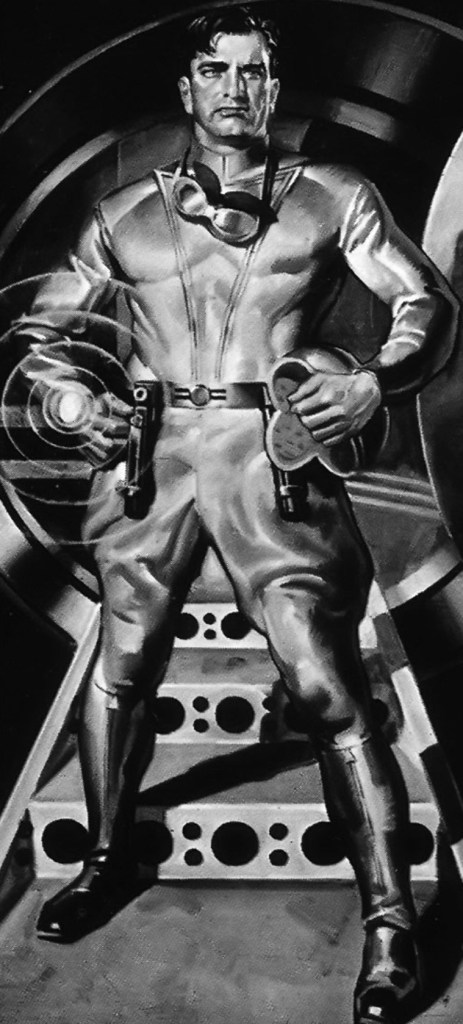
Placing the works of EE “Doc” Smith into its Societal Context

I read a fair amount of science fiction, as can clearly be seen from the content of this blog.  My first introduction to speculative fiction, beyond C.S. Lewis, was the works of E.E. “Doc” Smith, loaned to me by a fellow classmate during my early teens. I devoured every book by this author I could find, reading without judgement, just enjoying the galactic adventure. Like I have said many times about my annual reading of Frank Herbert’s Dune, it’s not the story that changes, but the perspective that the additional year gives me.  

E.E. “Doc” Smith is an undeniable cornerstone of science fiction, particularly in shaping the grand, sweeping narratives of the space opera subgenre. His works, from the Lensman to the Skylark series, established many of the storytelling conventions that would define science fiction for generations. Yet, these same works are deeply entwined with the patriarchal and often misogynistic norms of their time, offering a fascinating lens through which to examine the cultural attitudes of the early-to-mid 20th century. Smith’s legacy is both a celebration of speculative ambition, and a study in the limitations of its era.

The Lensman series, perhaps Smith’s most iconic work, epitomizes the space opera’s blend of high-stakes interstellar conflict and moral idealism. Published between 1934 and 1950, these novels follow the genetically perfected heroes of the Galactic Patrol, led by the stalwart Kimball Kinnison, in their battle against the shadowy forces of Boskone. While the series broke ground in envisioning a universe of sprawling galactic civilizations, its treatment of gender roles reveals a narrower imagination. Female characters, such as Clarissa MacDougall, are largely confined to nurturing or supportive roles, their significance often framed in relation to male protagonists. Even Clarissa’s ascension to the ranks of the Lensmen – a notable exception – feels more like a narrative anomaly than a redefinition of gender dynamics. The series reflects its time, portraying men as protectors and leaders while relegating women to emotional or domestic spheres.

Similarly, the Skylark series, begun in 1928, offers an early blueprint for the modern space opera, chronicling the scientific and exploratory exploits of Richard Seaton and his morally ambiguous rival, Marc “Blackie” DuQuesne. Once again, women – characters like Dorothy Seaton and Margaret Spencer – are predominantly relegated to roles as love interests, hostages, or secondary figures. Though occasionally resourceful or intelligent, their contributions are overshadowed by the male protagonists’ heroics. These dynamics reinforce traditional gender hierarchies, with men as agents of innovation and action while women serve as symbols of emotional stability or moral guidance.

In the Family d’Alembert series, co-written with Stephen Goldin during the 1960s and 1970s, there is a slight shift in representation. Yvette d’Alembert, part of a circus-trained secret agent duo, emerges as a rare competent female protagonist. Yet even her capabilities are often contextualized by her physical appeal and partnership with her brother Jules. By this time, feminist movements were beginning to reshape societal norms, but science fiction, especially that rooted in the pulp tradition, lagged in reflecting these changes. Yvette’s portrayal, while an improvement, still clings to the vestiges of earlier patriarchal frameworks.

Smith’s later works, such as Subspace Explorers (1965), continue to explore grand themes like telepathy, space exploration, and societal advancement, but the underlying gender dynamics remain unchanged. Female characters with psychic abilities feature in the narrative, yet their roles are secondary, reinforcing the notion that leadership and innovation are male domains.

These patterns are not mere quirks of individual stories but reflections of a broader societal framework. Smith’s fiction mirrors the rigid gender roles of early-to-mid 20th-century society, a time when women were often confined to domestic or secondary positions. His male protagonists, embodying traits of strength, rationality, and dominance, contrast sharply with the nurturing and emotional roles assigned to women. While Smith does not explicitly demean women, the systemic sidelining of female characters speaks to the cultural misogyny of the era. His works helped establish many tropes that would define space opera, but they also reinforced a male-centric vision of the genre that took decades to challenge.

Despite these limitations, Smith’s influence on science fiction is profound. His imaginative depictions of intergalactic civilizations, advanced technologies, and epic storytelling inspired luminaries such as Isaac Asimov, Arthur C. Clarke, and even George Lucas. Modern readers, however, often critique his works for their outdated gender dynamics and lack of diversity. These critiques, while valid, do not diminish the historical significance of his contributions. Instead, they offer an opportunity to reevaluate his legacy in light of the genre’s ongoing evolution.

E.E. “Doc” Smith’s works remain a double-edged artifact of science fiction history: a testament to the boundless creativity of speculative fiction, and a reminder of the cultural constraints of its time. By recognizing these dual aspects, we can celebrate his role in shaping the genre while continuing to push for more inclusive and equitable narratives in speculative storytelling.

The Weight of Words: A Lifelong Romance with Hardcovers

I usually think of myself as a modern man, fully bought into our digital world, and then I wander into the farmhouse library, and I realize that this space is a place outside of time, and I remember my ongoing love affair with hardback books. As I first wrote and edited this piece, I found myself switching back and forth between hardcover and hardback, mixing as I often do my British and Canadian English.  Rather than going with a uniform approach, I left the nouns and adjectives as I found them on the page.  

Screenshot

I still to this day buy hardback books because they embody something rare in our fast-paced, ephemeral world: permanence. There’s a kind of quiet romance to their weight in my hands—a grounding reassurance that I’m holding more than just paper and ink. Each hardcover feels like a promise, an intimacy that won’t vanish with the swipe of a screen or a fleeting notification. They are timeless, like the lingering warmth of a lover’s voice after they’ve left the room, soft yet unwavering.

On my shelves, their spines stand like steadfast sentinels, guarding fragments of my life. Each book holds a memory: a novel devoured on a long train ride, a cookbook sprawled across the counter on a rainy Sunday, a travel guide flipped through during quiet nights when the world outside was covered with snow. Their dust jackets, often worn and peeling at the edges, only make them dearer. Like laughter lines etched on a familiar face, they tell stories of years well-lived and hands well-loved.

Hardback books are resilient in ways I admire. Their pages hold firm, their spines don’t surrender, and their beauty only deepens with age. When I open one, the faint creak of the binding feels like the exhale of a secret shared just between us. The embossed covers beg to be touched, as though inviting me to connect not just with the words within, but with the countless others who’ve held the same book. In their permanence, I find companionship—kindred spirits who, like me, sought solace or joy in those very same pages.

My collection is a reflection of who I am. Beloved fiction titles transport me to worlds where I’ve found companionship in characters who now feel like lifelong friends. Illustrated cookbooks add bursts of color and life, inspiring meals that have punctuated moments of celebration, comfort, and discovery. And then there are my permaculture and agroforestry guides, rooted in a deep love for the earth and a longing to live in harmony with its rhythms. Together, they form an eclectic tapestry of passions that, when viewed as a whole, feel like an unspoken autobiography.

Perhaps, above all, I buy hardbacks for the future they promise. I picture someone I care for—perhaps a partner, or one of their children—one day standing before my shelves. They’ll trace the spines, pull a book down, and find my notations in the margins or a bookmark still tucked between the pages. Those scribbles and marks, though small, will be echoes of me—a life lived in dialogue with stories, recipes, and ideas.

Hardback books, like love, aren’t always practical, but they are endlessly worth it. They ask for time, for care, for patience. And in return, they give so much more—a place to lose myself, to learn, to dream, and, more often than not, a place to be found.