Five Things We Learned This Week

Week of September 13–19, 2025

Another week of sports shocks, economic shifts, and global moments. Below are five items that turned heads between Saturday, September 13 and Friday, September 19, 2025. Each item is date-checked and drawn from primary reporting so you can follow the facts and the context.


⚽ Canada ends New Zealand’s World Cup dominance to reach final

On September 19 Canada defeated defending champions New Zealand 34-19 in the Women’s Rugby World Cup semi final at Ashton Gate, booking a spot in the final for only the second time in the nation’s history. Why it matters: The result breaks a decade of New Zealand dominance, underlines the rise of Canada’s women’s program, and sets the stage for a historic final.

💷 UK borrowing surges and the pound weakens amid budget pressures

In mid September government borrowing rose well above forecasts, pushing August borrowing to its highest level in years. The pound weakened as markets digested the higher deficit and the risk of tougher fiscal measures. Why it matters: Higher borrowing raises questions for autumn budget planning and could force policy adjustments that affect growth and household budgets.

🧮 S&P Global updates show mixed growth with regional divergence

The September economic outlook from S&P Global revised growth up for economies such as the United States, Japan, Brazil and India while downgrading forecasts for Canada, Germany and Russia. Inflation remains uneven globally. Why it matters: The patchwork outlook changes the balance of global risks and opportunities, influencing trade, investment and policy choices.

📈 FAANG and AI stocks push markets higher as Fed cut odds rise

Tech giants and AI-related firms led gains during the week as investors continued to price a nearer Federal Reserve easing. The market rotation highlighted renewed appetite for growth names. Why it matters: Shifting expectations about monetary policy affect asset valuations, capital flows and corporate funding decisions.

🔭 Near-Earth asteroid 2025 FA22 made a safe flyby and was closely tracked

The object known as 2025 FA22, estimated between 130 and 290 meters, passed safely on September 18. Observatories used the close approach to refine orbital data and practice planetary defence procedures. Why it matters: Even large near-Earth objects can be monitored and ruled out as threats, which builds confidence in detection and response systems.


Closing thoughts: This week mixed sporting triumph and market optimism with sober economic readings and planetary vigilance. As these stories unfold they will shape policy decisions, investment priorities and public conversation. We will keep tracking developments and bringing you the five things worth your attention each week.

Sources

Five Things We Learned This Week

Week of September 6 – 12, 2025

A busy seven days brought hard headlines and surprising turns across geopolitics, markets, tech, and finance. Here are five things worth bookmarking from the week that just passed.


⚔️ Russia’s biggest air attack of the war pummels Ukrainian cities, including Kyiv

On September 8 Russia carried out its most intense air assault of the conflict to date, using a large barrage of missiles and drones that struck Kyiv and other population centres, set a government building ablaze, damaged infrastructure, and caused civilian casualties.
Why it matters: The scale of the strike shows an escalation in Russia’s long-range campaign and increases pressure on Ukraine’s air defences and humanitarian response.

⚖️ U.S. Supreme Court clears the way for broader immigration raids

On September 9 the Supreme Court allowed aggressive federal immigration operations to proceed, backing the administration’s approach to broad enforcement actions in several states.
Why it matters: The decision reshapes enforcement practice nationwide and will affect communities, labor markets, and legal challenges over civil rights and federal power.

📱 Apple unveiled its iPhone 17 lineup and a slimmer “iPhone 17 Air” at its September event

On September 9 Apple introduced the iPhone 17 family along with refreshed AirPods and Watch models, emphasizing a thinner design for the new iPhone Air and modest camera and battery upgrades across the range.
Why it matters: New hardware shapes holiday-season demand, supplier orders, and the consumer tech earnings cycle that drives parts of global markets.

📈 U.S. and global markets rally on growing bets that the Fed will cut rates soon

Through September 11 and 12 stocks posted weekly gains and several U.S. indexes reached fresh highs as traders priced a high probability of an imminent Fed rate cut after softer economic indicators. The rally was led by tech and AI-related names but was broad enough to lift major indices.
Why it matters: Shifting expectations about interest-rate policy change borrowing costs, asset valuations, and capital flows for businesses and households worldwide.

₿ Tether announces plans for a U.S.-facing stablecoin called USAT

On September 12 Tether confirmed plans to launch a new U.S. stablecoin, USAT, aimed specifically at U.S. residents and designed to comply with new domestic rules and banking arrangements.
Why it matters: A regulated U.S. stablecoin from a market leader could reshape crypto onramps, institutional adoption, and how regulators oversee digital dollars.


Closing thoughts: From geopolitical escalations to courtroom rulings, from flashy tech launches to market shifts and digital currency experiments, this week underscored how interconnected our world has become. The threads of war, law, innovation, and finance don’t just make headlines – they ripple into daily life. As we head into the next week, these five stories remind us to keep one eye on the big picture and another on the details shaping tomorrow.

The Regressive Weight of Road and Bridge Tolls

Tolls on bridges and highways are often presented as pragmatic tools of modern infrastructure finance. They provide a clear user-pay model, in which those who drive the road or cross the bridge contribute directly to its upkeep. Yet beneath the tidy arithmetic lies a deeper inequity. Tolling is inherently regressive, disproportionately affecting those least able to shoulder the burden, while leaving the wealthy relatively untouched. In the Canadian context, with a geography that frequently demands travel over water or long stretches of road, tolls create a system where access is rationed by income rather than need.

The Confederation Bridge linking Prince Edward Island to the mainland is an instructive example. Until this summer, Islanders and visitors alike were charged more than $50 per vehicle for the right to leave the province. For many families and small businesses, this was not a casual expense but a recurring cost that shaped economic opportunity and even the rhythm of daily life. Following recent political attention, the toll has been reduced to $20, but the principle remains unchanged. Crossing a bridge that connects one part of the country to another still requires a fee that weighs more heavily on working families than on tourists or affluent professionals. It is not simply a question of price but of fairness in access to mobility. 

Ontario’s Highway 407 tells a similar story, albeit in a different register. Originally built as a public project, the highway was privatized under a 99-year lease in the late 1990s. Since then, tolls have risen sharply, far outpacing inflation, with profits flowing to private shareholders rather than to the public purse. The highway’s users include commuters with little choice but to pay for faster access into Toronto. For higher-income households, the fee is a convenience. For those on modest wages, it can become a recurring penalty that extracts a significant portion of their income simply to get to work on time. The toll structure reinforces a two-tier mobility system, in which efficiency is a privilege purchased rather than a public good ensured. 

Beyond inequity, tolling is also an inefficient means of raising revenue. Collection and enforcement systems consume a substantial share of funds, with studies showing that administrative costs can swallow up to a third of toll revenues. The very act of charging per crossing introduces distortions, encouraging some drivers to divert onto untolled secondary routes, which increases congestion and emissions elsewhere. The costs, both financial and social, ripple outward in ways rarely accounted for in the fiscal logic of tolling schemes. 

If the objective is to ensure that those who benefit from road systems pay a fair share, there are more equitable instruments available. A progressive licensing system that levies higher annual fees on luxury or high-value vehicles would generate steady, predictable revenue without punishing those who rely on basic mobility. Such a measure would align responsibility with capacity to pay, ensuring that the wealthiest drivers contribute more to infrastructure upkeep. At the same time, it would leave ordinary workers and families free from the arbitrary impositions of per-trip tolls.

Canada’s transportation network binds communities, sustains commerce, and enables social life. It should not be carved into segments where access is contingent on one’s bank account. Tolls, whether on bridges or highways, undermine the principle of equitable mobility. A system of progressive licensing fees offers a better path, one that respects both fairness and fiscal responsibility. The country requires infrastructure policies that do not merely balance budgets, but also balance justice.

Sources
• Global News. “Confederation Bridge tolls lowered.” July 28, 2025. https://globalnews.ca/news/11314912/confederation-bridge-tolls-lowered
• Government of Canada. “Canada’s new government cuts transportation costs in Atlantic Canada.” July 28, 2025. https://www.pm.gc.ca/en/news/news-releases/2025/07/28/canada-s-new-government-cuts-transportation-costs-in-atlantic-canada
• Wikipedia. “Ontario Highway 407.” Accessed August 2025. https://en.wikipedia.org/wiki/Ontario_Highway_407
• Institute for Research on Poverty (University of Wisconsin). “Equity Implications of Tolling.” Working Paper 1378-10. https://www.irp.wisc.edu/publications/dps/pdfs/dp137810.pdf

Five Things We Learned This Week

Here’s the latest edition of “Five Things We Learned This Week” for July 5–11, 2025, featuring all-new insights within the past seven days—no repeats from previous lists:

⚖️ 1. Trump Intensifies Trade War with 30–50% Tariffs

  • Between July 7–11, President Trump sent letters threatening 30% tariffs on EU & Mexico (starting Aug 1), 35% on Canada, and 50% on imported copper, along with an extra 10% on BRICS allies  .
  • Global markets responded with caution—stocks dipped, safe-haven assets steadied, and commodity currencies showed volatility  .
  • Trade partners expressed strong concern, calling the moves disruptive amid ongoing negotiations  .

🛢️ 2. Oil Prices Jump Over 2% amid Tight Markets and Tariff Fears

  • On July 11, Brent rose ~2.5% ($1.72/barrel) to $70.36, and WTI climbed 2.8% to $68.45, sparked by IEA warnings of tighter supply, OPEC+ compliance, and trade policy risks  .
  • U.S. rig counts fell for the 11th straight week, intensifying concerns about future output ().

🌍 3. UN Adopts Climate–Human Rights Resolution

  • On July 8, the UN Human Rights Council passed a climate change motion that ties environmental harm to human rights—adopted by consensus after the Marshall Islands withdrew a controversial fossil-fuel phase-out amendment  .
  • The resolution calls for “defossilizing our economies” and sets a benchmark for framing climate action as a global human-rights priority  .

💼 4. BRICS Summit Highlights Climate Funding Demands

  • On July 7, at their Rio meeting, BRICS leaders urged wealthy nations to fund climate transitions in developing countries, while also affirming continued fossil fuel usage in their economies  .
  • Brazil’s President Lula warned against denialism, contrasting BRICS multilateralism with U.S. isolationism ().

🎤 5. Reuters NEXT Asia Summit Tackles Trade, AI & Global Stability

  • July 7, the Reuters NEXT Asia forum in Singapore convened ~350 global leaders to debate pressing issues—covering AI innovation, trade disputes, and geopolitical uncertainty  .
  • Discussions stressed AI’s dual potential for disruption and opportunity, with trade tensions—especially tariffs—looming large.

Each of these five highlights occurred between July 5–11, 2025, and brings fresh, global perspectives to this week’s roundup. Want full article links or deeper analysis? Just say the word!

Five Things We Learned This Week

Here’s the latest edition of “Five Things We Learned This Week” for June 28–July 4, 2025, showcasing five entirely new global developments—each occurring in the past seven days:

🧭 1. Trump Signs Sweeping Tax & Spending Bill

• On July 4, President Trump signed a landmark tax-and-spending package into law, following its narrow passage in Congress  .

• This $3.3 trillion bill includes large tax cuts and federal spending boosts, with analysts warning of significant long-term increases in national debt  .

🌍 2. Japan Warms for Possible Quakes, Authorities Calm Public

• On July 4, Japan’s disaster agency alerted residents of potential strong aftershocks off the southwest coast, though downplaying doomsday fears  .

• Authorities emphasized preparedness over panic, urging early warning systems remain active.

🇨🇳 3. China Signals Investment in Brazil‑Led Forest Fund

• At the end of the week, Reuters reported that China plans to back the “Tropical Forests Forever” fund led by Brazil—marking a strategic shift toward joint environmental efforts  .

• This move is viewed as a rare diplomatic gesture amid global climate partnerships.

📈 4. Global Equity Funds See Largest Inflows in 8 Months

• Global equity funds recorded a massive $43.15 billion inflow for the week ending July 2, driven by U.S. stock highs and surging interest in AI and tech sectors  .

• U.S. equity funds accounted for $31.6 billion, with robust gains also seen in European and Asian markets  .

🇲🇩 5. Moldova Leaders Emphasize EU Integration Ahead of Election

• On July 4, Moldova’s President Maia Sandu declared that citizens hold the future of the EU bid in their own hands as the country nears parliamentary elections  .

• Her appeal underscores Moldova’s ongoing push for formal European Union membership.

These five developments span U.S. fiscal policy, earthquake readiness, international environmental funding, global investment trends, and Eastern European geopolitics—all fresh this week. Want source links or deeper insights? Let me know!

Mr. Carney, Let’s Be Bold and Smart: A Revenue-Neutral Universal Basic Income Is Within Reach

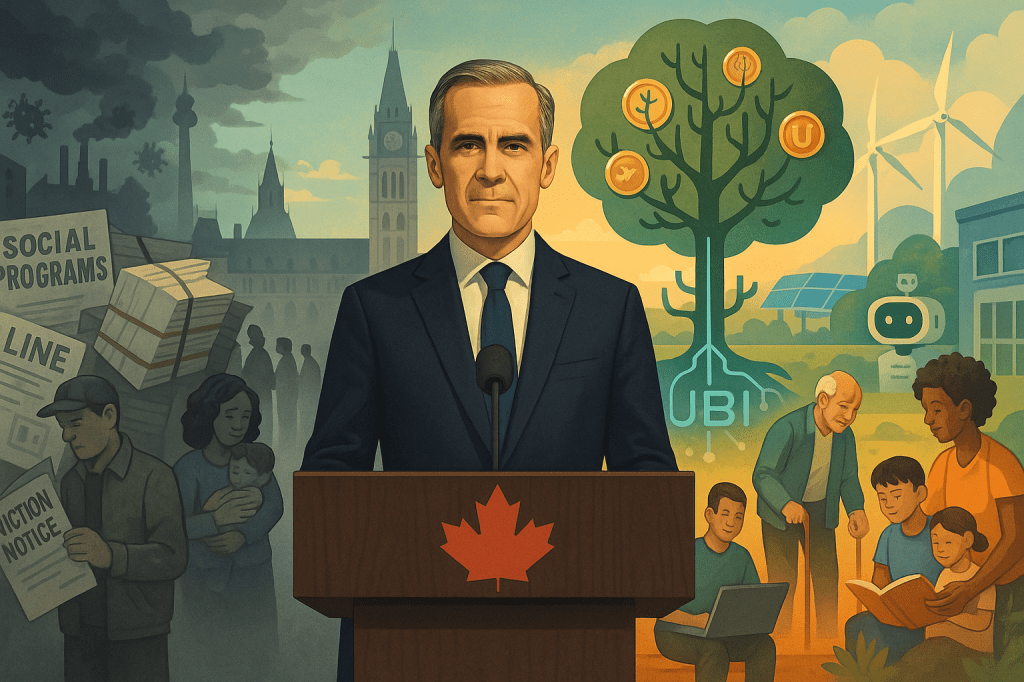
The election of Mark Carney as Canada’s new Prime Minister marks more than a changing of the guard, it signals a chance to transform how we think about economic justice, social policy, and the role of government in a post-pandemic, post-carbon, AI-disrupted world. Yet, if this new Liberal administration wants to do more than manage decline or tinker at the edges, it must champion Universal Basic Income (UBI), and it must do so within this first term.

To skeptics, the usual pushback is cost. “We can’t afford it.” But what if I told you we can, without adding a cent to the deficit?

A bold, revenue-neutral UBI is not only possible, it’s the smart, responsible, and forward-thinking choice. It would simplify our bloated patchwork of social programs, reduce inequality, and stabilize the economy, all while respecting fiscal realities. Carney, with his reputation for monetary prudence and social conscience, is uniquely positioned to make this happen.

The Case for UBI, Now More Than Ever
We live in precarious times. AI and automation are displacing jobs once thought secure. The gig economy has redefined work for an entire generation, offering flexibility but no stability. Climate change is reshaping our industries, economies, and communities. And regional inequalities, from rural depopulation to urban housing crises, are deepening social division.

UBI provides a powerful, simple solution: a no-strings-attached income that ensures every Canadian can meet their basic needs, make real choices, and live with dignity. No complex eligibility criteria. No stigma. Just a stable foundation for all.

This isn’t a call for endless spending. This is a plan for smart reinvestment, one that replaces outdated, fragmented systems with a coherent, efficient, and humane approach.

Revenue-Neutral UBI: A Practical Path
The key to political and economic viability is fiscal neutrality. Here’s how we get there:

Streamline the Social Safety Net
Our current welfare architecture is costly, overlapping, and often punitive. We propose replacing core income support programs, provincial social assistance, EI for low-wage workers, and a range of targeted income-tested tax credits, with a single, universal UBI. This simplification reduces administrative duplication and restores dignity to recipients.

Rethink OAS and GIS
These seniors’ programs already operate as a basic income for the elderly. By integrating them into a universal model, with UBI replacing these benefits for most, but supplemented by needs-based top-ups for seniors with unique medical or housing costs, we ensure fairness without duplication.

Restructure (Not Eliminate) CPP
CPP remains essential as a pension earned through contribution, but some recalibration of contribution thresholds and benefit tiers, alongside UBI, can reduce reliance on inflated public pensions to cover basic needs, while preserving the contributory principle.

Modest, Targeted Tax Reform
To close the revenue loop, introduce a small surtax (e.g., 2%) on individual incomes over $150,000, and slightly increase capital gains inclusion rates. These are not radical measures, they simply ask the wealthiest Canadians to help ensure every citizen has a secure foundation. For 95% of taxpayers, no increase would be necessary.

Numerous economic models (including work by Evelyn Forget, UBC’s Kevin Milligan, and CCPA researchers) show that a well-designed UBI can be nearly or entirely self-funding when paired with smart policy adjustments like these.

Political Opportunity and Liberal Legacy
Prime Minister Carney doesn’t need to look far for historical inspiration. Universal healthcare, bilingualism, the Charter, these were all ambitious Liberal achievements once considered politically risky and fiscally daunting, yet they reshaped Canada.

UBI can be his legacy. It would resonate across voter blocs: rural Canadians seeking stability, urban millennials burdened by debt and housing costs, women and caregivers locked out of full-time work, and gig workers with no safety net. It’s a unifying policy in a fragmented nation.

Moreover, by leading with a revenue-neutral model, Carney can neutralize opposition from deficit hawks and centrists, while winning support from social democrats, Indigenous leaders, environmentalists, and the entrepreneurial class alike.

A Step-by-Step Roadmap

  • Launch a National UBI Task Force in the first 100 days, chaired by experts in economics, social policy, and Indigenous governance.
  • Table a UBI White Paper by the end of Year 1, outlining fiscal models, legal changes, and implementation scenarios.
  • Pilot the program in a representative region (e.g., Northern Ontario, Atlantic Canada, or an urban-rural mix) with independent evaluation.
  • Introduce legislation in Year 3, with phased implementation beginning before the 2029 election.

This is not pie-in-the-sky. This is responsible governance meeting bold vision.

The Values We Must Uphold
UBI is about more than money, it’s about modernizing our social contract. It says to every Canadian: you matter. You are not a cost, a case file, or a problem to manage. You are a citizen with rights, worth, and potential.

Mr. Carney, you’ve spoken eloquently about “values-based capitalism” and “inclusive transitions.” UBI is the policy vehicle that delivers on those values. And by designing it to be fiscally neutral, you can bring the skeptics along without compromising ambition.

Now is the time to lead not just with caution, but with courage. We can afford Universal Basic Income, not in spite of economic constraints, but because of them.

Let’s stop managing poverty. Let’s start guaranteeing security. Let’s build a Canada where no one is left behind.

Five Things We Learned This Week

Here is the latest edition of “Five Things We Learned This Week” for May 3–9, 2025, highlighting significant global developments across various sectors.

🌋 1. Volcanic Eruption in Iceland Disrupts Tourism

The Sundhnúkur volcanic system in Iceland erupted this week, leading to increased seismic activity near Grindavík. The Icelandic Meteorological Office reported the eruption and registered accompanying earthquakes. As a precaution, popular tourist destinations like the Blue Lagoon were evacuated, impacting the country’s tourism sector.  

💰 2. India’s Forex Reserves Decline After Eight Weeks of Gains

India’s foreign exchange reserves fell by $2.07 billion to $686.06 billion as of May 2, 2025, ending an eight-week streak of gains. The decline was primarily due to a decrease in gold reserves, which dropped from $84.37 billion to $81.82 billion. During the same week, the Indian rupee experienced volatility, appreciating by about 1% due to increased foreign inflows and optimism surrounding a potential U.S.-India trade agreement, but later depreciated by 0.9% amid geopolitical tensions between India and Pakistan.  

🧪 3. Scientists Develop Method to Generate Electricity from Rainwater

Researchers have reported a new method of generating electricity from falling rainwater using plug flow in vertical tubes. This technique converts over 10% of the water’s energy into electricity, producing enough power to light 12 LEDs. The innovation holds promise for sustainable energy solutions, especially in regions with high rainfall.  

📉 4. Consumer Goods Prices Expected to Rise Amid Tariff Pressures

Following President Trump’s introduction of steep tariffs on imports, notably a 145% tariff on Chinese goods, major consumer goods companies like Procter & Gamble, Nestlé, and Unilever anticipate raising prices. These increases add to consumer strain after three years of inflation and declining confidence, especially in the U.S., where shoppers face job uncertainty and potential recession. While some companies are attempting to pass costs to consumers, retailers and supermarkets are pushing back, warning that consumers are reaching their financial limits.  

⚔️ 5. Escalation in South China Sea Territorial Disputes

China has seized the disputed Sandy Cay Reef in the Spratly Islands of the South China Sea, intensifying territorial disputes in the region. The move has raised concerns among neighboring countries and the international community about escalating tensions and the potential for conflict in the strategically important area.  

Stay tuned for next week’s edition as we continue to explore pivotal global developments.

Beyond Free Market Myths: Why Canada Needs the EU’s Stability

Mark Carney’s approach, alongside the broader European Union model, represents a forward-thinking vision that prioritizes long-term economic stability, environmental responsibility, and social equity; values that are increasingly crucial in a world facing climate change, global financial shifts, and geopolitical instability. Contrary to the claim, that these policies have led to economic and social decline, the EU has consistently ranked among the world’s largest and most stable economic blocs, demonstrating resilience in the face of global crises. Canada, by aligning with the EU’s principles, positions itself for a more sustainable and equitable future rather than shackling itself to the short-term volatility of unregulated free-market capitalism.

Economic Resilience Over Deregulated Instability
The argument against Carney relies on a false dichotomy; that Canada must choose between European-style economic management and a purely free-market U.S.-oriented model. However, the 2008 financial crisis demonstrated the perils of unchecked capitalism, particularly in the U.S., where financial deregulation led to one of the worst economic collapses in history. In contrast, Carney’s leadership at the Bank of Canada helped the country navigate that crisis more effectively than most, avoiding the catastrophic failures seen elsewhere. Similarly, his tenure at the Bank of England reinforced the importance of prudent regulatory oversight.

The EU, despite criticism, remains a powerhouse. It is the world’s third-largest economy, behind only the U.S. and China, and has consistently maintained a high standard of living, strong labor protections, and a more balanced wealth distribution than laissez-faire models allow. Canada benefits from closer ties with such an entity, particularly as economic nationalism rises in the U.S., where protectionist trade policies under both Democratic and Republican administrations have shown a clear shift away from open-market ideals.

Climate Leadership as an Economic Advantage
Critics of Carney’s climate policies fail to acknowledge that global markets are increasingly rewarding sustainable investments. Major institutional investors, including BlackRock and major European banks, are shifting towards green finance, recognizing that the transition away from fossil fuels is not just an environmental imperative, but a financial necessity. Canada’s economy, still heavily reliant on resource extraction, must evolve rather than double down on outdated industries.

The EU’s leadership in climate policy is not an economic burden; it is an opportunity. The European Green Deal has set the standard for sustainable economic transformation, spurring innovation in renewables, clean technology, and advanced manufacturing. Canada, with its vast natural resources and technological expertise, is well-positioned to benefit from this shift rather than clinging to an increasingly obsolete model of oil dependency.

A Stronger Canada Through Strategic Alliances
The portrayal of the EU as an anti-democratic bureaucracy ignores the reality that it is a collection of sovereign states voluntarily participating in a shared economic and political framework. The EU has been a stabilizing force, promoting peace, economic integration, and democratic norms across the continent. Canada’s engagement with such an entity strengthens its global influence, diversifies its economic relationships, and reduces over-reliance on any single partner, such as the increasingly unpredictable U.S.

Aligning with the EU does not mean abandoning national sovereignty but rather embracing a model of cooperative governance that has proven effective in mitigating economic shocks and geopolitical tensions. Given the uncertainty surrounding U.S. policies, including isolationist tendencies and shifting trade dynamics, Canada’s strategic interest lies in expanding partnerships rather than limiting them.

Carney’s vision is not a step towards economic decline, but a necessary evolution towards a more resilient, sustainable, and balanced economy. The argument for unregulated capitalism ignores the lessons of past crises, dismisses the realities of climate-driven economic transformation, and underestimates the benefits of diversified global partnerships. Rather than resisting European-style policies, Canada should embrace them as part of a modern, forward-looking strategy that ensures long-term prosperity, environmental sustainability, and social stability.

Carney’s Distinction: Spending vs Investing

Mark Carney’s recent remarks at the housing development announcement have sparked an intriguing debate on fiscal responsibility that could well shape our nation’s political discourse this election season. In a climate where every policy decision is scrutinized, Carney’s clear differentiation between mere spending and genuine investment stands out as both a pragmatic and visionary approach.

At the event, Carney took the podium with a measured resolve, declaring, “This is not merely spending.” The announcement, a multi-billion-dollar initiative aimed at creating thousands of affordable homes, was not just a government outlay but, as Carney argued, a strategic investment in the country’s future. He reminded us that spending provides short-term relief, a temporary boost that often fades without leaving a lasting impact. In contrast, investing builds physical assets, from homes that shelter citizens to infrastructure that drives long-term economic growth.

During the press conference, a journalist pressed Carney for clarity: “But what exactly distinguishes spending from investing, especially in these turbulent economic times?” Carney’s response was incisive. “Consider this housing initiative. If we were simply spending, we’d be issuing subsidies or providing temporary relief. That money would dissipate, leaving us to confront the same issues a year or two down the line. What we’re doing here is building assets that not only meet immediate needs, but also stabilize our market for decades to come.” His explanation resonated, emphasizing that when the government borrows money for tangible investments, it’s laying the groundwork for future prosperity, rather than just adding to the current debt burden.

Critics have raised valid concerns about increasing deficits, asking, “But what about government deficits? Isn’t this just adding to our debt load?” Carney acknowledged the worry, noting that borrowing for short-term fixes often leads to a perilous cycle of debt. However, he argued, borrowing to invest in enduring assets, such as new housing, yields dividends in the form of job creation, improved living standards, and a robust, resilient economy. “Debt for spending is dangerous because it leaves nothing behind,” he stated. “Debt for investment, however, is different. When we invest in projects that drive economic growth, we’re not just managing debt, we’re transforming it into a catalyst for long-term stability.”

As someone who has witnessed countless policy debates, I find Carney’s distinction particularly refreshing. In an era dominated by immediate solutions, and short-lived political gains, his perspective challenges leaders to think beyond the next election cycle. The choice, as Carney laid it out, is stark: Will our policymakers continue to opt for fleeting spending that merely masks underlying problems, or will they embrace investments that secure a prosperous future?

This is more than a fiscal debate, it’s a much needed, fundamental question about our nation’s priorities. As voters and citizens, Canadians must demand that our leaders consider the long-term impacts of their decisions. The current housing development initiative, if executed wisely, is a testament to the power of strategic investment over transient spending, such as tax cuts for the rich, or removing the carbon tax. It promises to deliver not just immediate relief, but a foundation upon which a stronger, more resilient economy can be built. Again, this goes beyond the usual election cycle promises, and short-term thinking, that politicians usually indulge in, to get the votes they need to stay in power. 

In these uncertain times, Carney’s message is a timely reminder that every dollar spent should be scrutinized for its future value. As the election nears, his call to invest in our collective future rather than merely spending for today is one that deserves our full attention, and, perhaps, our support.

Public-Private Partnerships: A Disaster For Tax Payers?  

Public-Private Partnerships (P3) are often presented as an optimal solution for improving public services through private sector efficiency and innovation. However, the reality frequently falls short of this ideal. Critics argue that P3 can lead to a lack of accountability and transparency, increased costs, and social inequality. These issues are not merely theoretical; real-world examples demonstrate the substantial risks and failures associated with the P3 model.

The Public-Private Partnership  between the City of Ottawa and the Ottawa Sports and Entertainment Group (OSEG) concerning the Lansdowne complex has faced criticism over financial, planning, and public engagement issues.

One of the most significant criticisms of P3 is the lack of accountability and transparency. Private companies, driven primarily by profit, may prioritize financial returns over public welfare. This conflict of interest can lead to cost overruns and poor service delivery. The United Kingdom’s National Audit Office (NAO) highlighted this issue in its report on the Private Finance Initiative (PFI) and PF2 projects. According to the NAO, privately financed public projects often result in higher costs and offer less value for money compared to traditional public sector financing. For instance, the NAO found that hospitals built under PFI schemes were significantly more expensive than those funded directly by the government, burdening taxpayers with long-term financial obligations.

PPPs can exacerbate social inequality by shifting the focus from universal access to profitability. In sectors like healthcare, education, and transportation, this shift can lead to the exclusion of low-income populations. A World Bank study on P3s in the health sector in low-income countries revealed that these partnerships often resulted in higher costs for patients. This increase in costs limited access to essential health services for the poorest segments of society. For example, in Lesotho, a P3 hospital project led by a private consortium resulted in costs that were three times higher than those of other public hospitals, severely straining the country’s health budget and limiting access for the poorest citizens.

Another critical issue with P3s is the potential undermining of public sector capabilities. When private companies take over roles traditionally filled by the government, there is a risk of eroding public sector skills and capacities. This dependency can make it difficult for the public sector to resume these roles in the future. The International Monetary Fund (IMF) has warned that P3s, if not carefully managed, can result in significant contingent liabilities for governments, potentially leading to fiscal instability. The case of the Jakarta Water Supply in Indonesia is a prime example. The P3 aimed to improve water services, but led to a deterioration in service quality and increased tariffs, while the private operators failed to meet investment targets. Eventually, the government had to take back control, illustrating the pitfalls of eroded public sector capabilities and the financial burden of failed partnerships.

The long-term contracts typical of P3s can limit future policy flexibility. Governments may find themselves locked into agreements that do not adapt well to changing public needs or economic conditions. This rigidity can stifle innovation and responsiveness, which are essential for effective public service delivery. The Melbourne CityLink in Australia exemplifies this problem. The toll road project involved a long-term contract that included compensation clauses if competing infrastructure reduced toll revenues. This agreement restricted the government’s ability to develop alternative transportation solutions, illustrating how PPPs can constrain public policy and innovation.

While P3s promise increased efficiency and innovation, they often fall short in practice. Higher costs, reduced access to services, diminished public sector capacity, and inflexibility in policy making are common issues. It is crucial to critically assess the implications of P3s before embracing this model for public service delivery, ensuring that public interests remain paramount.