
Roughly one hundred thousand years ago, the world was home to a remarkable diversity of human species. Modern humans were only beginning their first tentative steps beyond Africa, but they were not alone. Several other lineages thrived, each adapted to its own landscapes, climates, and ways of life. These were not different “races” of a single species but distinct human branches, separated by hundreds of thousands of years of evolution, yet sometimes still close enough to interbreed.
Neanderthals were the best known of these relatives. They occupied Europe and western Asia, building tools, hunting in coordinated groups, and surviving in some of the harshest Ice Age environments. To the east, Denisovans spread widely across Asia. Although only a handful of their bones and teeth have been recovered, genetic studies show that Denisovans were a major lineage, leaving traces of their DNA in modern populations from Tibet to Oceania. On the island of Java, the last populations of Homo erectus endured. This species had been extraordinarily successful, spreading out of Africa nearly two million years earlier, and fossils suggest they survived until at least 117,000 years ago.
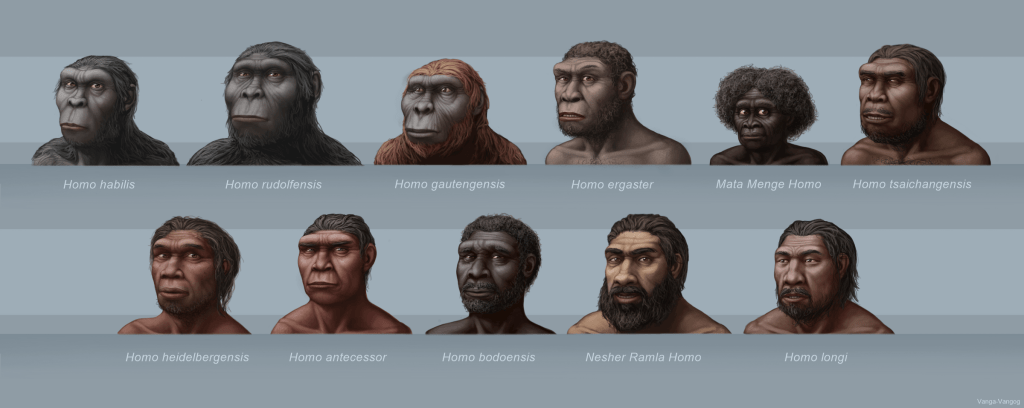
Other species thrived in more isolated environments. On the island of Flores in Indonesia lived Homo floresiensis, often nicknamed the “hobbit” because of its small stature. Despite its diminutive size, this species produced stone tools and likely controlled fire, persisting until around 60,000 years ago. In the Philippines, another small-bodied species, Homo luzonensis, has been identified from remains dating between 67,000 and 50,000 years ago. These island species highlight how isolation could produce unique evolutionary experiments within the genus Homo.
In Africa, earlier lineages had already left their mark. Homo naledi, known from the Rising Star cave system in South Africa, lived between 335,000 and 236,000 years ago. Their remains show an unusual mix of primitive and modern features, alongside evidence suggesting deliberate placement of bodies in cave chambers. Although not contemporaneous with Neanderthals or Denisovans, Homo naledi demonstrates that the human family tree was even more diverse than the late-surviving species of the Pleistocene.
These populations were not fully isolated from one another. Modern genetic evidence shows that Neanderthals and Denisovans interbred with Homo sapiens, and a few individuals even carry ancestry from both. Today, people of non-African descent typically have about 1–2 percent Neanderthal DNA, while some Oceanian groups carry up to 4–6 percent Denisovan DNA. Our genomes are a living archive of those encounters.
Why so many human lineages disappeared remains an open question. Climate fluctuations would have stressed small, scattered populations. Competition for resources may have sharpened between overlapping groups. New pathogens could have devastated communities without immunity. In some cases, Homo sapiens likely held advantages in technology, social organization, or long-distance networks of exchange. But randomness also played a role: survival at evolutionary bottlenecks is often as much about chance as about superiority.
By about 32,000 years ago, only one human species remained – Homo sapiens. Neanderthals had vanished from their European strongholds, Denisovans disappeared from the high plateaus of Asia, and the island species had long gone extinct. What survives of this lost diversity are fragments of bone, stone tools, and strands of DNA that remind us of a time when humanity was not a single lineage but a family of experiments in survival.
Far from a story of inevitable triumph, the rise of Homo sapiens is a reminder of how precarious our own existence once was. The fact that we endure may owe less to strength or intelligence than to timing, adaptability, and the accidents of evolutionary history.
Sources
• Dirks, P. H. G. M., et al. “The age of Homo naledi and associated sediments in the Rising Star Cave, South Africa.” eLife, 2017.
• Smithsonian National Museum of Natural History. “Homo naledi.” Updated January 3, 2024.
• Détroit, F., et al. “A new species of Homo from the Late Pleistocene of the Philippines.” Nature, 2019.
• Brumm, A., et al. “Age and context of Homo floresiensis remains from Liang Bua, Flores.” Nature, 2016.
• Antón, S. C., et al. “Redating Homo erectus at Ngandong, Java, Indonesia.” Nature, 2019.
• Higham, T., et al. “The timing and spatiotemporal patterning of Neanderthal disappearance.” Nature, 2014.
• Chen, F., et al. “A late Middle Pleistocene Denisovan mandible from the Tibetan Plateau.” Nature, 2019.
• Huerta-Sánchez, E., et al. “Altitude adaptation in Tibetans caused by introgression of Denisovan-like DNA.” Nature, 2014.
• Green, R. E., et al. “A draft sequence of the Neandertal genome.” Science, 2010.
• Reich, D., et al. “Denisova admixture and the first modern human dispersals into Southeast Asia and Oceania.” American Journal of Human Genetics, 2011.
• Slon, V., et al. “The genome of the offspring of a Neanderthal mother and a Denisovan father.” Nature, 2018.
 The Rowanwood Chronicles