
In the windswept corridors of Latin American geopolitics, the tensions between the United States and Venezuela have quietly transformed into something far more consequential than a mere counternarcotics campaign. As of late 2025, the scale of U.S. military deployment in the Caribbean, centered around the gargantuan USS Gerald R. Ford carrier strike group, marks not just a show of force, but a deeply calculated exertion of power. Beyond the stated mission of interdiction of drug trafficking, this posture suggests a layered strategy: pressuring Maduro, reasserting Washington’s influence in the region, and signaling to Latin American capitals that the era of passive U.S. tolerance may be drawing to a close.
From Caracas’s perspective, this is viewed not as a benign counternarcotics mission but as a direct existential threat. The Venezuelan leadership has responded by mobilizing broadly; ground, riverine, naval, aerial, missile, and militia forces have reportedly been readied for “maximum operational readiness.” Estimates suggest on the order of 200,000 troops could be involved, underscoring how deeply Maduro’s government perceives the risk. In public discourse, the Venezuelan regime frames this as defending sovereignty, not only against cartel-linked accusations but also against what it claims is a looming imperial design.

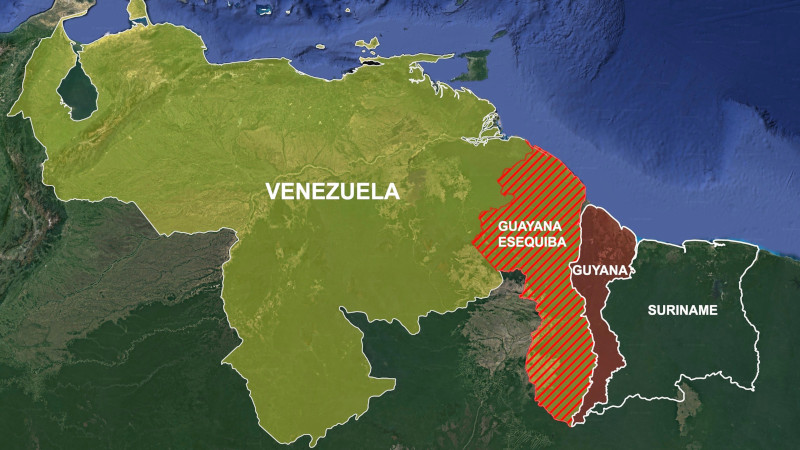
This confrontation cannot be fully understood, however, without examining Guyana and the long-running territorial dispute over the Essequibo region. Essequibo is no trivial piece of geography: historically claimed by Venezuela, it comprises more than two-thirds of Guyana’s land mass and borders rich offshore blocks. In recent years, ExxonMobil, Hess, CNOOC, and others have developed significant oil infrastructure just off Guyana’s coast, especially in the Stabroek Block.
Tensions flared visibly in March 2025, when a Venezuelan coast guard vessel sailed deep into waters claimed by Guyana, radioed warnings to floating production storage and offloading (FPSO) platforms, and asserted those vessels were operating in “Venezuelan” maritime territory. Guyana’s foreign ministry publicly protested, noting that the incursion violated not only its sovereign economic zone, but also a 2023 International Court of Justice order that prohibited Venezuela from taking actions that might change the status quo. Guyana also emphasized that its exploration and production activities are lawful under international law, and referenced its rights under the 1899 arbitral award.
From a strategic lens, Venezuela’s behavior in Essequibo aligns too neatly with its military mobilization against the U.S. The annexation drive, or at least the territorial claim, is not ideological romanticism, but realpolitik rooted in energy security. On multiple occasions, President Maduro has authorized Venezuelan companies, including PDVSA, to prepare for fossil fuel and mineral extraction in the disputed Essequibo territory. In Caracas’ calculus, asserting control over Essequibo could transform its geopolitical position: it reclaims a historical claim, undermines Guyana’s sovereignty, and potentially gives Venezuela leverage over lucrative offshore oil fields.
The U.S. is not blind to this. Washington’s backing of Guyana is deliberate and multilayered. Secretary of State Marco Rubio’s warnings to Maduro, at a joint press conference with Guyanese President Irfaan Ali, make clear that the U.S. considers any Venezuelan aggression against Guyana, especially against ExxonMobil-supported oil platforms, as a red line. For Guyana, which has very limited military capacity, the American presence is both a shield, and a bargaining chip; for the U.S., it’s a way to protect strategic investments, ensure energy flows, and project influence in a region increasingly contested by non-Western actors.
Yet, this is not a zero-sum game with only force on the table. Venezuela’s framing of U.S. activity as an imperial threat resonates powerfully with its domestic base, allowing Maduro to marshal nationalist sentiment and justify radical mobilization measures. The Bolivarian militias, riverine units, and civilian enlistment signal a willingness to wage not just conventional defense, but also hybrid and asymmetric warfare. The mobilization is as symbolic as it is practical.
At the same time, Guyana is investing in a diplomatic-legal offensive. The Guyanese government has formally protested Venezuelan naval incursions and made repeated appeals to the ICJ. International support for Guyana is gathering pace: the Organization of American States and other regional bodies have backed its territorial integrity. In parallel, Washington’s military buildup, dressed as counternarcotics, is likely calculated to saturate the region with deterrence against both terrorist/criminal maritime networks and more ambitious Venezuelan designs.
The risk now is of miscalculation. If Caracas underestimates Washington’s resolve, or if Guyana feels compelled to resist more aggressively, escalation could spiral. But equally, if the U.S. overplays its hand, moving from deterrence to coercion, it risks pushing Venezuela further into isolation or desperation, which could destabilize not only Caracas, but the broader region.
In the broader sweep of history, this crisis may well mark a turning point. Venezuela’s push into Guyana is not just about land; it’s about energy, influence, and the assertion of sovereignty in a global order where resources still drive power. For the U.S., the operation may begin as counternarcotics, but the strategic subtext is unmistakable: protecting American economic interests, reestablishing hemispheric primacy, and shaping the future of Latin America in an era of renewed geopolitical competition.
At Rowanwood, we often say that old maps matter: not just for their lines, but for what those lines mean when power shifts. Here, in the tropical currents of the Caribbean and the oil-laden jungles of Essequibo, the maps are being redrawn – quietly, dangerously, and with very real stakes for the future.
 The Rowanwood Chronicles