Building Home and Sovereignty: Indigenous-Led Modular Housing Across Canada

Indigenous-led housing initiatives across Canada are demonstrating how culturally rooted design, workforce development and modular building technology can be combined to produce durable, energy-efficient homes while returning economic agency to Indigenous communities. A clear example is the Keepers of the Circle project in Kirkland Lake, a women-led social enterprise building a 24,000 square foot modular factory to produce prefabricated panels and whole homes for northern communities. The project positions the facility as a year-round training centre focused on Indigenous women and 2SLGBTQQIA+ people and aims to deliver passive, off-grid capable homes that reduce mould, overcrowding and winter construction constraints.  

Modular construction matters in the North because it shifts much of the work indoors, shortens on-site assembly time and allows for higher quality control and better insulation choices than conventional stick-built homes. Projects that couple those technical advantages with local control multiply the social return. For example, NUQO and other Indigenous-owned modular firms emphasize culturally informed design and female leadership in construction, showing that modularity can be adapted to Indigenous aesthetics and community needs rather than imposed as a one-size-fits-all solution.  

At a larger urban scale, the Squamish Nation’s Sen̓áḵw development shows another side of Indigenous-led housing. Sen̓áḵw is an unprecedented City-building project on reserve land in Vancouver that will deliver thousands of rental units while generating long-term revenue for the Nation and reserving units for community members. It signals how Indigenous land stewardship paired with contemporary development can both address housing supply and shift municipal relationships with Nations.

Innovation is not limited to factory scale or towers. Community-driven designs such as Skeetchestn Dodeca-Homes merge Secwepemc cultural principles with modular technology to create homes tailored for rural and on-reserve realities. These initiatives highlight the importance of design sovereignty, where communities set performance, materials and spatial priorities that reflect family structures and cultural practice.  

Practical collaborations are emerging to accelerate delivery. Rapid-response modular programs and partnerships with existing manufacturers have been used to deploy units quickly to remote communities, showing a template for scale if funding, transportation and on-reserve financing barriers are addressed. Yet systemic obstacles remain, including the complex financing rules for on-reserve mortgages, patchwork funding across provinces and the logistics of shipping large components into remote regions.  

Taken together, the landscape suggests a pragmatic pathway: support Indigenous-led factories and design teams to ensure cultural fit and local jobs, expand funding mechanisms and credit products tailored to on-reserve realities, and prioritize modular, high-performance assemblies that cut costs over a building’s life. When Indigenous governance, training and technical innovation work in tandem the result is not just more housing but a model of reconciliation that builds capacity, preserves culture and produces homes that last.

Sources
Keepers of the Circle modular factory page.
NUQO modular housing company.
Squamish Nation Sen̓áḵw project page.
Skeetchestn Dodeca-Homes project page.
ROC Modular rapid-response and modular housing examples.  

Canada Day 2025: We the Land, We the People, We the Future

Each year, as summer settles across this vast country, Canada Day offers more than a pause to celebrate; it becomes a mirror. It reflects where we’ve been, how far we’ve come, and what still lies ahead. In 2025, that mirror shows a country in motion: humbled by hard truths, energized by change, and cautiously hopeful about its collective future.

Canada’s greatest strength has always been its people, more specifically, the way those people form communities, across difference, distance, and time. Whether it’s neighbourhoods organizing around mutual aid during crises, newcomers finding belonging through language and culture, or Indigenous and non-Indigenous Canadians working to build bridges of understanding, the story of Canada has always been about finding common cause in uncommon diversity.

A Country That Listens
The last decade has been a time of awakening. We have begun, in earnest, to face the truths long buried beneath the official narratives. The unmarked graves at residential school sites shook the conscience of the nation. The calls to action from the Truth and Reconciliation Commission and the National Inquiry into Missing and Murdered Indigenous Women and Girls have challenged us to move beyond apologies; to action, to justice, and to shared governance.

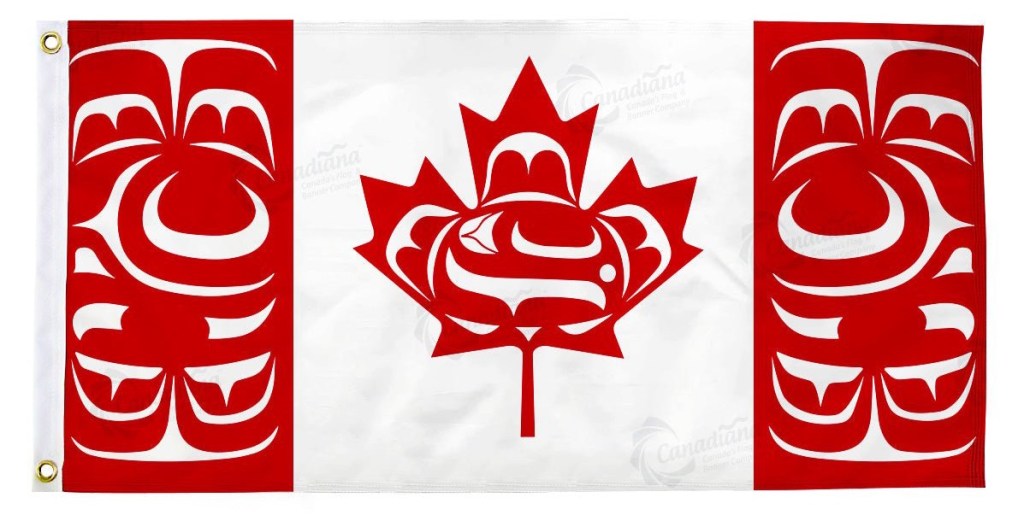
This year, as we mark Canada Day, many communities will fly the flag not just alongside fireworks, but beside Indigenous symbols and ceremonies. This is not tokenism, it is a recognition that Canada cannot be whole until its relationship with First Nations, Inuit, and Métis peoples is grounded in truth, respect, and partnership. We are not “including” Indigenous peoples in Canada. They are foundational to it. The land we gather on, from coast to coast to coast, has always been home to Indigenous Nations whose stewardship, governance, and wisdom predate Confederation by millennia.

Art by Mervin Windsor

Building Communities Worth Belonging To
Canada is changing, and so too is our idea of what belonging looks like. From the refugee who opens a bakery in a prairie town, to the queer teen finding affirmation in a Pride flag at city hall, to the elder reconnecting with their Anishinaabe language after decades of suppression, these are the quiet revolutions that define who we are becoming.

What binds us is not sameness, but a shared commitment to live well together. In our towns and cities, on reserves and in rural areas, Canadians are building communities that emphasize care, inclusion, and responsibility to one another. That might mean ensuring affordable housing, supporting local food systems, protecting public health care, or reimagining schools and services that honour different ways of knowing and being.

This is no small task in an era of global uncertainty, but across Canada, there is a growing understanding that prosperity isn’t measured solely in GDP, but in how well we support one another, and how wisely we care for the land we share.

A Collective Future Rooted in Respect
Canada Day is no longer a day of uncritical pride. It has become a space of reflection; of mourning, of gratitude, and of possibility. That shift is healthy. It shows maturity. It means we are ready to move past mythologies and start shaping a future based on partnership and mutual responsibility.

We must reject any vision of Canada that seeks to divide, exclude, or erase. Instead, we can choose a model of governance that is not merely tolerant, but collaborative. One where Indigenous laws sit alongside Canadian law, where treaties are living agreements, not dusty documents, and where decisions about land, water, and resources are made together, with full consent and shared benefit.

This is already happening. Across the North, in B.C., in the courts and in the communities, new models of co-governance are emerging. Indigenous youth are leading language revitalization and climate action. Urban reserves are revitalizing local economies. Land acknowledgements are being matched with land back initiatives. These are not threats to Canada, they are Canada’s best chance at becoming whole.

Choosing Hope
As we gather this Canada Day; on picnic blankets, around bonfires, in ceremonies, and in celebrations, let us remember that patriotism need not mean perfection. It can mean care. It can mean commitment. And it can mean an unwavering belief that we can do better – together.

The maple leaf is not just a symbol of peace and modesty. It’s a living thing, growing, branching, changing with the seasons. So too is this country.

Let us plant our feet not in nostalgia, but in the present. Let us honour the ancestors, Indigenous and settler alike, whose sacrifices shaped this land. Let us listen deeply to the truths we once ignored, and let us walk, side by side, into a future that is more just, more joyful, and more deeply rooted in shared respect.

Happy Canada Day – to the land, to the people, and to the promise of what we can build, together.

Alberta, the Treaties, and the Illusion of Secession

It is a curious feature of Canadian political discourse that every few years, the spectre of Alberta separatism re-emerges, driven largely by feelings of Western alienation or perceived federal overreach. Yet few of its proponents seem to understand the constitutional, historical, and moral terrain on which they stake their claims.

Most glaringly, the notion that Alberta could legally or legitimately secede from Canada ignores the foundational reality that this province exists entirely upon Indigenous treaty land: Treaties 6, 7, and 8, signed decades before Alberta was even established.

Treaty Obligations: The Legal Bedrock
Treaties 6 (1876), 7 (1877), and 8 (1899) are not quaint relics of the colonial past. These were solemn nation-to-nation agreements made between the British Crown and various Indigenous nations; primarily Cree, Dene, Blackfoot, Saulteaux, Nakota, and others. The Crown, not the provinces, is the party to these treaties. This distinction matters enormously: Alberta, created in 1905, was superimposed upon lands already bound by legal and moral obligations that persist to this day.

Treaty nations agreed to share the land, not to surrender it to a future province. Indigenous consent was given to the Crown, not to the provincial governments that came later. As such, Alberta’s claims to land, resources, and governance are valid only to the extent that they flow through the Crown’s treaty responsibilities, not through any inherent sovereignty.

The Supreme Court Speaks: Secession Is Not a Unilateral Act
This legal landscape was sharply clarified in the Supreme Court of Canada’s landmark Reference re Secession of Quebec (1998). The Court ruled decisively that no province has a unilateral right to secede. Any attempt at secession would require negotiations with the federal government and with other provinces and, crucially, with Indigenous peoples.

The Court emphasized that Indigenous peoples have rights protected under Section 35 of the Constitution Act, 1982, and that their consent is a necessary component of any major constitutional change. As the ruling states:

“The continued existence of Aboriginal peoples, as well as their historical occupancy and participation in the development of Canada, forms an integral part of our constitutional fabric.” (Secession Reference, [1998] 2 S.C.R. 217)

This is not simply a legal technicality. It is a reaffirmation of the reality that Canada is a nation founded not just through British and French settler traditions, but through treaties with Indigenous peoples, treaties that are still very much alive in constitutional law.

Indigenous Sovereignty and the Fallacy of Secession
The idea that Alberta could leave Canada while continuing to govern Indigenous treaty land is untenable. Indigenous peoples were never consulted in the creation of Alberta, and any attempt by the province to secede would, by necessity, face resistance from Indigenous governments asserting their own sovereignty.

During the Quebec referendum in 1995, the Cree and other First Nations asserted that they would remain in Canada regardless of Quebec’s decision. They argued, correctly, that their treaty relationships were with the Crown, not the province of Quebec. The same principle applies here: Treaty First Nations in Alberta are under no obligation to follow a secessionist provincial government. In fact, they would have a powerful legal and moral claim to reject it.

Furthermore, the United Nations Declaration on the Rights of Indigenous Peoples (UNDRIP), which Canada has committed to implement, recognizes the inherent right of Indigenous peoples to self-determination. Any secession that disregards that right would contravene both domestic and international law.

No Secession Without Consent
In short, Alberta cannot separate from Canada without first navigating the constitutional reality of treaties, Indigenous sovereignty, and the Supreme Court’s own binding interpretation of secession. The land on which Alberta stands is not Alberta’s to take into independence. It is treaty land, Indigenous land, shared under solemn agreement with the Crown.

Alberta exists because those treaties allowed Canada to exist in the West. To attempt secession without Indigenous consent is to ignore the very foundations of the province itself.

If separatist advocates wish to have a serious conversation about Alberta’s future, they must first understand its past, and the enduring obligations it entails.

Sources:
Supreme Court of Canada. Reference re Secession of Quebec, [1998] 2 S.C.R. 217
Constitution Act, 1982, Section 35
United Nations Declaration on the Rights of Indigenous Peoples (UNDRIP), 2007
Indigenous and Northern Affairs Canada. “Treaties 6, 7, and 8.”
Royal Commission on Aboriginal Peoples, Volume 1 (1996)
Borrows, John. Recovering Canada: The Resurgence of Indigenous Law (2002)

Resetting the Relationship: A Vision for a True Indigenous Partnership

As the dust settles from the recent election, there’s a palpable sense that the Liberal Party has been handed not just another mandate, but a historic opportunity; to begin building a new Canadian future rooted in respect, renewal, and real partnership with Indigenous peoples.

This isn’t merely an electoral moment. It’s a constitutional and moral one, and with the planned visit of King Charles III, it’s time to reset the relationship. 

The last decade saw growing national awareness around reconciliation, but also hard truths: court rulings reminding us of Canada’s obligations, tragedies like unmarked graves that brought history into the present, and persistent gaps in housing, healthcare, and infrastructure that continue to shape the daily lives of Indigenous families. The incoming government must now shift the conversation from acknowledgment to architecture. From reconciliation as sentiment to reconciliation as structure.

And that starts with one fundamental premise: Indigenous peoples are not stakeholders. They are nations, governments, and partners. That means our approach must be built not on program delivery, but on rights recognition, not on federal paternalism, but on Indigenous self-determination.

At the core of the Liberal government’s first steps should be a legislative framework for implementing the United Nations Declaration on the Rights of Indigenous Peoples (UNDRIP). While Bill C-15 laid important groundwork, it must now be operationalized across the federal system, with Indigenous consent and co-development embedded in environmental regulation, resource management, and national law. A new generation of legal pluralism is needed, one that supports Indigenous legal systems in areas like child welfare and justice, alongside Canadian institutions.

Health care is another frontline. The federal government has made strides, but now must go further by supporting the creation of a fully Indigenous-governed national health authority. The British Columbia model has shown us what’s possible. Culturally grounded, community-run care is not a luxury, it’s a human right. This includes mental health programs rooted in ceremony and land-based healing, supported through sustained federal investment.

Education is likewise a transformative space. Indigenous-run schools, immersion language programs, and universal post-secondary supports aren’t just policies, they are acts of resurgence. They offer a way forward not just for Indigenous youth, but for Canada itself, by rebuilding cultural foundations dismantled through generations of colonial education.

Meanwhile, the housing and infrastructure crisis in Indigenous communities must be treated with the urgency of a national emergency. No government can speak of reconciliation while children live in overcrowded homes, and communities boil their water for decades. The incoming government must move quickly to fund 25,000 new homes and eliminate every long-term boil water advisory, with planning and implementation led by Indigenous governments themselves.

Yet, reconciliation isn’t only rural. More than half of Indigenous people now live in urban centres. Yet their voices are often excluded from nation-to-nation dialogues. That has to change. The new Liberal government should support Indigenous-led urban governance models, recognizing urban Indigenous peoples not as dislocated citizens but as rightful partners in policy design and delivery.

The question of representation also looms large. If we’re serious about nation-to-nation relationships, then Indigenous peoples must have permanent seats at the table, literally. That could mean Indigenous representation in Parliament or the establishment of a Council of Indigenous Nations with the authority to review federal legislation. Either way, the message must be clear: the age of unilateralism is over. Perhaps a dedicated number of seats in the House of Commons and Senate, similar to the New Zealand system, might see Indigenous voices heard in the legislative process? 

This is the path toward a new Canadian approach, one that accepts the truth of the past but refuses to be limited by it. The Liberal Party has long seen itself as a nation-building force. Reconciliation must be at the center of that vision now. Not as a political issue, not as a file on a minister’s desk, but as the defining project of a generation.

We have the ideas. We have the frameworks. What we need now is the political will to turn commitments into laws, pilot projects into national systems, and partnerships into power-sharing. If we get this right, Canada will not only be more just, it will be stronger, more resilient, and more united than ever before.

Reviving Voices: How Canada is Fighting to Save Indigenous Languages

Each year on March 31, Canada pauses to recognize National Indigenous Languages Day, a moment to reflect on the state of Indigenous languages across the country. For many, this is not just a symbolic date on the calendar; it is a call to action, a reminder of both the fragility and resilience of the more than 70 Indigenous languages spoken in Canada today. These languages, rooted in the land, carrying centuries of knowledge, culture, and identity, have survived despite relentless attempts to erase them. Now, communities are fighting to bring them back to life.

The weight of history is impossible to ignore. For generations, Indigenous children were taken from their families and placed in residential schools, where speaking their native language was strictly forbidden. The goal was assimilation, the devastating impact still felt today. Some languages have been lost entirely, while others teeter on the edge of extinction, with only a handful of fluent speakers left. Yet, amid this painful legacy, a quiet, but determined movement is growing, breathing new life into words and phrases once whispered in secret.

In 2019, Canada passed the Indigenous Languages Act (ILA), recognizing Indigenous languages as fundamental to identity and committing to their protection. This legislation also led to the creation of the Office of the Commissioner of Indigenous Languages, tasked with supporting revitalization efforts. Government funding has followed, helping to sustain language programs across the country, though many communities argue that the support remains inconsistent and insufficient. Real change, they insist, must come from within, driven by those who have lived the loss and are determined to reclaim what was stolen.

One of the most promising efforts has been the growth of language immersion programs, where young learners are surrounded by their ancestral language from an early age. In places like Kahnawake, Mohawk immersion schools have become a beacon of hope, proving that with dedication and resources, language revival is possible. Universities and colleges have also stepped in, offering courses in Cree, Inuktitut, and other Indigenous languages, ensuring that the next generation of educators is equipped to pass on these traditions.

Beyond the classroom, technology has emerged as an unexpected ally. Apps like Duolingo, have introduced Indigenous languages such as Ojibwe and Michif, while YouTube channels and TikTok creators are making language learning accessible in ways that previous generations never could have imagined. Even radio and television stations, including the Aboriginal Peoples Television Network (APTN), continue to broadcast in Indigenous languages, reinforcing the presence of these voices in mainstream media.

Recently, Manitoba took a bold step in expanding the role of Indigenous languages in government. The province announced a pilot project to translate Hansard, the official transcript of legislative proceedings, into Indigenous languages. This project, starting with Anishinaabemowin, is expected to generate a wealth of linguistic material, supporting both language learners and artificial intelligence researchers; working to integrate Indigenous languages into modern technology. It also creates new jobs, with Manitoba actively recruiting Indigenous translators to bring this initiative to life.

Despite these efforts, challenges remain. Some Indigenous languages have so few speakers that urgent action is needed to prevent their disappearance. Others struggle with finding enough fluent teachers to meet demand. And while federal funding exists, it is often tied to bureaucratic processes that slow progress rather than support it.

Yet, if there is one thing that history has shown, it is that Indigenous languages, like the people who speak them, are resilient. National Indigenous Languages Day is more than just a commemoration; it is a reminder that these languages are still here, still fighting to be heard, and that their survival is a testament to the strength of the communities that cherish them.