
Let’s get this out of the way: my favorite Mission: Impossible movie isn’t Fallout, Ghost Protocol, or even Brian De Palma’s stylish original. It’s Mission: Impossible 2 – yes, the one with the doves, the slow motion, the leather jackets, and the long-haired Ethan Hunt. Directed by John Woo, MI:2 is often derided as the weakest in the series, but I’m here to make the case that it’s not only misjudged, it’s the most essential Mission: Impossible film ever made.
Why? Because MI:2 dares to be different. It wears its emotions, its aesthetic, and its mythic ambitions on its sleeve. It isn’t trying to be slick and restrained, it’s trying to be opera. While all the following franchise movies blur into one non-stop stream of Ethan, running, jumping and swimming, Woo’s offering stands out with epic, colourful, emotional scenes, even as we ignore the tension between the stars on set.
John Woo’s Operatic Vision and Mirror Play
John Woo didn’t just direct this movie, he painted it in fire and shadows. Known for his balletic action and emotionally-driven storytelling, Woo transformed the franchise from a Cold War puzzle box into a mythic fable about identity, loyalty, and sacrifice. His signature use of slow motion, dual pistols, and flying doves isn’t just flair – it’s true storytelling. His visuals aren’t grounded in realism, but in emotion, in metaphor, in motion.
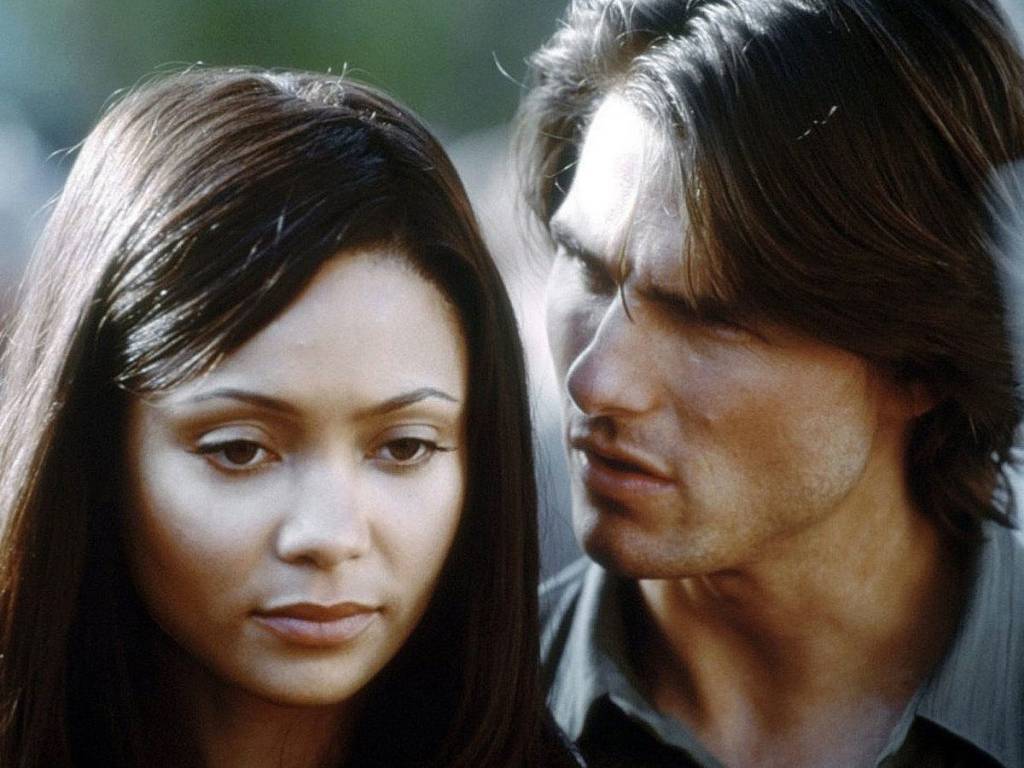
Nowhere is this clearer than in the mirrored choreography of the Spanish flamenco scene and the car chase that follows. The flamenco, intense, rhythmic, intimate, sets the stage. Nyah (Thandiwe Newton) is framed in a dance of danger and desire, her fate hanging in every beat. Then comes the high-speed courtship: Ethan and Nyah’s cars spin around each other on a cliffside, their metal dance echoing the flamenco footwork. Tires screech like heels on tile. It’s absurd, yes, but it’s also visual storytelling at its boldest. Love, risk, seduction, all told through spinning machines and glances, not exposition.
Woo is obsessed with duality. Mirrors, masks, doubles – these are his tools. The villain Sean Ambrose isn’t just another bad guy; he’s Ethan’s shadow. Same training, same skills, different soul. Woo externalizes this conflict in every frame: Ethan and Ambrose are fire and ice, destiny and destruction, two sides of a cracked mirror.
Romance as Central Conflict
Unlike the rest of the franchise, where Ethan’s personal life is often secondary, here it’s the engine. Nyah isn’t a plot device, she’s the heart of the story. Her relationship with Ethan isn’t just emotional texture; it’s the moral battlefield. And when she chooses to inject herself with the Chimera virus rather than let Ambrose use her as a pawn, she reclaims her agency in a way few MI women have.
This romance gives MI:2 its soul. The stakes aren’t just global, they’re personal. Ethan isn’t a superspy on autopilot. He’s a man in love, out of control, running toward catastrophe not just to save the world, but to save her. Later Ethan Hunts are defined by loyalty to team and mission. This Ethan is driven by something more elemental: passion.
Set Pieces as Mythic Theatre
MI:2 is filled with over-the-top set pieces, but each one has a purpose beyond spectacle. The free solo rock climb at the film’s start isn’t just cool – it’s symbolic. Ethan hangs off a cliff, alone, testing his limits. He’s already defying death before the mission even starts. The final motorcycle joust on the beach? Absurd, yes! But also a culmination of the film’s themes: man versus shadow, control versus chaos, love versus fear. Every slow-motion dive, every dove flying through flame, is there to remind us, this isn’t a covert op. It’s a Greek tragedy with motorcycles.
A Stylized, Mythic Ethan Hunt
Cruise leans into this version of Ethan with rare abandon. He’s romantic, cocky, vulnerable. He doesn’t just complete the mission, he bleeds, he burns, he breaks. This is the most emotional Ethan Hunt in the series, and possibly the most human.
Thandiwe Newton brings grace and strength to Nyah, whose sacrifice is the film’s emotional peak. And Dougray Scott, as the villainous Ambrose, is often dismissed but deserves better. He’s not just a bad guy – he’s a cracked reflection of Ethan, a reminder of what power without conscience looks like.
Why It’s Misjudged
Mission: Impossible 2 came out in a cinematic moment that wasn’t ready for it. Audiences were beginning to crave realism, the Bourne films were about to reset spy cinema, and Woo’s aesthetic – so earnest, so heightened – felt out of step. Critics saw melodrama where they should have seen myth, but time has been kind to MI:2. Rewatch it today, and it’s clear: this is the franchise’s emotional, artistic outlier, and maybe its boldest film.
It’s not the sleekest. It’s not the smartest. But it’s the one that took the biggest swing. In a franchise built around deception, misdirection, and masks, Mission: Impossible 2 may be the only film that dares to show us the face beneath. Not just Ethan’s, but the franchise’s own: ambitious, romantic, operatic, and unapologetically alive.
 The Rowanwood Chronicles