
It is almost impossible to talk about Justified without the gravitational pull of Raylan Givens and Boyd Crowder. The lawman and the outlaw. The hat and the sermon. Their dynamic is electric, their scenes mesmerizing. But if we stop there, we miss something quieter, yet no less vital: the women of Harlan County. They are not background ornaments. They are architects, operators, and sometimes arbiters of the county’s power.
Justified is, at its core, a show about negotiation: of power, of survival, of legacy, and its women navigate that negotiation with courage, intelligence, and persistence. They do not always receive accolades for their choices. They are rarely celebrated in tidy narrative terms. But they endure. They plan. They adapt. And through them, the show demonstrates that influence in Harlan County is rarely a matter of brute force alone.
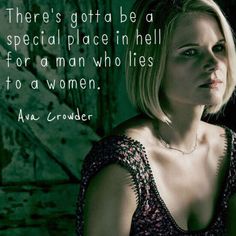
From the first season, Ava Crowder (Joelle Carter) establishes the stakes for women in this world. Killing Bowman Crowder, her husband’s brother, is an act of necessity, not spectacle. What follows is not freedom but responsibility. Ava spends the rest of the series managing consequences, trying to carve stability in a world that punishes female assertiveness. By the time she runs the bar, she is no longer reacting to Boyd’s schemes—she is shaping outcomes herself. Her story is not about redemption. It is about agency and the cost of holding it.
Winona Hawkins (Natalie Zea) embodies a different but equally compelling form of strength. She does not wield influence through violence. She wields it through clarity and boundaries. Winona sees Raylan for who he is and refuses to shrink herself to accommodate him. She plans for herself and her child, navigating danger without illusion. In a genre where women are often defined by attachment to men, Winona functions as a moral and strategic measure, someone whose decisions ripple outward, shaping the male protagonist as much as he shapes hers.
Mags Bennett (Margo Martindale) is the series’ most commanding female presence. Mags is authority incarnate, her power flowing from land, legacy, and an encyclopedic understanding of loyalty and leverage. She manipulates, protects, and threatens with equal grace. Her final act is not defeat but authorship. Through Mags, Justified demonstrates that women can embody menace and sophistication simultaneously, and that female power does not need narrative apology.
Loretta McCready (Kaitlyn Dever) represents the adaptive, forward-looking dimension of female agency. Starting as a teenager growing weed to survive in a county that offers her nothing, she inherits Mags’ fortune and invests it strategically, buying land and positioning herself for the future. Loretta anticipates change, particularly legalization, and adapts faster than the men around her. She is clever, deliberate, and allowed to grow without punishment, one of the quietest, but most revolutionary arcs on the show.
Ava and Loretta represent two sides of the same coin: inherited constraint and adaptive ambition. One negotiates consequences, the other seizes opportunity. Both highlight Justified’s commitment to showing women who act deliberately within systems that seek to contain them.
Rachel Brooks (Erica Tazel) offers another vision of female authority. Beginning as a competent U.S. Marshal and rising to lead the office, Rachel reins in Raylan not through theatrics, but through competence and moral authority. Her power is quiet, principled, and unassailable, demonstrating that leadership is not measured in gunfights or legend alone.
Even secondary figures contribute meaningfully. Ellen May survives through stubborn presence rather than dominance. Wendy Crowe navigates family chaos with foresight disguised as meekness. Katherine Hale exercises influence without violence, through strategy and capital. And Helen Givens, Raylan’s stepmother, though less visible on-screen, represents moral grounding and continuity. She shapes Raylan’s choices not through confrontation, but through the quiet weight of family and conscience, reminding viewers that influence in Justified often comes from wisdom, care, and endurance, not only action or ambition.
Taken together, these women redefine what it means to hold space in a crime drama. They are not there to soften male narratives. They are not props for mythology or morality. They negotiate survival, power, and legacy in ways subtle, sometimes morally ambiguous, and always consequential. Strength in Justified is not always loud or victorious. Sometimes it is simply the refusal to disappear.
Raylan and Boyd carry the mythic frame of the series. They give us the Western, the duel, the rhetoric. But the women carry its realism. They see clearly, act deliberately, and influence the county, the protagonists, and the story itself in ways that make Harlan feel lived-in, generational, and real. They are not secondary. They are operators, planners, and survivors. And in a show obsessed with consequence, that is nothing short of revolutionary.
 The Rowanwood Chronicles