Objective vs. Subjective Truth: Can Reality Be Independent of Perspective?

With many of our political leaders and wannabes being even more flexible with facts these days than usual, especially during elections and internal party races, I felt I needed to get back into the whole Truth vs.Transparency debate.  The notion that truth depends on perspective is a long-standing debate in philosophy, epistemology, and even science. This idea, often associated with relativism, suggests that truth is not absolute, but rather contingent on individual experiences, cultural backgrounds, or frameworks of understanding. However, this claim is not without challenges, as there are also arguments in favor of objective and universal truths. To fully explore this concept, we must examine different domains where truth operates: subjective experience, science, social and political contexts, and philosophical thought.

Perspective and Subjective Truth
In many aspects of human experience, truth is shaped by individual perspective. This is especially evident in perception, memory, and personal beliefs. Two people witnessing the same event might recall it differently due to factors such as their background, cognitive biases, emotional states, or even the angle from which they viewed the scene. This idea aligns with psychological research on eyewitness testimony, which has shown that memory is often reconstructive rather than a perfect recording of reality.

Similarly, in moral and ethical debates, truth is often perspective-dependent. For example, the moral acceptability of euthanasia, capital punishment, or animal rights varies across cultures and individuals. Some believe that these issues have absolute moral answers, while others argue that they are contingent on cultural norms, social circumstances, or personal values. This form of truth relativism suggests that moral truths exist only within particular frameworks and are not universally binding.

The same can be said for aesthetic judgments. Whether a painting is beautiful or a piece of music is moving depends entirely on the individual’s perspective, cultural exposure, and personal taste. In these cases, truth appears to be entirely relative, as there is no objective standard for determining beauty or artistic value.

Scientific and Objective Truth
While subjective truths are shaped by perspective, there are many instances where truth appears to be independent of personal viewpoints. In science, for instance, objective truths are discovered through empirical evidence and repeatable experimentation. The boiling point of water at sea level is 100°C, regardless of who measures it or what they believe. The theory of gravity describes forces that apply universally, irrespective of individual perspectives. These facts suggest that some truths exist independently of human perception and belief.

However, even in science, perspective plays a role in shaping how truths are understood. Scientific paradigms, as described by Thomas Kuhn in The Structure of Scientific Revolutions, shift over time. What is considered “true” in one era may later be revised. For example, Newtonian physics was once seen as the ultimate truth about motion and force, but Einstein’s theory of relativity redefined our understanding of space and time. This suggests that while some scientific truths may be objective, our understanding of them is influenced by perspective and historical context.

Social and Political Truths
In social and political discourse, truth is often contested, shaped by competing narratives and interests. Political ideologies influence how events are interpreted and presented. The same historical event can be described differently depending on the source; one news outlet may highlight a particular set of facts while another emphasizes a different aspect, leading to multiple “truths” about the same event.

This phenomenon is especially evident in propaganda, media bias, and misinformation. A politician may claim that an economic policy has been a success, citing certain statistics, while an opponent presents an alternative set of data to argue the opposite. In such cases, truth becomes less about objective reality and more about which perspective dominates public discourse.

Additionally, postmodern thinkers like Michel Foucault argue that truth is linked to power structures. Those in power determine what is accepted as truth, shaping knowledge production in ways that reinforce their authority. This perspective challenges the idea that truth is purely objective, suggesting instead that it is constructed through discourse and institutional influence.

Philosophical Challenges: Can Truth Ever Be Objective?
Philosophers have long debated whether truth is ultimately subjective or objective. Immanuel Kant, for example, argued that we can never access the world as it truly is (noumena), but only as it appears to us through our senses and cognitive structures (phenomena). This implies that all knowledge is shaped by human perception, making pure objectivity impossible.

On the other hand, Plato’s theory of forms suggests that there are absolute truths – unchanging, eternal realities that exist beyond the material world. Mathematical truths, for instance, seem to be independent of human perspective. The Pythagorean theorem is true regardless of culture, language, or opinion.

Existentialist philosophers like Jean-Paul Sartre take a different approach, arguing that meaning and truth are constructed by individuals rather than discovered. From this perspective, truth is not something external to be found but something we create through our actions and beliefs.

Is Truth Relative or Absolute?
The idea that truth depends on perspective holds significant weight in subjective, moral, and social contexts. In matters of perception, ethics, and politics, truth often appears to be relative, shaped by individual experiences, cultural backgrounds, and power dynamics. However, in science, mathematics, and logic, objective truths exist independently of human interpretation, though our understanding of them may evolve over time.

The challenge lies in distinguishing between what is truly relative and what is universally valid. While perspective influences many aspects of truth, dismissing the possibility of objective truth altogether leads to skepticism and uncertainty. A balanced approach recognizes that while some truths are shaped by perspective, others remain constant regardless of human interpretation.

A Year in the Wilds of The Rowanwood Chronicles

A reflective essay by the fellow who somehow decided that blogging about politics, climate, gender, and quantum mechanics was a relaxing hobby

I did not set out to become a blogger. No one does. Blogging is something that happens to you when you’ve said “someone should really write about this” one too many times and then realize the someone is you. That was my first year of The Rowanwood Chronicles. A steady accumulation of small irritations, large curiosities, and the occasional planetary existential dread finally pressuring me into a keyboard.

Over the past twelve months I have written about food systems, seismic faults, mononormativity, AI governance, and the demise of centralized social media platforms. This is, I admit, not a tidy list. Most writers pick a lane. I picked several highways, a few dirt roads, and one unmarked trail that led straight into a thicket of gender theory. Some readers have thanked me. Others have quietly backed away like I had started talking about cryptocurrency at a family barbecue. Fair enough.

The funny thing about running a blog with the byline “Conversations That Might Just Matter” is that you end up feeling mildly responsible for the state of the world. Somewhere in the back of my mind I became convinced that if I took one week off, climate policy would collapse, privacy laws would be gutted by corporate lawyers, and Canada would discover a massive geological fault running directly under my house. It is exhausting being the only person preventing civilization from tipping off its axis, but I have bravely carried on.

Along the way, I learned a few things.

First, people really do want long-form writing. They want context. They want to know why their health system is groaning like a Victorian heroine on a staircase. They want someone to explain decentralized social media without sounding like a blockchain evangelist who drinks only powdered mushroom tea. They want nuance rendered in plain language. I can do that. Sometimes even coherently.

Second, writing about politics is like trying to pet a squirrel. You can do it, but you have to keep your hands calm, your movements measured, and be prepared for the possibility that something small and unpredictable will bite you. Every time I published a political piece, I felt like I was tiptoeing across a frozen lake holding a hot cup of tea. Most of the time it held. Some days it cracked.

Third, the world is endlessly, maddeningly fascinating. One moment I was researching drought-related crop instability in the Global South. The next, I was reading government reports about flood plain management. Then I found myself knee-deep in a rabbit hole about the Tintina Fault, which sits there in the Yukon like an unbothered geological time bomb politely waiting its turn. Writing the blog became my excuse to satisfy every curiosity I have ever had. It turns out I have many.

What surprised me most was what readers responded to. Not the posts where I worked terribly hard to sound authoritative. Not the deeply researched pieces where I combed through reports like a librarian possessed. No. What people loved most were the pieces where I sounded like myself. Slightly bemused. Occasionally outraged. Often caffeinated. Always trying to understand the world without pretending to have mastered it.

That was the gift of the year. The realization that a blog does not need to be grand to be meaningful. It simply needs to be honest. Steady. And maybe a little mischievous.

I will admit that I sometimes wondered whether writing about governance, equity, and science from my small corner of Canada made any difference at all. But each time someone wrote to say a post clarified something for them, or started a discussion in their household, or helped them feel less alone in their confusion about the world, I remembered why I started.

I began The Rowanwood Chronicles because I wanted to understand things. I kept writing because I realized other people wanted to understand them too.

So here I am, a year older, slightly better informed, and armed with a list of future topics that spans everything from biodiversity corridors to the psychology of certainty. The world is complicated. My curiosity is incurable. And The Rowanwood Chronicles is still the place where I try to make sense of it all.

If nothing else, this year taught me that even in a noisy world full of predictions and outrage, there is room for thoughtful conversation. There is room for humour. There is room for stubborn optimism. And there is definitely room for one more cup of tea before I press publish.

The NRE Rule: Why Nothing You Say Should Count within the First 180 Days

I first shared a version of this article on Fetlife, where it sparked some discussion. My aim here is to focus on the experience of being in the NRE zone, rather than on the potential fallout that can sometimes occur around it. That said, I do include a few considerations you might find worth reflecting on. Enjoy!

Polyamory veterans know a universal truth: New Relationship Energy (NRE) makes people completely, gloriously bonkers. And not in a “quirky fun” way – in a “you just cancelled dinner with your long‑term partner because your new crush sent you a TikTok of a honey badger” kind of way.

For the uninitiated, NRE is that fizzy cocktail of dopamine, oxytocin, and serotonin your brain starts shaking up the moment you meet someone new who lights up your nervous system. Think champagne meets espresso meets a sugar rush. You’re drunk on possibility, jittery with lust, and convinced you’ve found The One (or The One Plus the Others You Already Love).

Your friends nod knowingly while making silent bets on how long before you resurface. Your partners smile politely while you quietly move your toothbrush back to your bathroom. And you? You’re busy imagining joint vacations, co‑buying an air fryer, and wondering whether it’s “too soon” to introduce them to your entire extended family. (Spoiler: yes, it is.)

The NRE Rule

My personal safeguard – forged in the fires of experience – is what I call The NRE Rule:

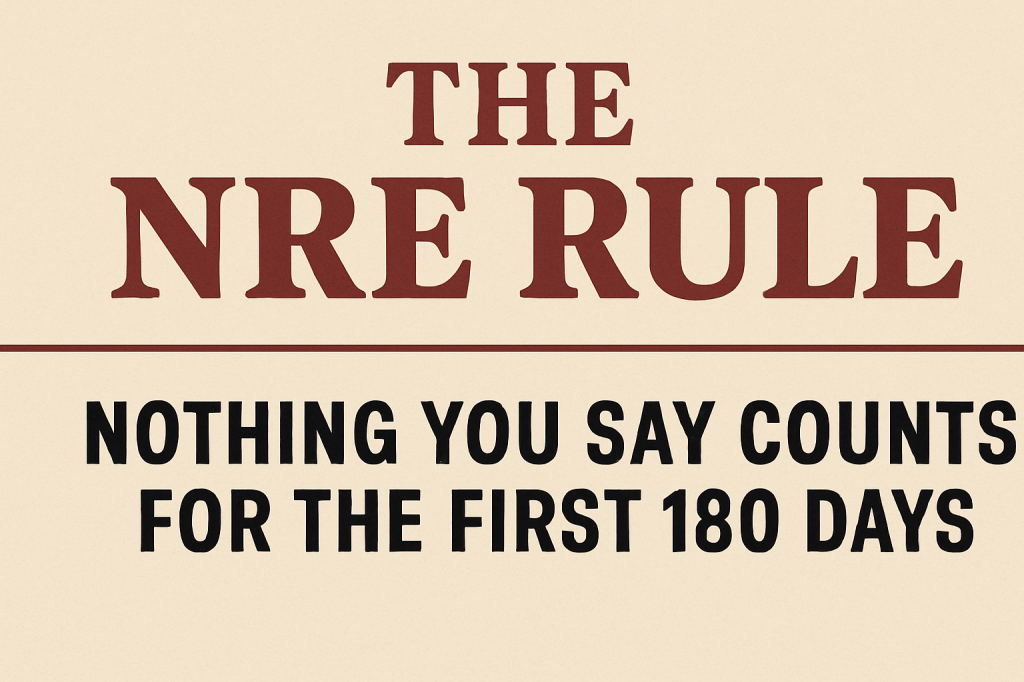
For the first 180 days, whatever you say to each other is lovely – even magical – but it doesn’t count for shit.
Come day 181, you’d better know what you’re saying and committing to… or else.

Why 180 days? Because science says that’s about how long it takes for the champagne bubbles of NRE to start going flat. The hormonal flood subsides, reality wanders back in wearing sweatpants, and suddenly you’re seeing this person in normal lighting – not just by candlelight or after three Negronis.

Neuroscience tells us that in those first months, your brain is actively conspiring to make you overlook flaws. Evolution likes this trick – it’s great for mating – but terrible for deciding who you should let rearrange your furniture.

Why It Works

The NRE Rule is not about being cynical. It’s about enjoying the high without buying real estate while you’re still tipsy. It:

  • Protects your long‑term loves from your NRE‑drunk time‑management disasters.
  • Keeps your new connection fun without attaching premature permanence.
  • Gives relationships breathing space to prove they work in ordinary, boring, real‑life conditions.

So by all means, whisper “forever” under the covers, build blanket forts, and make each other playlists. Just don’t sign a mortgage, merge your Netflix accounts, or promise to raise alpacas together until you’ve passed the 180‑day checkpoint.

Because here’s the thing: Day 181 is when the fun talk turns into real talk. That’s when “I’ll always be there for you” starts meaning right now, in this actual moment, with all our messy schedules and emotional baggage. It’s when the NRE sparkle gives way to the glow of real compatibility — or the thud of “oh… so that’s who you are.”

Until then? Enjoy the sugar rush. Just remember: before 180 days, you’re spending Monopoly money. After that? The bank account opens for real.

And I don’t care how cute they are – no one gets the air fryer until they’ve made it to Day 181.

The Jade Tree and Carl Jung’s Synchronicity

I hadn’t thought about her in over a year. No particular reason. No emotional weight behind it. She just drifted across my mind, calmly, clearly, and I noted it, then moved on.

Half an hour later, my phone buzzed. A message from her. No small talk, no explanation. Just a photo of a jade tree I’d given her a while back. It looked healthy. Thriving, actually. She thought I’d like to see how well it was doing.

I thanked her for the photo, wished her well, and left it at that. I didn’t feel any great pull to re-engage, but the moment stayed with me, not because of her, but because of the timing. The randomness. The feeling that something just lined up.

Carl Jung had a name for this kind of thing: synchronicity. He defined it as a “meaningful coincidence”. Two or more events connected not by cause and effect, but by meaning. They happen together, seemingly by chance, but resonate with something deeper. He saw it as a sign that there’s more to reality than we can see or measure. That sometimes, our inner world and the outer world speak to each other. Quietly. Precisely.

I’m not someone who needs to romanticize everything. People reach out. Thoughts come and go. But there was something clean about this particular moment; no buildup, no emotional noise. Just the sense of a thread that hadn’t fully frayed. A small echo between two people, delivered through a jade tree and a phone screen.

There’s no need to dig into it more than that. I wasn’t longing for her. I wasn’t unresolved, but when synchronicity shows up like this, I pay attention. Not because I think it means something I need to act on, but because it reminds me I’m connected to more than just what’s in front of me.

Jung believed these moments reflected the presence of a collective unconscious, a shared field of symbolic meaning, memory, and emotion. A psychic network we’re all tuned into, whether we realize it or not. Maybe that’s true. Maybe it’s simpler than that. Maybe we just carry people with us in subtle ways, and now and then, something stirs.

What I know is this: there was no reason for her to reach out when she did. And no reason for me to be thinking of her right before. But she did. And I was. And I’m glad I noticed.

The jade tree is still growing. That’s enough.

Her Power, My Rules: When a Submissive is a Real Alpha

She commands a room with a glance. Corporate meetings, brand deals, photo shoots, livestreams watched by thousands, she owns them all. My girl is a powerhouse in every sense. She’s in her 30s, brilliant, ferociously independent, raising kids and rising in an industry where power is often performative, and women are taught to either outdo men or obey them.

She does neither. She submits – to me.

I’m her older Daddy Dom. Retired. Steady. Quiet. A man who no longer needs to impress anyone, and in our private world, behind the soft chime of a voice note or the sharp tone of a command, she kneels. Not because she’s weak, because she chooses to lay down her power at my feet.

That’s not a contradiction. That’s the truth of submission most people can’t grasp: real power doesn’t vanish under discipline – it expands.

I Don’t Dom Her Potential – I Hold It
She didn’t come to me for control. She already controls everything. What she needed was containment. Someone who could see the whole of her and not be intimidated. Someone who would honor the woman, the brand, the mother, the CEO, and still grab her by the throat when the time was right.

My rules aren’t petty. They’re structural. She checks in before meetings, sends me her weekly intentions, wears specific underthings I’ve chosen for her to major events. I don’t micromanage her brand, I support the woman behind it. I help her carve out rituals that let her breathe.

And when she forgets herself, or needs to be brought back down from the ledge of performance and pressure? I correct her. Not cruelly. Not theatrically. Just enough to remind her that she doesn’t have to do it all alone.

She Makes Money. I Make Meaning.
There’s something that happens when an ambitious woman comes home to a Dominant who doesn’t need anything from her. I don’t want her money. I don’t curate her followers. I care that she ate today. That she’s sleeping enough. That she remembers who she is when the cameras are off.

She once said to me, “I’ve never had a man ask for less from me, and yet get more.”

She’s right. I don’t push her to produce. I make space for her to rest. And in that space, her submission blooms like something sacred.

Because here’s the truth: it takes a patient, considerate man to hold a woman like her. She is the Alpha Wolf in the public square, yet in my presence, she is a girl again. Not smaller, just softer. More fluid. More honest.

And I protect that space like it’s sacred.

Submission Is a Rebellion, Too
When we first began, she worried what people might think. “You’re older. You’re retired. You’re not in the scene like I am,” she said.

“You don’t need another performer,” I told her. “You need someone who sees past your act.”

She laughed. That was the moment we both knew.

She’s used to being the one people orbit, but in our dynamic, she surrenders. Not as a loss, but as a conscious, defiant act of rebellion against the world that insists she always be on.

When she kneels, she’s not giving up status. She’s reclaiming her soul.

We Negotiate With Truth, Not Fantasy
Our D/s doesn’t run on clichés. There are no 24/7 protocols that disregard her children’s needs. There are no humiliating tasks that undermine her role in the industry. Our play is intense, yes, but always integrated.

Sometimes she wears my collar under a power suit. Sometimes she sends a voice memo in the car before a pitch meeting “Daddy, I’m scared. Tell me I’ve got this.”

I tell her. Every time. Because my Dominance isn’t performative. It’s responsive. It adapts to her evolution without compromising its authority.

She calls it the most grown-up relationship she’s ever had.

Not Everyone Will Understand Us, and That’s Okay
Sometimes people within our inner circle ask her why a woman like her; beautiful, public, successful, would kneel to a retired, older man. They don’t understand that what we have isn’t about age or power imbalances. It’s about Resonance. Safety. Depth.

She once whispered in bed, after a scene, “I feel small and safe in your hands. Like everything I don’t show the world can just…..fall away.”

That’s the highest compliment a submissive can give, because when a woman like her chooses to submit, it’s not from need. It’s from trust.

And when a man like me receives it, it’s not from conquest. It’s from care.

There are many kinds of D/s relationships. Ours is not performative, or photogenic, or built for display. It is deeply intentional, ethically structured, and spiritually rich. She brings the storm. I hold the stillness. She is the Alpha in the world, but in my arms?

She is mine. Entirely.

Great Textpectations: And Other Hauntings From Ghosters Anonymous

Ah yes, ghosting, the ultimate disappearing act of the digital age. It’s like ditching a party through the bathroom window without so much as a “thanks for the snacks.” Passive-aggressive? Check. Lazy? Double check. But effective? Sure, if you count avoiding awkward conversations as an accomplishment. Spoiler alert – it’s not.

Let’s be real. Ghosting is less about sparing someone’s feelings and more about dodging accountability. It’s like saying, “I’m too emotionally constipated to have an adult conversation, so here’s eternal silence instead.” Bravo, ghoster. You’ve unlocked the relationship equivalent of turning off your phone and calling it self-care.

Now, here’s the plot twist: some people ghost people they actually like. Why, you ask? Oh, just a cocktail of commitment issues, fear of vulnerability, and the maturity of a houseplant. Think of it as emotional dodgeball, except they threw the ball, ran home, and never came back.

Research (and common sense) shows that people with attachment avoidance are the reigning champions of ghosting. These are the folks who would rather fake their own death than text, “This isn’t working out.” Instead, they fade away like a bad Wi-Fi signal, leaving you wondering if it was something you said, did, or wore (it wasn’t).

Here’s the kicker, ghosting isn’t about you. It’s about them. Their fears. Their insecurities. Their inability to handle adult-level emotions. So, when someone ghosts you, consider it a blessing. You just dodged a lifetime of, “Why won’t they talk about their feelings?” Pop the champagne and move on.

That said, let’s not sugarcoat it, ghosting hurts. It’s the emotional equivalent of yelling into an empty canyon and waiting for an echo that never comes. One minute you’re texting about your favorite pizza toppings, the next you’re refreshing your messages like a stock ticker in free fall. And just when you’ve pieced yourself back together, in shuffles the ghost turned zombie.

Ah yes, the zombie; a ghoster who rises from the dead with a “Hey stranger!” text at 2 a.m., as if they didn’t vanish like a magician’s rabbit. It’s the ultimate insult: “I didn’t care enough to stay, but I’m bored enough to come back.” Block them, delete the thread, and light a sage stick for good measure.

So, what’s the moral of the story? Ghosting is the coward’s way out. It’s a neon sign flashing, “I can’t handle hard conversations!” If you’re ghosted, clap for yourself because you dodged an emotional grenade. And if the zombie reappears? Ghost them right back. Poetic justice tastes even better than that pizza you never got to share.

No Seed, All Sizzle: My Secret Weapon in Modern Dating

I’ve learned there are a few phrases in a man’s conversational toolkit that can stop time, reset the vibe, and spark a flash of unexpected interest. “I cook a tasty risotto” is decent. “I volunteer at the local animal shelter” gets a respectful nod. Yet nothing, and I mean nothing, hits quite like “I’ve had a vasectomy.”

Boom. Eyes widen. Shoulders relax. Somewhere in the distance, you can almost hear a jazz saxophone kick in. Suddenly, I’m no longer just another charming guy with good shoes and half-decent banter – I’m the unicorn of casual dating. The Responsible One. The Guy Who Took the Hit So Nobody Else Has To.

Make no mistake, this is not about pity. I don’t limp into rooms or tell tragic tales of what was bravely left behind in a clinic that smelled faintly of antiseptic and regret. Quite the opposite. I say it with a wink and a little smile, because I know exactly what it means to them. No babies. No pills. No oopsies.

In that moment, it’s as if the entire weight of reproductive labour, historically dropped squarely on women’s shoulders, suddenly lifts. No tracking cycles. No last-minute pharmacy dashes. No quiet dread over a missed period, and a malfunctioning condom. I’m walking, talking sexual freedom, with a surgical receipt.

Now, not every woman reacts the same way. Some go wide-eyed and whisper “thank you” like I’ve just rescued a puppy from a burning building. Others get curious, like I’ve admitted I can tie knots with my tongue or moonlight as a tantra instructor. Either way, it’s a green light wrapped in satin and signed “with gratitude.”

The snip, you see, is the ultimate adult move. It doesn’t just say I’m not planning on having more (or any) kids. It says I’ve thought about consequences. I’ve taken action. I’ve made a permanent decision not to play Russian roulette with someone else’s uterus. That’s hot.

Sex becomes lighter. Freer. No post-coital math, no awkward “you on the pill?” conversations, no side-eye toward the bedside drawer and its expired latex. Just grown-up fun, with a safety net sewn in by a professional.

And let’s not ignore the sheer boldness of it. There’s something undeniably sexy about a man who says, “Yeah, I let someone down there with a scalpel, and I did it for the team.” That’s confidence. That’s swagger. That’s a whole new level of big dick energy (ironic, considering the location of the procedure).

So, yes, when I mention I’ve had a vasectomy, women’s eyes light up. Not just because of what it says about the plumbing, but because of what it says about the person attached to it. Consider it a plot twist, a punchline, and a promise: no surprises, just pleasure.

I may have had the tubes tied, but trust me, the vibes? Completely unleashed.

A Gentleman’s Guide to Fostering Love

At this point in my life, I’ve figured out who I am, and what I bring to the table. I’m not here for grand romantic illusions, nor am I fumbling through awkward first dates trying to impress anyone. No, what I do is far more refined – I teach, I mentor, I foster.

I provide a comfortable, well-appointed sanctuary for remarkable women in their 30s and 40s who are figuring out their next steps. They come into my life, full of ambition, wit, and occasionally a deep frustration with men who still haven’t mastered basic emotional intelligence. They stay for a while, we share some incredible experiences, and eventually, they find their forever home; sometimes with another partner, sometimes in a new adventure, and sometimes still with me, just in a different way.

Now, before you assume I’m some kind of wandering sage, let me be clear; I’m not a lonely old monk dispensing wisdom and jazz records. I’ve got a full, dynamic love life of my own. My partner in her 60s keeps me on my toes, challenging me in ways only someone who’s been around long enough to take no nonsense can. She’s my equal, my match, and my co-conspirator in navigating a life filled with love, humor, and a shared appreciation for craft ale, especially stouts. And then there are my younger partners, fiercely independent, brilliantly talented, and unwilling to settle for anything less than what they deserve.

I’m not collecting people; I’m building connections. And fostering isn’t about temporary fixes or waiting for someone to move on. It’s about appreciating the time we have together, without needing to force it into a predefined shape. Some partners stay in my orbit for years, others drift in and out, and it all works because honesty, respect, and a shared love of good conversation make everything smoother.

People often assume polyamory is chaotic, but that’s only if you’re doing it wrong. For me, it’s about balance. It’s about offering and receiving care without ownership. It’s about knowing that love isn’t a finite resource, and that just because someone moves on to another stage of their life doesn’t mean what we had wasn’t real.

And while I’ve fostered many wonderful women through various chapters of their journeys, let’s not forget, I’m a bit of a rescue myself. My partners challenge me, push me to grow, and occasionally force me to retire my outdated pop culture references. They bring new energy, new perspectives, and new reasons to keep up with life’s ever-changing rhythms.

So no, I don’t date in the traditional sense. I create space for extraordinary women to thrive, sometimes with me, sometimes elsewhere. And if that means I get to spend my years surrounded by sharp minds, quick wit, and an ever-expanding appreciation for different ways of loving? Well, I’d say that’s a pretty great forever home of my own.

A Pigeonhole for Every Personality

Have you noticed how obsessed western society is with pigeonholing people into neat little personality categories? From zodiac signs to Myers-Briggs types, it seems we can’t rest until we’ve crammed ourselves, and everyone else, into a box labeled with letters, numbers, or vague, semi-mystical descriptors. Aries male? Oh, you must be stubborn and impulsive. ENFP? Wow, you’re totally creative and scatterbrained. Big Five score leaning high in agreeableness? People-pleaser alert!

And yet, here I stand, a man who simply cannot be boxed. Yes, yes! We all think that! Whenever I take the Myers-Briggs test, my Introvert/Extrovert (I/E) score hovers awkwardly in the middle, waffling like a hungover short-order cook. “You’re not answering honestly,” the test experts claim. Well, excuse me for periodically liking a quiet evening at home and the occasional raucous dinner party. I’m sorry my human complexity doesn’t fit neatly into your binary little grid.

So, after decades of this existential crisis, I’ve decided to take matters into my own hands. I’ve created a new label for myself: ANTJ. It stands for “Ambivert (Neither This nor That Junkie),” and it’s a perfect match for my 60-plus years of observational data. An ANTJ thrives on ambiguity, refuses to commit to being either an introvert or extrovert, and gleefully resists every attempt to pigeonhole them.

The world’s addiction to personality tests doesn’t stop at Myers-Briggs. The Enneagram insists we’re all one of nine archetypes, like “The Helper” or “The Achiever,” while the DISC assessment asks whether we’re more “dominant” or “conscientious.” Gallup’s StrengthsFinder suggests that some of us are “Woo” types (which, hilariously, stands for Winning Others Over—basically extroverts on steroids). Even HEXACO dives deep into whether we score high on “honesty-humility.”

But here’s the kicker: these labels are treated like gospel. Once you’ve slapped on your type, whether you’re a “Type 7 Enthusiast” or an “Analytical Green”, you’re expected to live your life accordingly. Changing? Growing? Evolving? Don’t you dare! You’re an Aries male, so start yelling at someone, whilst buying a motorcycle already.

Frankly, I refuse to play along. I’m an ANTJ, a free agent in the world of personality classification. Want me to be outgoing? Sure, I’ll host a dinner party with great wine and bad karaoke. Want me to be introspective? Absolutely, and I’ll write you a heartfelt essay about it afterward.

So, to my fellow fence-sitters, I say this: embrace the waffle. Be an ANTJ, a proud dweller of the in-between. Just don’t let anyone box you in, or worse, force you to buy a subscription to yet another fucking personality test.

He Said, She Said: The Perks of Dating Across Generations

He Says: Dating an independent younger mother is like finding a partner with superhero qualities. She’s resilient, focused, and masterful at managing her time; better than most CEOs. She doesn’t need rescuing; she’s already fought her battles and won. What she values is a partner who brings wisdom, stability, and a calm presence in her whirlwind of responsibilities. For an older guy like me, it’s refreshing. There’s no pretense, no unnecessary drama, just an authentic, meaningful connection, built on mutual respect.

And let’s talk about her energy! It’s magnetic, a constant reminder that life is vibrant and full of possibilities. She keeps me engaged, challenges me to stay present, and proves that growing older doesn’t mean slowing down. More than that, she’s aligned with my thinking about the beauty of balance; how to be both independent and deeply connected.

She Says: Dating an older gentleman is like stepping into an oasis of calm after the daily chaos of parenting. He’s emotionally grounded, self-assured, and, best of all, done with playing games. My time is my most valuable asset, and I need someone who respects my schedule, understands my priorities, and supports me without trying to control or fix things. Older men get that.

What I love about him is his ability to listen, his steady presence. I’ve spent so much time managing crises and doing everything myself that it’s a relief to be with someone who can just be there without adding pressure. He doesn’t expect perfection, he values honesty and effort, and there’s something deeply reassuring about being with someone who knows who they are, what they want, and how to be a real partner.

He Says: Stability? Sure, but let’s talk about the fact that I’m learning just as much from her. Her independence is inspiring, it pushes me to be more adaptable, more open to change. And that vitality? It’s contagious. I may have a few gray hairs, but that doesn’t mean I’m set in my ways. If anything, her passion and determination remind me that life is about movement, growth, and embracing new experiences.

What makes this work is that we’re not trying to force anything. We don’t have to be everything to each other, but we show up when it counts. When life throws us curveballs, we face them together; no drama, no games. It’s a partnership built on respect, not expectations.

She Says: And let’s not forget patience. Older men have a way of slowing things down in the best possible way. In a world that’s constantly demanding more, that kind of presence is priceless. I used to worry about how a relationship might affect my kids, but with him, it’s just… easy. He’s patient with them, but he also knows when to step back and give me space to handle things. He respects the boundaries I’ve set as a parent, but he’s always there when I need him.

And the way he makes time for me, just us, no distractions, reminds me of how important it is to nurture the connection we’ve built. There’s an ease to being with him that I didn’t know I was looking for, and now that I’ve found it, I can’t imagine going back to anything less.

He Says: And that’s what makes it work, isn’t it? We’re not playing by anyone else’s rules. We’re just two people figuring it out together, supporting each other, growing together, and sharing a real connection. Her kids, her responsibilities, they’re part of the package, but they’re never a barrier. I’m not here to replace anyone or change anything; I’m here to be part of her life, to add something positive. And honestly, it’s one of the most rewarding things I’ve ever done.