
Mark Carney was sworn in as Canada’s 24th Prime Minister during March 2025, taking over from Justin Trudeau at a time of economic uncertainty, and escalating trade tensions with the United States. Carney, the former governor of both the Bank of Canada and the Bank of England, is widely seen as a steady hand in financial matters. His first major move as leader was to restructure the Liberal cabinet, streamlining its size and refocusing its priorities to address the most pressing issues facing the country.
One of the defining characteristics of Carney’s new government is efficiency. The cabinet has been reduced in size, reflecting longstanding calls within the Liberal Party for a more effective governance structure. With no more than 20 ministers, the streamlined approach is meant to improve coordination and decision-making. A key figure in this reshaped cabinet is Dominic LeBlanc, who takes on the powerful role of Minister of International Trade and Intergovernmental Affairs, while also serving as President of the King’s Privy Council. His extensive political experience positions him as a central player in both trade negotiations and federal-provincial relations, two areas where stability will be crucial.
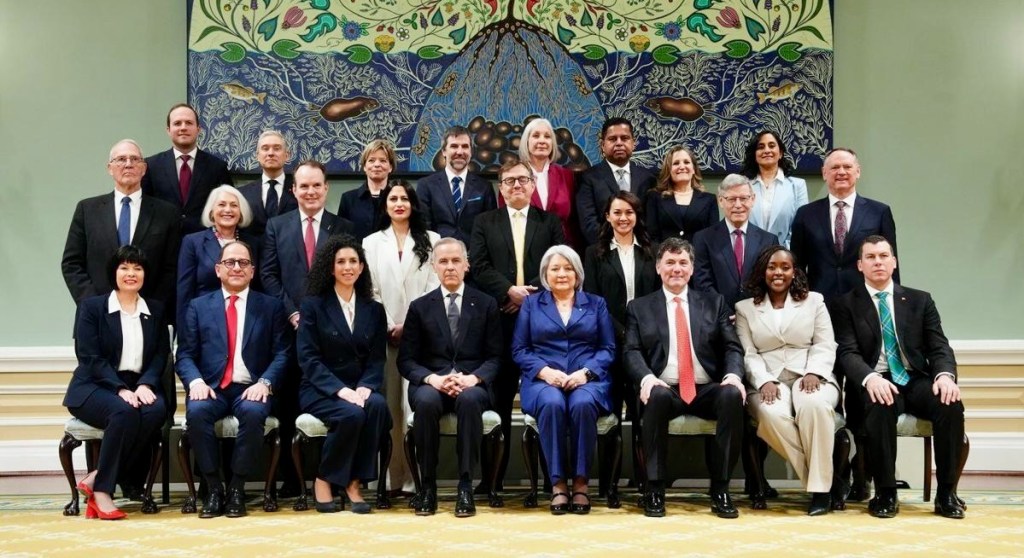
Mélanie Joly retains her role as Minister of Foreign Affairs, but with an expanded focus on international development. At a time of growing global instability, Canada’s diplomatic relationships will be under close scrutiny, particularly as tensions with the United States continue to simmer. Meanwhile, François-Philippe Champagne steps into the critical position of Minister of Finance. His background in trade and innovation makes him well suited to tackle Canada’s economic challenges, especially as the government navigates the fallout of trade disputes, and seeks to bolster domestic investment.
Another notable appointment is Anita Anand, who assumes the role of Minister of Innovation, Science, and Industry. With Canada needing a competitive edge in technology and research, her portfolio will play a key role in shaping the country’s economic future. Bill Blair moves into National Defence, bringing his experience in emergency preparedness and public safety to an increasingly complex security environment. With global conflicts intensifying and Canada’s military commitments under review, Blair’s role will be one of the most closely watched in the new cabinet.
On the domestic front, Carney has signaled a renewed emphasis on Indigenous relations and social equity. Patty Hajdu remains in charge of Indigenous Services, reinforcing the government’s commitment to reconciliation and improved support for Indigenous communities. Jonathan Wilkinson, whose portfolio has been expanded to include both Energy and Natural Resources, will be tasked with balancing Canada’s economic interests with environmental sustainability—a challenge that has long been a point of contention in federal politics.
Chrystia Freeland, one of the government’s most experienced ministers, has taken on the role of Minister of Transport and Internal Trade. Her ability to manage complex negotiations will be key as the government looks to strengthen internal trade and infrastructure development. Meanwhile, Steven Guilbeault has been given a new role overseeing Canadian culture, heritage, and national parks. His appointment suggests a renewed effort to promote national identity and environmental conservation as part of the government’s broader agenda.
Overall, Carney’s cabinet reshuffle reflects a clear strategy: economic resilience, strengthened trade relationships, national security preparedness, social equity, and environmental sustainability. By bringing together experienced political veterans and streamlining decision-making, the new Liberal government is positioning itself to navigate both domestic and global challenges with a renewed sense of purpose. Whether this strategy will prove effective remains to be seen, but for now, Carney’s government appears focused and ready to tackle the road ahead.

 The Rowanwood Chronicles