The Budapest Memorandum of 1994: A Cautionary Tale in Security Assurances

The Budapest Memorandum on Security Assurances, signed on 5 December 1994, stands as a pivotal moment in post-Cold War geopolitics. Emerging from the ashes of the Soviet Union, it marked a rare convergence of nuclear disarmament and multilateral diplomacy. Ukraine, Belarus, and Kazakhstan, each inheriting a share of the USSR’s vast nuclear arsenal, were persuaded to relinquish their strategic weapons in exchange for assurances from the United States, the United Kingdom, and the Russian Federation. The signing took place at an OSCE summit in the Hungarian capital, hence the document’s name.

At the heart of the memorandum was Ukraine’s possession of the third-largest nuclear arsenal in the world. Though the warheads were technically under Russian operational control, they remained physically on Ukrainian soil. The U.S. in particular led efforts to prevent the emergence of new nuclear states from the former Soviet republics, promoting the Treaty on the Non-Proliferation of Nuclear Weapons (NPT) as the legal mechanism for disarmament. In return for joining the NPT as a non-nuclear weapon state, Ukraine was promised political assurances regarding its sovereignty, territorial integrity, and security.

The terms of the Budapest Memorandum were significant, though pointedly not binding under international law. The signatories pledged to respect the independence and existing borders of Ukraine, refrain from the threat or use of force, and avoid economic coercion. They also committed to seek UN Security Council action if nuclear weapons were ever used against Ukraine, and promised not to use nuclear weapons against the country themselves. The inclusion of a clause requiring consultations in the event of disputes or threats was intended to provide a diplomatic channel in times of crisis.

What is critical to understand is that the memorandum was not a formal treaty. It lacked enforcement mechanisms and legal penalties, relying instead on political goodwill and international norms. This distinction would prove fatal to its credibility two decades later.

The annexation of Crimea by the Russian Federation in early 2014, followed by its support for separatists in the Donbas region, represented a direct challenge to the core principles enshrined in the Budapest Memorandum. Ukraine’s territorial integrity was violated by a state that had explicitly committed to uphold it. While the United States and the United Kingdom issued strong condemnations and imposed sanctions on Russia, neither country provided direct military support to Ukraine, citing the memorandum’s non-binding nature.

Russia, for its part, has argued that the circumstances of 2014, namely, the change in Ukraine’s government following the Maidan Revolution, nullified the commitments under the agreement. It has also claimed that Crimea’s “referendum” justifies its actions. These positions are widely rejected by the international legal community and by the other signatories of the memorandum, but the damage to the credibility of security assurances was done.

The legacy of the Budapest Memorandum is now viewed with a mix of regret and realism. It illustrates the limits of non-binding agreements in deterring aggression by great powers, and it has become a central reference point in discussions on nuclear disarmament and non-proliferation. For Ukraine, the memorandum is a bitter reminder of the price paid for denuclearization without robust, enforceable guarantees. For the global community, it raises hard questions about the viability of relying on political promises in an increasingly unstable world.

The Budapest case has also had ramifications beyond Eastern Europe. It has been cited by countries such as North Korea and Iran in debates over nuclear policy, reinforcing the perception that possession of nuclear weapons may offer more reliable security than any assurance signed on paper. In the decades since, the gap between rhetoric and reality in international security agreements has only widened.

Sources
• United States Department of State Archive. Background Briefing on Ukraine, March 2014. https://2009-2017.state.gov
• United Nations Office for Disarmament Affairs. Treaty on the Non-Proliferation of Nuclear Weaponshttps://disarmament.un.org
• Council on Foreign Relations. Why Ukraine Gave Up Its Nuclear Weapons, 2022. https://www.cfr.org/backgrounder/why-ukraine-gave-nuclear-weapons
• Chatham House. Ukraine, Russia and the West: The Budapest Memorandum at 30, 2023. https://www.chathamhouse.org

Canada’s Strategic Shift: Weighing the Costs and Benefits of Joining Europe’s ReArm Program

Canada’s decision to signal its intention to join Europe’s ReArm initiative marks a significant pivot in its strategic and procurement priorities, with implications that extend well beyond the defense sector. This pan-European effort, catalyzed in the wake of Russia’s invasion of Ukraine and the shifting tenor of transatlantic politics, aims to coordinate defense procurement, scale industrial capacity, and strengthen European security autonomy. For Canada, a non-European NATO member with strong ties to both the U.S. and Europe, alignment with ReArm offers both substantial opportunity and strategic complexity.

At the forefront of the appeal is diversification. Canada has long relied on the United States for upwards of 75% of its military procurement. While the U.S. – Canada defense relationship, particularly through NORAD, remains indispensable, the risks of a politically volatile or inward-focused Washington have grown. Europe’s response, particularly Germany’s ramped-up defense commitments, and the €800 billion EU proposal to stimulate continental arms production, presents an alternative axis of reliability. Canada’s participation could signal to both NATO allies and global partners that it seeks greater resilience in its defense posture.

One of the most concrete areas of cooperation could lie in the domain of submarine procurement. The CBC reports that Canada is exploring options for the German-Norwegian Type 212CD submarine, a next-generation conventional submarine being co-developed by ThyssenKrupp Marine Systems and Kongsberg. This class boasts extended underwater endurance through air-independent propulsion and quiet operation ideal for Arctic patrols, long a capability gap in Canadian naval strategy. The possibility of Canada becoming a formal partner in the 212CD project would not only address its aging Victoria-class fleet but also create industrial synergies through potential domestic assembly and technology transfer agreements.

Beyond submarines, ReArm opens the door to collaborative fighter jet production. Canada’s inclusion in discussions around final assembly of Swedish Saab Gripen fighters suggests that Ottawa is seeking industrial offset opportunities beyond its existing Lockheed Martin F-35 commitments. These talks, while preliminary, reflect a desire to reassert domestic defense manufacturing after years of outsourcing.

Still, the risks are considerable. Aligning procurement strategies with European standards could create friction in interoperability with American systems, particularly relevant given NORAD modernization and Canada’s Arctic commitments. There is also the question of cost. Canada’s new defense policy promises to increase military spending to 1.76% of GDP by 2030, a notable jump, but still short of NATO’s 2% target. Adding ReArm investments could strain the federal budget, and force trade-offs in domestic priorities.

Geopolitically, joining a European initiative risks being interpreted in Washington as a soft decoupling. While this may be overstated, managing the optics with U.S. defense officials will require careful diplomacy. At the same time, any major procurement projects pursued under ReArm would need to be justified as both value-for-money, and strategically essential in a Canadian context.

ReArm represents a chance for Canada to assert greater agency in its defense strategy, while leveraging European innovation and industrial momentum, but this is no risk-free proposition. Ottawa will need to walk a careful line: embracing new partnerships without compromising old ones, and ensuring that each procurement project is grounded in long-term strategic logic, not simply in search of novelty.

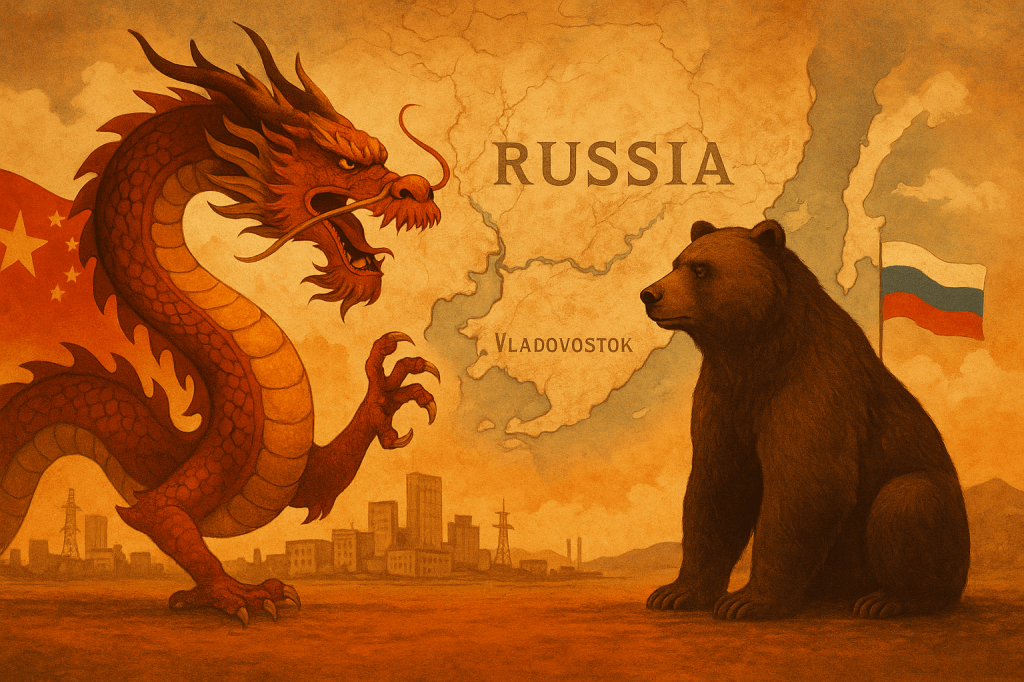
The Dragon at the Gate: China’s Quiet Reversal of the Peking Accord

It’s a strange sight to behold – the old bear, once feared across continents, now leaning heavily on the dragon, who circles with a slow, calculating grace. Russia, once the hammer of the East, has been brought to heel by a grinding war in Ukraine, and while the West cuts ties and imposes sanctions, China, with the patience of a millennia-old civilization, sees opportunity, not just to profit, but perhaps to reshape history.

There’s a sense of irony that hangs over this moment. In 1860, the Qing dynasty signed the Peking Accord under duress, ceding vast swathes of land to the Russian Empire. That territory, now known as the Russian Far East, includes strategic regions like Vladivostok and the Amur Basin, lands that had once been part of China’s imperial periphery. The Chinese state, pragmatic in diplomacy, but deeply historical in self-conception, has never fully forgotten these losses. While official maps no longer lay claim to those regions, nationalist narratives in China occasionally whisper about redrawing what was once erased.

Fast forward to today, and the tables have turned. The war in Ukraine has battered Russia’s economy, and severed its connections to Europe. In desperation, Moscow has tilted eastward, selling gas, oil, and influence to Beijing at discount prices. This is not a partnership of equals. Russia needs Chinese markets, Chinese currency, and Chinese technology. China, meanwhile, gains leverage with every shipment of discounted crude, and every signed memorandum that ties the Russian economy tighter to the yuan. Where once they competed in Central Asia and the Arctic, now Russia finds itself the junior partner in a relationship it once dominated.

But China’s strategy isn’t conquest, it’s saturation. In the underpopulated stretches of Siberia and the Russian Far East, Chinese traders, laborers, and companies are embedding themselves quietly, but firmly. Towns along the border increasingly do their business in yuan, and many look more to Harbin or Heihe, cities in China’s Heilongjiang Province, than to Moscow. Infrastructure projects, often funded with Chinese capital, and executed by Chinese firms, are weaving a new economic fabric, one that binds these regions more to Beijing than to the Kremlin.

This isn’t a territorial war. China doesn’t need tanks to reverse the Peking Accord. It just needs time, capital, and a weakened Russia with few other friends. What we may be witnessing is not the formal return of lost lands, but something more subtle and enduring; a slow-motion annexation by way of economy, trade, and cultural seepage. A kind of imperial inversion, done not with gunboats, but with invoices and supply chains.

In geopolitics, history never dies, it just waits for the moment when the balance tilts. With every sanctioned ruble, and every Chinese-funded deal, the echoes of the 19th century grow louder. Russia may not yet realize it, but the dragon is already at the gates. Not to conquer, but to reclaim, softly, surely, and without ever having to fire a shot.

Abandoned Sovereignty: How Canada Gave Up on Its Own Defence Industry

I began writing this piece over a year ago, and now it seems time to publish. I have seen first hand, during my time working for the UK feds, the way most members of NATO, not just Canada, have purchased U.S. military equipment, often under political pressure, and to the detriment of their own defence industries.  NATO interoperability standards should mean that any compatible equipment should be a viable option, considered through open competitive bidding, yet the geopolitical reality is something completely different. 

Canada has long faced intense pressure—political, economic, and social—to purchase U.S. military equipment for its armed forces, a reality that has shaped its defense procurement decisions for decades. This pressure is deeply rooted in history, from Cold War-era alliances to modern-day trade dependencies, and it has left Canada with little choice, but to align its military acquisitions with American interests. The consequences of this alignment go beyond procurement choices; they have also played a role in the erosion of Canada’s own defense research and development capabilities.

The political pressure to buy American is most evident in Canada’s commitment to joint defense initiatives, particularly NORAD and NATO. From the early days of the Cold War, Canada’s defense policies have been deeply entwined with those of the United States. The integration of North American air defense under NORAD meant that Canada’s fighter aircraft, radar systems, and missile defense strategies had to be compatible with those of the U.S. When Canada scrapped its own Avro Arrow fighter program in 1959, ostensibly for cost reasons, it conveniently cleared the way for the adoption of American aircraft like the CF-101 Voodoo, locking the Royal Canadian Air Force (RCAF) into a reliance on U.S. technology that continues to this day.

This trend persisted throughout the latter half of the 20th century. Canada’s navy, which once built world-class destroyers and anti-submarine vessels, saw its shipbuilding industry decline, and by the 1990s, the country was purchasing used British submarines while remaining dependent on American-built weapons and sensors. Similarly, Canada’s decision to buy the CF-18 Hornet fighter in the 1980s followed a pattern of choosing U.S. aircraft over European or domestic alternatives. While the CF-18 has served well, it locked Canada into the U.S. military supply chain for parts, upgrades, and replacements. Now, with the planned acquisition of F-35 stealth fighters, that dependence is only deepening.

Economically, Canada’s military procurement is heavily influenced by its integration with the U.S. defense industrial base. The Defense Production Sharing Agreement (DPSA), signed in 1956, allowed Canadian defense firms to bid on U.S. military contracts, but it also cemented Canada’s role as a supplier of components rather than a leader in weapons development. This effectively sidelined Canadian military research and engineering projects, making it far more difficult to revive independent initiatives. When the Arrow was canceled, it wasn’t just a single aircraft project that was lost—it was an entire aerospace industry that could have positioned Canada as a technological leader rather than a perpetual customer of American defense contractors.

The economic argument for buying American is always framed in terms of cost-effectiveness and interoperability, but the reality is that it often comes with trade-offs. The purchase of American equipment frequently involves hidden costs—maintenance contracts, dependency on U.S. technology, and restrictions on modifications. The recent push to buy American-made submarines, replacing the troubled British-built Victoria-class boats, is another example of how Canada’s choices are limited by its reliance on U.S. and NATO systems. In many cases, American weapons systems are the only viable option simply because Canada has not maintained the capability to produce its own alternatives.

Public sentiment in Canada is often skeptical of major military purchases, and this can create social and political tensions. Many Canadians are uncomfortable with high military spending, particularly when it benefits American defense giants like Lockheed Martin or Boeing. This unease has been reinforced by past procurement scandals, such as the costly and controversial EH-101 helicopter cancellation in the 1990s, which resulted in years of delays in replacing Canada’s aging Sea Kings. Yet, despite public resistance, successive Canadian governments—Liberal and Conservative alike—have found it almost impossible to escape the gravitational pull of American defense procurement.

Interoperability with U.S. forces is the most frequently cited justification for this dependence, and in some cases, it is a valid one. Canadian troops often train and deploy alongside U.S. forces, making shared equipment a practical necessity. However, this argument is often overstated to justify buying American even when other options exist. The recent decision to acquire P-8 Poseidon maritime patrol aircraft from Boeing, rather than exploring alternatives like the Airbus C295 or continuing to develop Canadian-built options, reflects this bias. The same was true with the decision to buy Sikorsky CH-148 Cyclone helicopters, a troubled program that has suffered significant delays and technical issues.

Over time, Canada’s ability to independently design and produce advanced military hardware has been systematically dismantled. The cancellation of the Arrow was just the first in a series of decisions that saw Canadian innovation sacrificed in favor of American procurement. The loss of the CF-105 program, the shelving of independent drone development efforts, and the abandonment of domestic tank production have left Canada as a nation that buys rather than builds. While there are still areas of strength—such as armored vehicle production through General Dynamics Land Systems Canada—the overall trajectory has been one of increasing dependence on the U.S.

The reality is that Canada’s defense procurement strategy is shaped as much by geopolitics as by practical military needs. The U.S. is both Canada’s closest ally, and its largest trading partner, and any significant deviation from American military procurement norms risks diplomatic and economic fallout. The fear of upsetting Washington is a powerful deterrent against seeking alternatives, whether from European manufacturers or through domestic production.

In the end, Canada’s military procurement is not just a matter of choosing the best equipment—it is a strategic and political decision that reflects the country’s place in the global order. Until Canada makes a concerted effort to rebuild its defense research and production capabilities, it will remain at the mercy of U.S. military priorities. Whether that is an acceptable trade-off is a question that Canadian policymakers—and the public—must continue to grapple with.

Update
Since writing the core of this piece, there has been some signs that Canada is trying to rekindle its own defence industry with its ship building program for the new River class destroyers, the conversation about purchasing European designed and built submarines, and early discussions regarding reducing the F-35 purchase program, in favour of the Swedish Saab Gripen. The Swedish proposal, which promised that aircraft assembly would take place in Canada, and that there would be a transfer of intellectual property, which would allow the aircraft to be maintained in this country, was very different from the U.S. F-35 program, where major maintenance, overhaul and software upgrades would happen in the States. The second Trump administration might just be the catalyst that Canada needs to seek alternative solutions rather than the business as usual approach we have seen over the last 75 years.