Yesterday in Washington

Washington likes to believe it understands itself. Staffers stride through hallways with the old confidence that policy, power, and predictable alliances still define the town. But yesterday the city felt like it had been tipped on its side. The familiar landmarks were still there, the marble still gleaming, the security lines still long, yet the political gravity had shifted. Something in the air made even the most seasoned observers pause. The rhythms were off. The choreography was wrong. The script had been changed without warning.

It began with the House vote. A resolution denouncing the supposed horrors of socialism sailed through with 285 votes. Eighty-six Democrats joined Republicans in an act that looked, to many, like a public renunciation of their own party’s progressive wing. Senior Democrats who had once embraced the energy of their younger socialists suddenly stood at the podium to praise a line of rhetoric that could have been lifted from a mid-century anticommunist tract. It was symbolic and it was safe, yet it carried the unmistakable sting of disloyalty. In a political moment defined by economic anxiety, this vote felt like an attempt to distance the party from the very language that had helped fuel its grassroots revival.

Then came the Oval Office.

Within hours of the anti-socialism vote, Zohran Mamdani, the democratic socialist mayor-elect of New York City, walked through the gates of the White House. Cameras rolled as Donald Trump, the man who had built years of rallies on the promise of defeating socialism, suddenly praised Mamdani as rational and pragmatic. The same leader who had weaponized the word socialism now spoke about affordability, collaboration, and even the possibility of making a life in Mamdani’s New York. Reporters searched for context, staffers searched for talking points, and the city searched for its footing.
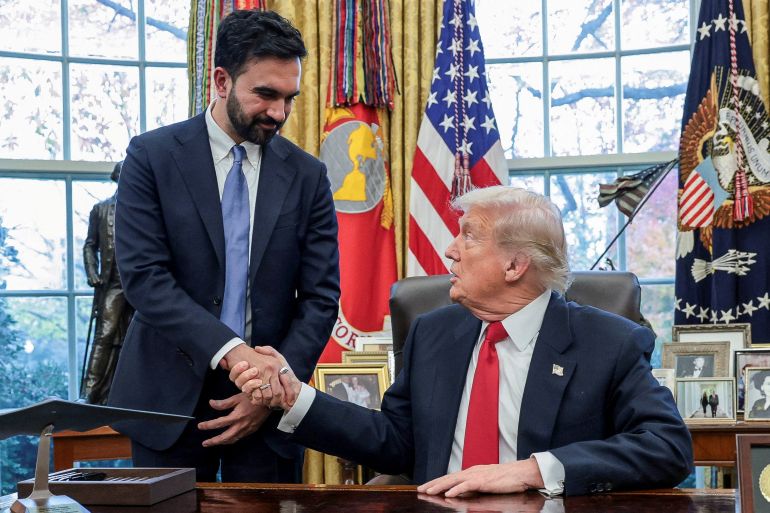
It was the kind of contradiction Washington hates because it cannot be easily spun. Democrats had voted to distance themselves from socialism while Trump offered the socialist of the hour a political embrace. Progressives stared at their own leadership in disbelief. Conservatives stared at Trump in confusion. Centrists stared at both sides and wondered whether anyone was still playing by recognizable rules. By late afternoon, Washington felt like it had been rewritten by a novelist with a sense of humor and a taste for irony.

Meanwhile Mamdani himself appeared untouched by the chaos swirling around him. He brushed off the congressional vote and spoke instead about affordability and governance. He treated the Oval Office meeting not as a political earthquake but as a practical encounter with a president who happened, on this particular day, to be in a generous mood. His calmness only amplified the surreal tone of the day. The city was upside down. The socialist was steady. The partisans were unmoored.

By evening, analysts were already scrambling to interpret the meaning of it all. Was Trump repositioning himself. Were Democrats attempting to signal caution to suburban voters. Was this simply political theater without consequence. Or had Washington revealed something deeper. The sense of an old order losing its predictability. The sense that ideological labels no longer behave as they are expected to. The sense that alliances can flip in the space of an afternoon.

For a brief moment, the capital looked like a place where the usual logic had cracked. The marble buildings and polished floors remained, but the stories being told within them no longer lined up with the roles each character was supposed to play. It was a day that left Washington blinking in the light, unsure of whether it had witnessed a temporary disruption or an early sign that the political axis itself is beginning to tilt.
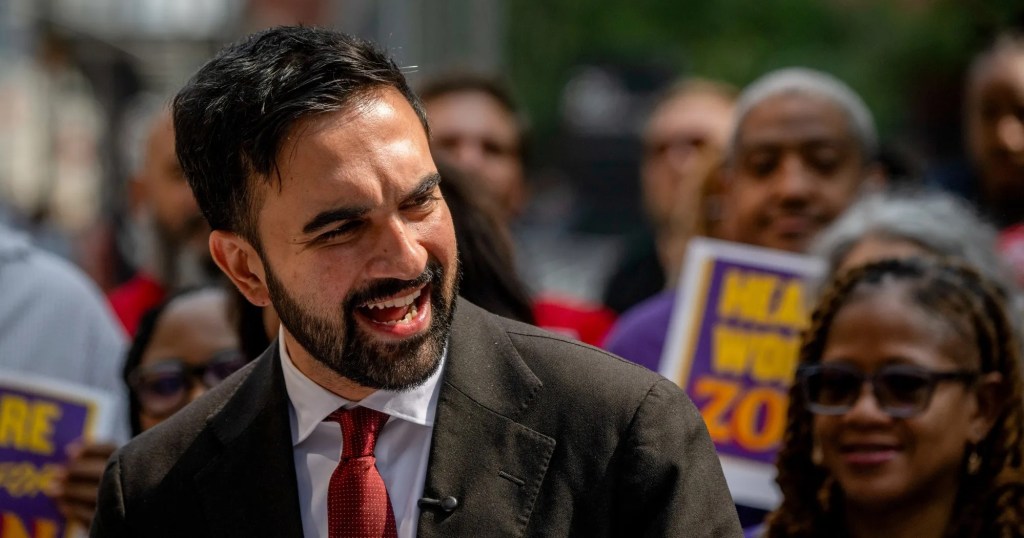
A Whisper of Momentum: Could the Democrats Be Tilting Toward a Kinder, More Grassroots Future?

Something is stirring within the Democratic Party of the United States. The off-year elections held this week were, in purely political terms, a resounding success. Democrats swept high-profile races in Virginia, New Jersey, and New York City, while quietly notching smaller but strategically vital wins in states like Georgia and California. These victories, taken together, have left political analysts wondering whether we are seeing the faint outlines of a new political momentum; one that could pull the party closer to its grassroots and, perhaps, toward a more caring, socially grounded, even socialist vision of governance.

In Virginia, Abigail Spanberger’s victory for governor was a study in moderate competence. Her campaign was pragmatic, rooted in local concerns: affordability, infrastructure, and the language of unity over ideology. In New Jersey, Mikie Sherrill followed a similar script, emphasizing trust and stability in a time of global uncertainty. Both are centrists, comfortable in the tradition of cautious, business-friendly Democratic politics that has defined the party’s leadership for decades.

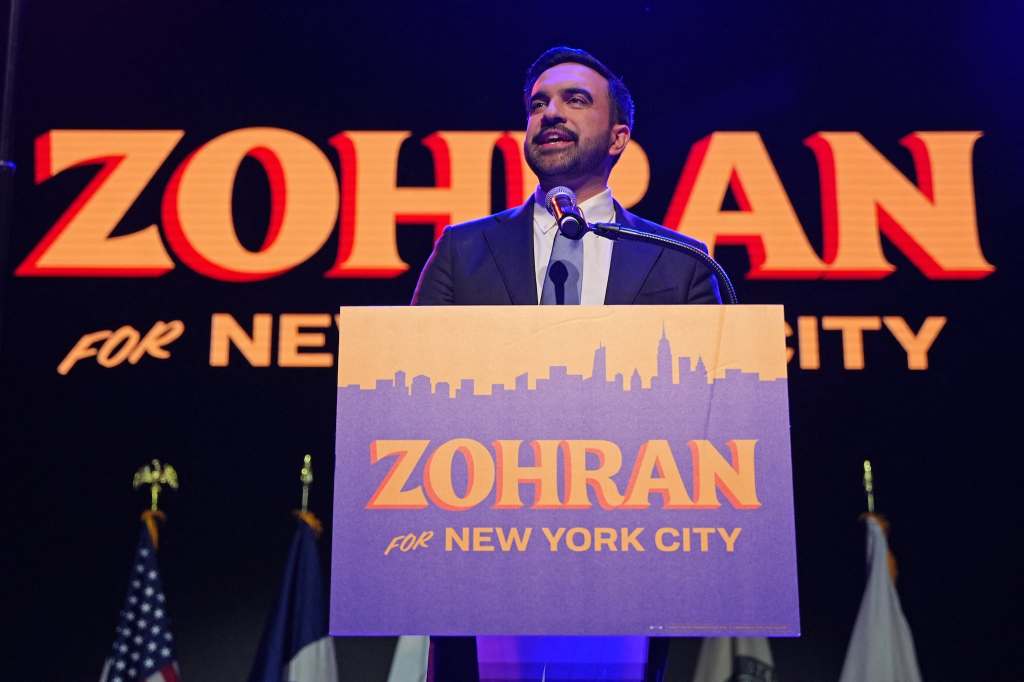
And yet, something more radical glimmered elsewhere. In New York City, Zohran Mamdani, a self-described democratic socialist, captured the mayoralty with a platform that read like a manifesto for a more humane urban future: a rent freeze, free public transit, and universal childcare. His campaign attracted young voters and those disillusioned by what they see as the corporate centrism of Washington. For many, his win was not just local — it was symbolic. It suggested that, beneath the polished pragmatism of the party establishment, there lies a restless hunger for deeper change.

Down-ballot, too, the signs were intriguing. In Georgia, Democrats flipped Public Service Commission seats on the strength of voter frustration over energy prices, a victory built less on ideology than empathy for working-class struggles. In California, the passage of Proposition 50, which allows the legislature to draw congressional districts, handed Democrats a structural advantage that could support longer-term policy experimentation. Across the map, voters seemed to respond to messages centered on care: the cost of living, health, childcare, and the simple question of who the system serves.

These results invite a larger question: Are we witnessing the start of a shift toward a more caring, grassroots Democratic Party; one that takes social justice and collective wellbeing as its compass?

The case for optimism rests on several pillars. Mamdani’s win gives the left a tangible foothold in executive leadership, something not seen since the days of Bernie Sanders’ insurgent campaigns. The new generation of Democratic voters is younger, more diverse, and more skeptical of market orthodoxy than at any point in recent memory. The cost-of-living crisis has blurred the old ideological lines, making redistributive and solidarity-based policies newly attractive to the middle class. And in the wake of Trump’s re-election, the moral and cultural energy of resistance has turned inward, focusing less on opposition and more on what a humane Democratic vision might actually look like.

Yet optimism must coexist with realism. The party’s leadership remains firmly in centrist hands. The Democratic National Committee, congressional leadership, and major donor networks are aligned with a strategy of cautious coalition-building and market-compatible reform. They have reason to be pleased: the moderate playbook, they can argue, just won two governorships. Leaders like Spanberger and Sherrill embody the view that Democrats must win from the middle to govern at all. Their victories, like Joe Biden’s before them, reinforce the institutional belief that centrism is safety.

This is the core tension now facing the party: the grassroots energy that fuels local and progressive campaigns versus the corporate and donor-driven pragmatism that defines national leadership. For the socialist or justice-oriented wing to shape the future, it must turn local victories into durable infrastructure; unions, candidates, policy think tanks, and media networks that can sustain the pressure upward. Without that, the leadership will absorb the energy, rebrand it in softer language, and continue to steer the ship gently leftward without truly changing its course.

The most likely scenarios unfold along three lines. In the first, progressive candidates keep winning, their policies prove popular, and the national platform slowly adapts; integrating labour rights, universal childcare, and socialised public services into the mainstream Democratic identity. In the second, the leadership co-opts the rhetoric of care without altering the underlying economic model, producing a modestly kinder capitalism that soothes but does not transform. And in the third, the leadership doubles down on centrism, citing electability, and the left’s momentum fractures into isolated city-level experiments.

At this moment, it is too early to tell which path will prevail. The evidence of change is real, but fragile. Mamdani’s New York, after all, stands beside Spanberger’s Virginia; two visions of the Democratic Party separated by temperament, class, and strategy. The question is not whether the party can win, but what it intends to do with its wins.

Still, for those who believe in a more compassionate politics, one that measures success not by GDP but by dignity, these elections whisper possibility. The caring impulse, long buried under poll-tested language, is stirring again. It will take courage, organisation, and persistence to turn that whisper into policy, but every movement begins this way: not with a roar, but with the quiet sound of voters choosing empathy over fear.

Sources:
Reuters, Democrats bask in electoral victories a year after Trump’s reelection(Nov 5 2025)
The Guardian, Democrats have racked up election wins across America – but they would do well not to misread the results (Nov 5 2025)
Politico, The last time Democrats won like this was right before the 2018 blue wave (Nov 5 2025)
AP News, Georgia PSC races highlight voter anger over energy costs (Nov 5 2025)
NBC Washington, Takeaways from Election Day 2025 (Nov 5 2025).

The Democrats’ Dilemma: Mamdani, Progressive Policies, and the Party’s Future

Update – With Eric Adams now out of the 2025 New York City mayoral race, new polls show Zohran Mamdani maintaining a strong lead. Across Marist, Emerson, and Quinnipiac data, Mamdani holds steady in the mid-40s while Andrew Cuomo edges up to around 30 percent, suggesting Adams’ exit has done little to change the race’s overall direction.

Mainstream Democrats continue to treat left-of-center politics with caution, even as voter dissatisfaction, economic pressures, and social inequality push many Americans toward structural change. The tension has been evident in national interviews, where figures such as Vice President Kamala Harris offer measured support for progressive candidates like Zohran Mamdani, the insurgent Democratic nominee for mayor of New York City. That lukewarm endorsement reflects deeper structural and ideological dynamics: a party historically rooted in pragmatism and centrism struggles to reconcile its identity with the rising energy of its progressive wing.

Several factors explain this cautious stance. U.S. electoral politics favors moderation. The geography of swing states, the power of suburban and independent voters, and the design of the electoral college create incentives for Democrats to avoid appearing “radical.” Progressive policies, ranging from universal healthcare to rent freezes and free transit, often poll well in the abstract but face skepticism once voters consider costs, trade-offs, and feasibility. Party strategists worry that pursuing bold policies could alienate moderate or older voters, threatening general election viability.

Institutional pressures reinforce this cautious posture. The Democratic Party relies on a coalition that includes centrist politicians, business-aligned donors, and interest groups, many of whom prefer incremental reforms over systemic change. Media framing amplifies this risk, as ambitious proposals are often labeled “socialist” or “extreme,” creating a political environment in which party leaders hesitate to embrace bold policies fully. Even when polling shows popular support for measures such as stricter rent control or climate investment, strategic reticence prevails because of narrative risk and fear of electoral backlash.

The 2025 New York City mayoral race brings these dynamics into sharp relief. Zohran Mamdani, a democratic socialist from Queens, has built a platform around rent freezes, affordable housing, free bus service, and major public investment. For many progressives, his rise demonstrates that bold left-of-center policies can mobilize voters in one of the nation’s largest and most visible cities. For establishment Democrats, however, his candidacy raises questions about the party’s future direction and internal cohesion.

Polling indicates Mamdani enters the fall campaign as the clear front-runner. A Quinnipiac University survey of likely voters showed him at 45 percent, compared to Andrew Cuomo at 23 percent, Curtis Sliwa at 15 percent, and Eric Adams at 12 percent. (Adams has since dropped out of the race.) An AARP New York/Gotham Polling survey reported similar results, with Mamdani at 41.8 percent. Marist College and the New York Times/Siena College polls echo this pattern, consistently placing him near or above 45 percent. Two-way scenarios narrow the margin, Marist found Mamdani at 49 percent versus Cuomo’s 39 percent, but the general trend underscores his advantage. Mamdani’s support is strongest among younger voters, renters, and those most concerned about housing affordability and cost-of-living pressures, while Cuomo performs better with older voters and those prioritizing experience or safety.

A Mamdani victory could produce significant ramifications for the Democratic Party. Symbolically, it would validate progressive policy as electorally viable and energize activists nationwide. It could encourage ambitious policy proposals in housing, transit, and climate, pressuring other Democrats to adopt a more leftward orientation to remain relevant. The victory would also likely sharpen internal tensions, forcing a confrontation between centrists who favor incremental change and progressives advocating systemic reform.

National polling underscores the opportunity for such a shift. Surveys indicate widespread support for policies associated with progressive Democrats. Measures like a $15 minimum wage, universal pre-K, expanded childcare, and climate investment enjoy majority backing, even among some independents and moderate Republicans. Younger voters, in particular, consistently favor progressive positions, with many willing to endorse structural change across a range of economic and social issues. Yet a gap remains between policy support and ideological self-identification. Many Americans back specific policies without labeling themselves progressive or wanting the party to move sharply left, reflecting ambivalence about broader systemic change. Framing, trade-offs, and cost perceptions significantly influence these attitudes.

The interplay of local victories and national trends will shape the Democratic Party’s evolution. Mamdani’s success could embolden progressive candidates elsewhere and accelerate the adoption of left-of-center policy agendas. At the same time, his tenure would face significant constraints, including state law, budget limits, opposition from landlords and businesses, and the need to deliver tangible results. Failures or perceived missteps could reinforce centrist arguments that progressive policies are impractical, deepening intra-party divides.

Thus, the Democratic Party stands at a crossroads. Mainstream leaders remain cautious due to electoral risk, institutional pressure, and fear of alienating moderates. Nationally, public support for progressive policies is significant, particularly among younger voters and urban constituencies, but the party must balance ambition with pragmatism. The 2025 New York mayoral race offers a high-profile test of whether progressive governance can gain legitimacy and influence broader party strategy. A Mamdani victory could shift the party leftward and validate systemic reform, while setbacks or backlash could reinforce centrist control, illustrating the fragility and contested nature of the party’s ideological trajectory.

The Democratic Party’s future may hinge on its ability to reconcile grassroots enthusiasm for progressive change with the practical demands of governance and national electoral strategy. The outcome in New York may not only determine local policy, but also signal the direction of American liberal politics in the coming years.

A Turning Point for Democrats: Embracing or Repelling the Mamdani Moment

As I write this, I’m still struck by the fact that this is even a controversy. The policies Zohran Mamdani is proposing: free public transit, universal childcare, publicly owned services, are standard practice across much of Europe and other G7 nations, yet many Democrats are voicing concern that New Yorkers, and perhaps Americans more broadly, still aren’t ready to embrace what they call “socialist” ideas.

In June 2025, New York voters spoke clearly. Fifty-six percent of Democratic primary voters chose Zohran Mamdani, a 33-year-old democratic socialist, to carry the party’s nomination for mayor. His platform includes free public transit, universal childcare, rent freezes, and publicly owned grocery stores. To many, this was a breath of fresh air in a city suffocating under the weight of rising costs and entrenched inequality. To others, it was a red flag waving at the edge of a cliff. Now, Democrats face a decision that could define the party for years to come.

Mamdani’s victory was not a fluke. His campaign, reportedly the largest volunteer mobilization in the city’s history, reached over 750,000 doors with 30,000 committed canvassers. He ran on small donations and working-class energy, uniting activists, renters, and disaffected youth. Against him stood Andrew Cuomo, backed by unions, wealthy donors, and a legacy machine. Yet Cuomo could not withstand the wave of grassroots momentum.

The question now facing Democrats is not only how Mamdani won, but what they should do about it. Cuomo is already considering an independent run. Mayor Eric Adams, expelled from the Democratic fold, is still in the race and is quietly collecting business support. This sets up a potential three-way general election, one that could split the left-leaning vote and throw the door open for the candidate who best reassures moderate, outer-borough voters. Democrats must decide if Mamdani’s energy is transferable to the broader electorate or if his policies will cost them the mayoralty.

Mamdani offers a bold, future-oriented vision. He speaks of climate policy not as abstraction but as urban necessity. His platform calls for retrofitting buildings, expanding transit access, and protecting tenants, all framed as investments in equity and resilience. He proposes paying for this with new taxes on the wealthy and on corporations that profit from the city’s infrastructure and labour. For progressives, he represents hope. For moderates, he presents risk.

Critics argue that Mamdani’s platform is more idealism than governance. Taxing millionaires at the city level is legally complex and politically fragile. Governor Hochul has already signaled opposition to any such proposal. Implementing rent freezes and creating city-owned grocery stores would require significant legislative cooperation and administrative capacity. There are also concerns about whether such sweeping programs are financially viable under New York City’s budget constraints.

National Republicans have already begun to label Mamdani as a communist, a charge that PolitiFact has debunked. He is a democratic socialist, not a revolutionary. He believes in using democratic institutions to expand access to public goods and services. Nevertheless, the right will use his image to galvanize resistance, not only in New York but nationwide. Democrats, particularly those eyeing swing districts in 2026, will be watching closely.

The party also faces internal tensions. Some centrist Democrats worry about alienating suburban and immigrant voters who may view Mamdani’s platform as radical. Others remember Buffalo in 2021, when India Walton won the Democratic primary only to be defeated in the general election by a write-in campaign for incumbent Byron Brown. Business leaders in New York have already begun organizing to prevent a Mamdani administration. They are joined by conservative Democrats and Republicans who see this as an existential challenge.

Mamdani’s base, however, is broader than many expected. He performed well not only in left-leaning Brooklyn neighborhoods but also in parts of Queens, the Bronx, and Staten Island. He attracted support from Hispanic, Black, and Asian voters, many of whom feel excluded from the city’s economic gains. Still, his positions on Israel, elite school admissions, and Indian politics have alienated parts of the Jewish, Korean, and Hindu communities. Holding this coalition together in the general election will be a test of political skill and message discipline.

This race is not just about New York City. It is a referendum on the direction of the Democratic Party. After disappointing results in 2024, especially in swing districts and rural areas, Democrats are torn between a progressive future and a centrist past. Mamdani’s success presents a new model: bold ideas, grassroots energy, and unapologetic populism. If he wins in November, the party may shift permanently. If he loses, the lesson may be that ideology cannot overcome institutional resistance and suburban caution.

Democrats now face three decisions. First, whether to support Mamdani fully or distance themselves from his agenda. Second, whether to adopt parts of his platform as a new standard or treat it as a local anomaly. Third, how to communicate his vision without triggering a backlash that could hurt candidates elsewhere.

In many ways, the choice has already been made. Mamdani is now the party’s nominee in the country’s largest and most diverse city. Whether his campaign signals renewal or foreshadows division will depend on the next five months. The general election in November will not just determine who leads New York, but what kind of party the Democrats want to be.

Why Mamdani’s “Democratic Socialist” Label Is a Strategic Win in the NYC Mayoral Race

In a city where political identities are often blurred by the pragmatism of urban governance, the decision by New York City mayoral candidate Zohran Mamdani to brand himself as a Democratic Socialist rather than the more conventional Social Democrat is not just a semantic flourish, it is a calculated and resonant act of political self-definition. With this move, Mamdani has signaled both clarity of purpose and a refusal to soften the ideological edges that increasingly define contemporary progressive movements.

The term “Social Democrat” has long carried the weight of historical compromise. It evokes images of European-style welfare capitalism: generous but measured; systemic but rarely disruptive. In the American context, it has often been used to describe politicians whose policies emphasize equity within capitalism without directly challenging its underlying structures. This has made it a safe label, palatable to centrists and progressives alike, but also, increasingly, a vague one. In contrast, “Democratic Socialist” offers sharper contours. It suggests not merely redistribution, but reimagination: of public housing as a universal right, of transit as a decommodified public service, and of the city itself as a collective endeavor rather than a marketplace.

Mamdani’s use of the term places him firmly in the lineage of figures like Bernie Sanders and Alexandria Ocasio-Cortez, both of whom have successfully mainstreamed democratic socialism in American electoral politics. In doing so, he taps into an energized political current, particularly among younger voters, renters, union members, and New Yorkers disillusioned by the city’s deepening inequality and chronic dysfunction. For a generation raised amid austerity, pandemic precarity, and climate anxiety, the usual reformist language has begun to ring hollow. Mamdani’s brand of politics, by contrast, offers a promise of structural transformation, not just technocratic adjustment.

Importantly, this positioning also exerts strategic pressure on the rest of the field. In a crowded race where multiple candidates will profess progressive values, Mamdani’s unambiguous ideological label sets a benchmark. It forces other candidates to articulate whether their vision for the city includes systemic change or simply more efficient management. It also inoculates Mamdani from accusations of policy inconsistency or opportunism, his brand is explicit, unapologetic, and tied to a coherent political tradition.

The risks are not insignificant. “Socialism” remains a loaded term in American discourse, and Mamdani’s opponents will undoubtedly attempt to weaponize it. Yet recent electoral cycles suggest that voters, especially in urban areas, are increasingly unmoved by such attacks. If anything, they may interpret them as evidence that the candidate is willing to speak uncomfortable truths. In this context, reclaiming the term “Democratic Socialist” is not a liability, but an asset; a demonstration of conviction in an era fatigued by ideological hedging.

In choosing that label, Mamdani has not only clarified his own platform but reshaped the ideological stakes of the mayoral race. It is a move that marks him not merely as a candidate of the left, but as one committed to a transformative vision of what New York City could be.

New York Awakens: The Rise of Mamdani and a Progressive Shift

Zohran Mamdani’s victory in the Democratic primary for New York City mayor represents a seismic shift in the city’s political landscape, one that carries reverberations far beyond municipal governance. At just 33 years old, the Queens-born state assemblyman and self-described democratic socialist toppled former Governor Andrew Cuomo, the establishment favorite, signaling a generational and ideological realignment within the Democratic Party. 

Grassroots Power vs. Establishment Legacy
Cuomo entered the race with formidable credentials: a deep political network, endorsements from figures like Bill Clinton and Michael Bloomberg, and at least $25 million in Super PAC funding. Yet, despite this financial and institutional advantage, his campaign floundered. Critics pointed to a lackluster message, lingering baggage from his 2021 resignation amid sexual harassment allegations, and a scared reluctance to engage broader audiences.

In contrast, Mamdani surged from near anonymity (0–1% in early polling) to command 43.5% of first-choice votes on primary night, an astonishing ascent driven by a youth-led, grassroots coalition. Supported by endorsements from Bernie Sanders and Alexandria Ocasio‑Cortez, his campaign tapped into the deep well of dissatisfaction over rising housing costs, stagnant wages, and a city increasingly and wildly unaffordable.

Policy Vision: Progressive Ambition or Overreach?
Mamdani’s policy platform, ambitious in scope, centers on affordability and public service transformation. Proposals include a rent freeze for stabilized units, fare-free buses, universal childcare, and municipal grocery stores, all paid for through new taxes on corporations and high-income earners. 

While appealing to a generation struggling with inflation and economic precarity, these ideas have drawn scrutiny over execution feasibility, budget implications, and economic impact.  Wall Street and real estate interests have voiced concern, warning of tax burdens and regulatory uncertainty. 

The Ranked-Choice Factor and Cross-Endorsements
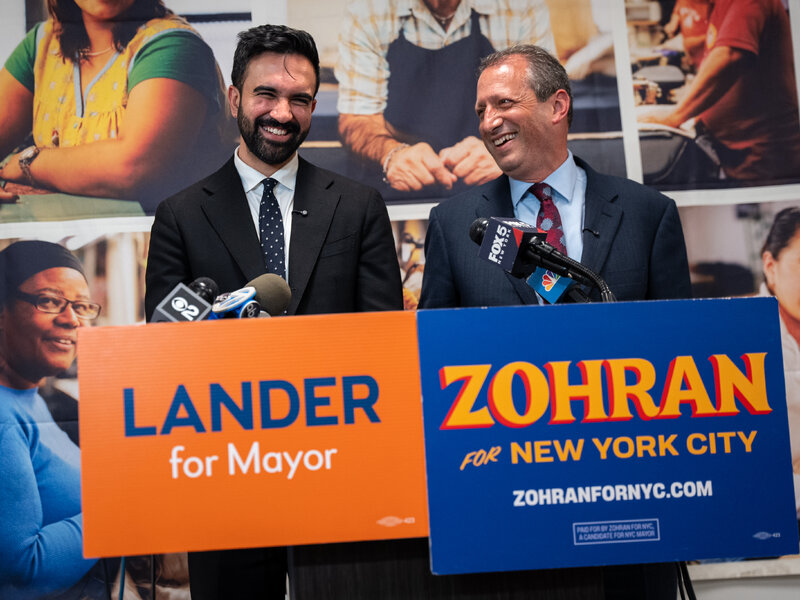
New York’s ranked-choice voting system played a decisive role. Mamdani strategically formed cross-endorsements, most notably with Brad Lander, who garnered around 11% of the vote, to position himself as a second-choice favorite. Analysts widely agree this will likely cement his victory once second-round, and later votes are redistributed. 

Navigating Controversy: Israel, Palestine, and Identity
Despite the momentum, Mamdani’s campaign has not been immune to controversy. His outspoken criticisms of Israeli policies, including references to the “globalization of the Intifada” and support for Boycott, Divestment, Sanctions (BDS) a Palestinian-led movement for freedom, justice and equality, have drawn accusations of antisemitism, particularly in a city with one of the largest Jewish populations outside Israel. He has sought to clarify his statements, asserting his opposition to hate and his commitment to civil rights. The controversy may crystallize how future general election opponents choose to attack, while also spotlighting internal tensions within urban progressive politics.

Cuomo’s Concession, so What Comes Next? 
On primary night, Cuomo recognized that the narrow path to victory was irrevocably closed, conceding to Mamdani, and acknowledging the campaign’s resonance with younger voters. Notably, he left open the possibility of running in the general election on an independent ballot line, a move that could fracture the Democratic vote and complicate the race.

The Broader Implications for the Democratic Party
Mamdani’s emergence marks a broader ideological turning point within the Democratic Party. It highlights the growing influence of progressive, youth-driven politics willing to challenge entrenched power. His candidacy echoes similar movements in other U.S. cities where left-leaning candidates have flipped local offices, redefining policy scopes on housing, climate, social services, and racial justice. 

For Democrats nationally, New York is a critical test case: can a bold progressive agenda resonate with urban voters in a general election? And can party unity be maintained while platform demands intensify?

November Showdown: A Crowded Field
If Mamdani completes the nomination, he heads into a three‑way fall election against the independent incumbent Eric Adams, whose legal troubles and declining approval ratings have damaged his standing, and Republican Curtis Sliwa. The contest’s contours are stark: progressive change vs status quo, left coalition vs fractured moderate support, and a referendum on policy versus personality.

A Turning Point in Urban Governance
The Democratic primary in New York City was more than a local race, it was a referendum on the future direction of American progressive politics. Mamdani’s success, powered by grassroots strategy, ranked-choice prowess, and a sweeping vision for economic justice, exposes the vulnerabilities of establishment politics and signals a generational handoff within the party. As ranked ballots are fully tallied, and the fight shifts to November, New Yorkers and national observers will be watching closely. Is this the beginning of a progressive resurgence, or a fleeting moment in a cyclical political saga?