Pierre Poilievre and the Perils of a Political Retreat: Alberta as Safe Harbour or Symbol of Stubbornness?

At time of publication, there are no hard facts that support the notion that Mr. Poilievre will be standing in an Alberta by-election to regain a parliamentary seat. Prime Minister Mark Carney has stated that if this happens he has told Mr. Poilievre that he will trigger a by-election as soon as possible, “with no games, nothing.” 

Update
Within an hour of my publishing this post, Conservative MP-elect Damien Kurek says he will resign his Alberta seat so Conservative Leader Pierre Poilievre can run in a forthcoming by-election.

With the dust barely settled on the 2025 federal election; an election that saw Pierre Poilievre’s Conservatives fall short of forming government, new political tremors are already stirring on the Prairies. In a move that has stunned even some within his party, a newly elected Alberta Conservative MP is reportedly prepared to resign their seat to make way for Poilievre to run in a by-election.

This extraordinary gesture, while perhaps well-intentioned, forces Canadians to confront uncomfortable questions about leadership, legitimacy, and political culture. When a party leader is rejected by the country, what message does it send when they attempt to cling to power through a political back door?

A federal by-election in Alberta might appear, at first glance, like a logical next step for a leader whose personal popularity in that province remains high. Yet politics is not merely about numerical safety; it’s about national optics, political narrative, and public trust. This latest development is not just a test of Pierre Poilievre’s judgment; it’s a test of how far Canadian political norms can stretch before they snap.

What Happens When the Nation Says “No”?
Poilievre led the Conservatives through a campaign in which he promised transformation, fiscal discipline, and a crusade against what he called the “gatekeepers” of Canada’s institutions. The message, while resonant with segments of the electorate, ultimately fell short. He lost not just the confidence of Parliament, but of the majority of Canadians. In Canadian political culture, such a loss carries a clear implication: it’s time to step aside.

History provides no shortage of examples. Stéphane Dion resigned promptly after the Liberals’ dismal 2008 result. Michael Ignatieff, after the Liberal collapse in 2011 and the personal loss of his own seat, departed politics altogether. Andrew Scheer, who arguably performed better by winning the popular vote in 2019, still stepped down under pressure. Erin O’Toole, ousted by caucus after a 2021 campaign that yielded no significant breakthroughs, made no attempt at a comeback.

In each of these cases, the defeated leader recognized an essential political truth: leadership legitimacy comes not just from internal loyalty, but from external validation. Without a mandate from voters, remaining at the helm, or re-entering the ring, can seem more like ego than service.

Alberta as Sanctuary or Sideshow?
Poilievre’s political instincts have long found fertile ground in Alberta. His messages about oil, taxes, and personal freedom resonate strongly in a province often at odds with the federal government. A by-election there would almost certainly be safe terrain.

But that very safety raises difficult questions. Is the goal to represent the people of Alberta, or to use them as a political life raft? Reports that a newly elected MP, who just earned the trust of their constituents, might step aside to create space for Poilievre do not sit well with everyone. It smacks of backroom deal-making at a time when Canadians are demanding transparency and authenticity.

Alberta is no longer a monolith. Calgary and Edmonton have shown a consistent willingness to elect Liberals and New Democrats, especially in urban ridings. The electorate is younger, more diverse, and increasingly skeptical of overt political opportunism. A by-election staged to rehabilitate a failed leader could risk turning a Conservative stronghold into a national conversation about political entitlement.

The Constituency Question: Representation or Rehabilitation?
At its core, a by-election is a local exercise in democracy. Constituents elect someone to speak for their needs, not to serve as a stepping stone in a national chess match. If Poilievre proceeds with this path, it raises the question: who is the by-election really for?

Canadians are not blind to political calculation. They understand strategy, but they also understand sincerity. A leader who has been rejected nationally, yet insists on staying in the House of Commons via a seat that wasn’t theirs to begin with, risks being seen as more focused on personal relevance than party renewal.

This dynamic becomes even more delicate when local party members, many of whom fought hard to win a close race, are told to stand down or step aside. A backlash could erupt not just among voters, but within the Conservative grassroots. The image of parachuting a defeated leader into a riding might not sit well in the era of decentralized political engagement and hyper-local activism.

Internal Divisions and Leadership Overhang
Poilievre’s leadership was always going to be a high-risk, high-reward proposition. His populist rhetoric electrified many disaffected voters, but alienated others, including centrist swing voters in Ontario and British Columbia. That coalition wasn’t enough to win in 2025, and now, it may not be enough to secure his continued relevance.

Within the party, the response to the by-election rumour has been mixed. Some insiders, eager for continuity, view it as a practical step. Others see it as a dangerous delay to a necessary leadership transition. A successful by-election campaign might embolden Poilievre’s loyalists, but it won’t erase the larger strategic failures of the campaign. Worse, it may divide caucus between those pushing for reform and those clinging to the status quo.

If Poilievre wins a seat, but not a second chance, the Conservative Party risks entering a prolonged period of drift, neither fully post-Poilievre nor able to rebrand under new leadership. It’s the political equivalent of suspended animation.

What Kind of Political Culture Do We Want?
At a deeper level, the question is not just about Pierre Poilievre. It’s about the kind of political culture Canadians want. Do we reward resilience at any cost, or do we expect our leaders to recognize when their time is up?

Canadian political history has respected those who step aside with dignity after defeat. They may later return, as Jean Chrétien did after a long opposition tenure, but they do so only after earning back the trust of the public and their party. A quick return via a strategically engineered by-election feels more like a workaround than a comeback.

A Moment of Reckoning
Poilievre’s possible bid to return to the House of Commons via a by-election in Alberta, on the heels of a national rejection, could set a precedent, but it may be one the country comes to regret. He may win the seat, but lose the opportunity to be remembered as a leader who put country and party renewal ahead of personal ambition.

In that sense, this is no ordinary by-election rumour. It is a moment of reckoning, for a leader, a party, and a political culture that must decide whether to move forward or loop endlessly around the gravitational pull of defeat.

About Alberta: A Personal Perspective on Culture, Conversation, and Contribution

After more than 25 years as a business consultant, I’ve been fortunate to work across continents, meeting people, solving problems, and learning from cultures far from home. Yet, one of the most eye-opening cultural journeys I’ve taken has been much closer to home, right here in Canada.

In the early 2000s, I married a university professor from Alberta. With that union came a second family: ranchers, farmers, nurses, and small business owners from the Prairies. They welcomed me warmly, and over time, I found myself immersed in a culture both deeply Canadian and distinctly Albertan. What I discovered challenged assumptions I didn’t even know I had, and continues to shape how I think about communication, leadership, and nation-building.

Alberta isn’t just a place. It’s a way of being.

Like all Canadian regions, Alberta’s culture is shaped by its geography, economy, and history, but what stands out most is its ethos: plain speaking, hard work, and a fierce belief in self-reliance. This is a province built on the backs of people who tamed land, raised cattle, built farms, extracted energy, and raised families while weathering the booms and busts of resource cycles. It’s no surprise that such a setting produces a political and social landscape that leans more conservative, values independence, and tends to be skeptical of centralized authority, especially from Ottawa.

Yet, it’s also a province of surprising complexity. Urban centres like Calgary and Edmonton are home to vibrant, diverse communities. There’s deep thoughtfulness here, too, but it often takes a different form than what some Central Canadians might expect. Alberta’s discourse is grounded in lived experience, not theory. “Common sense” matters. So does speaking your mind, and when someone feels unheard, it’s often not about a lack of airtime, but about the feeling that their reality is being brushed aside.

One phrase I’ve heard countless times in Alberta is, You’re not listening to me. Sometimes, that’s not a literal complaint, it’s a coded way of saying, You’re not agreeing with me. In Alberta, where beliefs are often forged in the furnace of real-world outcomes, farming yields, small business margins, frontline nursing shifts, disagreement can feel like dismissal. If someone tells you a policy won’t work, it’s probably because they’ve lived through something similar. Ignoring that isn’t just impolite, it’s a denial of experience.

This is where conversations between Alberta and other parts of Canada can break down. We confuse disagreement with disrespect. We treat pragmatism as resistance to progress, and we forget that emotional intelligence requires listening to not just what is being said, but why it matters to the speaker.

My Alberta family holds views that might make some urban Central Canadians bristle. They question bureaucratic red tape. They prize personal responsibility. They believe in earning what you get, and yet these are the same people who will pull over in a snowstorm to help a stranger, or give you the shirt off their back if they think you need it. They don’t expect perfection, but they expect fairness, honesty, and above all, effort.

So how do we move forward, together?

First, we stop talking about Alberta and start talking with Albertans. We acknowledge the tensions, but we also recognize the province’s extraordinary contributions: to our economy, to our energy independence, to our national character. As we help Alberta navigate economic transformation, from oil to innovation, we must do so with respect for the culture that built this place.

That means understanding that communication here is not always couched in policy language or academic nuance. It’s plain. It’s passionate. It’s personal. And it deserves to be met with the same.

If we want a better Canada, we need a better conversation with Alberta, not just about it. That begins with listening not just to words, but to the values and experiences behind them. When we do that, we’ll find that Alberta doesn’t need to be changed, it needs to be understood.

The Desert Reactor That Could Power the Future

I’ve spent decades watching promising nuclear technologies come and go; from breeder reactors to pebble beds to compact fusion dreams. Most end up in the “what might have been” pile, but something different is stirring in the Gobi Desert, and for once, the promise feels within reach. China’s recent success with a small thorium-fueled molten salt reactor (MSR) might just be the beginning of the nuclear renaissance we’ve all been waiting for.

It’s not just that they got the reactor running, that’s impressive in itself. What’s groundbreaking is that China’s researchers, operating under the Chinese Academy of Sciences, didn’t just fire up the experimental two-megawatt reactor. They ran it at full power and, in a world first, reloaded it while it was still running. That kind of feat is only possible with molten salt designs, where the fuel is dissolved in a hot liquid and circulates through the reactor like lifeblood. That fluid nature allows for continuous refueling, which not only boosts efficiency, but also sidesteps many of the safety risks that haunt traditional pressurized water reactors.

Molten salt reactors have long been the “what if” of nuclear design. The U.S. tried this back in the ‘50s at Oak Ridge, looking for ways to power nuclear bombers. But once uranium became the fuel of choice, and the Cold War demanded weapons-grade material, thorium was shelved. China dusted off those old reports (many of which were openly published), studied them carefully, and got to work. Now, they’re ahead of everyone else in a race that could redefine what nuclear power looks like in the 21st century.

And it’s not just about the molten salt. Thorium, the element at the heart of this reactor, is a game-changer. It’s far more abundant than uranium,  about three to four times as common in the Earth’s crust, and it doesn’t carry the same baggage. While uranium reactors inevitably produce plutonium-239 (which can be used for bombs), thorium reactors don’t. In fact, the byproducts of the thorium fuel cycle are notoriously hard to weaponize. It’s nuclear energy with a built-in disarmament clause.

Safety, too, is baked in. Unlike conventional reactors that operate under enormous pressure, molten salt reactors run at atmospheric pressure. There’s no steam explosion risk. If things start overheating, a freeze plug at the base of the reactor melts, draining the fuel into a safe containment tank. The fuel simply stops reacting. This isn’t theory, China’s demonstration shows it works.

We’re talking about a reactor that produces less waste, can’t easily be weaponized, runs more efficiently, and might even be paired with renewables or used to generate clean hydrogen. Add in the fact that thorium is cheap and widely available, and you start to wonder: why didn’t we do this sooner?

The answer, of course, is politics, economics, and inertia, but that may be changing. China’s quiet, but steady march toward thorium MSRs has now captured global attention. If this tiny desert reactor is scaled up, it could provide a path toward carbon-free baseload power, without the nightmares of Fukushima, or the baggage of Cold War proliferation. It’s not just a technological breakthrough. It’s a glimpse of a world powered differently.

And for once, that’s a world I believe we can build.

Sources:
South China Morning Post: “China’s experimental molten salt reactor project achieves major milestone” (https://www.scmp.com/news/china/science/article/3247984)
Nuclear Engineering International: “China achieves online refuelling with MSR” (https://www.neimagazine.com/news/newschina-achieves-online-refuelling-with-msr-11607915)
World Nuclear Association: “Molten Salt Reactors” (https://world-nuclear.org/information-library/current-and-future-generation/molten-salt-reactors.aspx)
Oak Ridge National Laboratory archives on MSR development (https://info.ornl.gov/sites/publications/files/Pub29596.pdf)
National Academies of Sciences, Engineering, and Medicine: “Thorium Fuel Cycle — Potential Benefits and Risks” (https://nap.nationalacademies.org/catalog/13368/thorium-fuel-cycle-potential-benefits-and-risks)

Public Broadcasting is Democratic Infrastructure: It’s Time We Treated It That Way

A healthy democracy doesn’t just depend on free elections or a functioning parliament, it requires a well-informed public. And that, in turn, depends on public media. Yet, while countries like Norway, Switzerland, and Germany invest heavily in their national broadcasters, Canada lags behind, spending just $32 per capita on the CBC. The average among comparable nations? $82 per person, over two and a half times as much. These aren’t obscure outliers. They are the very countries we hold up as models of good governance and enviable quality of life.

The implications of this underfunding are profound and dangerous.

For starters, let’s be clear about what a strong national broadcaster provides: verified, fact-checked information; in-depth investigative reporting; representation for marginalized communities; cultural production that reflects national identity; and local coverage that commercial networks consider financially unviable. It produces journalism and storytelling not because it will sell ads, but because the public needs to hear it. In short, a national broadcaster is not just media, it’s civic infrastructure.

And like all infrastructure, when it’s neglected, the cracks begin to show. Coverage gets thinner. Journalists are laid off. Investigative units are cut back. Cultural programming disappears. Public trust erodes. This is not some abstract danger. We’re already seeing it. In many rural and northern communities, CBC/Radio-Canada is the only news outlet on the ground. If we let it wither, those Canadians lose their voice.

Some critics argue that the CBC is biased or outdated. Others go further, calling for its privatization or outright abolition, but calls to defund the CBC aren’t coming from a place of principle, they’re coming from political convenience. The CBC’s critics are often those who fear being held to account. The very fact that it makes governments uncomfortable is proof of its relevance. A neutered or commercialized broadcaster wouldn’t challenge power. It would amplify it.

That’s why funding isn’t the only issue. Independence matters just as much.

Right now, the CBC depends on annual allocations from the federal government—allocations that can be increased, frozen, or cut depending on the political mood. That dynamic creates an impossible tension: how can journalists freely investigate the very politicians who control their budgets? To resolve this, Canada should follow the lead of countries like the UK and Germany, where national broadcasters are governed by arms-length boards and funded through fixed, long-term mechanisms like licence fees or parliamentary endowments.

We don’t just need to preserve the CBC, we need to drastically increase its funding. Canada should not be spending less than a dollar a week per citizen on one of its most vital democratic institutions. A national broadcaster must be robust, resilient, and equipped to compete in a rapidly changing media landscape. That takes serious investment. The federal Liberal government has acknowledged this, pledging in successive platforms to increase funding to the CBC and Radio-Canada; but pledges are not progress. What’s needed now is political will to deliver not just marginal boosts, but transformational support, the kind that allows the CBC to rebuild local newsrooms, expand digital services, and commission bold, public-interest journalism across all regions and communities in Canada.

We must also abandon the false binary that public media is either pro-government or obsolete. Neither is true. A public broadcaster does not exist to defend the state, it exists to inform the public. In an age when foreign disinformation campaigns, clickbait economics, and algorithmic echo chambers dominate, a trusted public voice is not a relic of the past. It’s an essential defense against manipulation and ignorance.

In fact, defunding public media doesn’t reduce bias, it opens the door to greater corporate influence. When information is treated solely as a commodity, public interest takes a back seat to private profit. Stories that matter but don’t sell, like Indigenous issues, climate policy, or rural healthcare, vanish from the airwaves. And the stories that do remain are curated not for accuracy or balance, but for engagement, outrage, and revenue.

We know where that leads. We’ve seen it south of the border.

So let’s learn the right lesson. Let’s fund the CBC, not as a cultural subsidy, but as a democratic necessity. Let’s enshrine its editorial independence in law. Let’s give it the tools to innovate, expand, and thrive in the 21st century. And let’s stop pretending that cutting public media is some kind of populist virtue.

Supporting a national broadcaster is not a left-wing or right-wing issue. It’s a civic one. And at $32 per Canadian per year, it’s also a bargain.

We don’t need less CBC. We need more of it, improved and independent.

TVO’s The Agenda to Wrap After 19 Seasons: What’s Next for Steve Paikin?

In a move that marks the end of an era in Canadian public broadcasting, TVO has announced it will sunset its flagship current affairs program, The Agenda with Steve Paikin, after an impressive 19-season run. The final broadcast is set for June 27, 2025, and for many Ontarians, it will feel like saying goodbye to a trusted dinner guest—one who always brought facts, balance, and an impressive Rolodex of guests to the table.

Since its launch in 2006, The Agenda has been a cornerstone of civic discourse in Ontario. It emerged from the ashes of Studio 2, with Paikin at the helm, guiding viewers through complex political, social, economic, and cultural landscapes. Whether you agreed with his guests or not, you knew you’d come away smarter for having watched.

But fear not, public affairs junkies—TVO isn’t abandoning the field. Come fall 2025, a new show, The Rundown, will take its place. While details remain sparse, TVO promises it will carry on the tradition of thoughtful journalism that The Agenda embodied. One notable change: The Rundown will not be hosted by Steve Paikin.

The Paikin Legacy: A Journalist’s Journalist
For those unfamiliar with Steve Paikin’s long and storied career (where have you been?), the man is a broadcasting institution. Before The Agenda, he co-hosted Studio 2 and anchored Diplomatic Immunity, showcasing his deft moderation skills and encyclopedic knowledge of politics and international affairs. His journalistic journey began in the 1980s, with stints at CHCH-TV in Hamilton and CBC Newsworld, and he even authored several books exploring Canadian politics and leadership.

Paikin’s interviewing style—unfailingly polite, often probing, never performative—earned him accolades and respect from all corners of the political spectrum. He doesn’t shout, he doesn’t sensationalize. He listens. And in today’s media landscape, that’s become a rare and precious commodity.

What’s Next for Steve Paikin?
Though he’s stepping back from full-time hosting duties, Steve Paikin isn’t exactly riding off into the sunset. TVO has confirmed he will remain part of the team in a part-time capacity. He’ll co-host the weekly political podcast #onpoli, continue as a columnist on the TVO website, and lead Ontario Chronicle, a history-focused series on YouTube. He’ll also serve as a host for public events—likely to be as packed as his Twitter mentions during election nights.

So, while The Agenda may be coming to a close, the Paikin chapter in Canadian journalism is far from over.

The goodbye may be bittersweet, but it’s also a reminder of what good, measured, insightful media can look like, and if the past is any indication, Paikin’s next act will be worth watching too. 

Preferential Revolt: How Australia’s Voting System Is Breaking the Mould

As Australia prepares for the 2025 federal election on May 3, the national mood carries a distinctly restive undercurrent. While the major parties, the governing Labor Party under Anthony Albanese and the Liberal-National Coalition led by Peter Dutton, continue to dominate the headlines and stage debates, there is an unmistakable stir among the electorate. It’s not just about who will win, but about how Australians want to be represented in the years ahead. And this year, more than any in recent memory, the answer may lie in a growing movement determined to disrupt the traditional two-party stranglehold on power.

This discontent didn’t arise overnight. Over the past two decades, the combined vote share for Labor and the Coalition has gradually eroded. In the 2022 election, only 15 of the 150 seats in the House of Representatives were won on first preferences, down significantly from 46 in 2019. This decline in first-choice support reflects a broadening desire for alternatives, and the cracks in the old foundations have only widened since then. Australians are increasingly looking beyond the major parties to a field of independents and minor parties who promise to speak to the concerns long ignored: climate change, political integrity, housing, Indigenous rights, and gender equity among them.

At the forefront of this insurgency are the so-called “teal” independents, many of whom are professional women with strong credentials, campaigning for climate action and a more accountable, less adversarial form of politics. In 2022, they claimed several safe Liberal seats in wealthy urban electorates, sending a clear signal that voters were no longer content with business as usual. Now, in 2025, these candidates and their supporters are back, energized and better organized, facing off not only against the majors, but also against newly formed, sometimes opaque groups like “Repeal the Teal” and “Better Australia.” These groups claim neutrality, but have drawn scrutiny for shadowy funding, and messaging strategies that mirror traditional conservative talking points.

What makes this electoral fluidity possible is Australia’s unique and, in some ways, underappreciated voting system. In the House of Representatives, voters use preferential voting, where they rank candidates in order of preference rather than picking just one. If no candidate achieves a majority in the first count, the one with the fewest votes is eliminated and their ballots redistributed based on second choices, and so on, until someone crosses the 50 percent threshold. This system rewards candidates who may not be first on everyone’s list but are broadly acceptable to most voters, an ideal scenario for strong independents or minor party contenders.

The Senate, meanwhile, uses proportional representation via the single transferable vote. Voters can either rank individual candidates or select a party group, and the allocation of seats is determined by how many votes each candidate or party garners relative to a calculated quota. This system allows smaller parties, be they progressive Greens, libertarian groups, or issue-focused movements, to punch above their weight. It’s why the Senate has consistently been more diverse and less dominated by the major parties, and it’s increasingly becoming a model for what many Australians would like the lower house to reflect as well.

The major parties are far from blind to these shifts. Both Labor and the Coalition are attempting to reframe themselves in ways that respond to this moment of political flux, but their efforts are often read as reactive rather than visionary. Labor has enjoyed diplomatic and trade wins in its relationship with China, but is grappling with domestic fatigue around housing and healthcare. The Coalition, for its part, has doubled down on culture war rhetoric, and economic orthodoxy, hoping to rally its base. In taking this approach, it risks looking out of touch with a population more worried about rising rents than ideological crusades.

Nowhere is this tension more visible than in Australia’s growing Chinese-Australian communities, whose votes may swing marginal electorates. Both major parties are courting this demographic carefully. The ALP points to its restored ties with Beijing as a diplomatic success; the Coalition pushes national security fears. Yet neither approach may be enough to capture the full complexity of voter identity and aspiration in a country as diverse, and as impatient for change, as modern Australia.

A hung parliament is not only possible; many analysts consider it likely. If that happens, power will shift dramatically toward the crossbench: the independents and minor parties who are no longer content to be “preferences”, but now aspire to real leverage. For some, this signals instability. For others, it is a long-overdue correction, a rebalancing of a political system that has for too long treated voter discontent as an aberration instead of a force.

In the end, the 2025 election will be more than just a contest of parties. It will be a referendum on a political system straining under the weight of modern expectations. Voters are not just deciding who governs, they’re redefining howAustralia should be governed. If the results reflect the momentum of the past three years, then the two-party system may not collapse overnight, but it will be forced to make room for a future that looks far more plural, more negotiated, and perhaps, finally, more representative.

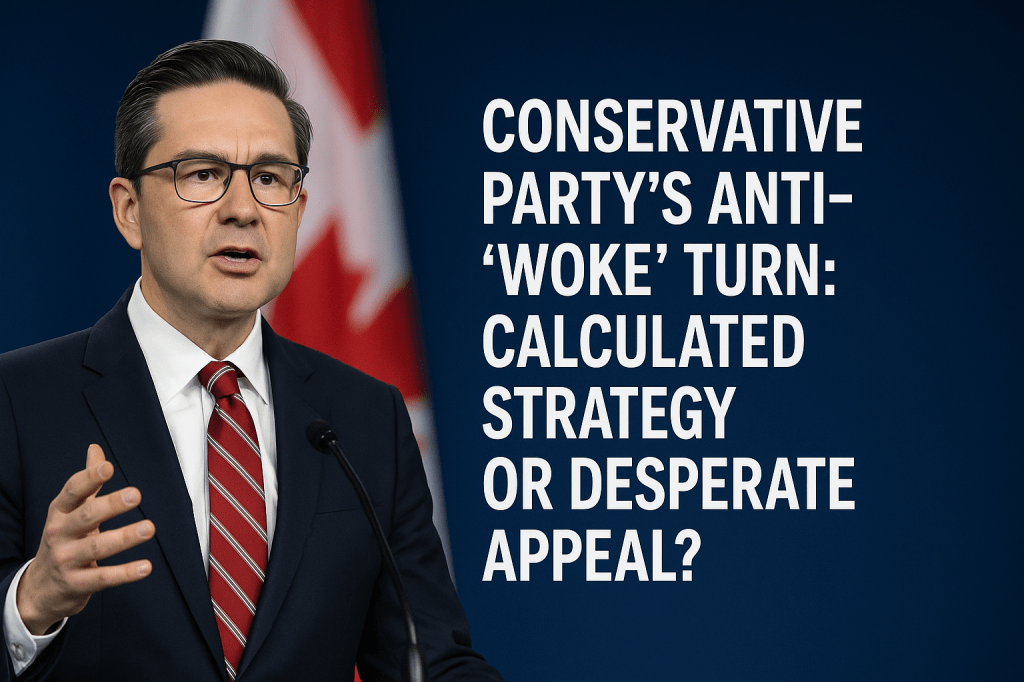
Conservative Party’s Anti-“Woke” Turn: Calculated Strategy or Desperate Appeal?

The Conservative Party of Canada has quietly republished the English-language version of its platform to reinsert a plank that had been conspicuously absent; a pledge to crack down on so-called “woke ideology” within the federal public service, and in university research funding. Described as a “publishing oversight,” this addition raises far more questions than it answers, particularly about Pierre Poilievre’s political calculus as the next election draws closer.

First, let’s interrogate the substance. “Woke ideology,” while undefined in the platform, is often shorthand on the political right for progressive stances on diversity, inclusion, gender identity, anti-racism, and decolonization efforts. To include language targeting these frameworks suggests the Conservatives are not just passively uncomfortable with current equity-focused public policy, they’re actively preparing to dismantle it. But why now?

One possible explanation is strategic: this is a deliberate overture to Canada’s emergent far-right electorate. While still fringe in some parts of the country, this voter segment has grown increasingly vocal, particularly on social media, and within alternative media ecosystems. By tapping into their grievances, against public sector DEI programs, gender-inclusive language, or research funding tied to Indigenous reconciliation, the Conservatives may be attempting to consolidate a reliable, energized bloc of voters.

Another interpretation is more inward-facing: Poilievre is shoring up his base, not for the election, but for what comes after. Should the Conservatives form government, he may face internal fractures between establishment conservatives and newer ideological hardliners. This platform language signals allegiance to the latter, potentially ensuring his continued leadership in a post-election caucus that could be divided on everything from fiscal policy to foreign affairs.

There’s also the broader issue of timing. The re-publication came after criticism that the party had been “softening” to appeal to moderate or urban voters, many of whom are uncomfortable with overt culture war rhetoric. By reaffirming this pledge, the party might be trying to reassure its core that the campaign’s centrist gestures are mere optics, not policy commitments.

But this move is not without risks. Canada’s public service is one of the most diverse and professionalized in the world. Federal civil servants are unlikely to respond positively to a government that frames their professional values as ideological threats. Likewise, university researchers who rely on federal grants will see this as a chilling signal that academic freedom could be compromised by political litmus tests.

And then there’s the broader electorate. While “anti-woke” politics have gained traction in the U.S. and U.K., Canadian voters have historically been more moderate. The risk for Poilievre is that in appealing to a narrow base, he alienates the swing voters he’ll need to actually win. Recent polling shifts, driven in part by U.S. President Donald Trump’s aggressive new tariffs on Canadian goods and Liberal leader Mark Carney’s boost in credibility, suggest the tide may already be turning against Poilievre’s hard-right gambit.

The re-insertion of this controversial language into the Conservative platform isn’t a glitch, it’s a signal. The question now is whether it’s a strategic masterstroke aimed at cementing a new ideological alignment in Canada, or a desperate hedge against the possibility that Poilievre wins the election, but loses control of his own party.

Pierre Poilievre’s Fear Tactics: A Betrayal of Canadian Values

This is the first of hopefully many guest posts for this blog.

I have been heartened by the civility characterizing the 2025 Canadian Federal Election Campaign. Amid global unrest, our nation’s commitment to respectful discourse has been a beacon of hope. Until today.

Today, Pierre Poilievre crossed a line. He didn’t just resort to name-calling; he employed fear on a scale that is both alarming and disheartening.

Leadership demands vision, a comprehensive plan, and the ability to inspire confidence. A true leader assesses situations holistically, allocates resources wisely, and maintains composure under pressure.

However, Mr. Poilievre chose a different path. He took a speculative report, designed to explore potential future scenarios, and distorted its findings to paint a dystopian narrative. This manipulation wasn’t just misleading; it was a calculated attempt to exploit Canadians’ emotions for political gain.

The report in question, published by Policy Horizons Canada, is intended to inform policymakers about possible future challenges and opportunities. It’s a tool for strategic foresight, not a definitive prediction. By presenting its content as an imminent threat, Mr. Poilievre has not only misrepresented the report, but also undermined the very purpose of such forward-thinking analyses.

This approach is not just a deviation from responsible leadership; it’s a betrayal of the trust Canadians place in their elected officials. It sows unnecessary fear and distracts from constructive dialogue about our nation’s future.

I urge every Canadian to read the report themselves at Policy Horizons Canada. Understand its intent, and see through the fear-mongering.

https://horizons.service.canada.ca/en/2025/01/10/future-lives-social-mobility/index.shtml

Our future is ours to shape. Let’s base our decisions on facts, not fear.

About the Author

Angela is a Canadian veteran who was honoured to be part of the first class of women at Collège militaire royal de Saint-Jean and retired from the Canadian Forces in 1991. Since then, she has built a diverse career in industry and has owned and operated small businesses for over two decades. Her lifelong commitment to service, leadership, and community informs her thoughtful perspective on Canada’s future.

Building the Future: Kemptville’s Affordable Housing Vision

In communities across Canada, the housing crisis has become more than a policy debate, it’s a daily struggle. While costs rise and waitlists grow, the Municipality of North Grenville, just south of Ottawa, is offering a bold response. Its $25 million proposal to convert Bell Hall, a vacant dormitory on the Kemptville Campus, into more than 60 affordable rental units is both practical and symbolic, a microcosm of what’s possible when local governments lead.

The campus itself is a 630-acre hub of community, education, and sustainability activities. Once part of the University of Guelph’s agricultural network, it’s now owned by the municipality and governed by a 2021 master plan that prioritizes adaptive reuse, environmental responsibility, and deep community engagement. Bell Hall fits that vision precisely; a municipally owned, appropriately zoned, fully serviced building, already standing and waiting to be converted.

This is not a speculative plan. Developed over months with input from senior staff and not-for-profit partners, the Bell Hall project targets the real needs of North Grenville’s most vulnerable; seniors, veterans, and working families being priced out of their hometown. It offers not just housing, but stability, dignity, and a sense of belonging.

And yet, despite being shovel-ready, the proposal remains stalled in a growing backlog at the Canada Mortgage and Housing Corporation (CMHC). It’s a familiar story for municipalities across the country, many of whom are reporting delays due to limited federal processing capacity, particularly in underwriting. As federal priorities shift with the political winds, viable projects are left in limbo.

Mayor Nancy Peckford recently sounded the alarm in the Ottawa Citizen, arguing that the issue is not preferential treatment, but systemic inefficiency. Her call for transparency and faster turnaround is resonating with other small communities also ready to build. In an age where housing need is immediate, the logic is simple: when a plan meets all the criteria, and the groundwork is laid, it should move forward.

Some critics are suggesting that municipalities are just now “stepping up” on housing, but local governments have long managed zoning and development approvals. What’s new is the scale and pace of their engagement, assembling land, forming partnerships, applying for federal tools, and leading where senior governments lag.

North Grenville’s approach is part of a broader shift in small-town Canada, where pressures once confined to major cities are now spreading. The housing crisis isn’t urban anymore, it’s national. In this context, Bell Hall becomes more than a local project. It’s a test of the federal-municipal partnership that modern housing policy demands.

There’s also economic logic behind the urgency. A 2023 Deloitte report estimated that expanding community housing could add $70 billion to Canada’s GDP over five years. In places like Kemptville, where growth is manageable and materials can be sourced locally, the multiplier effects are significant with jobs, procurement, community stabilization, and reduced strain on health and social services.

And this is just one community. Rural municipalities across Eastern Ontario are facing similar challenges – aging populations, limited rental stock, and infrastructure that hasn’t kept pace. A regional alliance, or even a coordinated appeal, could elevate the urgency of rural housing and draw more attention to what’s at stake.

North Grenville is ready. Bell Hall is ready. The question is whether the federal system is ready to respond with the speed and seriousness the moment demands. If the next government wants to prove its commitment to housing, here is the perfect place to start.

Your Anti-Vax Opinion Is a Public Health Threat

It’s astonishing, and frankly infuriating, that in 2025 we’re still arguing about the value of the measles vaccine. The data is clear, the science is airtight, and yet somehow, vaccine hesitancy continues to chip away at public health. Let me be blunt: the risk of a vaccine like the MMR is vanishingly small compared to the catastrophic potential of a disease like measles. And if you don’t believe that, then you’re either ignoring the data or falling for misinformation. Either way, lives are at risk.

Measles isn’t just a “harmless childhood illness.” That’s a dangerous myth. Measles is one of the most contagious viruses we know, spread through the air, able to linger for hours, and capable of infecting up to 90% of unvaccinated people exposed to it. In well-resourced countries, about 1 or 2 out of every 1,000 children who get measles will die. That’s not a rounding error. That’s a funeral. And it gets worse in poorer regions where malnutrition and limited healthcare access make mortality rates even higher.

And for the kids who survive? About 1 in 20 ends up with pneumonia, 1 in 10 gets a potentially permanent ear infection, and roughly 1 in 1,000 develops encephalitis, a dangerous brain swelling that can cause lifelong disability. Years later, a rare but fatal condition called SSPE can develop from a childhood measles infection, slowly destroying the brain. No cure. No mercy.

Now contrast that with the MMR vaccine. It has been used globally for decades, and it works. Two doses give you about 97% protection. Most people have no side effects at all. At worst, maybe a fever or a mild rash. Some kids, about 1 in 3,000 to 4,000, might experience a febrile seizure, which is scary for parents, but causes no long-term harm. And the odds of a life-threatening allergic reaction? Less than one in a million. In other words, you’re more likely to be struck by lightning. Twice! 

And we’ve seen what happens when vaccine coverage drops. Samoa in 2019 is a tragic case study. After a decline in vaccine confidence, a measles outbreak swept the islands. Eighty-three people died, mostly young children. In Europe that same year, measles cases exploded. More than 82,000 in the WHO European Region, and 72 people dead. In the U.S., the 2019 outbreak saw over 1,200 cases, largely among unvaccinated individuals, threatening the country’s measles elimination status. This isn’t theoretical. This isn’t debatable. It’s what happens when people stop vaccinating.

It’s no surprise that the World Health Organization named vaccine hesitancy one of the top ten global health threats. And it should be, because when you refuse a vaccine, you’re not just making a decision for yourself, you’re putting babies, cancer patients, and immunocompromised people at risk. You’re weakening herd immunity, which is the only thing standing between them and a virus that doesn’t care about your opinions or your YouTube rabbit holes.

Let’s stop sugarcoating it. Vaccines are safe. Measles is deadly. Choosing not to vaccinate isn’t a personal health decision, it’s a public health threat. We’re not debating anymore. We’re fighting ignorance with facts, and if that offends you, maybe it should.