
I want to share my love of Northumbrian smallpipes with you. Yes, it is partly because I was born and raised in that part of the world, but I have always been a huge fan of the folk music and instruments of the British Isles. In my late teen/early twenties, I was a member of an electric folk band called ‘Pastime with Good Company’ playing a variety of the ‘fill’ instruments such as mandolin, crumhorn, and bodhran, along with the odd backing vocals. We were paid in beer for the first year or two, and it was just great fun seeing the same friendly faces at the Blackbird, the King’s Arms or a Working Men’s club.
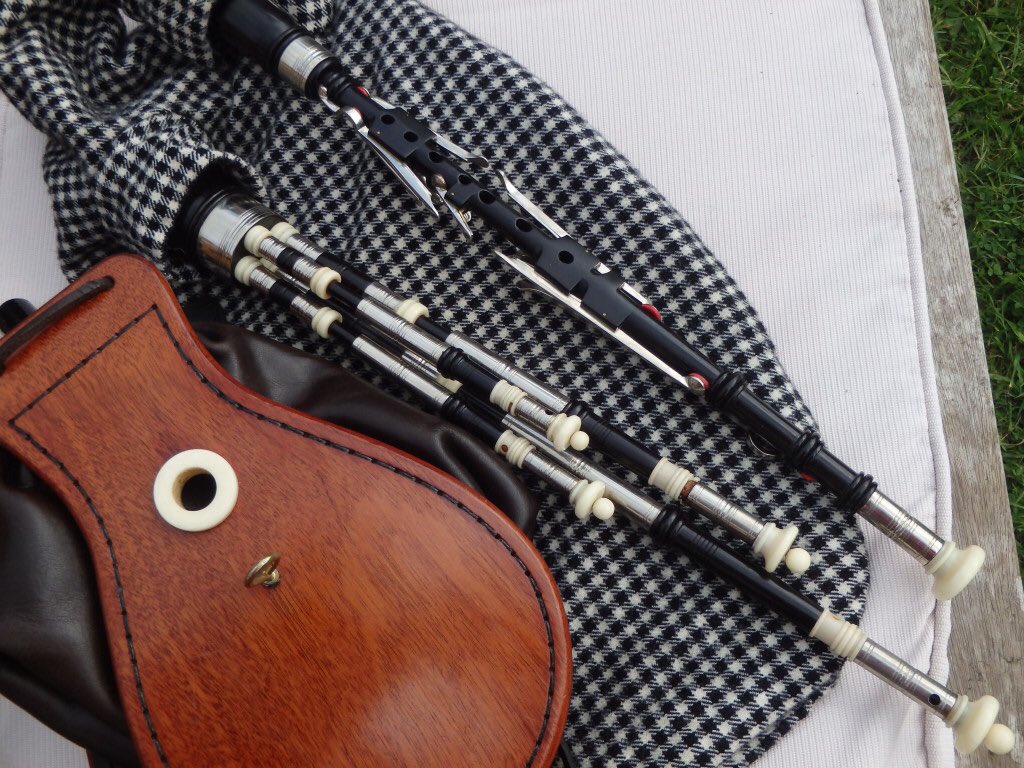
The Northumbrian smallpipes are a traditional folk instrument from Northeast England with a rich and varied history. These small pipes are known for their sweet, melodious sound, and are distinguished by their closed-finger holes, allowing for a staccato playing style unique among bagpipes.
Dating back to the 17th century, their evolution was heavily influenced by various cultural and musical trends over the centuries. The modern version, with its distinctive closed chanter and keyed system, emerged in the early 19th century, thanks to innovations by pipemakers such as John Dunn and Robert Reid.
Throughout its history, the Northumbrian piping tradition has been shaped by many notable musicians. One key figure is Billy Pigg (1902-1968), renowned for his virtuosic playing and composition. Pigg’s influence on the Northumbrian piping repertoire is profound, with many of his compositions still widely played today. He was a central figure in reviving interest in the instrument during the mid-20th century, often performing at folk festivals and on radio broadcasts.

Another significant figure is Richard Butler, an old work colleague and friend, who served as the Duke of Northumberland’s Piper for four decades until his death in 2022. I remember watching and listening to Richard practice most lunchtimes, while I munched on my date and cream cheese stottie, drinking tea from one of the lab’s old enamel mugs. Butler was an esteemed piper and educator, known for his deep knowledge of the instrument and his contributions to Northumbrian music. He played at many high-profile events, including performances for British royalty, as well as producing educational materials for the pipes, ensuring the tradition’s continuation through his teaching and published works.
The history of the Northumbrian smallpipes is marked by the role of ducal piper at Alnwick Castle. This tradition dates back to the 18th century, with pipers playing at various ceremonial and public functions. Notable past pipers, before Richard, include William Green and Tom Clough, both of whom made significant contributions to the repertoire and technique of Northumbrian piping. Andrew Davison is the current official Piper to His Grace the Duke of Northumberland, and Chairman of the Northumbrian Pipers’ Society.

Kathryn Tickell, a modern-day ambassador of the Northumbrian smallpipes, has further elevated the instrument’s profile. Born in 1967, Tickell learned to play from her family and local pipers. Her career has seen her perform internationally, collaborate with various artists, and release numerous acclaimed albums. Tickell’s contributions have been pivotal in bringing the Northumbrian pipes to new audiences and ensuring their ongoing relevance in contemporary music. Her work with Sting and Jon Lord has always been favourites of mine, but it’s her ability to blend the pipes with more modern instruments and the human voice that pleases me the most.
The Northumbrian smallpipes continue to build their storied history, enriched by the contributions of many talented musicians including Ian Gelston, Alice Robinson, and Andrew Lawrenson. From the early pipers who developed the instrument to modern virtuosos like Kathryn Tickell, the tradition continues to thrive, bridging the past with the present. Richard Butler’s legacy exemplifies the dedication required to preserve and advance this unique musical tradition.
When I get a moment, I will update this post with links to some of my favourite pieces.
 The Rowanwood Chronicles