The Budapest Memorandum of 1994: A Cautionary Tale in Security Assurances

The Budapest Memorandum on Security Assurances, signed on 5 December 1994, stands as a pivotal moment in post-Cold War geopolitics. Emerging from the ashes of the Soviet Union, it marked a rare convergence of nuclear disarmament and multilateral diplomacy. Ukraine, Belarus, and Kazakhstan, each inheriting a share of the USSR’s vast nuclear arsenal, were persuaded to relinquish their strategic weapons in exchange for assurances from the United States, the United Kingdom, and the Russian Federation. The signing took place at an OSCE summit in the Hungarian capital, hence the document’s name.

At the heart of the memorandum was Ukraine’s possession of the third-largest nuclear arsenal in the world. Though the warheads were technically under Russian operational control, they remained physically on Ukrainian soil. The U.S. in particular led efforts to prevent the emergence of new nuclear states from the former Soviet republics, promoting the Treaty on the Non-Proliferation of Nuclear Weapons (NPT) as the legal mechanism for disarmament. In return for joining the NPT as a non-nuclear weapon state, Ukraine was promised political assurances regarding its sovereignty, territorial integrity, and security.

The terms of the Budapest Memorandum were significant, though pointedly not binding under international law. The signatories pledged to respect the independence and existing borders of Ukraine, refrain from the threat or use of force, and avoid economic coercion. They also committed to seek UN Security Council action if nuclear weapons were ever used against Ukraine, and promised not to use nuclear weapons against the country themselves. The inclusion of a clause requiring consultations in the event of disputes or threats was intended to provide a diplomatic channel in times of crisis.

What is critical to understand is that the memorandum was not a formal treaty. It lacked enforcement mechanisms and legal penalties, relying instead on political goodwill and international norms. This distinction would prove fatal to its credibility two decades later.

The annexation of Crimea by the Russian Federation in early 2014, followed by its support for separatists in the Donbas region, represented a direct challenge to the core principles enshrined in the Budapest Memorandum. Ukraine’s territorial integrity was violated by a state that had explicitly committed to uphold it. While the United States and the United Kingdom issued strong condemnations and imposed sanctions on Russia, neither country provided direct military support to Ukraine, citing the memorandum’s non-binding nature.

Russia, for its part, has argued that the circumstances of 2014, namely, the change in Ukraine’s government following the Maidan Revolution, nullified the commitments under the agreement. It has also claimed that Crimea’s “referendum” justifies its actions. These positions are widely rejected by the international legal community and by the other signatories of the memorandum, but the damage to the credibility of security assurances was done.

The legacy of the Budapest Memorandum is now viewed with a mix of regret and realism. It illustrates the limits of non-binding agreements in deterring aggression by great powers, and it has become a central reference point in discussions on nuclear disarmament and non-proliferation. For Ukraine, the memorandum is a bitter reminder of the price paid for denuclearization without robust, enforceable guarantees. For the global community, it raises hard questions about the viability of relying on political promises in an increasingly unstable world.

The Budapest case has also had ramifications beyond Eastern Europe. It has been cited by countries such as North Korea and Iran in debates over nuclear policy, reinforcing the perception that possession of nuclear weapons may offer more reliable security than any assurance signed on paper. In the decades since, the gap between rhetoric and reality in international security agreements has only widened.

Sources
• United States Department of State Archive. Background Briefing on Ukraine, March 2014. https://2009-2017.state.gov
• United Nations Office for Disarmament Affairs. Treaty on the Non-Proliferation of Nuclear Weaponshttps://disarmament.un.org
• Council on Foreign Relations. Why Ukraine Gave Up Its Nuclear Weapons, 2022. https://www.cfr.org/backgrounder/why-ukraine-gave-nuclear-weapons
• Chatham House. Ukraine, Russia and the West: The Budapest Memorandum at 30, 2023. https://www.chathamhouse.org

Israel’s Nuclear Arsenal: The Open Secret of the Middle East

For decades, Israel has maintained an official policy of “nuclear ambiguity”, neither confirming nor denying its possession of nuclear weapons. Yet this studied silence stands in stark contrast to a substantial body of verifiable evidence, much of it sourced from credible whistle-blowers, declassified intelligence, military analysis, and satellite data. In practice, the Israeli nuclear arsenal has become one of the worst-kept secrets in international security. The absence of formal acknowledgment is strategic, not evidentiary. Israel’s nuclear capability is both real and operational, undergirded by a robust triad of delivery systems and supported by a long history of secrecy, scientific sophistication, and political calculation.

The story begins with the Dimona nuclear reactor in the Negev Desert, built in the late 1950s with clandestine French assistance. Officially described as a textile plant, it was in fact a plutonium production facility. By the mid-1960s, U.S. intelligence had concluded that Israel possessed the technical capability to produce nuclear weapons. In 1969, after a series of secret meetings, the United States and Israel reached a tacit agreement: Israel would not publicly test or declare its nuclear weapons, and the U.S. would cease pressuring it to sign the Non-Proliferation Treaty (NPT). This diplomatic fiction has endured for over fifty years.

However, the most damning evidence came in 1986, when Mordechai Vanunu, a former technician at Dimona, provided The Sunday Times with detailed photographs and descriptions of Israel’s nuclear warheads. Vanunu claimed Israel had produced enough weapons-grade plutonium for over 200 nuclear devices, including thermonuclear warheads, statements later corroborated by Western intelligence assessments. Vanunu’s disclosures confirmed what many had suspected: that Israel was not merely in possession of a handful of crude bombs but had developed a sophisticated and sizeable arsenal.

Independent experts such as the Federation of American Scientists (FAS) and the Stockholm International Peace Research Institute (SIPRI) have consistently estimated that Israel holds between 90 and 400 nuclear warheads. These are believed to be deployable through a triad of systems: land-based ballistic missiles, air-delivered bombs, and submarine-launched cruise missiles. The Jericho III, a long-range intercontinental ballistic missile, is believed to have a range of up to 6,500 kilometers, potentially extending to 11,500 kilometers depending on payload. These missiles are housed in hardened silos, well-concealed and dispersed for survivability. Additionally, Israel’s fleet of Dolphin-class submarines, purchased from Germany and believed to be modified to launch nuclear-capable Popeye Turbo cruise missiles, offers a potent second-strike capability.

The Israeli Air Force also plays a central role in the country’s nuclear deterrence. Modified F-15I and F-16I aircraft are capable of carrying nuclear payloads, further broadening the strategic options available to decision-makers in Tel Aviv. The ability to deliver nuclear weapons from sea, air, and land ensures that Israel retains a survivable deterrent, reinforcing the credibility of its nuclear posture even in the event of a first strike by an adversary.

Israel’s refusal to sign the NPT or to subject its nuclear facilities to International Atomic Energy Agency (IAEA) safeguards further confirms its unique position in the global nuclear order. While this policy isolates Israel diplomatically in certain forums, it has not resulted in significant punitive measures, due in large part to its close alliance with the United States and the widespread, if unspoken, acceptance of its strategic rationale. From the perspective of Israeli leadership, nuclear weapons serve as the ultimate insurance policy against existential threats in a region fraught with hostility and volatility.

From time to time, Israeli political and military leaders have let the mask slip. Former Prime Minister Ehud Barak acknowledged the existence of the arsenal in indirect but unmistakable terms. Other officials have alluded to it in speeches or interviews, especially when referring to red lines for Iran or Israel’s qualitative military edge. These statements are often quickly walked back or couched in hypothetical language, but the implications are unmistakable.

Perhaps the most compelling argument for Israel’s nuclear capability is the simple fact that no serious analyst or international observer denies it. The international community, especially the intelligence and military establishments of major powers, operates on the assumption that Israel is a nuclear-armed state. Its capabilities, though untested in public, are viewed as credible and strategically integrated. The lack of open testing has not diminished deterrence; rather, the veil of ambiguity enhances it, allowing Israel to maintain strategic deterrence without the diplomatic fallout of formal admission.

The accumulated evidence of Israel’s nuclear weapons program is overwhelming and irrefutable. The country’s longstanding policy of ambiguity may serve its diplomatic and strategic interests, but it does not conceal the reality of its capabilities. With a mature triad, hundreds of warheads, and decades of operational readiness, Israel stands as a de facto nuclear power in a region where deterrence often serves as the only firewall against catastrophe.

Sources
• Wired, “Israel’s Secret Nuke Arsenal Exposed”, October 5, 2011: https://www.wired.com/2011/10/1005israel-secret-nuclear-arsenal-exposed
• Federation of American Scientists (https://fas.org)
• Stockholm International Peace Research Institute (https://sipri.org)
• Nuclear Threat Initiative (https://nti.org)
• The Sunday Times archive on Mordechai Vanunu (1986)
• GlobalSecurity.org and IISS assessments of Jericho III and Dolphin-class platforms
• U.S. Congressional Research Service Reports on Middle East security and nuclear proliferation

Between Sovereignty and Survival: Britain’s Nuclear Reality

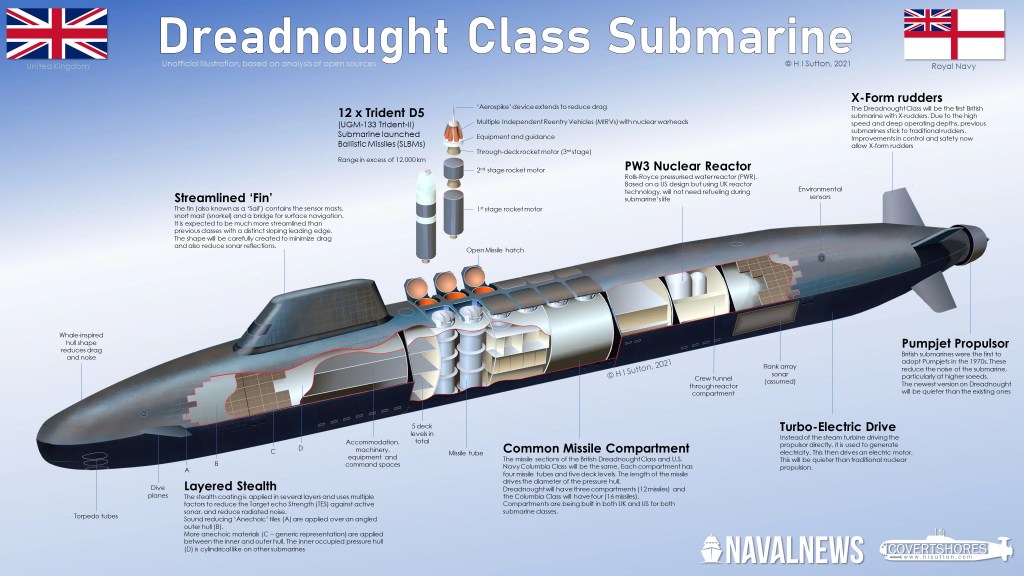
The keel-laying of HMS Dreadnought in March 2025 marked a milestone in Britain’s strategic deterrent program and the future of its nuclear-powered ballistic missile submarine (SSBN) fleet. As the first of four vessels in the new Dreadnought-class, this submarine embodies both an engineering triumph and a signal of sustained commitment to the UK’s Continuous At-Sea Deterrent (CASD), which has remained unbroken since 1969. At 153.6 meters and 17,200 tonnes, the Dreadnought will be the largest submarine ever operated by the Royal Navy: a floating cathedral of stealth, survivability, and silent lethality.

The new class is expected to replace the aging Vanguard-class submarines by the early 2030s and will be in service well into the 2070s. Powered by the Rolls-Royce PWR3 nuclear reactor, a substantial evolution from the PWR2 used in the Vanguards, the Dreadnoughts promise longer life, reduced maintenance, and quieter operation, essential for a vessel designed to avoid detection at all costs. Innovations in stealth include a reshaped hull form, advanced sound-dampening technologies, and X-shaped stern rudders for more agile maneuvering in deep water. The integration of BAE Systems’ Active Vehicle Control Management (AVCM) fly-by-wire system and Thales’ Sonar 2076 gives the submarine cutting-edge sensory and navigation capabilities.

Comfort and crew sustainability have not been overlooked. Designed to accommodate 130 personnel, the submarine includes improved living quarters, separate facilities for female sailors, a small gym, and an artificial lighting system to simulate day and night cycles, no small consideration for the psychological health of crews spending months submerged in strategic silence. Operationally, the class will carry 12 missile tubes using the Common Missile Compartment (CMC), co-developed with the United States. These tubes will launch the Trident II D5 ballistic missile, a weapon system that is central to the debate over British nuclear sovereignty.

For all its sovereign trappings, the UK’s nuclear deterrent is not entirely domestically independent. The Dreadnought-class, like its predecessor, remains intimately tied to US strategic infrastructure, a reality that undermines, in the view of some, the claim of an “independent” deterrent. The Trident II D5 missiles aboard Dreadnought are not built in Britain, but rather drawn from a shared pool maintained by the US Navy at Kings Bay, Georgia. These missiles are periodically rotated, serviced, and upgraded in the United States. The UK owns no domestic facility for full-cycle missile maintenance, which introduces a logistical and, some would argue, strategic dependency.

Even the warheads, while built and maintained at the Atomic Weapons Establishment in Aldermaston, are widely understood to be based on the American W76 design. British scientists have not tested a warhead since 1991, relying instead on simulation and US data. Further, the PWR3 reactor at the heart of the Dreadnought-class, although built by Rolls-Royce, is significantly influenced by the US Navy’s S9G reactor used in its Virginia-class attack submarines. This level of integration, from missile tubes to propulsion, reflects decades of close US-UK military cooperation, formalized in arrangements like the 1958 Mutual Defence Agreement.

Supporters of the Dreadnought program argue that such collaboration is not a weakness but a pragmatic alliance. By sharing R&D burdens and pooling procurement, the UK can field a credible nuclear deterrent without spending the tens of billions required for full-spectrum independence. Operational command and control of the submarines, including launch authority, remains fully in British hands, with final decision-making retained by the Prime Minister. Indeed, the “letters of last resort” carried on each submarine are uniquely British in character: a final instruction from one head of government to another in the event of national annihilation.

Yet critics maintain that the veneer of sovereignty cannot obscure the fact that a central pillar of British defence policy is structurally dependent on American goodwill, technology, and supply chains. In any future divergence of interests between London and Washington, or under a more isolationist US administration, the UK’s deterrent capability could be compromised, not technically, perhaps, but in terms of assuredness and resilience.

The Dreadnought-class represents both continuity and compromise. It is a technical marvel and a credible means of sustaining Britain’s strategic nuclear posture; but it is also a reminder that sovereignty in the nuclear age is often a layered illusion, one maintained not through autarky, but through alliance, collaboration, and trust in the enduring strength of an Anglo-American strategic partnership that remains, for now, as silent and watchful as the vessels patrolling the deep.