In recent years, VIA Rail has faced internal and external pressures to prioritize speed and efficiency over regional accessibility, with proposals suggesting the reduction of service to smaller towns along the southern corridor in favor of focusing on larger urban centers. While such an approach might seem rational from a purely commercial perspective, it fundamentally misunderstands VIA Rail’s statutory mandate and the public value of its service. The introduction of a high-speed network such as Altos further underscores the importance of VIA Rail fulfilling its original mission: providing essential rail connectivity to smaller cities, towns, and villages in eastern Canada as part of a cohesive national transportation network.
VIA Rail’s mandate is not to compete with high-speed intercity travel. Its core purpose is to ensure that communities which lack alternative rapid transportation options remain linked to major metropolitan centers. Towns like Belleville, Kingston, Brockville, and Cornwall rely on VIA Rail for access to jobs, education, health care, and commerce. Reducing service to these communities in favor of express connections between larger cities would sever vital lifelines and exacerbate regional inequality, undermining the social and economic fabric of eastern Canada.
The coming of Altos high-speed rail makes this role even clearer. High-speed service is designed to connect major urban anchors quickly, leaving no capacity or mandate for serving smaller towns along the route. By concentrating on long-distance, limited-stop service, Altos will meet the demand for speed without addressing the needs of communities that depend on regular, accessible rail service. VIA Rail, therefore, must retain and enhance its focus on regional connectivity, ensuring that small and mid-sized communities continue to be fully integrated into Canada’s national transportation framework.
Investing in VIA Rail’s southern corridor for smaller-community service yields tangible benefits. Frequent, reliable connections allow residents of towns and villages to access economic opportunities in larger centers without requiring private vehicles or air travel, while supporting local economies by maintaining links for tourism, commerce, and labor mobility. Service improvements, schedule reliability, and modernized rolling stock for regional service are far more aligned with VIA Rail’s mission than reallocating resources toward high-speed, limited-stop service.
In the context of national rail strategy, VIA Rail’s mandate should be reaffirmed and protected. It is not a commercial exercise to maximize speed between cities, but a public service designed to ensure connectivity, accessibility, and equity. As Altos takes on the role of rapid intercity travel, VIA Rail must double down on its responsibility to smaller communities, strengthening the southern corridor as a reliable and inclusive lifeline for eastern Canada. Maintaining this distinction between high-speed and regional service is essential for a balanced, effective, and socially responsible rail network.
Ontario’s blue cheeses occupy a distinctive place within Canada’s dairy landscape. They do not dominate by volume, nor do they pursue the extremity that often defines international blue-cheese prestige. Instead, Ontario producers have developed a reputation for restraint, balance, and technical discipline. In a category often tempted by pungency for its own sake, Ontario blues tend to privilege structure and repeatability. That choice has quietly earned them national and international respect.
At the centre of this story is Celtic Blue Reserve, produced by Glengarry Fine Cheese in eastern Ontario. It is widely regarded as the province’s flagship blue and, by extension, one of the most important cheeses ever produced in Canada. Its recognition as Best in Show at the American Cheese Society competition was not a novelty outcome but a validation of method. The cheese combines dense, creamy paste with assertive but measured blue veining. Salt, tang, and cultured sweetness remain in equilibrium. Nothing dominates, and nothing feels unfinished. It is a blue cheese built for confidence rather than shock.
The success of the Reserve rests on foundations laid by the original Celtic Blue, which remains a mainstay on Ontario cheese boards. This earlier expression is milder, softer, and intentionally accessible. Its importance lies not in awards but in function. It established that Ontario blues could invite rather than challenge the eater. In doing so, it broadened the audience for blue cheese within the province and created space for more ambitious expressions to follow.
Ontario’s blue-cheese identity is not confined to a single producer. Krüger Blue, made with Guernsey milk in eastern Ontario, represents a more rustic and assertive branch of the same tradition. Richer milk brings deeper colour and a more aromatic profile, with flavours that lean toward earth and cellar rather than cream and butter. Its recognition at the World Cheese Awards signals that Ontario blues can scale intensity without losing composure.
Sheep’s-milk blues such as Highland Blue further complicate the picture. These cheeses tend to display layered flavours, faint spice, and a denser mouthfeel. They appeal to experienced blue-cheese drinkers looking for depth rather than familiarity. Their presence matters because it shows that Ontario producers are not confined to a single style, even if balance remains the common thread.
Acknowledging this does not require diminishing the achievements of other provinces. Quebec’s monastic blues bring historical continuity and spiritual craft. British Columbia’s brie-style blues explore lushness and surface-ripened elegance. Yet Ontario’s contribution is different. It is less about inheritance or stylistic flourish and more about calibration. Ontario blues succeed because they are engineered carefully, aged deliberately, and released only when the elements align.
The defining characteristic of Ontario blue cheese is therefore not boldness, but control. These are cheeses designed to be eaten often rather than remembered once. They sit comfortably on the table, return well to the palate, and reward familiarity. In a category that often celebrates excess, Ontario has chosen discipline, and the results speak quietly but persuasively for themselves.
For years, Canada’s ambitious dream of linking its greatest cities with true high-speed rail has hovered in the realm of feasibility studies and future pipe dreams. Now, in the closing weeks of 2025, that dream has shifted decidedly toward reality; not because steel is yet being laid, but because the Alto high-speed rail initiative has crossed a crucial threshold from concept to concerted preparation and public engagement.
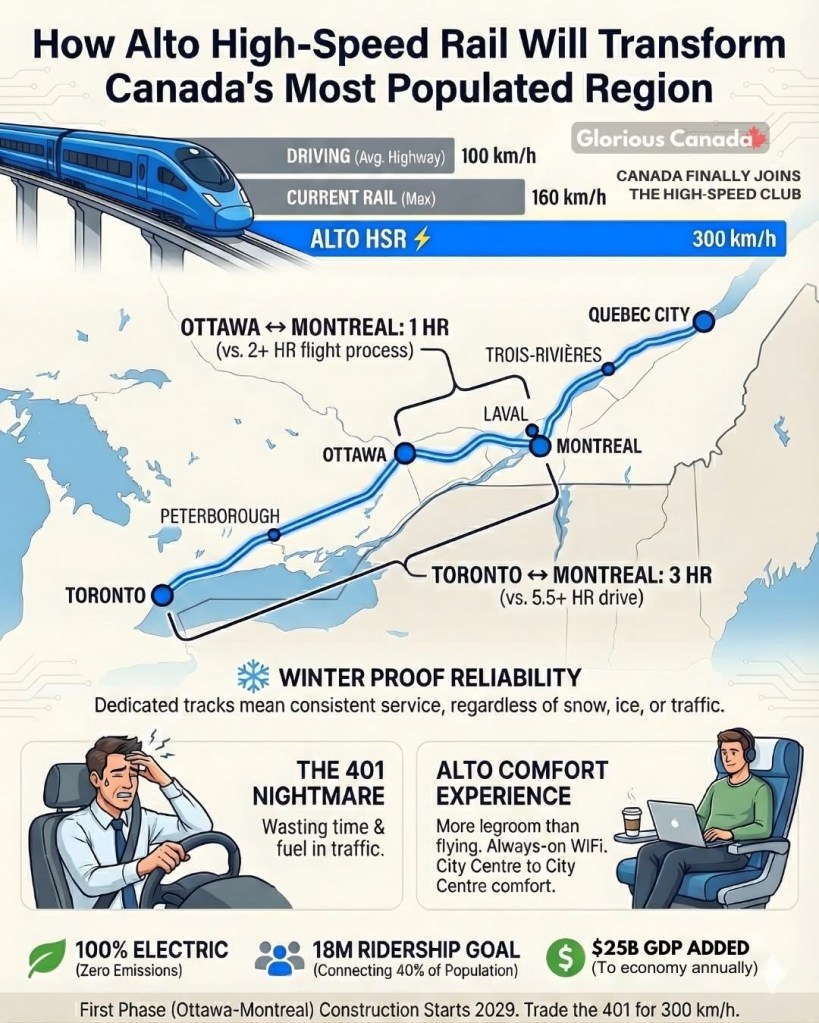
At its core, Alto is a transformative infrastructure vision: a 1,000-kilometre electrified passenger rail network connecting Toronto to Québec City with trains capable of 300 km/h speeds, slicing travel times compared to what today’s intercity rail offers and binding half the nation’s population into a single, rapid mobility corridor. The design phase, backed by a multi-billion-dollar co-development agreement with the Cadence consortium, is well underway, and the federal government has signaled its intent to see this project delivered as one of the largest infrastructure investments in decades.
The most noteworthy milestone in recent weeks has been a strategic decision about where Alto will begin to take physical shape. On December 12, officials announced that the Ottawa–Montreal segment – roughly 200 km – will be the first portion of the network to advance toward construction, with work slated to begin in 2029. This choice reflects a practical staging strategy: by starting with a shorter, clearly defined corridor that spans two provinces, engineering and construction teams can mobilize simultaneously in Ontario and Québec and begin delivering economic and skills-development benefits sooner rather than later.
This announcement isn’t just about geography; it marks a shift in Alto’s progression from broad planning to community-level engagement. Beginning in January 2026, Alto will launch a comprehensive three-month consultation process that includes open houses, virtual sessions, and online feedback opportunities for Canadians along the corridor. These sessions will inform critical decisions about alignment, station locations, and mitigation of environmental and community impacts. Indigenous communities, municipalities, and public institutions will be active participants in these discussions as part of Alto’s ongoing commitment to consultation and reconciliation, a recognition that this project’s success hinges not only on engineering prowess, but on thoughtful, inclusive planning.
Beyond route planning, Alto and Cadence are also turning to Canada’s industrial capacity, particularly the steel sector, to gauge the domestic supply chain’s readiness for what will undeniably be a massive procurement exercise. With thousands of kilometres of rail and related infrastructure components needed, early outreach to the steel industry is intended not just to assess production capacity, but to maximize Canadian content and economic benefit from the outset.
Yet not every question has a definitive answer. Strategic discussions continue over the optimal location for Alto’s eventual Toronto station, with the CEO publicly acknowledging that a direct connection to Union Station may not be guaranteed; a decision that could shape ridership patterns and integration with existing transit networks across the Greater Toronto Area.
As the calendar turns toward 2026, the Alto project sits at an inflection point: one foot firmly planted in detailed design and consultation, the other inching closer to the realm of shovels and steel rails. Political support appears robust, and fiscal planning, including major project acceleration initiatives and supportive legislation, has built momentum. Yet, as any transportation planner will tell you, the distance between planning and construction is long, often winding, and frequently subject to political, economic, and community pressures.
Still, for advocates and observers alike, the significance of the latest developments cannot be overstated. Alto has graduated from “what if?” to “when and how,” and that alone marks a major step forward in Canada’s transportation evolution.
Background updated to reflect the government announcement of October 31, 2025.
🔎 Background
On October 31, 2025 the Ministry of the Environment, Conservation and Parks announced its intention to introduce legislation to create a new Ontario Provincial Conservation Agency to provide province-wide leadership and oversight of conservation authorities. At the same time the government released a public consultation proposing to consolidate Ontario’s 36 conservation authorities into seven regional, watershed-based authorities.
The stated aims are reducing fragmentation, improving consistency in permitting and services, freeing up resources for front-line conservation work and aligning watershed management with provincial priorities in housing, infrastructure, economic growth and climate resilience.
Note — The proposal retains watershed-based boundaries and envisions seven regional conservation authorities aligned with major watershed systems. Implementation would follow further legislation, regulation and a formal transition period.
✅ Advantages (Pros)
⚖️Consistency and Standardization
The current 36-authority system shows significant variation in policies, fees, processes and technical capacity. Consolidation seeks to standardize permitting and reduce duplication.
A more consistent system may speed approvals, improve service delivery and align permitting with broader provincial housing and infrastructure goals.
🛠️Scale and Capacity Building
Larger regional authorities can pool technical specialists in hydrology, ecology, GIS, modelling and flood forecasting.
A single digital permitting platform, improved data management and updated floodplain mapping could strengthen operational efficiency.
🧭Watershed-Scale Management
Environmental issues such as flood risk and source protection cross municipal boundaries; watershed-level jurisdictions better reflect ecological realities.
Regional governance may improve coordination between upstream and downstream communities and enable restoration at appropriate scales.
📈Uplift in Minimum Service Standards
Province-wide minimum standards could reduce disparities between well-resourced and under-resourced conservation authorities.
Improved mapping, monitoring and data systems may enhance hazard warnings and risk reduction for communities.
⚠️ Disadvantages (Cons)
🌾Loss of Local Knowledge and Relationships
Local conservation authorities often maintain deep, place-based knowledge and long-standing relationships with municipalities, landowners, volunteers and Indigenous communities.
Centralization may weaken local responsiveness and reduce the fine-grained understanding needed for small watershed issues.
👥Governance and Accountability Dilution
Shifting authority to regional boards or a provincial agency risks reducing municipal voice and local accountability.
Changes to levy systems, board appointments or decision-making structures could alter how closely governance reflects community priorities.
🔄Transition Risk, Disruption and Cost
Merging organizations requires complicated alignment of IT systems, budgets, staffing, policies and permitting processes.
Short-term disruption, backlog growth or staff uncertainty may affect performance even if long-term efficiencies are possible.
🏞️Threat to Locally-Tailored Programs
Education programs, stewardship initiatives, volunteer groups and recreation programming may be deprioritized in a larger regional authority.
Locally raised funds may be redistributed toward broader regional priorities, limiting community-specific flexibility.
🪶Indigenous Consultation and Place-Based Considerations
The restructuring spans multiple Indigenous territories; a one-size-fits-all model risks overlooking local priorities and cultural site protection.
Strong Indigenous partnerships are increasingly recognized as essential to watershed management and must be protected during transition.
❓ Key Uncertainties and Implementation Risks
How governance structures will be designed, including board composition and municipal representation.
How locally-generated funding will be treated and whether it will remain local during and after transition.
How IT migration, mapping, staffing and permitting backlogs will be managed to maintain service continuity.
How performance standards will be enforced and how regional authorities will be monitored.
How Indigenous and local stakeholder engagement will be maintained throughout the transition process.
🛡️ Recommendations and Mitigation Measures
Maintain local field offices, technical staff and advisory committees to preserve place-specific knowledge.
Ensure meaningful municipal representation on regional boards, including mechanisms for smaller communities’ voices.
Protect locally-generated revenues for an initial transition period to safeguard community programs.
Publish a transition plan with clear timelines, role protections and service-level guarantees.
Establish Indigenous participation protocols and co-governance options where desired.
Create province-wide standards with room for regional adaptation based on watershed differences.
🧾 Conclusion
The proposed consolidation provides opportunities to modernize Ontario’s conservation authority system, build technical capacity, improve consistency and align watershed management with provincial priorities. At the same time, the risks are substantial: loss of local stewardship, weakened accountability, transitional disruption and potential erosion of long-standing municipal and Indigenous partnerships.
The outcome will depend on governance design, funding arrangements, transition planning and the strength of public and Indigenous engagement. With appropriate safeguards, the reforms could enhance watershed resilience and public service; without them, consolidation could undermine decades of community-led conservation work and trust.
References
“Proposed boundaries for the regional consolidation of Ontario’s conservation authorities” (ERO 025-1257), Environmental Registry of Ontario.
Ontario Government announcement on conservation authority restructuring, October 31, 2025.
McMillan LLP analysis of proposed consolidation.
Dentons LLP overview of amalgamation and the creation of the Ontario Provincial Conservation Agency.
Reporting and analysis from conservation organizations and independent media regarding risks to local stewardship and watershed management.
As I write in my Ottawa living room, and although my sympathies stretch eastward into Quebec and the Martimes, I am watching Alberta events on the evening news as if viewing a distant cousin gone rogue. From here, in Central Canada, we’ve built our identity on a tapestry of industrial dynamism, social progressiveness, and an uneasy, yet genuine, devotion to national unity. So when Alberta thunders about “owning” its oil sands, rails under federal pipeline delays, and threatens separatism with a bravado more suited to Texas than to the spirit of Confederation, it feels less like a debate among equals, and more like a family spat escalating into road rage.
The Great Divide Central Canada’s frustration begins with a simple question: Why can’t Alberta appreciate that its prosperity rides on Canada’s backbone? We know well the clang of steel from Lake Ontario factories, the laboratories of McGill and U of T, the commuter trains of the GTA carrying workers into offices that fuel innovation, culture, and trade. We see our tax dollars flow westward into infrastructure grants and environmental clean‑ups, yet all we hear back is how Ottawa is strangling Alberta’s lifeblood. In boardrooms and bistros alike, we exchange incredulous glances. “Is that really how they see us?”
In Ontario’s legislature or Quebec City’s cafés, the lament is the same. Alberta’s insistence on unfettered resource development, against carbon pricing, against pipeline regulations, against the minimal environmental guardrails that we accept as part of modern governance, strikes us as not only shortsighted, but tone‑deaf. After all, we’re the ones negotiating trade deals abroad, keeping Canada’s credit rating intact, and answering to the world for our climate commitments. When Alberta rips up its federal‑provincial agreements, and paints itself as a victim, it risks making the rest of us look like oppressors.
When Conservatives Moved the Needle It wasn’t a personal chemistry with any one leader that mattered so much as policy alignment. Under Conservative governments, particularly during the years following 2006, Ottawa embraced free‑market principles that resonated deeply in Alberta: lower corporate taxes, streamlined approvals, and a lighter regulatory touch on energy projects. This wasn’t about nostalgia for a single prime minister, but about a political philosophy that saw energy as an engine of growth, not a problem to be managed.
From Alberta’s perspective, deregulated markets and balanced budgets felt like recognition of its core economic values. In Central Canada, we may have questioned some of those choices, but we accepted that a spectrum of economic approaches made Canada stronger. The result was a pragmatic détente: pipelines moved forward, investment flowed, and while we debated environmental trade‑offs, there was at least mutual respect for each region’s priorities.
When Regionalism Becomes Roadblock Today, the rhetoric out west often sounds like, “Build the pipeline, or we’ll build our own exit ramp.” Yet Central Canada knows unequivocally that there is no exit ramp. Our factories, hospitals, and schools depend on the interprovincial movement of people, goods, and capital. The same pipelines Alberta demands are the conduits that keep our cars running, and our manufacturing humming. When Alberta complains that Ottawa’s carbon tax is an “Ottawa cash grab,” it ignores that those funds have helped pay for the recent transit expansions in Edmonton and Calgary, along with the wastewater infrastructure upgrades in Lethbridge.
Even more galling is the separatist thunder: poll after poll invites alarm with one in three Albertans saying they might consider leaving Canada under a Liberal government, feels like a hostage‑negotiation tactic, rather than a legitimate policy platform. Central Canada hears the echoes of Texas secession talk, fireworks and flags, bravado and bluster, but we see the policy vacuum behind the spectacle. We wonder: can they name a single agreement on the global stage that would willingly recognize a 4.4 million‑person “Republic of Alberta”? Or do they really believe they can simply flip a switch and declare independence?
Progressive Values Under Siege For all our differences, Central Canada prides itself on progressive values: public healthcare that is universal, environmental targets that align with global science, and social policies that aim to reduce inequality. We do not see these as luxuries, but as imperatives for a 21st century nation. So when Alberta snarls at any shift toward renewable energy or regulatory tightening, we perceive a rejection, not only of policy, but of shared national values. It’s as if Alberta believes that “progressive” is a dirty word, an urban‑elitist dictate, rather than a democratic choice.
The result is a mutual distrust. We view Alberta as obstinate, and uncooperative; they view us as meddlesome and judgmental. And somewhere in the commotion, Canada the country begins to feel less like “one nation” and more like warring fiefdoms.
Pathways to Reconciliation Even as Central Canadians exhale in frustration, we still cling to the idea that this can be repaired. We remember that the Constitution, our shared contract, grants Alberta ownership of its resources (Section 92A), but also vests Ottawa with authority over interprovincial trade, environmental standards, and national unity. Those overlapping jurisdictions are not battlegrounds to be won; they are negotiation tables to be inhabited with respect.
Here’s what we in the centre would propose: 1. Joint Stewardship Councils Permanent federal‑provincial bodies—one on energy and one on climate—co‑chaired by ministers from Ottawa and Edmonton, with rotating seats for other provinces. Their mandate: to align pipelines, carbon policy, and regional development in a single coherent plan. 2. Mutual Accountability Reporting Instead of one‑way complaints, require quarterly reports on how federal actions affect provincial economies and vice versa, published publicly so Albertans and Ontarians alike can see the trade‑offs. 3. Shared Diversification Funds A federally matched investment fund for Alberta to channel resource revenues into hydrogen, critical minerals, and technology hubs—mirroring grants Ontario and Quebec receive for their own diversification. 4. Cultural Exchange Programs Scholarships and internships pairing Alberta students with agencies in Ottawa, and Central Canadians with energy‑sector positions in Calgary and Fort McMurray, because trust grows when people move across the lines, not when walls go up.
Towards a True Confederation As I look east from Ontario or west from Quebec, I still see Alberta as part of Canada’s grand promise, a province of immense resources, entrepreneurial spirit, and resilient people. But a promise requires reciprocity. If Alberta wants the benefits of the Canadian federation, it must share responsibility for national projects, ideals, and compromises. And if Central Canada wants Alberta to feel at home in Confederation, we must speak not with condescension, but with open hands and honest trade‑offs.
In the end, Texas doesn’t have to be our model, and neither does Paris or Beijing. We can be distinctly Canadian: united not in uniformity, but in a federalism that accepts our regional flavors and binds them together in mutual respect. Only then will Alberta’s roar feel like a proud Canadian voice, rather than an echo of someone shouting from outside our walls.
The emergence of Project Ontario marks a new phase in Canadian conservative politics. While Premier Doug Ford’s Progressive Conservatives hold a comfortable majority, a group of policy advocates, commentators, and activists argue that his government has strayed too far from conservative principles. Through Project Ontario, they are pressing for a return to fiscal discipline, smaller government, and freer markets. The initiative is not a political party but a policy and advocacy movement aimed at shaping the direction of Ontario’s right. In many ways, it mirrors the role of Project 2025 in the United States: a blueprint designed to realign governance around more ideologically driven goals.
Project Ontario made its debut with a call for an autumn assembly of conservative thinkers, strategists, and policy experts. Its agenda emphasizes cutting red tape, lowering or reforming taxes, encouraging school choice, and tackling Ontario’s lagging productivity. Health care reform and housing affordability also feature heavily, framed through the lens of efficiency and deregulation. The group’s intellectual backbone comes from figures like Ginny Roth, Josh Dehaas, and Adam Zivo, with ties to institutions such as the Macdonald-Laurier Institute and the National Citizens Coalition. While the initiative presents itself as grassroots, it is clearly embedded within conservative policy networks.
Doug Ford has publicly dismissed Project Ontario, branding its supporters as “radical right” and “yahoos.” His sharp rejection underlines the political tension: while Ford governs from a pragmatic, populist center-right position, Project Ontario represents conservatives dissatisfied with compromise, seeking to tighten the ideological screws.
South of the border, Project 2025 represents the same instinct at a far larger scale. Organized by The Heritage Foundation, it is a sweeping plan to prepare a conservative administration for 2025. The nearly 900-page Mandate for Leadership: The Conservative Promise lays out detailed proposals for reshaping the executive branch, replacing civil servants with political loyalists, rolling back climate regulation, and imposing more conservative positions on education, immigration, and social policy. Its ambition is not merely to influence but to structurally reengineer American governance.
Comparing the two reveals important similarities. Both initiatives arise from frustration within conservative ranks, demanding that governments lean harder into free markets, deregulation, and fiscal restraint. Both set out to pre-write the policy script, defining what conservative governance “should” look like. And both blur the line between advocacy and preparation, building networks of people and ideas ready to be deployed when political openings appear.
Yet the differences are just as telling. Project Ontario is provincial, modest, and reformist. It seeks to push an existing government rather than overturn governing structures. Project 2025 is national, well-funded, and radical in scope, proposing changes that critics argue threaten democratic safeguards. Ontario’s conservatives debate incrementalism versus ideology within the safe confines of provincial policy; the U.S. effort aims at wholesale transformation of federal power.
The rise of Project Ontario highlights the pressures facing conservative parties across democracies. Governing requires compromise, but ideological movements demand purity. Whether Project Ontario grows into a defining force or remains a niche critique will depend on how well it mobilizes supporters, attracts funding, and survives Ford’s dismissive pushback. What is clear is that this is only the opening chapter of a story likely to grow louder in Ontario’s political landscape.
Watchlist: What to Track Next • Leadership: Will Project Ontario name formal leaders or remain a loose network of policy advocates? • Funding: Who finances the initiative, and how transparent will it be about its backers? • Government Response: Will Ford continue to dismiss them, or be forced to absorb parts of their agenda to maintain support on his right flank? • Media Coverage: Do they gain traction in mainstream debate, or stay confined to policy circles? • Public Reception: Will Ontarians respond positively to their calls for fiscal restraint, or view them as too ideological for provincial politics?
In the midst of Canada’s growing primary care crisis, it’s time we take a hard look at how patient rosters are handled, or mishandled, when physicians transition or leave their practices. Across the country, millions of Canadians are without a family doctor. Against this backdrop, we can no longer tolerate a system in which doctors purchase entire rosters of patients only to turn around and drop half of them, not based on clinical need, but lifestyle preference.
This is not a matter of gender. It is a matter of professional accountability and ethical stewardship. Patients are not chattel. They are people, often elderly, immunocompromised, managing multiple chronic conditions, who place their trust in a system that is supposed to protect their continuity of care. When a physician acquires a patient list, they are not buying a gym membership or a book of business. They are assuming responsibility for the long-term health of hundreds, sometimes thousands, of human beings.
Let’s be clear: physicians have every right to structure their practice in a way that supports their well-being. Burnout is real, and work-life balance matters, but that personal balance cannot come at the expense of vulnerable patients being systematically cast adrift.
Professional colleges, including the College of Physicians and Surgeons of Ontario (CPSO), do provide formal mechanisms for a doctor to reduce their patient list. These guidelines exist to allow flexibility, but they were never meant to be a loophole for roster triage based on convenience. If the intention was always to serve only a part-time practice, why was the entire roster purchased? Why was the community not informed in advance? And why are regulatory bodies permitting what amounts to a public harm, wrapped in private contractual terms?
These are not just hypothetical concerns. The abandonment of patients, especially those without alternatives, has ripple effects throughout the entire healthcare system. Walk-in clinics become overwhelmed. Emergency rooms fill with non-emergency cases. Preventable conditions go unmanaged until they become acute, and meanwhile, the public’s trust in the integrity of primary care continues to erode.
If physicians wish to buy a practice, that is a valid path to establishing their career; but there must be clear, enforceable rules to ensure that patient care is not commodified in the process. A few policy options worth considering:
Conditional licensing of roster transfers: Require binding disclosure of the incoming physician’s intended working hours and patient capacity before the sale is finalized, with oversight by a neutral third party such as the local health authority.
Mandatory transition plans: If a physician intends to offload more than 10% of a newly acquired roster, they should be required to demonstrate how those patients will be supported in finding alternate care – not simply left to fend for themselves – meaning that there is actually an alternative primary caregiver available who is willing and able to add them to their existing roster.
Public-interest reviews of large roster changes: Just as utility companies can’t hike rates without justification, physicians shouldn’t be able to restructure public-facing services without transparent public reasoning.
Ultimately, the issue is not about lifestyle choices. It’s about stewardship. Every doctor, upon licensing, accepts a social contract with the people they serve. That contract includes not just the right to treat patients, but the responsibility to do so with equity, consistency, and integrity.
We wouldn’t accept it if a public school principal took over a school and expelled half the students because they only wanted to work mornings. We shouldn’t accept it in primary care either.
The vast majority of my readers know how enthusiastic I am about the continued development of public transportation capacity, and especially trains for regional services.
After more than a decade of absence, the Ontario Northlander train is poised to make its triumphant return, and for many in Northern Ontario, it couldn’t come soon enough. This isn’t just a story about a train line being revived. It’s about equity, connectivity, environmental sustainability, and economic renewal. As someone who has spent the better part of my career analyzing and advocating for robust public transit solutions, I see the Northlander’s revival as a long-overdue correction to a critical transportation misstep.
The Ontario Northlander was first launched in 1976, operated by Ontario Northland Railway (ONR), as a passenger rail service running between Toronto and Cochrane. For decades, the train was a vital artery, an essential link between rural northern communities and the political, economic, and cultural hub of Southern Ontario. Students rode it to university. Seniors depended on it for healthcare visits in the city. Tourists boarded it in search of pristine lakes and forests. And entire communities built their sense of connection around it.
Then, in 2012, the service was cancelled. The provincial government at the time pointed to financial unsustainability and declining ridership, replacing the train with bus service. But buses, while useful, were never an adequate substitute for the comfort, reliability, and year-round stability of rail. For the people of the North, many of whom already feel excluded from Queen’s Park’s decision-making, the cancellation was a bitter pill. And so, for over a decade, the memory of the Northlander lived on not as a nostalgic curiosity, but as a symbol of something lost and needed again.
Fast-forward to 2021, when the Ontario government formally announced that it would restore Northlander rail service. The new plan is far more ambitious than a simple restart of the old route. This time, the train will run between Toronto and Timmins, with a continuation to Cochrane, and it will serve up to 16 stops along the way. North Bay, Temiskaming Shores, Kirkland Lake; these are not just waypoints, but communities that have long been underserved by modern transportation infrastructure. The revival is no half-measure. It’s a $139.5 million commitment, involving track upgrades, station refurbishments, and the acquisition of three brand-new Siemens Venture trainsets. These aren’t your grandfather’s rail cars. They’ll feature accessible washrooms, Wi-Fi, wider seating, power outlets, and onboard storage for mobility aids, meeting the full range of needs for modern travellers.
One of the most exciting aspects of the Northlander’s return is the attention being paid to operational timing and scheduling. Service is expected to begin by the end of 2026, with trains running between four and seven days per week, depending on demand and seasonal needs. The journey from Toronto to Timmins will take about 10 to 11 hours, and both daytime and overnight departures are being considered to best accommodate passengers. This scheduling approach reflects a deeper understanding of how people in the North actually travel, whether they’re making medical trips, visiting family, or commuting for work. It’s not just about frequency; it’s about relevance and reliability.
There are several layers of benefit to this project, each more meaningful than the last. First and foremost, it’s about connectivity. For too long, Northern Ontario has been left behind in the transportation conversation, despite its immense contributions to the provincial economy through mining, forestry, and tourism. Reconnecting the North to the South by train helps bridge not only physical distances but economic and cultural divides as well. Trains don’t just move people, they move opportunity.
Economically, this revival is a catalyst. Local businesses will benefit from improved mobility for both workers and customers. Tourism operators can expect a boost as more visitors opt for the scenic, stress-free route north. And for municipalities along the route, the return of passenger rail service is a magnet for investment in everything from hospitality to infrastructure. The Northlander isn’t just arriving—it’s bringing momentum with it.
There’s also a compelling environmental case. In a province increasingly focused on climate resilience, rail offers a significantly greener alternative to individual car travel and regional flights. Each trainload of passengers represents dozens of vehicles off the road, translating into measurable reductions in greenhouse gas emissions. For Ontario to meet its long-term sustainability goals, projects like the Northlander aren’t just helpful, they’re necessary.
Perhaps most importantly, though, this train is about accessibility and inclusion. Whether you’re a senior with limited mobility, a student on a tight budget, or a resident of a remote community without a driver’s license, the Northlander offers something invaluable: freedom. The freedom to travel without dependence on a car. The freedom to access services and opportunities that would otherwise be out of reach. And the freedom to feel seen and served by the systems meant to support you.
The Northlander’s return is not a silver bullet, and challenges will remain. Ridership must be cultivated through thoughtful marketing and community outreach. Service quality must be maintained. And long-term funding must remain a political priority, no matter who holds office. But none of these challenges are insurmountable. What matters most is that the train is coming back, new, improved, and loaded with promise.
For too long, the Northlander was a missing piece of the provincial puzzle. Its return is not only an act of restoration but of renewal. It affirms that every corner of this province matters, and that no community should be cut off from the future by virtue of its geography. So, all aboard. The North is on track once again.
Last week, I attended a public consultation in my township concerning the proposed development and operation of a battery storage facility. While I support the idea of more distributed energy systems; including local generation, storage, and distribution, I left the session with more concerns than confidence.
The generational divide in the room was striking. The corporate representatives were mostly in their late 20s or early 30s, while the attending community members were primarily in their 50s and 60s. That’s not a critique of age, but it did highlight a gap in understanding and communication. One representative I spoke with didn’t even know the name of our village or the township they were in, and confused our location with the nearest city. That lack of local awareness is troubling.
When it came to questions about employment, the answers were just as vague. There are no local jobs being created by this facility. Pressed on this point, the company conceded that construction would likely be contracted out to a large regional firm. So much for community economic development.
Technically, this consultation was part of the process required to secure project approval. But calling it a “consultation” is generous. In practice, it was an information session for a project that already has funding and, by all appearances, a green light, once the required Environmental Assessment has been completed and approved. Input from residents was neither requested nor meaningfully incorporated. That’s not consultation—that’s optics.
There was discussion of the township gaining a $300,000 gift from the business, yet when this was explored further, it turns out that the gift is over the 20 year projected life of the facility; so by my calculations that’s $15,000/year for a township with an annual budget of around $4.5 million.
I also learned that the company developing this project, which is ultimately owned by a private corporation through a series of businesses, partnered with a local First Nation to qualify for the contract. On paper, this is a positive step. I strongly support Indigenous involvement in provincial development, but I couldn’t help but ask: beyond a share of the profits, what is the First Nation partner actually gaining from this deal? Meaningful involvement? Job creation? Capacity building? Those questions went largely unanswered.
Many of the company reps struggled to answer even basic questions. When challenged, they became defensive, admitting they were not properly briefed or that statements about local benefits were merely “possibilities.” That kind of unpreparedness doesn’t inspire public trust.
Let me be clear: I’m not opposed to the project itself. I believe in the need for renewable energy infrastructure, and support the transition to a more decentralized grid. I have no “Not In My Backyard” objections here. My issue is with the process, and with the privatization of what should be a public utility. This kind of infrastructure should be owned and operated by the province for the benefit of its citizens, not by private firms whose primary accountability is to shareholders.
If this is the future of our energy system, we need a better framework, one rooted in public ownership, transparent processes, and genuine community engagement.
Over the past decade, Ontario’s healthcare system has undergone a quiet, but profound transformation, one that started with a promising pilot, and has grown into a full-scale shift in how care is coordinated and delivered. For those of us watching the system evolve, it’s been a journey from Health Links to Ontario Health Teams (OHTs), with important lessons, growing pains, and renewed hope for more client-centered care.
Back in 2012, the province launched Health Links, a program designed to tackle one of our most pressing challenges: the care of patients with complex, multiple health conditions. These individuals, often seniors, frequently moved between hospitals, doctors’ offices, and community services, repeating their stories at every turn. Health Links aimed to change that by bringing local healthcare providers together to create a single, coordinated care plan for each patient. As part of this program, I co-chaired a Champlain Local Health Integration Network (LHIN) client committee for the region from Arnprior – Ottawa West & South – North Grenville, and we produced a number of strategic presentations, and patient-focused papers that were used to help transform healthcare delivery.
The Health Links mandate was clear; improve the quality of care, reduce unnecessary hospital use, and make the system more efficient. It worked, at least in part. Coordinated Care Plans (CCPs) helped reduce emergency room visits and made transitions between care settings smoother. Patients reported feeling more supported, and providers began to see the value of collaboration, but as the program grew, so did its limitations. Implementation varied across regions, digital systems didn’t always connect, and Health Links lacked the scale or structure to truly transform the system.
The lessons from Health Links laid the foundation for something bigger. In 2019, Ontario began rolling out Ontario Health Teams, a bold reimagining of how care is delivered. OHTs bring together hospitals, family doctors, long-term care homes, mental health agencies, and other providers under one umbrella. They share budgets, goals, and responsibility for the health of their local populations, and they aim to do what Health Links started, only broader and more sustainably.
As of April 2025, there are 58 OHTs operating across Ontario, each tailored to the needs of its community. Their vision is simple, but ambitious; to offer fully integrated care, where patients don’t fall through the cracks, don’t have to chase paperwork, and don’t have to navigate a fragmented system alone.
Where does Home and Community Care Support Services (HCCSS) fit into all this? As the LHINs were dismantled, their care coordination functions transitioned to HCCSS, which continues to support patients, especially seniors, at home or after hospital discharge. For many, the face of home care hasn’t changed much, and that’s a good thing, as continuity matters.
For Ontarians, especially older adults or those caring for aging loved ones, these changes hold real promise. If your parent is discharged from hospital with a coordinated plan, supported by a team that talks to each other, that’s the system working. If you no longer have to explain your health history to five different providers, that’s integration in action.
Of course, not every region is there yet. Some OHTs are more advanced, some systems still don’t share data well, and some patients are still lost in the shuffle, but the trajectory is promising, and the intent is clear; a more connected, compassionate healthcare experience for everyone.
Ontario has moved from a patchwork of pilot projects, such as the one I was involved with, to a province-wide commitment to collaboration. As we look ahead, the hope is that we not only build on these reforms,but also hold the system accountable to the values that started it all; access, dignity, and care that truly wraps around the patient.







 The Rowanwood Chronicles