
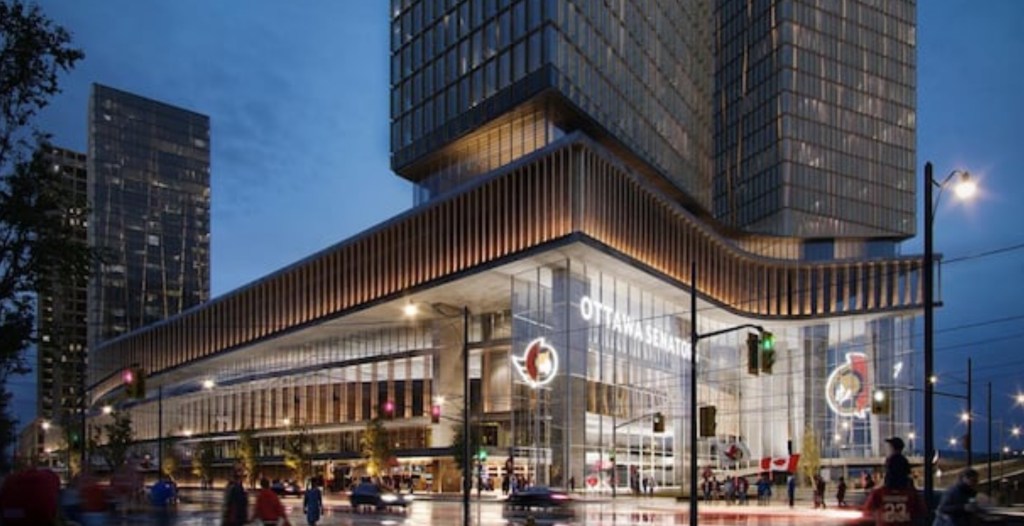
The renewed push for a taxpayer supported arena at Ottawa’s LeBreton Flats arrives at a moment when the economic evidence is clear. Professional sports franchises continue to seek public subsidies while independent academic research demonstrates that taxpayer funded arenas provide little to no measurable economic return to host cities.
The current lobbying effort by Capital Sports Development Inc. mirrors a common strategy in North America: frame the project as an economic generator rather than a private entertainment investment. The empirical data provides a different assessment.
Economic research and city outcomes
Consensus across economic literature is stable. Major reviews and empirical studies show that sports arenas do not create net new economic activity. Spending at arenas typically reallocates existing entertainment consumption within a city. Construction jobs are temporary. Longer term measures such as regional GDP, employment, and household income do not show statistically significant improvement following arena construction.
Representative findings
| Study | Scope | Finding |
|---|---|---|
| Noll & Zimbalist | Multiple stadium projects | Economic effects extremely small or negative |
| Coates & Humphreys | Cross city panel analyses | No association between franchises and long term income growth |
| Bradbury, Coates & Humphreys (2023) | Historical review | Little to no tangible economic impact from stadium subsidies |
| Journalist’s Resource (2024) | Literature roundup | Public stadium funding rarely produces the projected economic returns |
Comparative evidence from recent arena projects
Recent Canadian and North American arena projects reveal the scale of public exposure when municipal and provincial governments participate. The table below summarizes selected examples and a chart illustrates the variation in public contributions.
| Arena Project | Approximate Public Contribution (Millions CAD) | Funding Notes |
|---|---|---|
| Calgary Event Centre | 537 | Municipal and provincial contributions for arena and district infrastructure |
| Rogers Place, Edmonton | 226 | Municipal funding combined with tax increment and CRL mechanisms |
| UBS Arena, New York | 0 | Privately financed on state land lease |
| T-Mobile Arena, Las Vegas | 0 | Privately financed |
Why public private partnerships often underperform
Public private partnerships are presented as compromise solutions but frequently shift long term fiscal risk onto taxpayers while securing stable private returns for franchise owners. Cost overruns, maintenance liabilities and revenue shortfalls commonly become municipal obligations. Promised spinoff benefits such as meaningful tourism increases or broad district revitalization are often overstated in proponent studies.
Opportunity cost
Public funds allocated to stadium projects carry opportunity costs. Funds used for an arena are not available for transit, housing, healthcare, climate adaptation or education. These alternatives typically deliver higher social and economic returns than subsidizing privately owned entertainment facilities. Private financing eliminates this trade off.
Policy conclusion
Evidence supports a default policy of requiring private financing for professional sports facilities. Public funds should be reserved for investments that yield broad-based returns and reduce systemic risk for residents. Where public contributions are proposed they should be subject to independent review, enforceable community benefits, strict caps on public exposure and, where appropriate, direct public approval through referendum or legislative vote.
Sources and further reading
- Bradbury, J C, Coates, D and Humphreys, B R. The economics of stadium subsidies. Policy retrospective. 2023.
- Coates, D and Humphreys, B R. Do subsidies for sports franchises, stadiums, and mega events work? Econ Journal Watch.
- Noll, R G and Zimbalist, A. Sports, Jobs and Taxes. Review of economic impacts of sports teams and stadiums.
- Journalist’s Resource. Public funding for sports stadiums: a primer and research roundup. 2024.
- Reporting on Ottawa Senators lobbying activity and StrategyCorp engagement. SportsBusiness Journal and national coverage.
For readers seeking original reports and news coverage please consult academic databases and major news outlets for the documents cited above.
 The Rowanwood Chronicles