
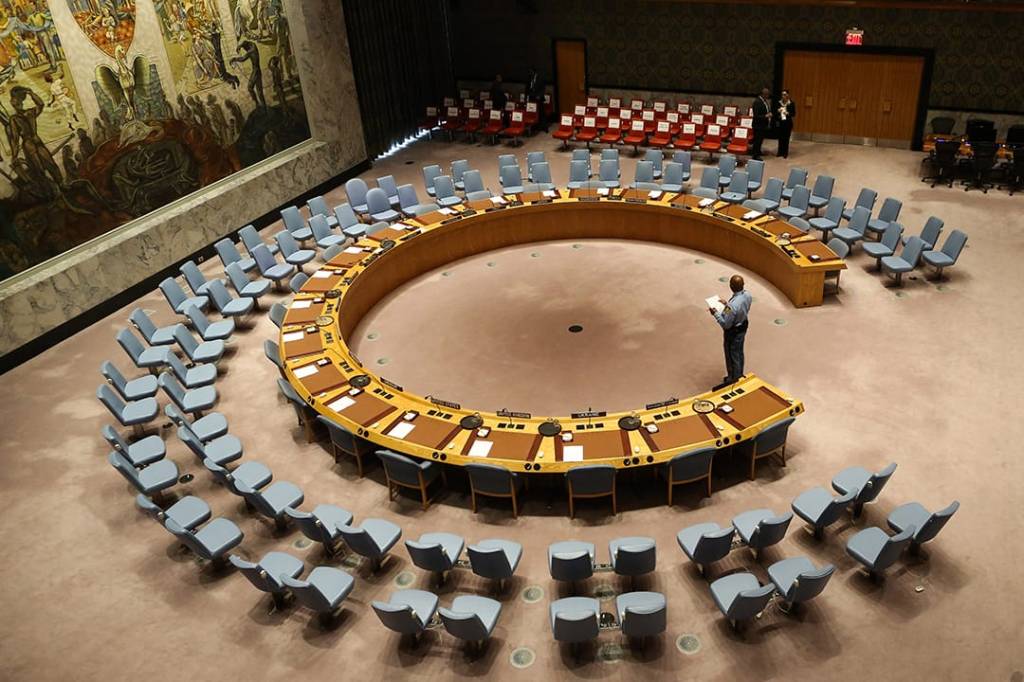
The United Nations is often portrayed as the cornerstone of international diplomacy, a forum where nations come together to resolve disputes, prevent wars, and promote human rights. Yet, in practice, the UN is frequently cast as a convenient scapegoat by the very superpowers that designed it. Its structure, particularly the veto power held by the five permanent members of the Security Council, the United States, Russia, China, the United Kingdom, and France, has become a structural bottleneck, ensuring that decisive action is only possible when the interests of these nations align. Until the veto is removed, the UN will remain hamstrung, caught between high expectations and systemic limitations.
The veto was introduced in 1945 as a compromise to secure the participation of the world’s most powerful states. Without it, the founding members feared that superpowers might bypass or abandon the organization altogether. In theory, the veto was a stabilizing mechanism. In practice, it has become a tool for inaction. Consider Syria: during the ongoing civil war, Russia has repeatedly vetoed resolutions condemning the Assad regime and calling for intervention, while China has often supported Russia’s position. As a result, the Security Council has been paralyzed even in the face of clear evidence of atrocities, leaving millions of civilians exposed to violence. Western leaders then criticize the UN for inaction, conveniently ignoring the very vetoes that prevented it from acting.
Other historical examples reinforce this pattern. During the Rwandan genocide in 1994, the Security Council was slow to act, partly due to reluctance from major powers to commit troops or risk entanglement. The UN Assistance Mission in Rwanda (UNAMIR) was critically under-resourced, and resolutions to expand its mandate were delayed or watered down. Later, when Iraq invaded Kuwait in 1990, the Security Council acted decisively, but only because the superpowers’ interests aligned in opposing Saddam Hussein. This selective engagement demonstrates that the UN’s effectiveness is contingent less on law or morality than on the geopolitical priorities of the P5.
Even more recently, the Russian invasion of Ukraine in 2022 exposed the limitations of the UN system. Russia’s veto prevented any meaningful Security Council action, forcing Western nations to rely on unilateral sanctions, NATO coordination, and General Assembly resolutions that carry moral but not binding authority. Russia, in turn, dismissed UN criticism as biased or irrelevant, highlighting the paradox: the UN is invoked when it serves the interests of a superpower, and criticized when it does not. Similarly, the ongoing Israeli-Palestinian conflict shows how the U.S. veto has blocked resolutions condemning settlements or military actions, creating a perception that international law is applied selectively.
These examples illustrate a persistent problem: the UN is used by superpowers as both a tool and a scapegoat. It legitimizes actions when convenient, shields states from criticism, and is blamed for failures beyond its control. The veto allows a single nation to prevent collective action, regardless of the humanitarian or legal merits of a situation. Meanwhile, smaller nations, despite representing the vast majority of UN members, have little real influence. The General Assembly can issue resolutions expressing global consensus, but these are largely symbolic without enforcement mechanisms.
The solution is straightforward: no country should have veto power. The veto institutionalizes inequality and ensures that the UN cannot fulfill its mandate impartially. Proposals have been made to reform the Security Council, including requiring multiple vetoes to block a resolution or eliminating the veto for crimes against humanity, genocide, or aggression. Yet these reforms have stalled because the P5 have no incentive to relinquish privilege. True UN reform requires equalizing the decision-making process, where all nations have a voice and no single state can unilaterally obstruct action. Only then could the UN function as a legitimate arbiter of international law and human rights.
Until veto power is removed, the UN will continue to struggle. It will remain a forum where crises are debated but seldom resolved, where resolutions are celebrated symbolically but ignored in practice, and where superpowers externalize responsibility, casting the organization as weak or ineffectual while maintaining control behind the scenes. The world deserves a UN capable of enforcing its own principles, rather than one whose moral authority is hostage to the interests of a handful of powerful nations. Removing the veto is not just an administrative reform, it is a moral imperative, a prerequisite for a truly effective international system.


 The Rowanwood Chronicles