
Mass as Delay: Rethinking the Universe’s Clockwork

Every once in a while, a new idea comes along that doesn’t just tweak the edges of our understanding, but tries to redraw the map entirely. John C. W. McKinley’s Mass Imposes Delay principle is one such idea. Published in mid-2025 and still sitting at the intersection of speculation and serious theoretical intrigue, this deceptively simple thesis – that mass is not just an object of gravity, but an agent of temporal delay – invites us to reconsider what we think space, time, and matter are really doing.

What if mass is not a thing, but a tempo? What if the cosmos is not a machine, but a performance – its rhythms set not by ticking clocks, but by the gravitational drag of being itself?

At its heart, McKinley proposes that mass structures time by imposing delays on how photons, and by extension, all information, resolves into physical experience. Rather than viewing mass merely as the cause of curvature in spacetime (as in general relativity), or as a Higgs-bestowed quality of particles (as in the Standard Model), this theory suggests something more metaphysical and yet startlingly concrete: mass sets the timing of reality’s unfolding.

Delay × Mechanics = Observed Physics

This is McKinley’s governing equation. Delay, introduced by mass, interacts with basic mechanical instructions, what he calls “photon-coded instructions”, to produce the physical phenomena we observe. It’s a view that doesn’t discard quantum field theory or general relativity but reframes them as emergent from an underlying informational pacing system.

In the Shapiro delay, light signals passing near a massive object take slightly longer to reach us. Traditionally explained as curved spacetime, McKinley reframes it: mass itself introduces a resolution delay.

This subtle shift moves the focus from where things happen to when they are allowed to happen.

A Delayed Universe: From Quantum Collapse to Cosmic Expansion

In quantum mechanics, the collapse of a wavefunction – the moment when a system’s potential resolves into a definite outcome – has long baffled philosophers and physicists alike. It’s not the math that confuses us; it’s the implication that reality is, in some sense, probabilistic until someone, or something, causes it to resolve.

McKinley’s theory offers an elegant twist: mass itself acts as a selector. By introducing delay, it filters and sequences quantum outcomes into coherent, observed experience. This bridges relativity and quantum theory by offering a common denominator: timing control.

It also touches cosmology. In a universe where mass determines delay, and delay governs resolution, cosmic time itself becomes pliable. The early universe might have operated under very different delay patterns – suggesting that the laws we observe today could be the outcome of an evolving cosmic schedule. Inflation, dark energy, and even the cosmological constant could be reframed as manifestations of shifting delay regimes.

A Two-Filter Reality

McKinley envisions reality as filtered twice: first by wavefunction possibility and again by mass-governed delay. Picture a vast quantum landscape filled with all possible outcomes, then imagine a “mass curtain” that slows and sequences how those potentials crystallize into reality.

This recalls Mach’s principle, which links inertia to the gravitational influence of distant matter. McKinley extends it: not only inertia, but the timing of reality’s unfolding depends on the universe’s mass distribution.

No exotic particles, no extra dimensions – just a new lens on familiar physics. The photon’s instructions may be timeless, but when they’re read depends on the local mass environment.

Challenges and Promise

Is it testable? Not yet, but in principle yes. If mass imposes resolution timing, high-precision quantum timing experiments might detect non-local delays, or gravitational lensing could show subtle deviations from purely geometric predictions. Such tests could turn this elegant speculation into empirical science.

The biggest contribution may be conceptual: replacing the image of a universe as a stage with actors, with that of a performance unfolding according to a mass-driven tempo.

Final Thoughts

McKinley’s work, still awaiting rigorous peer review, is worth attention. It asks us to imagine mass not as the glue holding the universe together, but as the metronome pacing its unfolding.

We may be on the cusp of a physics that is not only about what exists, but about when it happens. If he’s right, mass isn’t what keeps the universe in place – it’s what slows it down, just enough for reality to make sense.
Sources

  • McKinley, J.C.W. (2025). The Principle of Delayed Resolution. SSRN. Read here
  • Shapiro, I. I. (1964). Fourth Test of General Relativity. Physical Review Letters.
  • SciTechDaily. (2025). “New Physics Framework Suggests Mass Isn’t What You Think It Is.”
  • Wikipedia. Mach’s Principle. Read here

Quantum Awakening: The Cat Steps Out

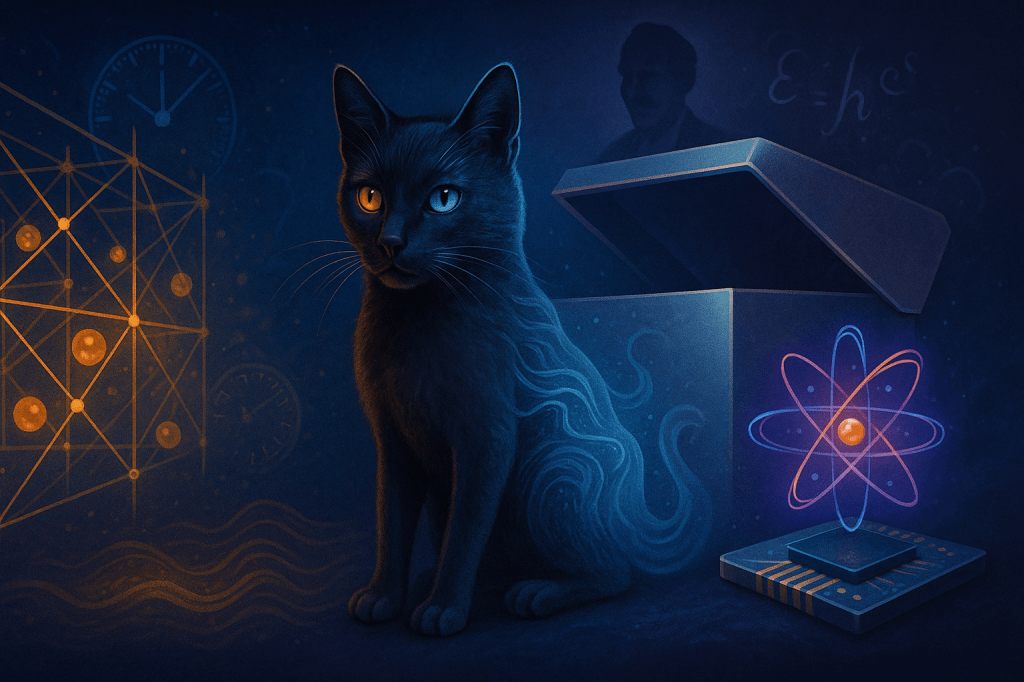
For nearly a century, Schrödinger’s cat has prowled the imagination of physicists and philosophers alike, half-alive, half-dead, trapped in a quantum box of uncertainty. It’s been a durable metaphor, capturing the mind-bending strangeness of quantum superposition, where particles can occupy multiple states at once, but only collapse into a definite reality when observed. Now, a series of new experiments have not only extended the cat’s mysterious life, they may well have cracked open the lid of that theoretical box.

In one breakthrough, researchers at the University of Science and Technology of China have managed to sustain a quantum superposition in a group of atoms for an unprecedented 1,390 seconds, over 23 minutes. To put that in perspective, most quantum states decay in milliseconds, collapsing under the weight of their environment. These scientists cooled ytterbium atoms to near absolute zero and suspended them in a laser-generated lattice, creating a sort of optical egg carton that isolated the atoms from external noise. The result? A stable, coherent quantum state that lasted longer than any yet recorded. If Schrödinger’s feline had been curled up in that lab, it might have been both alive and dead long enough to get bored.

The implications are profound. Quantum coherence over such extended periods could radically advance quantum computing, quantum communications, and even fundamental tests of the boundary between quantum and classical worlds. It also hints at the possibility of observing, and perhaps one day manipulating, quantum phenomena at larger, more tangible scales. The line between weird and real is getting thinner.

Yet, the story doesn’t end in China. Across the world in Sydney, engineers at the University of New South Wales have been tinkering with the quantum cat’s metaphorical whiskers in a different way. They’ve embedded an antimony atom with eight possible spin states into a silicon chip, creating a quantum bit (qubit) capable of holding significantly more information than the binary states of traditional bits. Each of these eight spin configurations acts like a tiny door into a different potential reality, giving rise to a computational system that can tolerate a degree of error, essential in the fragile world of quantum information.

This “hot Schrödinger’s cat,” as some have dubbed it, refers not just to the technical feat but to the strange warmth of the system, higher energy levels that challenge the traditional assumption that quantum systems must be deeply frozen. By designing systems that can operate at relatively warmer conditions, and still retain quantum coherence, scientists are inching toward scalable, real-world applications of quantum logic.

So what does this mean for the cat, and for us? It means we’re closer than ever to pulling that quantum feline out of abstraction and into the world of working tools. The cat is no longer just a paradox. It’s a partner, mysterious, elusive, but increasingly real. And in the glow of the lab’s lasers and chip circuits, it might even be purring.

Sources
• Wired: Scientists Have Pushed the Schrödinger’s Cat Paradox to New Limits
• Phys.org: Quantum Schrödinger’s Cat on a Silicon Chip

A Universe Without Time: Physics, Consciousness, and the Nature of Existence

If time were to happen all at once – where past, present, and future coexisted simultaneously – it would upend our understanding of reality, causality, and even consciousness itself. Our perception of time as a flowing sequence of events is deeply ingrained in both our experience and our scientific models, but what if that flow was an illusion? What if every moment simply existed, with no distinction between before and after?

One of the most immediate consequences of such a reality would be the breakdown of cause and effect. Our world operates on the principle that actions have consequences, that the past influences the present, which in turn shapes the future. If time were simultaneous, there would be no before or after – everything would simply be. In such a reality, would it even make sense to speak of events “happening”? Without sequence, there is no causality, and without causality, the entire structure of our decision-making and agency becomes questionable. Could free will exist in a reality where all choices have already unfolded in every possible way?

Our perception of time is not just a philosophical construct, but a deeply embedded feature of human consciousness. We process the world sequentially because our brains are wired to do so. If time were happening all at once, would we experience our entire lives simultaneously? Would we be both a newborn and an elderly person at the same time, fully aware of every moment we have ever lived? If that were the case, then identity itself might become meaningless, dissolving into an incomprehensible blur of every possible experience. Alternatively, it is possible that our consciousness would still only access one “slice” at a time, navigating an eternal landscape without truly perceiving its timeless nature.

This idea is not entirely foreign to physics. The “block universe” model in relativity suggests that time is a fixed, four-dimensional structure where the past, present, and future all exist equally. In this view, time does not “flow”; rather, it is a static dimension much like space, with our perception of movement through it being an emergent phenomenon. If this were true, the notion of “now” would be subjective, merely a point of reference chosen by an observer rather than a fundamental feature of the universe. This model sounds similar to how the fictional wormhole aliens in Star Trek: Deep Space 9 live, as they have no understanding of linear time, and the concept of consequences. 

Another major implication of a timeless reality is how it would affect the laws of physics themselves. Much of modern science relies on the assumption that time allows for entropy, the increase of disorder in a system. This principle explains why we remember the past but not the future and why systems evolve rather than remaining frozen in place. If time did not progress, but instead existed as a complete whole, then entropy might be an illusion, or at the very least, an incomplete way of understanding change. Could it be that what we perceive as time’s passage is simply our consciousness moving through an already-existent structure?

If time truly happened all at once, it would redefine the very nature of reality. Perhaps we are already living in such a universe but are unable to perceive its full nature due to the limitations of human cognition. What we call “the present” might just be a thin veil over a vast, timeless structure, one that we are only beginning to understand.