Albertans Choose Stability Over Separation: What the Pension Rejection Really Means

When the Alberta government finally released the long-awaited results of a commissioned survey on the Alberta Pension Plan (APP), the findings spoke volumes. Nearly two-thirds of Albertans (63%), rejected the idea of replacing the Canada Pension Plan with a provincial version. The number supporting an APP? Just 10%. That’s not just a policy rejection; it’s a political reality check.

For all the heated rhetoric around Alberta’s place in Confederation, this result reinforces what many longtime observers have suspected: Albertans may be frustrated, but they’re not fools. They know a good thing when they see it, and the CPP, with its portability, investment scale, and intergenerational reliability, is exactly that. The pensions issue cuts across partisan lines and ideological bluster. It’s not about Trudeau or equalization. It’s about people’s futures, and the people have spoken.

What’s more striking is how this undercuts the oxygen feeding Alberta separatism. The idea of a provincial pension plan was floated not just as fiscal policy, but as a marker of provincial autonomy, even sovereignty. It was pitched as a way to “keep Alberta’s money in Alberta.” Yet, when the chips were down, Albertans didn’t bite. The same population that occasionally flirts with separation talk has no appetite for tearing up foundational institutions like the CPP.

Even Premier Danielle Smith, no stranger to courting Alberta-first narratives, quickly distanced herself from the APP following the release of the data. There’s no referendum planned, no legislative push, just a quiet shelving of an unpopular idea. It’s a clear sign that even among the UCP leadership, there’s recognition that the political capital required to pursue this agenda simply doesn’t exist.

The APP result also aligns with a broader trend we’re seeing in regional sentiment polling. Despite pockets of separatist energy, especially in reaction to federal climate policy, most Albertans prefer reform within Canada to rupture. A recent Angus Reid survey found that only 19% of Albertans would “definitely” vote to leave Canada, while three-quarters believed a referendum would fail. The rhetoric is louder than the resolve.

This doesn’t mean western alienation is a myth. Far from it. Economic frustrations, federal-provincial disputes, and the sense of being politically outvoted still resonate deeply in Alberta. But the reaction isn’t revolution, it’s recalibration. What Albertans appear to want is a stronger voice in a better Canada, not a lonely march toward the exits.

There’s a deeper lesson here, too. Identity politics and economic nationalism may be good for stirring the base, but when policies collide with kitchen-table concerns, like pensions, voters choose the pragmatic over the symbolic. Separatism, in Alberta’s case, has become less of a movement and more of a mood. And moods change when the numbers hit home.

At its core, the rejection of the APP is a reaffirmation of Canadian federalism. Not the perfect, polished version dreamed of in civics classes, but the messy, functional, deeply embedded version that shows up in every paycheque and retirement plan. That version still has teeth. And Albertans, whatever else they may say about Ottawa, just voted to keep it.


Rethinking the “Middle East”: Why Greater West Asia Works Best

The term Middle East has long been used in Western discourse to refer to the region spanning from Egypt and Turkey through to Iran and the Arabian Peninsula. This label is neither geographically accurate nor politically neutral. As calls grow for more inclusive and less Eurocentric terminology, there is a strong case for renaming the region altogether. A number of alternatives have been proposed, each with merits and limitations, but Greater West Asia emerges as the most appropriate and equitable option.

The Problems with “Middle East”

Eurocentrism

The label “Middle East” reflects a 19th-century British imperial perspective. From London, it was east of Europe, but west of British India—hence “middle.” It is not a term rooted in the cultures or languages of the people it describes, but in the navigation maps and strategic concerns of empires.

Vagueness and Inconsistency

The boundaries of the “Middle East” shift depending on context. Does it include North Africa? Is Afghanistan in or out? Turkey? This imprecision reduces its utility and fosters confusion.

Cultural Baggage

The term is often associated with conflict, terrorism, and religious strife in Western media, reinforcing stereotypes rather than offering a neutral geographic description.

Possible Alternatives

West Asia

This term corrects the geographic problem, situating the region accurately within the continent of Asia, but it has not gained widespread traction. Some critics argue it may be too narrow, excluding North Africa and the Caucasus.

Southwest Asia and North Africa (SWANA)

A politically motivated term intended to center Indigenous and decolonial perspectives. It explicitly includes North Africa and parts of Asia, but its complexity and unfamiliarity outside activist and academic circles limit its uptake.

MENA (Middle East and North Africa)

Common in policy and development discourse, but it retains the problematic “Middle East” and is more of a bureaucratic construct than a corrective.

Arab World / Muslim World

These terms are culturally specific and exclude non-Arab and non-Muslim populations in the region such as Persians, Jews, Christians, Kurds, Druze, and others. They entrench religious or ethnic majoritarian narratives.

Why Greater West Asia Works Best

Geographically Accurate

“West Asia” correctly places the region within the Asian landmass, and “Greater” allows for a broader scope including the Levant, Anatolia, the Arabian Peninsula, the Iranian Plateau, and parts of the Caucasus and even North Africa, if contextually needed.

Free of Cultural, Religious, or Ethnic Ties

The term avoids privileging one group over another: Arab, Persian, Turkish, Jewish, Kurdish, or otherwise. This neutrality is vital in a region that is home to dozens of languages, religions, and ethnic identities.

De-centres the West

Using “Greater West Asia” acknowledges the geographic reality from a global, not Eurocentric, perspective. It also strips away the legacy of colonial nomenclature imposed by British and French cartographers and strategists.

Scalability and Clarity

The prefix “Greater” allows for flexible boundaries while “West Asia” provides the core anchor. This mirrors successful regional terms like “Greater Europe” or “Greater Southeast Asia.”

Conclusion

Renaming the “Middle East” is more than a semantic exercise; it’s about decolonizing our geographic imagination. Of the alternatives, Greater West Asia is the most inclusive, descriptive, and politically neutral. It offers a clean break from imperial labels and better reflects the region’s complexity and humanity, without reducing it to a cultural monolith or geopolitical battleground. It’s time we updated our vocabulary accordingly.

Why Logic Only Wins When Your Opponent Feels Secure

In business, politics, leadership, and high-stakes negotiations, we often fall into the trap of believing that logic and competence are all that’s needed to win arguments and drive outcomes. After all, facts are facts, right? Yet, anyone who’s been in the room when a pitch falls flat or a strategy session derails knows better. The hard truth is this: logic only persuades when the person you’re speaking to feels emotionally secure, and, without that, even the most elegant argument can be perceived as a threat.

People, leaders included, don’t operate in purely rational mode. They operate in identity mode. When someone is secure in their role, confident in their own intelligence, and grounded in their self-worth, they can listen to a strong counterargument without flinching. They can say, “I hadn’t thought of it that way,” or “Let’s explore that.” That kind of openness is the hallmark of true professional maturity.

Insecurity changes the playing field. When someone feels uncertain about their competence, status, or place in the organization or society, even a well-intentioned challenge can land like a personal attack. You may be bringing insight and value to the table, but what they hear is, “You’re not smart enough. You’re not in control.” Once you trigger that kind of emotional threat response, logic goes out the window. Now you’re not having a conversation – you’re in a turf war.

I’ve seen this in boardrooms, in project teams, in conflict mediation. A junior consultant presents data that contradicts the assumptions of a senior manager. The numbers are rock-solid. But the response isn’t curiosity – it’s defensiveness. Dismissal. Or worse, undermining. Why? Because accepting the analysis would require the leader to admit a blind spot, and for some, that’s psychologically intolerable.

In politics, particularly in the polarized landscapes of North America and parts of Europe, the same dynamic plays out on a much larger scale: the political left often leans on data, logic, and evidence-based policy proposals, assuming these will persuade. For many on the political right, especially in populist circles, political identity is rooted not in reasoned analysis, but in emotional belonging, cultural defense, and distrust of intellectualism. Logical arguments about climate change, public health, or wealth inequality frequently fail not because they’re weak, but because they challenge the very narratives that insecure political identities cling to for meaning and safety. Until the left acknowledges that logic only works when the listener feels secure enough to engage with it, their arguments, however sound, will continue to bounce off hardened ideological shields.

This is why so many skilled communicators emphasize emotional intelligence alongside analytical sharpness. It’s not enough to be right, you have to be received. If you want your logic to land, you need to create a container of safety. That means pacing before leading. Asking questions before offering answers. Establishing rapport before pointing out gaps. It means checking your tone, your timing, and your audience’s readiness.

There’s also a counterintuitive insight here for those who are confident in their own competence; dial it down sometimes. Over-projecting brilliance can make insecure colleagues feel smaller, and smaller people don’t collaborate well. They retreat, they sabotage, or they lash out. The best leaders aren’t just smart, they’re smart enough to know when not to show it all at once.

Winning with logic is a strategic act, not just an intellectual one. You have to play the long game. It’s not about proving someone wrong, it’s about making them feel safe enough to explore the possibility that they might be. Only then do real insights emerge, and only then can collaboration thrive. So next time you’ve got the facts on your side, pause. Ask yourself: does my audience feel secure enough to hear the truth?

Because if they don’t, even the truth won’t save you.

When the Witness Holds the Gavel: The Constitutional Perils of Reverse Disclosure

Canada’s lower courts are now bearing the brunt of an ill-conceived and constitutionally fraught innovation in sexual assault law: reverse disclosure. Introduced under Bill C‑51 in 2018, this legislative regime forces accused persons to disclose in advance any private communications; such as texts, emails, or social media messages, they intend to use in cross-examination of the complainant. The complainant, in turn, is granted full participatory rights and legal representation to argue against the admissibility of such evidence. While politically expedient and publicly palatable in the wake of the Ghomeshi trial, the legal architecture of reverse disclosure has proven to be unstable, incoherent, and in many cases, plainly unconstitutional.

Trial courts across the country have issued sharply divergent rulings on how these provisions should operate. In some decisions, judges have deemed the mandatory timelines imposed on the defence to be incompatible with the fair-trial rights guaranteed by section 7 of the Charter. Others have questioned the very foundation of the regime, arguing that it unjustly burdens the accused with obligations that reverse the presumption of innocence and compromise the right to full answer and defence. Nowhere else in Canadian criminal procedure is a complainant, essentially a Crown witness, granted standing to challenge what evidence may be used in their own cross-examination. It is a distortion of the adversarial system.

The concept of reverse disclosure is not merely controversial; it is structurally flawed. The defence is no longer free to mount a case in the manner required by the facts and theory of the defence, but is instead placed under the supervision of the court and the complainant’s counsel, long before trial. This undermines not only trial strategy, but also the accused’s right to test the Crown’s case without disclosing defence evidence in advance. Worse still, it creates an asymmetry in which the complainant is effectively briefed on what the defence intends to argue, giving them an opportunity, conscious or not, to shape their testimony accordingly.

This problem is compounded by the legislative vagueness surrounding what constitutes a “private record” and how relevance, prejudice, and privacy should be weighed. The result has been legal uncertainty and procedural chaos. Judges are left to interpret a vague and often contradictory set of provisions, and defence counsel must navigate a landscape where each courtroom may yield different rules and interpretations. This is not how constitutional criminal law is meant to function.

Some courts have gone so far as to strike down portions of the reverse disclosure regime altogether, citing fundamental Charter violations. These judgments are not aberrations, they are warnings. When a regime designed to protect complainants ends up jeopardizing the constitutional rights of the accused, the entire framework must be re-evaluated. The criminal trial must remain a place where the presumption of innocence is more than a platitude, and where the right to a fair trial is not subject to the political winds of the day.

Until the Supreme Court addresses these concerns decisively, lower courts will continue to struggle with reverse disclosure. And in that struggle, justice itself hangs in the balance.

Israel’s Nuclear Arsenal: The Open Secret of the Middle East

For decades, Israel has maintained an official policy of “nuclear ambiguity”, neither confirming nor denying its possession of nuclear weapons. Yet this studied silence stands in stark contrast to a substantial body of verifiable evidence, much of it sourced from credible whistle-blowers, declassified intelligence, military analysis, and satellite data. In practice, the Israeli nuclear arsenal has become one of the worst-kept secrets in international security. The absence of formal acknowledgment is strategic, not evidentiary. Israel’s nuclear capability is both real and operational, undergirded by a robust triad of delivery systems and supported by a long history of secrecy, scientific sophistication, and political calculation.

The story begins with the Dimona nuclear reactor in the Negev Desert, built in the late 1950s with clandestine French assistance. Officially described as a textile plant, it was in fact a plutonium production facility. By the mid-1960s, U.S. intelligence had concluded that Israel possessed the technical capability to produce nuclear weapons. In 1969, after a series of secret meetings, the United States and Israel reached a tacit agreement: Israel would not publicly test or declare its nuclear weapons, and the U.S. would cease pressuring it to sign the Non-Proliferation Treaty (NPT). This diplomatic fiction has endured for over fifty years.

However, the most damning evidence came in 1986, when Mordechai Vanunu, a former technician at Dimona, provided The Sunday Times with detailed photographs and descriptions of Israel’s nuclear warheads. Vanunu claimed Israel had produced enough weapons-grade plutonium for over 200 nuclear devices, including thermonuclear warheads, statements later corroborated by Western intelligence assessments. Vanunu’s disclosures confirmed what many had suspected: that Israel was not merely in possession of a handful of crude bombs but had developed a sophisticated and sizeable arsenal.

Independent experts such as the Federation of American Scientists (FAS) and the Stockholm International Peace Research Institute (SIPRI) have consistently estimated that Israel holds between 90 and 400 nuclear warheads. These are believed to be deployable through a triad of systems: land-based ballistic missiles, air-delivered bombs, and submarine-launched cruise missiles. The Jericho III, a long-range intercontinental ballistic missile, is believed to have a range of up to 6,500 kilometers, potentially extending to 11,500 kilometers depending on payload. These missiles are housed in hardened silos, well-concealed and dispersed for survivability. Additionally, Israel’s fleet of Dolphin-class submarines, purchased from Germany and believed to be modified to launch nuclear-capable Popeye Turbo cruise missiles, offers a potent second-strike capability.

The Israeli Air Force also plays a central role in the country’s nuclear deterrence. Modified F-15I and F-16I aircraft are capable of carrying nuclear payloads, further broadening the strategic options available to decision-makers in Tel Aviv. The ability to deliver nuclear weapons from sea, air, and land ensures that Israel retains a survivable deterrent, reinforcing the credibility of its nuclear posture even in the event of a first strike by an adversary.

Israel’s refusal to sign the NPT or to subject its nuclear facilities to International Atomic Energy Agency (IAEA) safeguards further confirms its unique position in the global nuclear order. While this policy isolates Israel diplomatically in certain forums, it has not resulted in significant punitive measures, due in large part to its close alliance with the United States and the widespread, if unspoken, acceptance of its strategic rationale. From the perspective of Israeli leadership, nuclear weapons serve as the ultimate insurance policy against existential threats in a region fraught with hostility and volatility.

From time to time, Israeli political and military leaders have let the mask slip. Former Prime Minister Ehud Barak acknowledged the existence of the arsenal in indirect but unmistakable terms. Other officials have alluded to it in speeches or interviews, especially when referring to red lines for Iran or Israel’s qualitative military edge. These statements are often quickly walked back or couched in hypothetical language, but the implications are unmistakable.

Perhaps the most compelling argument for Israel’s nuclear capability is the simple fact that no serious analyst or international observer denies it. The international community, especially the intelligence and military establishments of major powers, operates on the assumption that Israel is a nuclear-armed state. Its capabilities, though untested in public, are viewed as credible and strategically integrated. The lack of open testing has not diminished deterrence; rather, the veil of ambiguity enhances it, allowing Israel to maintain strategic deterrence without the diplomatic fallout of formal admission.

The accumulated evidence of Israel’s nuclear weapons program is overwhelming and irrefutable. The country’s longstanding policy of ambiguity may serve its diplomatic and strategic interests, but it does not conceal the reality of its capabilities. With a mature triad, hundreds of warheads, and decades of operational readiness, Israel stands as a de facto nuclear power in a region where deterrence often serves as the only firewall against catastrophe.

Sources
• Wired, “Israel’s Secret Nuke Arsenal Exposed”, October 5, 2011: https://www.wired.com/2011/10/1005israel-secret-nuclear-arsenal-exposed
• Federation of American Scientists (https://fas.org)
• Stockholm International Peace Research Institute (https://sipri.org)
• Nuclear Threat Initiative (https://nti.org)
• The Sunday Times archive on Mordechai Vanunu (1986)
• GlobalSecurity.org and IISS assessments of Jericho III and Dolphin-class platforms
• U.S. Congressional Research Service Reports on Middle East security and nuclear proliferation

Public Drinking: A Study in Trust, Culture, and Control – Ottawa vs. Germany

Public drinking reveals much about how societies balance freedom, responsibility, and trust. The stark contrast between Ottawa’s tentative, tightly-controlled 2025 pilot program for alcohol consumption in municipal parks and Germany’s longstanding acceptance of public drinking illustrates deeper social and cultural divides. In short, while Germans operate under a framework of collective behavioral expectations and trust, Canadians, at least in Ottawa, approach public behavior through a lens of institutional caution and control.

In Germany, it is not only legal, but culturally unremarkable to walk through a park or down a street sipping beer or wine. Public drinking is allowed in virtually all spaces: parks, streets, public transport, so long as behavior remains respectful. There is no need for signage, restricted hours, or opt-in zones. Instead, the rules are social: keep your voice down, clean up after yourself, and don’t cause a disturbance. The assumption is that most people, most of the time, can be trusted to enjoy alcohol in public without devolving into chaos. Enforcement is minimal and focused on conduct rather than consumption. The legal framework reflects this confidence in citizens’ capacity for self-regulation.

Ottawa, by contrast, is poised to take a small, hesitant step into public drinking territory. The 2025 summer pilot, if passed by full council, will allow alcohol in select municipal parks during restricted hours and away from certain facilities. Local councillors must “opt in” their parks, and enforcement mechanisms, signage, and safety protocols are emphasized. The premise is that public drinking is potentially risky, necessitating detailed restrictions and contingency planning. The policy does not presume that residents can handle this responsibility; rather, it cautiously tests whether they might.

This divergence is not simply legal, it is philosophical. German norms lean on a social compact that assumes citizens will behave decently in shared spaces. Canadians, or at least Canadian policymakers, appear to lack such confidence. Public drinking is imagined not as an ordinary act, but as a behavior to be fenced in, bounded, and watched. Ottawa’s delay in launching even a pilot underscores a broader cultural tendency: one that privileges regulation over trust, institutional control over social cohesion.

Underlying this is a question of what kind of public life a society envisions. In Germany, a Feierabendbier (after-work beer) on a park bench is an extension of civil society, part of a shared public realm. In Ottawa, such an act still falls outside acceptable norms, even as urban life becomes denser and more diverse. This points to a lingering paternalism in Canadian municipal governance: the belief that citizens must be managed rather than trusted.

Ultimately, the Ottawa-Germany contrast reveals a deeper social reality. Where Germans assume the public is capable and socialized, Canadians assume the public needs structure and limits. That divergence shapes not just laws, but the very character of public space, and what we are allowed to do within it. Public drinking, then, becomes a proxy for how much a society trusts its own people.

Canada’s Strategic Shift: Weighing the Costs and Benefits of Joining Europe’s ReArm Program

Canada’s decision to signal its intention to join Europe’s ReArm initiative marks a significant pivot in its strategic and procurement priorities, with implications that extend well beyond the defense sector. This pan-European effort, catalyzed in the wake of Russia’s invasion of Ukraine and the shifting tenor of transatlantic politics, aims to coordinate defense procurement, scale industrial capacity, and strengthen European security autonomy. For Canada, a non-European NATO member with strong ties to both the U.S. and Europe, alignment with ReArm offers both substantial opportunity and strategic complexity.

At the forefront of the appeal is diversification. Canada has long relied on the United States for upwards of 75% of its military procurement. While the U.S. – Canada defense relationship, particularly through NORAD, remains indispensable, the risks of a politically volatile or inward-focused Washington have grown. Europe’s response, particularly Germany’s ramped-up defense commitments, and the €800 billion EU proposal to stimulate continental arms production, presents an alternative axis of reliability. Canada’s participation could signal to both NATO allies and global partners that it seeks greater resilience in its defense posture.

One of the most concrete areas of cooperation could lie in the domain of submarine procurement. The CBC reports that Canada is exploring options for the German-Norwegian Type 212CD submarine, a next-generation conventional submarine being co-developed by ThyssenKrupp Marine Systems and Kongsberg. This class boasts extended underwater endurance through air-independent propulsion and quiet operation ideal for Arctic patrols, long a capability gap in Canadian naval strategy. The possibility of Canada becoming a formal partner in the 212CD project would not only address its aging Victoria-class fleet but also create industrial synergies through potential domestic assembly and technology transfer agreements.

Beyond submarines, ReArm opens the door to collaborative fighter jet production. Canada’s inclusion in discussions around final assembly of Swedish Saab Gripen fighters suggests that Ottawa is seeking industrial offset opportunities beyond its existing Lockheed Martin F-35 commitments. These talks, while preliminary, reflect a desire to reassert domestic defense manufacturing after years of outsourcing.

Still, the risks are considerable. Aligning procurement strategies with European standards could create friction in interoperability with American systems, particularly relevant given NORAD modernization and Canada’s Arctic commitments. There is also the question of cost. Canada’s new defense policy promises to increase military spending to 1.76% of GDP by 2030, a notable jump, but still short of NATO’s 2% target. Adding ReArm investments could strain the federal budget, and force trade-offs in domestic priorities.

Geopolitically, joining a European initiative risks being interpreted in Washington as a soft decoupling. While this may be overstated, managing the optics with U.S. defense officials will require careful diplomacy. At the same time, any major procurement projects pursued under ReArm would need to be justified as both value-for-money, and strategically essential in a Canadian context.

ReArm represents a chance for Canada to assert greater agency in its defense strategy, while leveraging European innovation and industrial momentum, but this is no risk-free proposition. Ottawa will need to walk a careful line: embracing new partnerships without compromising old ones, and ensuring that each procurement project is grounded in long-term strategic logic, not simply in search of novelty.

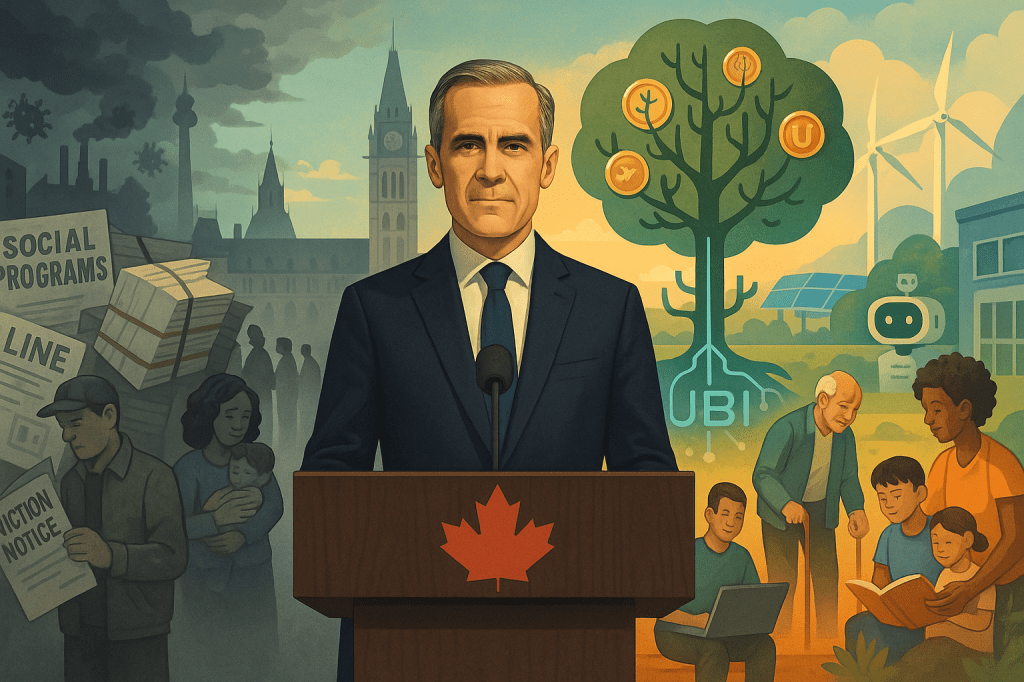
Mr. Carney, Let’s Be Bold and Smart: A Revenue-Neutral Universal Basic Income Is Within Reach

The election of Mark Carney as Canada’s new Prime Minister marks more than a changing of the guard, it signals a chance to transform how we think about economic justice, social policy, and the role of government in a post-pandemic, post-carbon, AI-disrupted world. Yet, if this new Liberal administration wants to do more than manage decline or tinker at the edges, it must champion Universal Basic Income (UBI), and it must do so within this first term.

To skeptics, the usual pushback is cost. “We can’t afford it.” But what if I told you we can, without adding a cent to the deficit?

A bold, revenue-neutral UBI is not only possible, it’s the smart, responsible, and forward-thinking choice. It would simplify our bloated patchwork of social programs, reduce inequality, and stabilize the economy, all while respecting fiscal realities. Carney, with his reputation for monetary prudence and social conscience, is uniquely positioned to make this happen.

The Case for UBI, Now More Than Ever
We live in precarious times. AI and automation are displacing jobs once thought secure. The gig economy has redefined work for an entire generation, offering flexibility but no stability. Climate change is reshaping our industries, economies, and communities. And regional inequalities, from rural depopulation to urban housing crises, are deepening social division.

UBI provides a powerful, simple solution: a no-strings-attached income that ensures every Canadian can meet their basic needs, make real choices, and live with dignity. No complex eligibility criteria. No stigma. Just a stable foundation for all.

This isn’t a call for endless spending. This is a plan for smart reinvestment, one that replaces outdated, fragmented systems with a coherent, efficient, and humane approach.

Revenue-Neutral UBI: A Practical Path
The key to political and economic viability is fiscal neutrality. Here’s how we get there:

Streamline the Social Safety Net
Our current welfare architecture is costly, overlapping, and often punitive. We propose replacing core income support programs, provincial social assistance, EI for low-wage workers, and a range of targeted income-tested tax credits, with a single, universal UBI. This simplification reduces administrative duplication and restores dignity to recipients.

Rethink OAS and GIS
These seniors’ programs already operate as a basic income for the elderly. By integrating them into a universal model, with UBI replacing these benefits for most, but supplemented by needs-based top-ups for seniors with unique medical or housing costs, we ensure fairness without duplication.

Restructure (Not Eliminate) CPP
CPP remains essential as a pension earned through contribution, but some recalibration of contribution thresholds and benefit tiers, alongside UBI, can reduce reliance on inflated public pensions to cover basic needs, while preserving the contributory principle.

Modest, Targeted Tax Reform
To close the revenue loop, introduce a small surtax (e.g., 2%) on individual incomes over $150,000, and slightly increase capital gains inclusion rates. These are not radical measures, they simply ask the wealthiest Canadians to help ensure every citizen has a secure foundation. For 95% of taxpayers, no increase would be necessary.

Numerous economic models (including work by Evelyn Forget, UBC’s Kevin Milligan, and CCPA researchers) show that a well-designed UBI can be nearly or entirely self-funding when paired with smart policy adjustments like these.

Political Opportunity and Liberal Legacy
Prime Minister Carney doesn’t need to look far for historical inspiration. Universal healthcare, bilingualism, the Charter, these were all ambitious Liberal achievements once considered politically risky and fiscally daunting, yet they reshaped Canada.

UBI can be his legacy. It would resonate across voter blocs: rural Canadians seeking stability, urban millennials burdened by debt and housing costs, women and caregivers locked out of full-time work, and gig workers with no safety net. It’s a unifying policy in a fragmented nation.

Moreover, by leading with a revenue-neutral model, Carney can neutralize opposition from deficit hawks and centrists, while winning support from social democrats, Indigenous leaders, environmentalists, and the entrepreneurial class alike.

A Step-by-Step Roadmap

  • Launch a National UBI Task Force in the first 100 days, chaired by experts in economics, social policy, and Indigenous governance.
  • Table a UBI White Paper by the end of Year 1, outlining fiscal models, legal changes, and implementation scenarios.
  • Pilot the program in a representative region (e.g., Northern Ontario, Atlantic Canada, or an urban-rural mix) with independent evaluation.
  • Introduce legislation in Year 3, with phased implementation beginning before the 2029 election.

This is not pie-in-the-sky. This is responsible governance meeting bold vision.

The Values We Must Uphold
UBI is about more than money, it’s about modernizing our social contract. It says to every Canadian: you matter. You are not a cost, a case file, or a problem to manage. You are a citizen with rights, worth, and potential.

Mr. Carney, you’ve spoken eloquently about “values-based capitalism” and “inclusive transitions.” UBI is the policy vehicle that delivers on those values. And by designing it to be fiscally neutral, you can bring the skeptics along without compromising ambition.

Now is the time to lead not just with caution, but with courage. We can afford Universal Basic Income, not in spite of economic constraints, but because of them.

Let’s stop managing poverty. Let’s start guaranteeing security. Let’s build a Canada where no one is left behind.

The Gender Revolution: Challenging Patriarchy Through Authenticity and Inclusion

At the beginning of Pride month, I thought I would write about how the gender revolution continues to challenge the patriarchy.

Transgender, non-binary, and intersex individuals are at the forefront of dismantling the patriarchy by challenging the rigid binary system of gender that has long served as a foundation for patriarchal control. Their very existence calls into question the assumption that gender is biologically fixed and limited to male and female, revealing instead that gender is a spectrum shaped by culture, society, and personal identity. By stepping outside these traditional categories, they expose the arbitrary nature of the binary and the oppressive structures that enforce it.

This disruption strikes at the heart of patriarchy, which relies on the dominance of men and the subjugation of women, while erasing those who exist outside these categories. Trans, non-binary, and intersex people decenter masculinity as the default and destabilize the hierarchy that assigns privilege based on adherence to rigid gender roles. By refusing to conform, they challenge the power structures that define worth and authority through this binary lens, opening the door to more equitable understandings of identity and power.

Their visibility also reshapes the cultural landscape, introducing new norms that value authenticity and inclusivity over conformity. The push for gender-neutral pronouns, inclusive policies, and equitable representation shifts societal expectations and disrupts patriarchal systems that thrive on control and standardization. These changes are not superficial; they represent a fundamental reimagining of how society organizes itself, centering individuality and respect over outdated binaries.

Furthermore, the activism of trans, non-binary, and intersex people often intersects with other struggles, including race, class, and disability justice. Their work highlights the interconnectedness of oppressive systems, fostering solidarity across movements and reinforcing the need for an intersectional approach to dismantling patriarchy. By challenging the binary, they do more than fight for their own liberation; they open pathways for others to envision a world free from the constraints of outdated gender norms.

In living authentically and advocating for change, trans, non-binary, and intersex individuals offer a radical critique of the status quo and a hopeful vision for the future. Their courage and resilience are reshaping how we think about gender, identity, and power, and in doing so, they are helping to dismantle one of the most deeply entrenched frameworks of oppression.

Policing the Halls: Why Officers Don’t Belong in Ontario Schools

The integration of police officers into Ontario schools, primarily through School Resource Officer (SRO) programs, has been a contentious issue for decades. Initially introduced in the early 1990s, these programs aimed to foster positive relationships between students and law enforcement, deter criminal behavior, and enhance school safety. Over time, however, concerns about their effectiveness and impact on marginalized communities have led to widespread reevaluation and, in many cases, the termination of such programs.

One of the most comprehensive evaluations of an SRO program in Ontario was conducted by Carleton University, focusing on Peel Region’s initiative. The study reported several benefits, including reduced crime and bullying, improved mental health among students, and a significant return on investment, estimating $11.13 in social and economic benefits for every dollar spent. Notably, students who had experienced bullying or violence reported feeling significantly safer after five months of the program. School staff also benefited, spending less time on disciplinary matters due to the support of SROs.  

Despite these findings, the presence of police in schools has faced mounting criticism. Critics argue that SRO programs disproportionately affect racialized and marginalized students, contributing to a school-to-prison pipeline. For instance, the Toronto District School Board (TDSB) implemented its SRO program in 2008, but terminated it in 2017 after a review revealed that some students felt intimidated by the presence of officers, particularly Black students who expressed fear related to armed officers in schools.    

Similarly, the Peel District School Board ended its SRO program in 2020, acknowledging that it had a negative impact on segments of the student population and citing concerns about systemic racism and the disproportionately punitive effects of such programming.  The Ottawa-Carleton District School Board followed suit in 2021, with trustees voting to end participation in the SRO program and issuing a formal apology for any harm experienced by students or community members.   

The Ontario Human Rights Commission (OHRC) has also weighed in, emphasizing the need to consider terminating SRO programs in light of existing research and meaningful community consultation. The OHRC highlighted that while some students may feel safer with police presence, others, particularly those from marginalized communities, may feel unsafe or targeted, which can negatively impact their educational experience.  

Given this historical context, reintroducing police into Ontario schools raises significant concerns. While studies like the one conducted in Peel Region suggest potential benefits, they often fail to adequately address the experiences of marginalized students who may feel alienated or criminalized by police presence. The risk of exacerbating systemic inequalities and undermining the educational environment for these students outweighs the purported advantages. 

Instead of reinstating SRO programs, resources should be allocated to initiatives that promote equity and inclusivity within schools. This includes investing in mental health services, hiring more guidance counselors, and implementing restorative justice practices that address behavioral issues without resorting to punitive measures. By focusing on these alternatives, Ontario can create a safer and more supportive educational environment for all students, particularly those who have historically been marginalized. 

While the intention behind placing police officers in schools may be to enhance safety and build community relations, the evidence suggests that such programs can have detrimental effects on marginalized student populations. Ontario’s educational institutions should prioritize inclusive and supportive measures that address the root causes of behavioral issues without contributing to systemic disparities.