Five Things We Learned This Week

Here is the latest edition of “Five Things We Learned This Week” for May 3–9, 2025, highlighting significant global developments across various sectors.

🌋 1. Volcanic Eruption in Iceland Disrupts Tourism

The Sundhnúkur volcanic system in Iceland erupted this week, leading to increased seismic activity near Grindavík. The Icelandic Meteorological Office reported the eruption and registered accompanying earthquakes. As a precaution, popular tourist destinations like the Blue Lagoon were evacuated, impacting the country’s tourism sector.  

💰 2. India’s Forex Reserves Decline After Eight Weeks of Gains

India’s foreign exchange reserves fell by $2.07 billion to $686.06 billion as of May 2, 2025, ending an eight-week streak of gains. The decline was primarily due to a decrease in gold reserves, which dropped from $84.37 billion to $81.82 billion. During the same week, the Indian rupee experienced volatility, appreciating by about 1% due to increased foreign inflows and optimism surrounding a potential U.S.-India trade agreement, but later depreciated by 0.9% amid geopolitical tensions between India and Pakistan.  

🧪 3. Scientists Develop Method to Generate Electricity from Rainwater

Researchers have reported a new method of generating electricity from falling rainwater using plug flow in vertical tubes. This technique converts over 10% of the water’s energy into electricity, producing enough power to light 12 LEDs. The innovation holds promise for sustainable energy solutions, especially in regions with high rainfall.  

📉 4. Consumer Goods Prices Expected to Rise Amid Tariff Pressures

Following President Trump’s introduction of steep tariffs on imports, notably a 145% tariff on Chinese goods, major consumer goods companies like Procter & Gamble, Nestlé, and Unilever anticipate raising prices. These increases add to consumer strain after three years of inflation and declining confidence, especially in the U.S., where shoppers face job uncertainty and potential recession. While some companies are attempting to pass costs to consumers, retailers and supermarkets are pushing back, warning that consumers are reaching their financial limits.  

⚔️ 5. Escalation in South China Sea Territorial Disputes

China has seized the disputed Sandy Cay Reef in the Spratly Islands of the South China Sea, intensifying territorial disputes in the region. The move has raised concerns among neighboring countries and the international community about escalating tensions and the potential for conflict in the strategically important area.  

Stay tuned for next week’s edition as we continue to explore pivotal global developments.

The Cameron Comparison: Will Danielle Smith Trigger Her Own Political Exit?

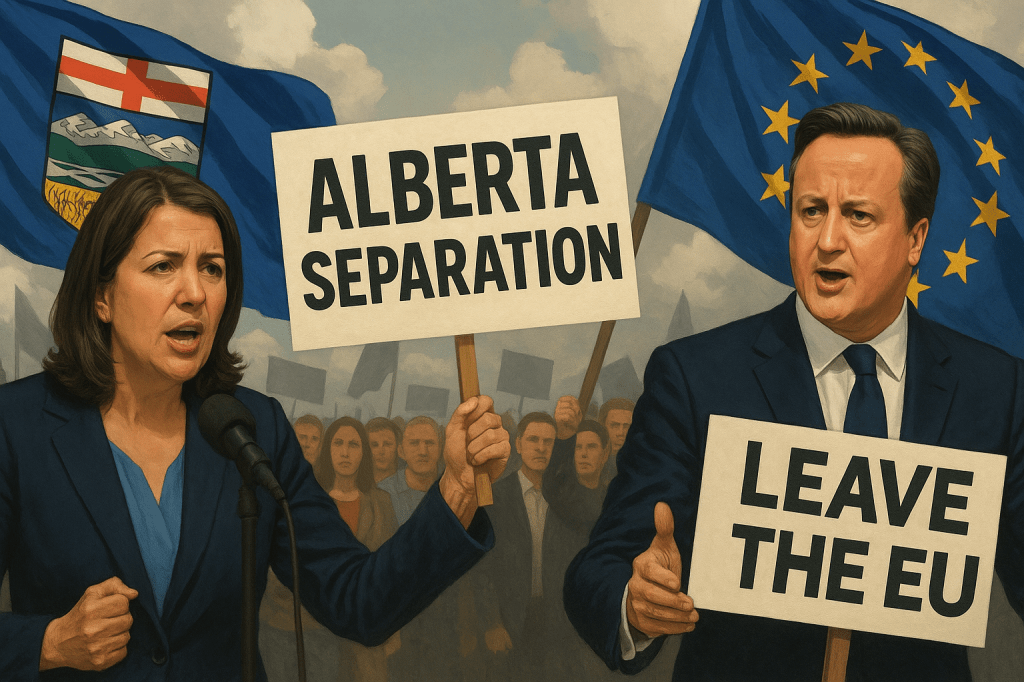
Danielle Smith’s political gambit with Alberta sovereignty bears an uncanny resemblance to David Cameron’s fateful decision to call a referendum on the United Kingdom’s membership in the European Union. Both leaders, faced with mounting internal pressures and populist insurgencies, sought to contain nationalist sentiment by giving it a structured outlet. In so doing, each gambled with the stability of their broader political project. Cameron, convinced that a plebiscite would put the Brexit question to bed and silence his party’s right-wing flank, ended up catalyzing the very crisis he had hoped to avoid, leading to his own political demise. Smith may be following the same treacherous path.

At the heart of both movements is the seductive notion of “taking back control”, from Brussels in the case of Brexit, and from Ottawa in Smith’s Alberta. The appeal is emotional and immediate: a narrative of betrayal by distant elites, a promise of restored autonomy, and the fantasy of economic self-sufficiency. Cameron allowed that narrative to play out on a national stage, legitimizing it with a referendum. Smith is doing something similar through legislation and rhetoric, invoking Alberta’s right to ignore or nullify federal laws under the guise of defending provincial jurisdiction.

Yet here lies the danger. Like Cameron, Smith has chosen to weaponize the language of sovereignty without a clear or viable endpoint. Her Alberta Sovereignty Within a United Canada Act is not a roadmap to secession, but it flirts with the logic of separation. The very act of mobilizing this discourse strengthens the hand of more radical forces in the province; those who see confederation not as a partnership, but as a prison. If Smith cannot deliver meaningful change within the framework of the Canadian constitution, and she likely cannot, she risks being outflanked by the separatists she once sought to co-opt. Just as UKIP’s rise drove Cameron’s decisions, the Maverick Party and other Alberta-first voices are shaping Smith’s hand, perhaps more than she realizes.

Politically, the parallels are striking and cautionary. Cameron misread the electorate and overestimated his ability to control the narrative. He expected the rational case for Remain to win out but failed to grasp the emotional and symbolic power of “Leave.” When the vote went against him, he resigned, leaving his party and country in turmoil. Smith may also be underestimating the Pandora’s box she is prying open. If public expectations are raised for a decisive break with Ottawa, one that cannot be delivered through mere provincial legislation, she may find herself either forced to escalate into unconstitutional territory or retreat in humiliation.

Moreover, Smith’s strategy could fracture the broader conservative coalition in Alberta. Urban moderates and business conservatives, critical to her electoral base, may grow weary of perpetual constitutional conflict, especially if it begins to affect investment, interprovincial relations, or federal funding. Meanwhile, the more extreme nationalist voices she has tried to placate will grow disillusioned if her sovereignty agenda produces no tangible results. Like Cameron, Smith is dancing between factions with incompatible goals, and she may end up satisfying none.

The tragedy of Cameron’s Brexit lies not just in the decision itself, but in the hubris that preceded it; the belief that one could flirt with nationalist fire and not get burned. Smith now faces a similar moment. In reaching for short-term political gain through an aggressive assertion of provincial autonomy, she may be sacrificing long-term credibility and coherence. The lesson from Brexit is not just about consequences, it’s about the limits of strategic populism. Smith, like Cameron, could soon discover that once sovereignty becomes the language of politics, it is no longer possible to control who speaks it, or how far they want to go.

From Reformist to Foot Soldier: The Political Evolution of Marco Rubio

For a time, Marco Rubio seemed to embody the hope that the Republican Party might modernize without losing its ideological spine. Young, charismatic, and the son of Cuban immigrants, he was hailed in the early 2010s as a conservative who could articulate traditional Republican values in a way that spoke to a broader, more diverse America. When he launched his presidential campaign in 2015, he positioned himself as a candidate of the future, one who could move past the culture wars and appeal to younger voters. To many in the media and even among some Democrats, Rubio seemed reasonable, serious, and, crucially, not dangerous.

This perception was always something of a projection. While Rubio carried himself with more polish and optimism than the emerging populist wing of the party, his actual positions were firmly in line with movement conservatism: staunchly anti-abortion, fiscally hawkish, anti-union, and reflexively interventionist on foreign policy.  Yet, because he wasn’t loud or cruel about it, and because he occasionally flirted with bipartisan gestures, most notably as a member of the 2013 “Gang of Eight” that attempted to pass comprehensive immigration reform, he was miscast as a moderate. The immigration effort was perhaps the high-water mark of his reputation as a bridge-builder, but the vicious backlash from conservative media and grassroots activists forced him into retreat. Rubio didn’t defend the bill; he distanced himself from it. This was an early sign of a pattern that would define his political choices; say the right thing when it’s safe, but retreat when it’s not.

Rubio’s realignment became undeniable with the rise of Donald Trump. In 2016, he famously called Trump a “con artist,” mocking his hands and personal behavior in an unusually caustic exchange; but after dropping out of the presidential race, he quickly endorsed Trump and began the long process of political adaptation. By the time Trump had cemented his control over the GOP, Rubio had made his peace with the new order. He supported Trump through both impeachment trials, echoed his talking points about “election irregularities” in 2020 without directly endorsing false claims, and has steadily absorbed the rhetoric and priorities of the MAGA movement, particularly on issues like “wokeism,” China, and the weaponization of federal institutions.

What surprises many observers now is not so much Rubio’s positions, many of which he has held, if more quietly, for years, but how fully he has embraced the tone and sensibility of the MAGA worldview. The man once billed as a “next-generation Republican” has become another foot soldier in the party’s turn toward grievance politics, culture war maximalism, and a brand of authoritarian-adjacent populism that defines today’s GOP. His evolution is not unique. It mirrors that of a party whose internal incentives now reward loyalty to Trump and punishment for dissent. Rubio is not leading that transformation; he’s adapting to it, and perhaps surviving because of it.

In truth, the notion that Rubio was ever a centrist or a true reformer was a comforting myth told by centrists and pundits who longed for a less chaotic Republican Party, but Rubio was never that man. He was always a disciplined conservative with big ambitions, more fluent in elite political language than many of his peers, but no less ideologically committed. The real shift, then, is not in Rubio’s principles, but in the conditions under which he operates. The surprise people express today is less about his transformation, and more about our own willingness to believe he was something else.

When Can We Expect the Alberta By-Election, and What’s the Process, Anyway?

Well, folks, the question on everyone’s lips in Ottawa and across the Prairies is this: when can we expect the by-election in Alberta’s Battle River–Crowfoot riding? Especially now that Pierre Poilievre is looking to claw his way back into the House of Commons after that stunning loss in Carleton. With Damien Kurek stepping aside to clear the path, the machinery of a federal by-election is now grinding into motion, but how soon is soon? And what exactly does the process look like?

Let’s walk it through.

Step 1: The Writs Must Be Returned
Before anything official can happen, the election results from the April 28 general vote need to be certified and the writs returned. According to Elections Canada, the official deadline for that is May 19, 2025. Until then, the government can’t formally acknowledge the vacancy in Battle River–Crowfoot, even if we all know Kurek’s seat is about to be up for grabs.

Step 2: Notifying the Vacancy
Once the results are certified and published in the Canada Gazette, the Speaker of the House issues a warrant to the Chief Electoral Officer, officially declaring the seat vacant. That’s the moment the countdown truly begins.

Step 3: Issuing the Writ
Here’s where the Canada Elections Act comes into play. The Governor General must call the by-election no fewer than 11 days and no more than 180 days after the vacancy is declared. That gives the Prime Minister a fair bit of discretion in setting the date, unless, of course, he’s under pressure to get the Leader of the Opposition back into Parliament sooner rather than later.

Mark Carney, now comfortably in the PM’s chair, has said he’s not playing games with this one. He told reporters on May 2 that the by-election would happen “as soon as possible…no games, nothing, straight.” That could mean we’re looking at a late June or early July contest, an unusually quick turnaround, but not out of the question.

Step 4: Campaign Period
By law, a federal campaign must last a minimum of 36 days. So once the writ drops, expect a quick-and-dirty sprint to the finish line.

And if you thought this was going to be a sleepy rural by-election, think again. The Longest Ballot Committee, a merry band of electoral reform activists, is threatening to run up to 200 candidates in the riding. It’s a stunt aimed squarely at exposing the flaws of our first-past-the-post system. Whether it derails Poilievre’s re-entry or just clogs the ballot box, it’s going to add a layer of political theatre to what might otherwise be a foregone conclusion.

Bottom Line
Barring delays, we’re likely to see the writ dropped sometime in late May or early June, putting election day in late June or early July. The political urgency, Poilievre’s comeback bid, Carney’s no-nonsense commitment, and a media circus brewing in east-central Alberta, suggests Ottawa isn’t going to wait the full 180 days.

So keep your calendars open and your popcorn handy. Battle River–Crowfoot may be heading into the national spotlight.

Sources
Canada Elections Act – Elections Canada
Battle River–Crowfoot federal by-election – Wikipedia
iPolitics – Longest Ballot Committee
OurCommons.ca – Election Candidates

Between Sovereignty and Survival: Britain’s Nuclear Reality

The keel-laying of HMS Dreadnought in March 2025 marked a milestone in Britain’s strategic deterrent program and the future of its nuclear-powered ballistic missile submarine (SSBN) fleet. As the first of four vessels in the new Dreadnought-class, this submarine embodies both an engineering triumph and a signal of sustained commitment to the UK’s Continuous At-Sea Deterrent (CASD), which has remained unbroken since 1969. At 153.6 meters and 17,200 tonnes, the Dreadnought will be the largest submarine ever operated by the Royal Navy: a floating cathedral of stealth, survivability, and silent lethality.

The new class is expected to replace the aging Vanguard-class submarines by the early 2030s and will be in service well into the 2070s. Powered by the Rolls-Royce PWR3 nuclear reactor, a substantial evolution from the PWR2 used in the Vanguards, the Dreadnoughts promise longer life, reduced maintenance, and quieter operation, essential for a vessel designed to avoid detection at all costs. Innovations in stealth include a reshaped hull form, advanced sound-dampening technologies, and X-shaped stern rudders for more agile maneuvering in deep water. The integration of BAE Systems’ Active Vehicle Control Management (AVCM) fly-by-wire system and Thales’ Sonar 2076 gives the submarine cutting-edge sensory and navigation capabilities.

Comfort and crew sustainability have not been overlooked. Designed to accommodate 130 personnel, the submarine includes improved living quarters, separate facilities for female sailors, a small gym, and an artificial lighting system to simulate day and night cycles, no small consideration for the psychological health of crews spending months submerged in strategic silence. Operationally, the class will carry 12 missile tubes using the Common Missile Compartment (CMC), co-developed with the United States. These tubes will launch the Trident II D5 ballistic missile, a weapon system that is central to the debate over British nuclear sovereignty.

For all its sovereign trappings, the UK’s nuclear deterrent is not entirely domestically independent. The Dreadnought-class, like its predecessor, remains intimately tied to US strategic infrastructure, a reality that undermines, in the view of some, the claim of an “independent” deterrent. The Trident II D5 missiles aboard Dreadnought are not built in Britain, but rather drawn from a shared pool maintained by the US Navy at Kings Bay, Georgia. These missiles are periodically rotated, serviced, and upgraded in the United States. The UK owns no domestic facility for full-cycle missile maintenance, which introduces a logistical and, some would argue, strategic dependency.

Even the warheads, while built and maintained at the Atomic Weapons Establishment in Aldermaston, are widely understood to be based on the American W76 design. British scientists have not tested a warhead since 1991, relying instead on simulation and US data. Further, the PWR3 reactor at the heart of the Dreadnought-class, although built by Rolls-Royce, is significantly influenced by the US Navy’s S9G reactor used in its Virginia-class attack submarines. This level of integration, from missile tubes to propulsion, reflects decades of close US-UK military cooperation, formalized in arrangements like the 1958 Mutual Defence Agreement.

Supporters of the Dreadnought program argue that such collaboration is not a weakness but a pragmatic alliance. By sharing R&D burdens and pooling procurement, the UK can field a credible nuclear deterrent without spending the tens of billions required for full-spectrum independence. Operational command and control of the submarines, including launch authority, remains fully in British hands, with final decision-making retained by the Prime Minister. Indeed, the “letters of last resort” carried on each submarine are uniquely British in character: a final instruction from one head of government to another in the event of national annihilation.

Yet critics maintain that the veneer of sovereignty cannot obscure the fact that a central pillar of British defence policy is structurally dependent on American goodwill, technology, and supply chains. In any future divergence of interests between London and Washington, or under a more isolationist US administration, the UK’s deterrent capability could be compromised, not technically, perhaps, but in terms of assuredness and resilience.

The Dreadnought-class represents both continuity and compromise. It is a technical marvel and a credible means of sustaining Britain’s strategic nuclear posture; but it is also a reminder that sovereignty in the nuclear age is often a layered illusion, one maintained not through autarky, but through alliance, collaboration, and trust in the enduring strength of an Anglo-American strategic partnership that remains, for now, as silent and watchful as the vessels patrolling the deep.

Germany’s Classification of AfD as ‘Extremist’: A Modern Reckoning with a Troubled Past

On May 2, 2025, Germany’s Federal Office for the Protection of the Constitution (BfV) declared the far-right Alternative for Germany (AfD) party a “proven right-wing extremist organization.” This unprecedented designation of a party with seats in both the national and European parliaments is rooted in deep constitutional concern: the BfV’s 1,100-page report outlined how AfD promotes an ethnically defined notion of the German people, dehumanizes migrants, and undermines the dignity of minorities. For Germany, a country still haunted by its 20th-century descent into fascism, the move reflects a renewed commitment to uphold democratic values through preventive vigilance.

Germany’s decision does not exist in a vacuum. Post-war German identity has been shaped by an explicit and institutionalized rejection of Nazism and all forms of authoritarian extremism. The Basic Law—the German constitution—was crafted in response to the collapse of the Weimar Republic and the rise of Hitler’s regime, placing safeguards against the resurgence of anti-democratic ideologies. Within that framework, the BfV is mandated to monitor organizations and parties that threaten the constitutional order. That the AfD, founded in 2013 as a eurosceptic party, has evolved into a vessel for radical nationalism and xenophobia is not a matter Germany can take lightly. With rising electoral support, especially in the former East, AfD has shifted its discourse toward ethnic nativism and authoritarian populism, echoing tropes historically used to dismantle democratic norms.

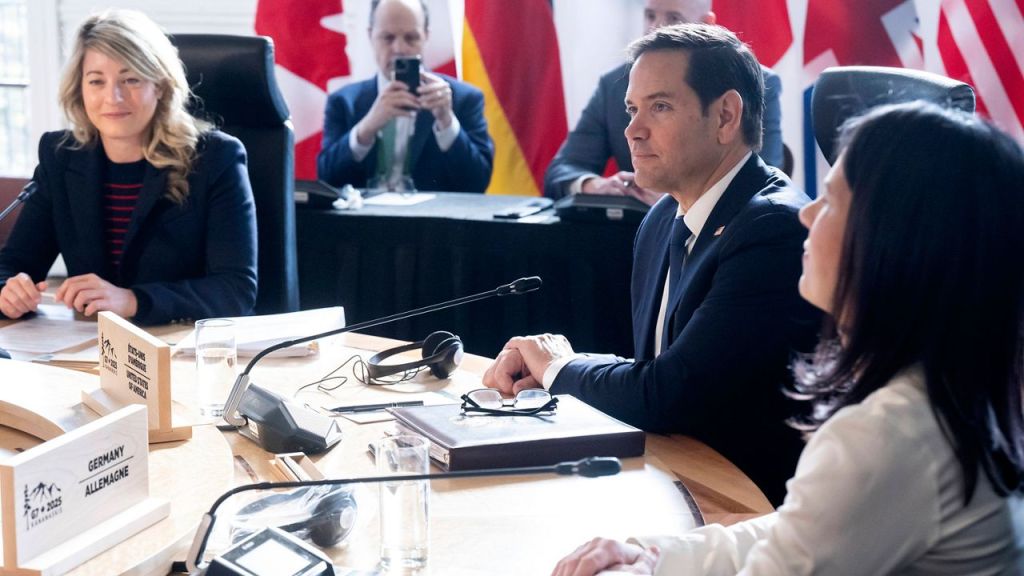
Internationally, the decision drew immediate and sharp criticism from the United States. Secretary of State Marco Rubio called it “tyranny in disguise,” suggesting that classifying and surveilling a legitimate opposition party undermines democratic pluralism. Vice President JD Vance went further, framing the move as a betrayal of East German voters and likening it to a bureaucratic reconstruction of the Berlin Wall. These comments align with a broader shift in U.S. conservative circles, where cultural affinity with nationalist parties in Europe, including AfD, has grown. Yet, Germany’s Foreign Ministry stood firm, underscoring the independence of its investigative bodies and asserting that the classification was about constitutional defence, not political suppression.

Interestingly, while American officials decried the move, European far-right parties offered a different reaction. France’s National Rally and Italy’s League, both members of the Identity and Democracy (ID) group in the European Parliament, expelled the AfD from their ranks after controversial statements from an AfD leader about the Nazi SS. Marine Le Pen declared it was time to make a “clean break” with the party, suggesting that even among populist allies, AfD’s rhetoric had become too extreme.

The designation is not simply a domestic decision, it is a declaration of principle. Germany is choosing constitutional integrity over political expediency, informed by the weight of its history. In doing so, it opens a conversation about the boundaries of democratic tolerance: how far can free speech and party politics go before they endanger the very freedoms that sustain them?

Crown and Country: King Charles’s Visit Tests Canada’s Unity

King Charles III is scheduled to open Canada’s Parliament on May 27, 2025, an event of considerable constitutional and political significance. It will be the first time a reigning monarch has performed this ceremonial role since Queen Elizabeth II in October 1977, during her Silver Jubilee tour. The announcement, made jointly with Prime Minister Mark Carney, carries symbolic weight and calculated political intent. As Canada contends with renewed provocations from U.S. President Donald Trump, including veiled economic threats and rhetoric that edges toward neo-imperial posturing, the Carney government appears to be leveraging the royal visit as a demonstration of constitutional resilience and international dignity. The moment is carefully staged to evoke continuity, stability, and institutional maturity in a time of cross-border unpredictability.

Yet there is a deeper strategic layer to this decision. Donald Trump has, in recent months, made no secret of his admiration for the British monarchy. He has praised royal decorum as a model of “true leadership” and even quipped during a campaign rally in Ohio that the United States “might do better in the Commonwealth.” While intended as theatre, the remark underscores Trump’s peculiar reverence for monarchical symbolism, a reverence that contrasts sharply with his often dismissive tone toward democratic norms. By welcoming King Charles into such a central role in Canadian political life, Carney may be sending a coded diplomatic signal to Washington: Canada, unlike its southern neighbour, is grounded in institutions that project both dignity and endurance. If Trump is moved by monarchy, then Carney is speaking a language he understands.

Domestically, however, the political optics are more complicated. While the Crown remains Canada’s formal head of state, public sentiment toward the monarchy is lukewarm at best. Recent polling suggests that 67 percent of Canadians were indifferent to Charles’s accession, and more than 80 percent described themselves as personally disconnected from the institution. For many, the monarchy feels like a vestige of another era, more relevant to history books than to modern governance. Carney’s gamble, then, is that the ceremonial gravitas of a royal visit will outweigh the public’s prevailing sense of apathy or irrelevance.

That apathy becomes pronounced opposition in Quebec, where nationalist sentiment remains particularly resistant to symbols of British authority. Quebec’s sovereigntist movements have long framed the Crown as emblematic of colonialism and cultural erasure. During King Charles’s coronation, the Société Saint-Jean-Baptiste de Montréal sent a telegram to Buckingham Palace declaring him “not welcome” in the province. The message was more than rhetorical: it echoed a deep-rooted political ethos that has challenged Canada’s constitutional architecture since the Quiet Revolution. In 2022, Premier François Legault’s government moved to eliminate the requirement that members of the National Assembly swear allegiance to the monarch, a pointed gesture of institutional defiance. For Quebec nationalists, the King’s presence in Ottawa may not symbolize unity, but rather federal tone-deafness.

Yet even as the visit stirs unease in some quarters, it presents a lesser-discussed opportunity: to reimagine the role of the Crown in Canada’s ongoing reconciliation with Indigenous peoples. The monarchy is, historically and legally, a signatory to many of the foundational treaties that continue to define the relationship between Indigenous nations and the Canadian state. For many Indigenous leaders, the Crown is not merely a colonial artifact, but also a legal partner whose standing can be invoked to press for the recognition of rights, lands, and sovereignty. If handled with humility and commitment, the King’s visit could serve as the opening of a new chapter, one in which the Crown renews its role not through symbolic visits alone, but through meaningful engagement with treaty obligations. Such a move would not erase historical wrongs, but it could elevate the discourse from ceremonial niceties to active responsibility and mutual respect.

In this light, the King’s appearance is more than a formal gesture. It is a high-stakes exercise in multi-layered symbolism, directed outward to a volatile American neighbour, inward to a fragmented federation, and downward through the strata of Canada’s colonial legacy. Carney is clearly betting that monarchy, however ambivalently received, can still serve as a unifying force if cast with the right mixture of diplomacy, gravity, and forward-looking intent. The risk is that in attempting to speak to all Canadians, the gesture may resonate with too few people. On the other hand, if successful, it could lay the foundation for a reimagined relationship between Canada and its institutions, one that asserts sovereignty, invites reconciliation, and strategically reclaims tradition in a turbulent geopolitical moment.

Pierre Poilievre and the Perils of a Political Retreat: Alberta as Safe Harbour or Symbol of Stubbornness?

At time of publication, there are no hard facts that support the notion that Mr. Poilievre will be standing in an Alberta by-election to regain a parliamentary seat. Prime Minister Mark Carney has stated that if this happens he has told Mr. Poilievre that he will trigger a by-election as soon as possible, “with no games, nothing.” 

Update
Within an hour of my publishing this post, Conservative MP-elect Damien Kurek says he will resign his Alberta seat so Conservative Leader Pierre Poilievre can run in a forthcoming by-election.

With the dust barely settled on the 2025 federal election; an election that saw Pierre Poilievre’s Conservatives fall short of forming government, new political tremors are already stirring on the Prairies. In a move that has stunned even some within his party, a newly elected Alberta Conservative MP is reportedly prepared to resign their seat to make way for Poilievre to run in a by-election.

This extraordinary gesture, while perhaps well-intentioned, forces Canadians to confront uncomfortable questions about leadership, legitimacy, and political culture. When a party leader is rejected by the country, what message does it send when they attempt to cling to power through a political back door?

A federal by-election in Alberta might appear, at first glance, like a logical next step for a leader whose personal popularity in that province remains high. Yet politics is not merely about numerical safety; it’s about national optics, political narrative, and public trust. This latest development is not just a test of Pierre Poilievre’s judgment; it’s a test of how far Canadian political norms can stretch before they snap.

What Happens When the Nation Says “No”?
Poilievre led the Conservatives through a campaign in which he promised transformation, fiscal discipline, and a crusade against what he called the “gatekeepers” of Canada’s institutions. The message, while resonant with segments of the electorate, ultimately fell short. He lost not just the confidence of Parliament, but of the majority of Canadians. In Canadian political culture, such a loss carries a clear implication: it’s time to step aside.

History provides no shortage of examples. Stéphane Dion resigned promptly after the Liberals’ dismal 2008 result. Michael Ignatieff, after the Liberal collapse in 2011 and the personal loss of his own seat, departed politics altogether. Andrew Scheer, who arguably performed better by winning the popular vote in 2019, still stepped down under pressure. Erin O’Toole, ousted by caucus after a 2021 campaign that yielded no significant breakthroughs, made no attempt at a comeback.

In each of these cases, the defeated leader recognized an essential political truth: leadership legitimacy comes not just from internal loyalty, but from external validation. Without a mandate from voters, remaining at the helm, or re-entering the ring, can seem more like ego than service.

Alberta as Sanctuary or Sideshow?
Poilievre’s political instincts have long found fertile ground in Alberta. His messages about oil, taxes, and personal freedom resonate strongly in a province often at odds with the federal government. A by-election there would almost certainly be safe terrain.

But that very safety raises difficult questions. Is the goal to represent the people of Alberta, or to use them as a political life raft? Reports that a newly elected MP, who just earned the trust of their constituents, might step aside to create space for Poilievre do not sit well with everyone. It smacks of backroom deal-making at a time when Canadians are demanding transparency and authenticity.

Alberta is no longer a monolith. Calgary and Edmonton have shown a consistent willingness to elect Liberals and New Democrats, especially in urban ridings. The electorate is younger, more diverse, and increasingly skeptical of overt political opportunism. A by-election staged to rehabilitate a failed leader could risk turning a Conservative stronghold into a national conversation about political entitlement.

The Constituency Question: Representation or Rehabilitation?
At its core, a by-election is a local exercise in democracy. Constituents elect someone to speak for their needs, not to serve as a stepping stone in a national chess match. If Poilievre proceeds with this path, it raises the question: who is the by-election really for?

Canadians are not blind to political calculation. They understand strategy, but they also understand sincerity. A leader who has been rejected nationally, yet insists on staying in the House of Commons via a seat that wasn’t theirs to begin with, risks being seen as more focused on personal relevance than party renewal.

This dynamic becomes even more delicate when local party members, many of whom fought hard to win a close race, are told to stand down or step aside. A backlash could erupt not just among voters, but within the Conservative grassroots. The image of parachuting a defeated leader into a riding might not sit well in the era of decentralized political engagement and hyper-local activism.

Internal Divisions and Leadership Overhang
Poilievre’s leadership was always going to be a high-risk, high-reward proposition. His populist rhetoric electrified many disaffected voters, but alienated others, including centrist swing voters in Ontario and British Columbia. That coalition wasn’t enough to win in 2025, and now, it may not be enough to secure his continued relevance.

Within the party, the response to the by-election rumour has been mixed. Some insiders, eager for continuity, view it as a practical step. Others see it as a dangerous delay to a necessary leadership transition. A successful by-election campaign might embolden Poilievre’s loyalists, but it won’t erase the larger strategic failures of the campaign. Worse, it may divide caucus between those pushing for reform and those clinging to the status quo.

If Poilievre wins a seat, but not a second chance, the Conservative Party risks entering a prolonged period of drift, neither fully post-Poilievre nor able to rebrand under new leadership. It’s the political equivalent of suspended animation.

What Kind of Political Culture Do We Want?
At a deeper level, the question is not just about Pierre Poilievre. It’s about the kind of political culture Canadians want. Do we reward resilience at any cost, or do we expect our leaders to recognize when their time is up?

Canadian political history has respected those who step aside with dignity after defeat. They may later return, as Jean Chrétien did after a long opposition tenure, but they do so only after earning back the trust of the public and their party. A quick return via a strategically engineered by-election feels more like a workaround than a comeback.

A Moment of Reckoning
Poilievre’s possible bid to return to the House of Commons via a by-election in Alberta, on the heels of a national rejection, could set a precedent, but it may be one the country comes to regret. He may win the seat, but lose the opportunity to be remembered as a leader who put country and party renewal ahead of personal ambition.

In that sense, this is no ordinary by-election rumour. It is a moment of reckoning, for a leader, a party, and a political culture that must decide whether to move forward or loop endlessly around the gravitational pull of defeat.

About Alberta: A Personal Perspective on Culture, Conversation, and Contribution

After more than 25 years as a business consultant, I’ve been fortunate to work across continents, meeting people, solving problems, and learning from cultures far from home. Yet, one of the most eye-opening cultural journeys I’ve taken has been much closer to home, right here in Canada.

In the early 2000s, I married a university professor from Alberta. With that union came a second family: ranchers, farmers, nurses, and small business owners from the Prairies. They welcomed me warmly, and over time, I found myself immersed in a culture both deeply Canadian and distinctly Albertan. What I discovered challenged assumptions I didn’t even know I had, and continues to shape how I think about communication, leadership, and nation-building.

Alberta isn’t just a place. It’s a way of being.

Like all Canadian regions, Alberta’s culture is shaped by its geography, economy, and history, but what stands out most is its ethos: plain speaking, hard work, and a fierce belief in self-reliance. This is a province built on the backs of people who tamed land, raised cattle, built farms, extracted energy, and raised families while weathering the booms and busts of resource cycles. It’s no surprise that such a setting produces a political and social landscape that leans more conservative, values independence, and tends to be skeptical of centralized authority, especially from Ottawa.

Yet, it’s also a province of surprising complexity. Urban centres like Calgary and Edmonton are home to vibrant, diverse communities. There’s deep thoughtfulness here, too, but it often takes a different form than what some Central Canadians might expect. Alberta’s discourse is grounded in lived experience, not theory. “Common sense” matters. So does speaking your mind, and when someone feels unheard, it’s often not about a lack of airtime, but about the feeling that their reality is being brushed aside.

One phrase I’ve heard countless times in Alberta is, You’re not listening to me. Sometimes, that’s not a literal complaint, it’s a coded way of saying, You’re not agreeing with me. In Alberta, where beliefs are often forged in the furnace of real-world outcomes, farming yields, small business margins, frontline nursing shifts, disagreement can feel like dismissal. If someone tells you a policy won’t work, it’s probably because they’ve lived through something similar. Ignoring that isn’t just impolite, it’s a denial of experience.

This is where conversations between Alberta and other parts of Canada can break down. We confuse disagreement with disrespect. We treat pragmatism as resistance to progress, and we forget that emotional intelligence requires listening to not just what is being said, but why it matters to the speaker.

My Alberta family holds views that might make some urban Central Canadians bristle. They question bureaucratic red tape. They prize personal responsibility. They believe in earning what you get, and yet these are the same people who will pull over in a snowstorm to help a stranger, or give you the shirt off their back if they think you need it. They don’t expect perfection, but they expect fairness, honesty, and above all, effort.

So how do we move forward, together?

First, we stop talking about Alberta and start talking with Albertans. We acknowledge the tensions, but we also recognize the province’s extraordinary contributions: to our economy, to our energy independence, to our national character. As we help Alberta navigate economic transformation, from oil to innovation, we must do so with respect for the culture that built this place.

That means understanding that communication here is not always couched in policy language or academic nuance. It’s plain. It’s passionate. It’s personal. And it deserves to be met with the same.

If we want a better Canada, we need a better conversation with Alberta, not just about it. That begins with listening not just to words, but to the values and experiences behind them. When we do that, we’ll find that Alberta doesn’t need to be changed, it needs to be understood.

First Past Its Prime: Rethinking Canada’s Voting System

It’s not every day a country is offered the chance to fix the structural rot in its democracy, but with frustration mounting across regions and communities, especially in Western and Indigenous Canada, the time for piecemeal reform is over. Canada stands at a crossroads, and the best path forward is the boldest one: comprehensive, simultaneous democratic renewal.

There is a rumour that a new white paper is now circulating among policy wonks, not just another tired commission report, but a blueprint for electoral and parliamentary transformation. It proposes we do four things at once: implement Proportional Representation (PR) in the House of Commons; guarantee Indigenous representation in both the House and Senate; elect our Senators instead of appointing them; and impose term limits across the board.

These are not radical ideas on their own, they’ve each been discussed, and in some cases even promised, by federal governments past. What’s radical, and deeply necessary, is the insistence that these reforms be pursued together. Not piecemeal. Not sequential. Together. Why? Because they reinforce each other, and together they promise a Canadian democracy that finally reflects our values, population, and future.

Let’s start with the cornerstone: Proportional Representation. The problems with first-past-the-post (FPTP) are well known. Governments get majority power with minority support. Voters in large swaths of the country, the Prairies, Northern Ontario, Atlantic Canada, feel their votes don’t count if they aren’t aligned with the winning party. Entire political movements, including Greens and Indigenous-led initiatives, are kept to the margins, not because people don’t support them, but because the system locks them out.

Under PR, the number of seats a party wins would actually reflect the votes it gets. It levels the playing field, encourages cooperation, and disincentivizes the hyper-partisanship we’ve seen grow in recent years. It also makes space for new voices, and that’s where the next reform matters deeply.

Indigenous peoples, who comprise nearly 5% of Canada’s population, are still structurally underrepresented in federal governance. Beyond symbolic appointments, there’s no permanent Indigenous voice in our institutions. That’s not reconciliation. That’s exclusion. The rumoured white paper proposes 10–17 guaranteed Indigenous seats in both the House and Senate, elected by Indigenous voters through systems that reflect their distinct traditions and nationhood. This is a direct response to the Truth and Reconciliation Commission’s call for political inclusion and UNDRIP’s principles of Indigenous self-determination.

Imagine, for a moment, a federal legislature where Indigenous nations hold formal, guaranteed space, not as guests or advisors, but as constitutional partners. That’s what real nation-to-nation dialogue would look like.

Then there’s the Senate, long the source of regional resentment and democratic embarrassment. An institution that holds legislative power, but whose members are appointed for life (until age 75). It’s no wonder people west of the Ottawa River roll their eyes. Reform here is overdue. The proposal calls for elected Senatorsterm limits, and regional balance, meaning each province and territory gets a fair say, regardless of population size. It also insists on something else: guaranteed Indigenous seats in the Senate, a chamber designed in part to protect minority interests and prevent majoritarian overreach.

And finally, term limits. Canadians respect experience, but they’re tired of career politicians clinging to power for decades. Democracy thrives when it breathes, when new leaders emerge, when old ideas are challenged, when public service is temporary and accountable. A 12-year limit for MPs and Senators allows plenty of time for impact, but makes space for renewal. It reduces the likelihood of political entrenchment, encourages succession planning, and invites more diverse participation, especially from younger generations and underrepresented communities.

Now, critics will argue this is too much at once. That we need to tread carefully. That the constitutional path is hard, and it is, but incrementalism is how we got here: decades of broken promises, failed referenda, and half-measures. The public is smarter than our politics. Canadians understand that systems matter, and that systems built in the 19th century can’t solve 21st-century problems.

By tackling PR, Senate reform, Indigenous representation, and term limits together, we don’t just update old institutions. We rebalance power. We rebuild trust. We open the doors to millions of people who have been shut out, by geography, by heritage, by design.

This isn’t about partisan advantage. It’s about democratic legitimacy. Every vote should count. Every region should matter. Every people should be heard.

This is Canada’s moment for democratic reckoning. Let’s not waste it. Let’s do it all at once.

I may/or may not have started the rumour about this so called white paper, and we all know it’s out there.