Article Five, Greenland, and the Fiction of Absolute Alliances – Reshaping the West (Part 1) 

NATO’s Article Five is often spoken of as if it were a law of nature rather than a political agreement. An attack on one is an attack on all. The phrase is repeated so often that it begins to sound automatic, inevitable, even mechanical. In practice, it is none of those things.

The hypothetical invasion or annexation of Greenland by the United States exposes the limits of Article Five with unusual clarity.

Greenland is an autonomous territory within the Kingdom of Denmark. Denmark is a full NATO member, and Greenland falls within NATO’s geographic scope. If a non NATO power were to land forces there, the alliance’s response would be swift and largely predictable. Consultations would be immediate. Article Five would almost certainly be invoked. Military planning would follow.

The situation changes fundamentally when the attacker is not outside the alliance, but at its center.

Article Five was never designed to restrain the most powerful member of NATO. It assumes a clear external adversary and a shared understanding of who constitutes a threat. There is no provision in the treaty that explains how to respond when the guarantor of collective defense becomes the source of aggression. NATO is a collective defense alliance, not a system of internal enforcement.

From a legal standpoint, Denmark’s options within NATO would be limited. Article Four consultations would be triggered at once. Emergency meetings of the North Atlantic Council would follow. Strong political statements would likely be issued. What would not follow is a clear, binding obligation for NATO members to take military action against the United States.

Politically, the outcome is even more constrained.

No NATO member would realistically initiate military action against the United States over Greenland. Major European powers would issue forceful condemnations, pursue emergency diplomacy, and press the matter through the United Nations and other multilateral forums. Canada would find itself in a deeply uncomfortable position, alarmed by the Arctic precedent but unwilling to escalate militarily against its closest ally. Smaller NATO members would be privately alarmed, yet publicly cautious, acutely aware that their security against Russia depends on the credibility of the American guarantee.

This is the reality that alliance theory often avoids stating directly. NATO operates by consensus within a structure of profoundly unequal power. The alliance’s credibility rests not only on legal commitments, but on the assumption that its most powerful member will act as a stabilizing force rather than a disruptive one.

An American annexation of Greenland would not trigger a unified military response under Article Five. It would instead produce a severe political crisis. NATO decision making would likely stall. Trust within the alliance would erode rapidly. European efforts toward strategic autonomy would accelerate, not as an abstract ambition but as a practical necessity.

The greatest damage would be neither territorial nor military. It would be institutional. Article Five would be revealed not as a universal shield, but as a conditional promise shaped by power, politics, and restraint. For NATO, the lesson would be stark. Collective defense works only as long as the strongest actor chooses to defend the system itself.

Arctic Gateways: Why Greenland Matters More Than Maps Suggest

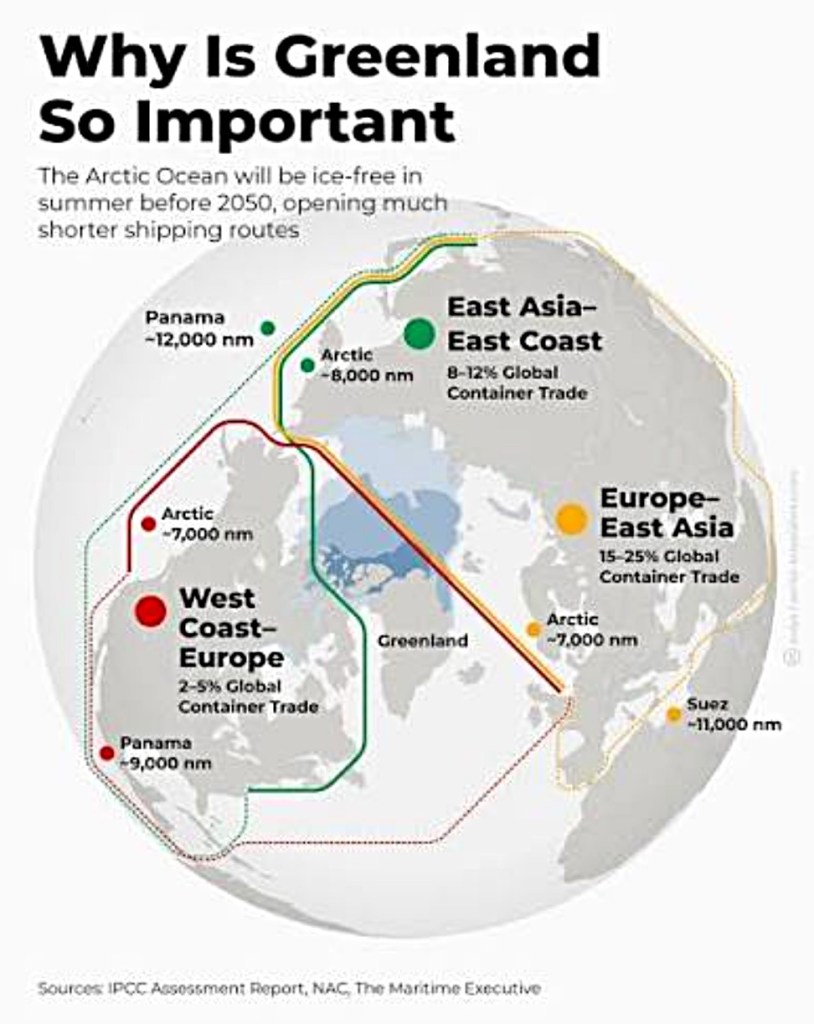
There is a deceptively simple geographic fact that sits quietly beneath much of the current Arctic maneuvering. In the entire Arctic region, there is effectively only one deep-water port that remains reliably ice-free year-round without the benefit of icebreakers, and that port is Nuuk, Greenland. This is not a trivia point. It is a structural constraint that shapes strategy, logistics, and power projection across the high north.

Nuuk’s status is the product of oceanography rather than politics. The West Greenland Current carries relatively warm Atlantic water northward along Greenland’s western coast, keeping the approaches to Nuuk navigable even through winter. By contrast, most other Arctic ports, including those in northern Canada, are either seasonally accessible or require sustained icebreaking support. Russia is often cited as an exception, but ports like Murmansk rely heavily on infrastructure, icebreaker fleets, and state subsidy to maintain year-round access. Nuuk stands apart in that its ice-free condition is natural, persistent, and proximate to the North Atlantic.

From a United States perspective, this matters enormously. American interest in Greenland is not primarily about territory in the nineteenth-century sense. It is about access, logistics, and denial. An ice-free port in the Arctic functions as a fixed node in what is otherwise a hostile operating environment. It enables sustained naval presence, resupply, maintenance, and potentially dual-use civilian and military shipping without the constant friction of ice conditions. In a future where Arctic sea lanes become more commercially viable and militarily contested, control or influence over such a node is strategically priceless.

This helps explain why U.S. engagement with Greenland has intensified well beyond rhetoric. Investments in airports, telecommunications, scientific infrastructure, and diplomatic presence all serve a dual purpose. They embed American interests into Greenland’s development trajectory while ensuring that any future expansion of Arctic activity occurs within a framework friendly to U.S. security priorities. The infamous proposal to “buy” Greenland was widely mocked, but it reflected a blunt articulation of a real strategic anxiety: the United States does not want its primary Arctic foothold to drift politically or economically toward rivals.

Canada’s position is more complex and, in some ways, more constrained. Canada has the longest Arctic coastline of any nation, yet no equivalent year-round ice-free deep-water port in its Arctic territory. This creates a persistent asymmetry. Canadian sovereignty claims rest on presence, governance, and stewardship rather than on continuous maritime access. The North is Canadian not because it is heavily used, but because it is administered, inhabited, and regulated.

As a result, Canada’s northern strategy cannot simply mirror that of the United States. Where Washington focuses on access and power projection, Ottawa must focus on resilience, legitimacy, and long-term habitation. Investments in northern communities, Indigenous governance, search and rescue, environmental monitoring, and seasonal port infrastructure are not secondary to sovereignty. They are sovereignty. Canada’s emphasis on the Northwest Passage as internal waters is inseparable from its need to demonstrate effective control without relying on year-round commercial shipping.

At the same time, the existence of Nuuk as the only naturally ice-free Arctic port creates both a vulnerability and an opportunity for Canada. The vulnerability lies in over-reliance on allied infrastructure. In any future crisis or competition scenario, Canadian Arctic operations would almost certainly depend on U.S. logistics routed through Greenland. The opportunity lies in cooperation. Joint development of northern capabilities, shared situational awareness, and integrated Arctic planning allow Canada to compensate for geographic disadvantages without surrendering policy autonomy.

What this ultimately reveals is that the Arctic is not opening evenly. It is opening selectively, along corridors dictated by currents, ice dynamics, and climate variability. Nuuk sits at the intersection of those forces. It is a reminder that geography still matters, even in an age of satellites and cyber power. For the United States, Greenland is a keystone. For Canada, it is a neighbor whose strategic weight must be acknowledged, managed, and integrated into a broader vision of a stable, governed, and genuinely Canadian North.

In that sense, the conversation about ice-free ports is not really about shipping. It is about who gets to shape the rules of the Arctic as it transitions from a frozen margin to a contested frontier.

Why Canada Should Make Voting Compulsory: Lessons from Australia

Canada prides itself on being a democratic nation, yet voter turnout tells a different story. In the 2021 federal election, just over 62% of eligible Canadians cast a ballot. Compare that with Australia, where voting has been mandatory since 1924, and turnout regularly exceeds 90%. The contrast is striking, and instructive. If Canada is truly committed to representative democracy, it should make voting compulsory.

Australia’s experience shows how dramatically voting laws can reshape political engagement. When the country introduced compulsory voting in 1924, turnout jumped from under 60% to over 91% in just one election. This wasn’t just a statistical change; it was a transformation of civic culture. Elections became more representative, and policy debates began to reflect a broader range of voter concerns. In Australia, “a parliament elected by a compulsory vote more accurately reflects the will of the electorate,” notes the Australian Election Commission. Canada could reap the same benefits.

One of the most compelling arguments for compulsory voting is the way it strengthens democratic legitimacy. When turnout is low, election results can be skewed by the interests of a narrow, often more affluent and ideologically extreme segment of the population. This leads to policies that favour the vocal few rather than the silent majority. By contrast, when everyone must vote, politicians must listen to everyone, including the marginalized and the poor. As historian Judith Brett puts it, “Now that means that politicians, when they’re touting for votes, know that all of the groups, including the poor, are going to have a vote. And I think that makes for a more egalitarian public policy.”

Critics argue that compulsory voting infringes on personal freedom. But Australians have lived with the system for a century, and public support for it remains strong, hovering around 70% since 1967. In fact, in 2022, 77% of Australians said they would still vote even if it weren’t mandatory. This suggests that making voting compulsory doesn’t stifle freedom; it cultivates civic responsibility.

Furthermore, compulsory voting could help counter political polarization in Canada. In voluntary systems, political parties often cater to their most radical base to energize turnout. But in Australia, where turnout is nearly universal, parties are forced to appeal to the political centre. This moderating influence is desperately needed in Canada’s increasingly divided political landscape.

Canada’s current voter turnout rates are simply not good enough. A democracy where one-third of citizens routinely sit out elections is a democracy with a legitimacy problem. If we want politics that are more representative, inclusive, and moderate, then it’s time to follow Australia’s lead. Voting is not just a right, it’s a duty. And like jury service or paying taxes, it should be expected of every citizen.

Source:
• BBC News (2022). “Why Australia makes voting mandatory.” https://www.bbc.com/news/world-australia-61505771
• Australian Electoral Commission. “Compulsory voting.” https://www.aec.gov.au/Voting/Compulsory_Voting/
• Elections Canada (2021). Voter Turnout. https://www.elections.ca/content.aspx?section=ele&dir=turn&document=index&lang=e

Ottawa at 25: The Amalgamation That Never Delivered

As Ottawa approaches the 25th anniversary of amalgamation this January, the moment invites a frank assessment. In 2001 the provincial government promised that merging 13 municipalities into a single-tier City of Ottawa would streamline governance, cut waste, improve services and stabilize taxes. Amalgamation was sold as modern, efficient and inevitable, a rational response to the untidy patchwork of local governments that once defined the region.

Two and a half decades later the record is far more complicated. Some benefits were real. Many others were aspirational. And for large portions of the city, especially rural and semi-rural communities, amalgamation has been a system that works to them, not for them. Bigger, it turns out, was not better.

The Promise of Better Services – The Reality of Uneven Delivery
The early pitch for amalgamation was simple: unify services and everyone wins. In practice, the outcome has been uneven across geography and income.

Urban residents gained the most. They saw expanded recreation programming, new library access and coordinated planning. Rural areas, by contrast, experienced reduced responsiveness in road maintenance, snow clearing, bylaw enforcement and transit. Communities like West Carleton, Rideau-Goulbourn and Osgoode have spent two decades reminding City Hall that “one size fits all” is not a service model; it is a compromise imposed on communities with profoundly different needs.

The city’s signature public-transit investment – the O-Train LRT system – was supposed to embody the advantages of centralization. Instead it has become a case study in the limits of mega-city governance: severe construction delays, cost overruns, and a nationally publicized public inquiry detailing systemic failures in oversight, transparency and project management. The LRT problems are not merely technical. They illustrate the deeper strain of running a sprawling municipality where accountability is diffused across layers of bureaucracy rather than rooted in local leadership.

The Financial Question: Where Were the Savings?
The financial rationale for amalgamation rested on scale. A bigger city would deliver efficiencies; efficiencies would reduce costs; reduced costs would protect taxpayers.

This never materialized.

Transition costs reached an estimated $189 million. Savings projections were optimistic, not guaranteed. The Transition Board did not promise tax cuts, and indeed taxes did not fall. In many rural and suburban areas they increased sharply, partly due to uniform tax policies that replaced diverse local rates.

Cost pressures accumulated in other ways:
• The city’s share of funding for provincial property-assessment operations has outpaced inflation every year since amalgamation.
• Capital projects, particularly transit, have grown more expensive while their benefits remain unevenly distributed.
• Ottawa now faces an annual transit operating shortfall approaching $140 million, straining a tax base already stretched by road, infrastructure and policing costs.

The efficiencies that were supposed to stabilize municipal finances largely failed to appear. In their place came the financial stresses of a city whose physical footprint rivals Toronto’s but without the provincial funding model Toronto enjoys.

Lost Local Control – And Lost Trust
Perhaps the most significant cost of amalgamation has been the erosion of local governance. Prior to 2001 communities had councils attuned to their unique needs and accountable to residents they lived beside. Today many rural and semi-rural residents feel politically peripheral; listened to, but not heard.

Ward representation cannot replicate local councils. Nor can city-wide policies reflect the distinct rhythms of a village like Manotick, the agricultural economy of Osgoode, or the infrastructure realities of West Carleton. The result has been a steady accumulation of resentment: a sense that rural areas subsidize urban priorities while their own needs remain secondary.

The weakening of local identity has democratic implications. Decision-making concentrated at the centre becomes less transparent, less responsive and harder for residents to influence. The LRT inquiry offered a stark reminder of what can happen when oversight drifts too far from citizens and too far from the specific communities most affected.

A Quarter Century Later: What Has Ottawa Gained – And What Has It Lost?
It would be simplistic to call Ottawa’s amalgamation a failure. Some benefits are undeniable: unified planning, expanded programming, strengthened economic-development strategies and early years of reasonably controlled citywide spending.

But at a structural level, amalgamation has not delivered its central promises. Taxes did not fall. Services did not equalize. Financial pressures did not ease. The governance system is more centralized but not more accountable. And the diversity of Ottawa’s communities – rural, suburban and urban – often exceeds the capacity of a single administrative structure to manage well.

The lesson is not that amalgamation should be reversed. The lesson is that centralized government must be paired with robust local power, transparent decision-making and an honest recognition that “efficiency” cannot override community identity or regional diversity.

As the 25-year mark approaches, Ottawa has an opportunity to look clearly at what was promised, what was delivered and what must change to make this city work fairly for everyone. Amalgamation may be permanent, but its shortcomings do not have to be.

Sources: 
en.wikipedia.org
todayinottawashistory.wordpress.com
app06.ottawa.ca (Rural Affairs Committee reports)
ottawa.ca (Long-Range Financial Plan II and III)
spcottawa.on.ca (WOCRC rural community report)
imfg.org (Single-tier municipal governance studies)
globalnews.ca (Ottawa LRT Public Inquiry)
ottawa.citynews.ca (Transit financial shortfall)
obj.ca (De-amalgamation commentary)

U.S. Border Rules: Security Theater at the Expense of the Economy

The United States is poised to implement border-crossing rules that threaten to strangle tourism and business travel under the guise of national security. Under a proposal from U.S. Customs and Border Protection, travelers from Visa Waiver Program countries could soon be required to disclose five years of social media activity, all phone numbers and email addresses used in the past decade, family details, and an array of biometric data including fingerprints, facial scans, iris scans, and potentially DNA. The stated purpose is to prevent threats before travelers set foot on American soil. The practical effect, however, is more likely to be economic self-sabotage than enhanced security.

Officials argue that social media monitoring can identify links to extremist networks and that biometric verification prevents identity fraud. Yet in reality, these measures are deeply flawed. Social media is ambiguous, easily manipulated, and prone to false positives. Connections to flagged accounts are not proof of malicious intent, and online behavior is rarely a reliable predictor of future actions. Biometric data can confirm identity, but it cannot reveal intent, and DNA collection provides little actionable intelligence for border security. What is billed as a comprehensive safety net is, in practice, security theater: a show of vigilance with limited ability to prevent genuine threats.

The economic consequences are far more immediate and measurable. Tourism generates hundreds of billions of dollars annually in the United States, and even modest deterrence can ripple across hotels, restaurants, retail, and transportation. Business travel and conferences may shift overseas to avoid intrusive vetting, while students and skilled professionals may choose alternative destinations for study and employment. The timing is particularly ill-advised: the 2026 FIFA World Cup, expected to bring millions of international visitors, risks diminished attendance and reduced economic activity due to privacy-invading entry requirements.

Beyond lost revenue, the proposal risks damaging the U.S.’s international reputation. Heavy-handed border rules signal that openness and hospitality are subordinate to bureaucratic procedures, potentially discouraging cultural exchange, foreign investment, and global collaboration. In balancing national security and economic vitality, policymakers appear to have prioritized symbolism over substance.

Ultimately, the proposed rules expose a stark imbalance: symbolic security at the expense of tangible economic and diplomatic costs. Public commentary over the next 60 days is the last line of defense against a policy that could chill travel, weaken industries reliant on foreign visitors, and tarnish America’s global image. National security is crucial, but when it comes at the cost of economic self-harm, it ceases to be protection and becomes self-inflicted damage.

Enough Already: Greenland, American Strategy, and an Envoy That Makes No Sense

In December 2025, President Donald Trump announced that he would appoint Louisiana Governor Jeff Landry as the United States special envoy to Greenland. The announcement came with Trump’s customary social-media flourish, framing Greenland as “essential to our national security” and praising Landry’s willingness to advance U.S. interests in the Arctic. Landry himself declared that it was an “honor … to make Greenland a part of the U.S.” even as he would remain governor of Louisiana concurrently. Reuters

1. It’s a Diplomatic Stunt, Not Strategy

Appointing a U.S. special envoy to a territory that is not a U.S. partner or diplomatic interlocutor is, by definition, an odd choice. Greenland is a semi-autonomous territory of the Kingdom of Denmark, and sovereignty over Greenland rests with Copenhagen under international law. Even if Greenland exercises home rule over many internal matters, Denmark retains foreign-affairs authority. Euronews

Denmark reacted accordingly. Its foreign minister denounced the move and summoned the U.S. ambassador in protest, asserting that territorial integrity must be respected. Danish and Greenlandic leaders jointly declared that “you cannot annex another country,” and reinforced that “Greenland belongs to the Greenlanders.” Euronews

2. The People of Greenland Have Spoken—Loudly

Trump and his allies have repeatedly hinted that Greenlanders might welcome U.S. affiliation or even statehood. Yet public opinion data tell a different story: 85% of Greenlanders oppose becoming part of the United States, with only about 6% in favor. A News AMERICAS poll

Ignoring the expressed will of the local population while proclaiming sovereign ambitions isn’t strategic leadership. It’s symbolic posturing that weakens U.S. credibility with the very audiences that Washington claims to want on its side.

3. National Security Strategy vs. Tactical Execution

To be fair, Greenland does matter in the Arctic geostrategic environment. Its geographic position gives control over approaches to North America, and U.S. military assets like Pituffik Space Base have long been elements of continental defense. There is also growing global competition in the Arctic amid climate change and resource access. These realities are consistent with core themes in the U.S. National Security Strategy (NSS): maintaining technological edge, reinforcing alliance structures, and securing critical supply chains. Associated Press

But that strategic framework does not justify appointing a governor as envoy with public remarks about making another country part of the United States. That is a conflation of long-term objectives (strengthening U.S. strategic position in the Arctic) with short-term theatrics that have real diplomatic and legal consequences.

4. Why This Matters Beyond Headlines

A smart Arctic strategy might include genuine cooperative defense partnerships with Greenland and Denmark, investment in shared security infrastructure, climate resilience, and economic collaboration that respects sovereignty. Instead, the current approach:

  • Undermines alliance trust with a NATO member whose cooperation is critical in Europe and the Arctic.
  • Misreads local sentiment, dismissing Greenlanders’ clear preference to determine their own future.
  • Reduces U.S. policy to rhetorical brinkmanship, distracting from substantive cooperation where it matters.

If the NSS is a roadmap for how the U.S. secures its interests in an increasingly competitive world, this envoy appointment reads like a sideshow detour driven by personality rather than policy.

Sources

When Interview Styles Collide: Why Some Political Conversations Feel Like Car Crashes

Every few years, Canadian audiences rediscover the same irritation: a high-profile interview that feels less like an exchange of ideas and more like a verbal wrestling match. The questions may be legitimate, even necessary, but the delivery leaves viewers tense, unsatisfied, and oddly unenlightened. The repeated clashes between Rosemary Barton and Mark Carney are a useful case study, not because either is acting in bad faith, but because they embody two very different traditions of public communication that were never designed to coexist comfortably.

The first tradition is the parliamentary press-gallery style that dominates Canadian political journalism. It is adversarial by design. It emerged in an era when access was limited, answers were evasive, and power was something to be pried open rather than invited to speak. In this model, interruption is not rudeness; it is a tool. The journalist asserts control of the frame, resists narrative-setting by the interviewee, and signals independence to both the audience and their peers. Toughness must be visible. Silence or patience can be misread as deference.

The second tradition is technocratic communication, exemplified by figures like Carney. This style evolved in central banks, international institutions, and policy forums where precision matters more than punch. Answers are layered, contextual, and carefully sequenced. The speaker often builds a framework before arriving at a conclusion, because conclusions without context are seen as irresponsible. This approach assumes the listener is willing to follow a longer arc in exchange for accuracy.

When these two traditions meet on live television, friction is inevitable. The journalist hears preamble and assumes evasion. The interviewee hears interruption and assumes misunderstanding. Each responds rationally within their own professional culture, and the conversation degrades anyway.

What makes this especially grating for audiences is that modern broadcast incentives amplify the worst aspects of the collision. Political interviews are no longer just about extracting information. They are performances of accountability. The interviewer must appear relentless, particularly when questioning elite figures who are widely discussed as potential leaders. Interruptions become proof of vigilance, even if they interrupt substance as much as spin.

At the same time, viewers are more sophisticated than broadcasters often assume. Many can tell the difference between a non-answer and a complex answer. When an interviewee remains calm and methodical while being repeatedly cut off, the aggression reads less like accountability and more like impatience. The audience senses that something useful is being lost, not exposed.

This is why these interviews linger unpleasantly after they end. It is not that hard questions are unwelcome. It is that hardness has been mistaken for haste. A genuinely rigorous interview would often benefit from letting a full answer land, then dissecting it carefully. Precision, not interruption, is what exposes weak arguments. Control of the conversation is not the same thing as control of the truth.

None of this requires villains. Barton is doing what her professional ecosystem rewards. Carney is speaking in the register his career trained him to use. The problem is structural, not personal.

If public broadcasting is meant to inform rather than merely provoke, it may be time to rethink whether visible combat is the best proxy for journalistic seriousness. Sometimes the most incisive move is not to interrupt, but to listen long enough to know exactly where to press next.

That, in the end, is why these moments grate. They remind us that we are watching two competent professionals speaking past one another, while the audience pays the price in lost clarity.

Public Funding for Private Arenas: Economic Realities Behind the Ottawa Senators Proposal

The renewed push for a taxpayer supported arena at Ottawa’s LeBreton Flats arrives at a moment when the economic evidence is clear. Professional sports franchises continue to seek public subsidies while independent academic research demonstrates that taxpayer funded arenas provide little to no measurable economic return to host cities.

The current lobbying effort by Capital Sports Development Inc. mirrors a common strategy in North America: frame the project as an economic generator rather than a private entertainment investment. The empirical data provides a different assessment.

Economic research and city outcomes

Consensus across economic literature is stable. Major reviews and empirical studies show that sports arenas do not create net new economic activity. Spending at arenas typically reallocates existing entertainment consumption within a city. Construction jobs are temporary. Longer term measures such as regional GDP, employment, and household income do not show statistically significant improvement following arena construction.

Representative findings

StudyScopeFinding
Noll & ZimbalistMultiple stadium projectsEconomic effects extremely small or negative
Coates & HumphreysCross city panel analysesNo association between franchises and long term income growth
Bradbury, Coates & Humphreys (2023)Historical reviewLittle to no tangible economic impact from stadium subsidies
Journalist’s Resource (2024)Literature roundupPublic stadium funding rarely produces the projected economic returns

Comparative evidence from recent arena projects

Recent Canadian and North American arena projects reveal the scale of public exposure when municipal and provincial governments participate. The table below summarizes selected examples and a chart illustrates the variation in public contributions.

Arena ProjectApproximate Public Contribution (Millions CAD)Funding Notes
Calgary Event Centre537Municipal and provincial contributions for arena and district infrastructure
Rogers Place, Edmonton226Municipal funding combined with tax increment and CRL mechanisms
UBS Arena, New York0Privately financed on state land lease
T-Mobile Arena, Las Vegas0Privately financed

Why public private partnerships often underperform

Public private partnerships are presented as compromise solutions but frequently shift long term fiscal risk onto taxpayers while securing stable private returns for franchise owners. Cost overruns, maintenance liabilities and revenue shortfalls commonly become municipal obligations. Promised spinoff benefits such as meaningful tourism increases or broad district revitalization are often overstated in proponent studies.

Opportunity cost

Public funds allocated to stadium projects carry opportunity costs. Funds used for an arena are not available for transit, housing, healthcare, climate adaptation or education. These alternatives typically deliver higher social and economic returns than subsidizing privately owned entertainment facilities. Private financing eliminates this trade off.

Policy conclusion

Evidence supports a default policy of requiring private financing for professional sports facilities. Public funds should be reserved for investments that yield broad-based returns and reduce systemic risk for residents. Where public contributions are proposed they should be subject to independent review, enforceable community benefits, strict caps on public exposure and, where appropriate, direct public approval through referendum or legislative vote.

Sources and further reading

  • Bradbury, J C, Coates, D and Humphreys, B R. The economics of stadium subsidies. Policy retrospective. 2023.
  • Coates, D and Humphreys, B R. Do subsidies for sports franchises, stadiums, and mega events work? Econ Journal Watch.
  • Noll, R G and Zimbalist, A. Sports, Jobs and Taxes. Review of economic impacts of sports teams and stadiums.
  • Journalist’s Resource. Public funding for sports stadiums: a primer and research roundup. 2024.
  • Reporting on Ottawa Senators lobbying activity and StrategyCorp engagement. SportsBusiness Journal and national coverage.

For readers seeking original reports and news coverage please consult academic databases and major news outlets for the documents cited above.

From Vision to Momentum: Alto Enters Its Defining Phase

For years, Canada’s ambitious dream of linking its greatest cities with true high-speed rail has hovered in the realm of feasibility studies and future pipe dreams. Now, in the closing weeks of 2025, that dream has shifted decidedly toward reality; not because steel is yet being laid, but because the Alto high-speed rail initiative has crossed a crucial threshold from concept to concerted preparation and public engagement.

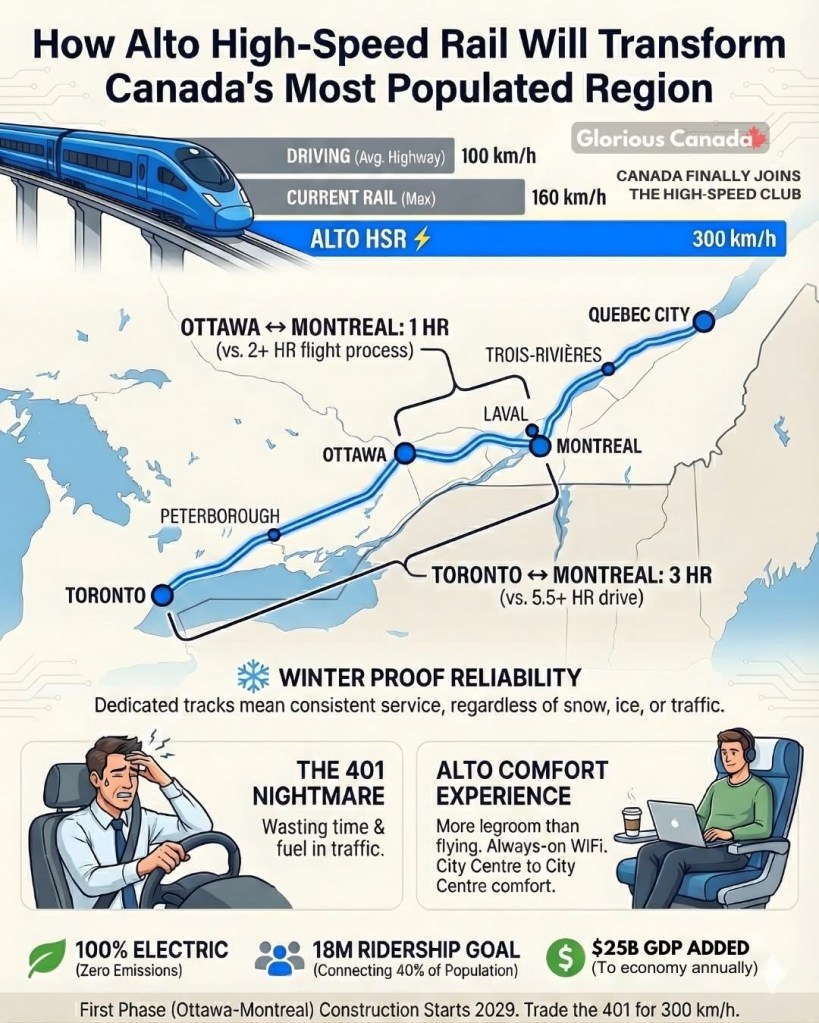
At its core, Alto is a transformative infrastructure vision: a 1,000-kilometre electrified passenger rail network connecting Toronto to Québec City with trains capable of 300 km/h speeds, slicing travel times compared to what today’s intercity rail offers and binding half the nation’s population into a single, rapid mobility corridor. The design phase, backed by a multi-billion-dollar co-development agreement with the Cadence consortium, is well underway, and the federal government has signaled its intent to see this project delivered as one of the largest infrastructure investments in decades.  

The most noteworthy milestone in recent weeks has been a strategic decision about where Alto will begin to take physical shape. On December 12, officials announced that the Ottawa–Montreal segment – roughly 200 km – will be the first portion of the network to advance toward construction, with work slated to begin in 2029. This choice reflects a practical staging strategy: by starting with a shorter, clearly defined corridor that spans two provinces, engineering and construction teams can mobilize simultaneously in Ontario and Québec and begin delivering economic and skills-development benefits sooner rather than later.  

This announcement isn’t just about geography; it marks a shift in Alto’s progression from broad planning to community-level engagement. Beginning in January 2026, Alto will launch a comprehensive three-month consultation process that includes open houses, virtual sessions, and online feedback opportunities for Canadians along the corridor. These sessions will inform critical decisions about alignment, station locations, and mitigation of environmental and community impacts. Indigenous communities, municipalities, and public institutions will be active participants in these discussions as part of Alto’s ongoing commitment to consultation and reconciliation, a recognition that this project’s success hinges not only on engineering prowess, but on thoughtful, inclusive planning.  

Beyond route planning, Alto and Cadence are also turning to Canada’s industrial capacity, particularly the steel sector, to gauge the domestic supply chain’s readiness for what will undeniably be a massive procurement exercise. With thousands of kilometres of rail and related infrastructure components needed, early outreach to the steel industry is intended not just to assess production capacity, but to maximize Canadian content and economic benefit from the outset.  

Yet not every question has a definitive answer. Strategic discussions continue over the optimal location for Alto’s eventual Toronto station, with the CEO publicly acknowledging that a direct connection to Union Station may not be guaranteed; a decision that could shape ridership patterns and integration with existing transit networks across the Greater Toronto Area.  

As the calendar turns toward 2026, the Alto project sits at an inflection point: one foot firmly planted in detailed design and consultation, the other inching closer to the realm of shovels and steel rails. Political support appears robust, and fiscal planning, including major project acceleration initiatives and supportive legislation, has built momentum. Yet, as any transportation planner will tell you, the distance between planning and construction is long, often winding, and frequently subject to political, economic, and community pressures.

Still, for advocates and observers alike, the significance of the latest developments cannot be overstated. Alto has graduated from “what if?” to “when and how,” and that alone marks a major step forward in Canada’s transportation evolution.

When Sovereignty Drifts Quietly Out of Orbit

There is a peculiar habit in Ottawa that reveals itself most clearly in defence procurement. It is the habit of mistaking alignment for dependence, cooperation for deference, and interoperability for inevitability. The proposed Canadian Forces space command and control project, now quietly priced somewhere between two hundred and four hundred million dollars, is a textbook example. What should be a sober discussion about Canadian sovereignty in the most strategic domain of the twenty-first century has instead become another case study in how deeply the senior civilian and uniformed leadership of the Department of National Defence has been captured by American assumptions, priorities, and frameworks.

The issue is not that Canada works closely with the United States in space. That is both unavoidable and desirable. The issue is that DND increasingly appears incapable of imagining a serious military capability that does not begin with the question, “How does the U.S. do this?” rather than, “What does Canada actually need?” When briefing notes openly frame U.S. assistance as a foundational requirement rather than an optional enhancement, the problem is no longer technical. It is cultural. Strategic thinking has been outsourced long before any contract is signed.

This is institutional capture, not conspiracy. It happens when careers are built inside allied command structures, when promotion rewards smooth interoperability rather than independent judgment, and when senior civilians absorb the same assumptions as the generals they are meant to challenge. Over time, the centre of gravity shifts. Canadian officers and officials begin to see American systems as the default, American timelines as the clock, and American doctrine as neutral truth rather than national preference. At that point, sovereignty is not surrendered dramatically. It simply fades into the background.

The space project exposes this drift with unusual clarity. Space command and control is not a niche capability. It sits at the intersection of intelligence, surveillance, targeting, Arctic defence, and escalation control. A system that cannot function independently in a crisis, even for a limited period, is not a sovereign capability. It is a terminal plugged into someone else’s infrastructure. Yet DND’s language suggests comfort with exactly that outcome, as though Canada’s role is to be a well-behaved node in an American-led network rather than a state with its own strategic thresholds and political constraints.

This is where the Carney government must act decisively, and quickly. Defence reform cannot be limited to budgets and white papers. The problem is not primarily money. It is leadership. Both the senior civilian ranks and the uniformed command structure at DND require a reset in incentives, expectations, and worldview. Canada needs defence leaders who are capable of working with the United States without being intellectually subordinate to it, who understand that alliance management is not the same thing as strategic abdication.

Strategic changes at the top of DND are therefore not punitive. They are corrective. The Carney government should be looking for leaders with demonstrated experience outside permanent U.S. frameworks, leaders who have worked in multilateral, civilian-led, or genuinely independent contexts. It should be asking hard questions about how often Canadian alternatives are even presented internally before U.S. options are adopted by default. And it should be willing to rotate out senior figures who have become too comfortable treating American preferences as Canadian interests.

None of this requires anti-Americanism. It requires maturity. The United States will continue to pursue its own interests in space, just as Canada must pursue ours. True allies respect that distinction. What they do not respect, and should not be encouraged to expect, is quiet compliance dressed up as partnership.

Space is not just another procurement file. If Canada cannot think clearly about sovereignty there, it will not think clearly about it anywhere. The danger is not that Canada will anger Washington. The danger is that Canada will stop mattering to itself. That is a failure no ally can fix for us, and no amount of interoperability will excuse.