
Every once in a while, a new idea comes along that doesn’t just tweak the edges of our understanding, but tries to redraw the map entirely. John C. W. McKinley’s Mass Imposes Delay principle is one such idea. Published in mid-2025 and still sitting at the intersection of speculation and serious theoretical intrigue, this deceptively simple thesis – that mass is not just an object of gravity, but an agent of temporal delay – invites us to reconsider what we think space, time, and matter are really doing.
What if mass is not a thing, but a tempo? What if the cosmos is not a machine, but a performance – its rhythms set not by ticking clocks, but by the gravitational drag of being itself?
At its heart, McKinley proposes that mass structures time by imposing delays on how photons, and by extension, all information, resolves into physical experience. Rather than viewing mass merely as the cause of curvature in spacetime (as in general relativity), or as a Higgs-bestowed quality of particles (as in the Standard Model), this theory suggests something more metaphysical and yet startlingly concrete: mass sets the timing of reality’s unfolding.
Delay × Mechanics = Observed Physics
This is McKinley’s governing equation. Delay, introduced by mass, interacts with basic mechanical instructions, what he calls “photon-coded instructions”, to produce the physical phenomena we observe. It’s a view that doesn’t discard quantum field theory or general relativity but reframes them as emergent from an underlying informational pacing system.
In the Shapiro delay, light signals passing near a massive object take slightly longer to reach us. Traditionally explained as curved spacetime, McKinley reframes it: mass itself introduces a resolution delay.
This subtle shift moves the focus from where things happen to when they are allowed to happen.
A Delayed Universe: From Quantum Collapse to Cosmic Expansion
In quantum mechanics, the collapse of a wavefunction – the moment when a system’s potential resolves into a definite outcome – has long baffled philosophers and physicists alike. It’s not the math that confuses us; it’s the implication that reality is, in some sense, probabilistic until someone, or something, causes it to resolve.

McKinley’s theory offers an elegant twist: mass itself acts as a selector. By introducing delay, it filters and sequences quantum outcomes into coherent, observed experience. This bridges relativity and quantum theory by offering a common denominator: timing control.
It also touches cosmology. In a universe where mass determines delay, and delay governs resolution, cosmic time itself becomes pliable. The early universe might have operated under very different delay patterns – suggesting that the laws we observe today could be the outcome of an evolving cosmic schedule. Inflation, dark energy, and even the cosmological constant could be reframed as manifestations of shifting delay regimes.
A Two-Filter Reality
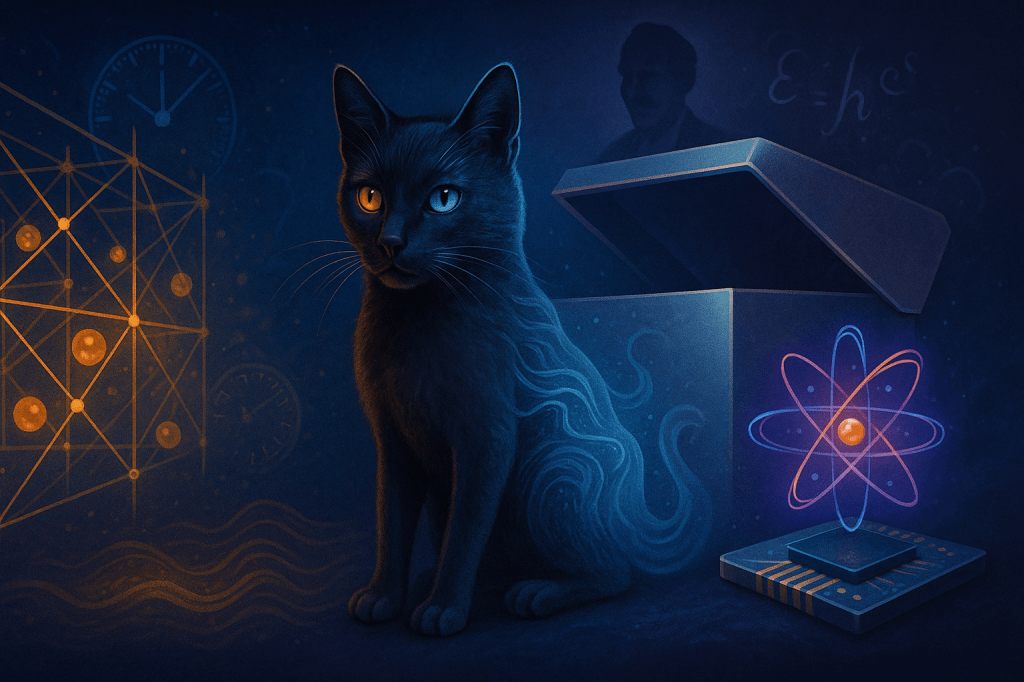
McKinley envisions reality as filtered twice: first by wavefunction possibility and again by mass-governed delay. Picture a vast quantum landscape filled with all possible outcomes, then imagine a “mass curtain” that slows and sequences how those potentials crystallize into reality.
This recalls Mach’s principle, which links inertia to the gravitational influence of distant matter. McKinley extends it: not only inertia, but the timing of reality’s unfolding depends on the universe’s mass distribution.
No exotic particles, no extra dimensions – just a new lens on familiar physics. The photon’s instructions may be timeless, but when they’re read depends on the local mass environment.
Challenges and Promise
Is it testable? Not yet, but in principle yes. If mass imposes resolution timing, high-precision quantum timing experiments might detect non-local delays, or gravitational lensing could show subtle deviations from purely geometric predictions. Such tests could turn this elegant speculation into empirical science.
The biggest contribution may be conceptual: replacing the image of a universe as a stage with actors, with that of a performance unfolding according to a mass-driven tempo.
Final Thoughts
McKinley’s work, still awaiting rigorous peer review, is worth attention. It asks us to imagine mass not as the glue holding the universe together, but as the metronome pacing its unfolding.
We may be on the cusp of a physics that is not only about what exists, but about when it happens. If he’s right, mass isn’t what keeps the universe in place – it’s what slows it down, just enough for reality to make sense.
 The Rowanwood Chronicles