
For nearly a century, Schrödinger’s cat has prowled the imagination of physicists and philosophers alike, half-alive, half-dead, trapped in a quantum box of uncertainty. It’s been a durable metaphor, capturing the mind-bending strangeness of quantum superposition, where particles can occupy multiple states at once, but only collapse into a definite reality when observed. Now, a series of new experiments have not only extended the cat’s mysterious life, they may well have cracked open the lid of that theoretical box.
In one breakthrough, researchers at the University of Science and Technology of China have managed to sustain a quantum superposition in a group of atoms for an unprecedented 1,390 seconds, over 23 minutes. To put that in perspective, most quantum states decay in milliseconds, collapsing under the weight of their environment. These scientists cooled ytterbium atoms to near absolute zero and suspended them in a laser-generated lattice, creating a sort of optical egg carton that isolated the atoms from external noise. The result? A stable, coherent quantum state that lasted longer than any yet recorded. If Schrödinger’s feline had been curled up in that lab, it might have been both alive and dead long enough to get bored.
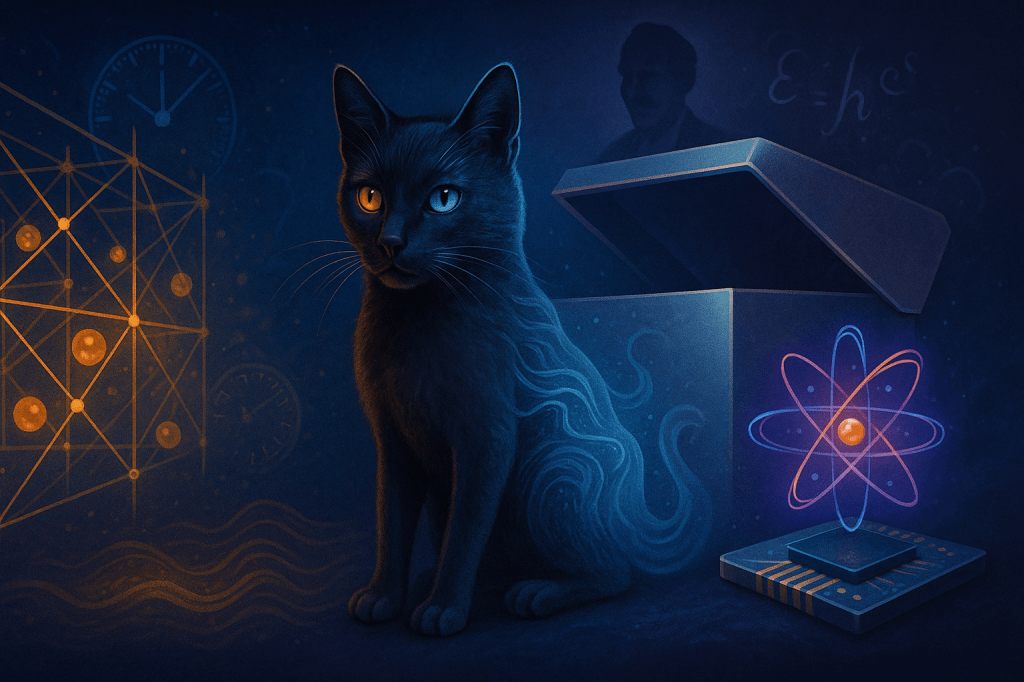
The implications are profound. Quantum coherence over such extended periods could radically advance quantum computing, quantum communications, and even fundamental tests of the boundary between quantum and classical worlds. It also hints at the possibility of observing, and perhaps one day manipulating, quantum phenomena at larger, more tangible scales. The line between weird and real is getting thinner.
Yet, the story doesn’t end in China. Across the world in Sydney, engineers at the University of New South Wales have been tinkering with the quantum cat’s metaphorical whiskers in a different way. They’ve embedded an antimony atom with eight possible spin states into a silicon chip, creating a quantum bit (qubit) capable of holding significantly more information than the binary states of traditional bits. Each of these eight spin configurations acts like a tiny door into a different potential reality, giving rise to a computational system that can tolerate a degree of error, essential in the fragile world of quantum information.
This “hot Schrödinger’s cat,” as some have dubbed it, refers not just to the technical feat but to the strange warmth of the system, higher energy levels that challenge the traditional assumption that quantum systems must be deeply frozen. By designing systems that can operate at relatively warmer conditions, and still retain quantum coherence, scientists are inching toward scalable, real-world applications of quantum logic.
So what does this mean for the cat, and for us? It means we’re closer than ever to pulling that quantum feline out of abstraction and into the world of working tools. The cat is no longer just a paradox. It’s a partner, mysterious, elusive, but increasingly real. And in the glow of the lab’s lasers and chip circuits, it might even be purring.
Sources
• Wired: Scientists Have Pushed the Schrödinger’s Cat Paradox to New Limits
• Phys.org: Quantum Schrödinger’s Cat on a Silicon Chip
 The Rowanwood Chronicles