
From Vision to Momentum: Alto Enters Its Defining Phase

For years, Canada’s ambitious dream of linking its greatest cities with true high-speed rail has hovered in the realm of feasibility studies and future pipe dreams. Now, in the closing weeks of 2025, that dream has shifted decidedly toward reality; not because steel is yet being laid, but because the Alto high-speed rail initiative has crossed a crucial threshold from concept to concerted preparation and public engagement.

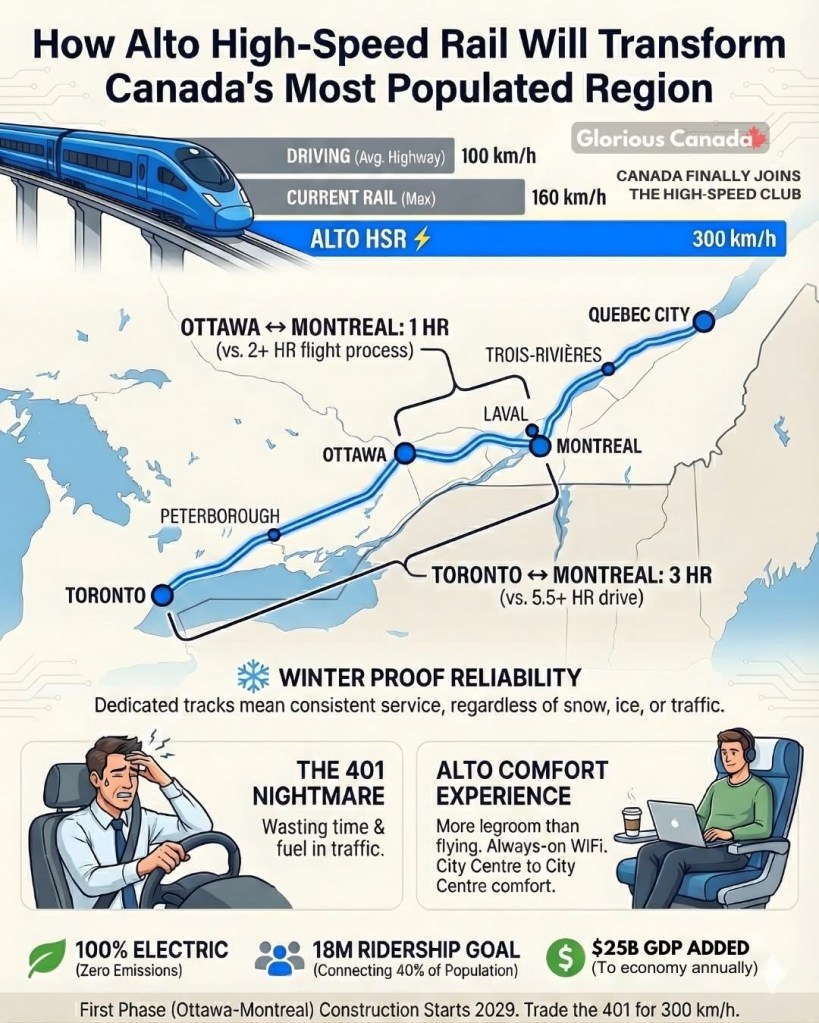
At its core, Alto is a transformative infrastructure vision: a 1,000-kilometre electrified passenger rail network connecting Toronto to Québec City with trains capable of 300 km/h speeds, slicing travel times compared to what today’s intercity rail offers and binding half the nation’s population into a single, rapid mobility corridor. The design phase, backed by a multi-billion-dollar co-development agreement with the Cadence consortium, is well underway, and the federal government has signaled its intent to see this project delivered as one of the largest infrastructure investments in decades.  

The most noteworthy milestone in recent weeks has been a strategic decision about where Alto will begin to take physical shape. On December 12, officials announced that the Ottawa–Montreal segment – roughly 200 km – will be the first portion of the network to advance toward construction, with work slated to begin in 2029. This choice reflects a practical staging strategy: by starting with a shorter, clearly defined corridor that spans two provinces, engineering and construction teams can mobilize simultaneously in Ontario and Québec and begin delivering economic and skills-development benefits sooner rather than later.  

This announcement isn’t just about geography; it marks a shift in Alto’s progression from broad planning to community-level engagement. Beginning in January 2026, Alto will launch a comprehensive three-month consultation process that includes open houses, virtual sessions, and online feedback opportunities for Canadians along the corridor. These sessions will inform critical decisions about alignment, station locations, and mitigation of environmental and community impacts. Indigenous communities, municipalities, and public institutions will be active participants in these discussions as part of Alto’s ongoing commitment to consultation and reconciliation, a recognition that this project’s success hinges not only on engineering prowess, but on thoughtful, inclusive planning.  

Beyond route planning, Alto and Cadence are also turning to Canada’s industrial capacity, particularly the steel sector, to gauge the domestic supply chain’s readiness for what will undeniably be a massive procurement exercise. With thousands of kilometres of rail and related infrastructure components needed, early outreach to the steel industry is intended not just to assess production capacity, but to maximize Canadian content and economic benefit from the outset.  

Yet not every question has a definitive answer. Strategic discussions continue over the optimal location for Alto’s eventual Toronto station, with the CEO publicly acknowledging that a direct connection to Union Station may not be guaranteed; a decision that could shape ridership patterns and integration with existing transit networks across the Greater Toronto Area.  

As the calendar turns toward 2026, the Alto project sits at an inflection point: one foot firmly planted in detailed design and consultation, the other inching closer to the realm of shovels and steel rails. Political support appears robust, and fiscal planning, including major project acceleration initiatives and supportive legislation, has built momentum. Yet, as any transportation planner will tell you, the distance between planning and construction is long, often winding, and frequently subject to political, economic, and community pressures.

Still, for advocates and observers alike, the significance of the latest developments cannot be overstated. Alto has graduated from “what if?” to “when and how,” and that alone marks a major step forward in Canada’s transportation evolution.
Quebec’s Agrifood Strategy: A National Lesson in Food Security

Quebec has quietly become a national leader in agrifood planning and food security. At a time when global food systems are increasingly fragile, the province offers a clear and pragmatic model for how public policy, local investment, and social equity can combine to build a more resilient, sustainable food system. The rest of Canada would do well to take note.

Central to Quebec’s approach is its comprehensive provincial framework, Politique bioalimentaire 2018–2025: Alimenter notre monde. This policy articulates a long-term vision for food sovereignty and ecological stewardship. It promotes value-added processing, regional production, and stronger local supply chains. What sets Quebec apart is not simply the breadth of the strategy, but the coordination behind it. Provincial and federal funds are deployed in tandem, targeting greenhouse expansion, food transformation infrastructure, agri-environmental practices, and innovation. In 2023, Quebec committed $175 million toward increasing regional food self-sufficiency, a move that signaled a shift away from dependence on volatile global supply chains.

This funding strategy has been reinforced by the Canada–Quebec Sustainable Canadian Agricultural Partnership agreement, which committed $955 million over five years to support producers across the province. The agreement includes enhanced compensation under AgriStability, infrastructure renewal programs, and expanded support for environmental and climate-smart practices. With a 25 percent increase over the previous five-year framework, this is one of the most ambitious agrifood investments in the country.

Quebec’s focus on food processing has also paid dividends. In Saguenay–Lac-Saint-Jean, for example, Céréales Normandin received over $3.5 million in combined provincial and federal support to expand its grain-processing capacity. By transforming local cereals into flour, semolina, and plant-based protein concentrates, the facility strengthens Quebec’s ability to retain value within the province. It also reduces dependency on long-haul transportation and foreign inputs. This kind of investment represents a structural shift toward field-to-fork sovereignty.

But production and processing are only part of the story. Quebec integrates food security into its broader public health and education agenda. The province supports farm-to-school programs that connect children directly with local farms, using classroom engagement and institutional procurement to build food literacy and sustainable eating habits. Programs like AgrÉcoles and Farm to School Québec are designed not as symbolic gestures, but as long-term educational investments. They are complemented by robust health policy measures, including proposed front-of-package nutrition labels and consideration of a sugary drinks tax. While other provinces rely on voluntary industry commitments, Quebec has shown a willingness to legislate for public health.

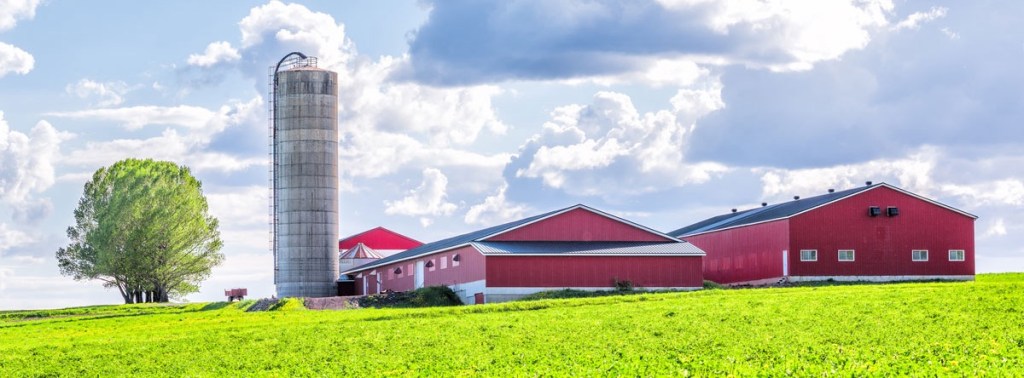
Climate adaptation is another defining element. Quebec has made significant advances in controlled-environment agriculture, particularly hydro-powered greenhouses. These facilities now supply roughly half of the province’s fruits and vegetables year-round. This model aligns well with Quebec’s decarbonization goals and offers a buffer against supply chain disruptions caused by weather, wildfires, or border issues. The greenhouse sector also creates jobs in rural regions, adding social and economic depth to what might otherwise be seen as technical infrastructure.

Quebec’s broader social policy reinforces its food security efforts. The province maintains Canada’s most generous child benefits and has indexed income supports to inflation, resulting in lower levels of food insecurity compared to most other provinces. By recognizing that hunger is not just a supply issue but a matter of income and social policy, Quebec links its agrifood system to social resilience. This integrated approach provides not only food, but dignity and stability.

Cultural identity plays a role as well. Quebec has long embraced supply management in sectors like dairy and maple syrup, not as a form of protectionism, but as a tool for supporting regional producers and maintaining quality standards. This model may not translate directly across all of Canada, but it offers a reminder that local economies thrive when policy reflects place-based values.

Perhaps the most compelling lesson from Quebec is its refusal to silo food policy. Instead, it has created a system where agriculture, health, education, environment, and social equity intersect. The result is not just a stronger food system, but a stronger society. In an era of climate disruption, geopolitical instability, and growing inequality, Quebec is showing how to build something that is local, resilient, and future-ready.

Canada as a whole will face increasing pressure in the years ahead to secure its food systems. If policy-makers are serious about ensuring affordability, sustainability, and sovereignty, they would be wise to study what Quebec has already built.

Sources
• Government of Canada. “Canada and Quebec sign a new $955 million agreement over five years to support Quebec’s agricultural sector.” March 2023. https://www.canada.ca/en/agriculture-agri-food/news/2023/03/canada-and-quebec-sign-a-new-955-million-agreement-over-5-years-to-support-quebecs-agricultural-sector.html
• Government of Canada. “Over $3.5 million for Céréales Normandin to expand its product range.” March 2024. https://www.canada.ca/en/economic-development-quebec-regions/news/2024/03/increasing-quebecs-food-selfsufficiency-over-35m-for-cereales-normandin-to-expand-its-product-range.html
• Equiterre. “Farm to School Québec.” https://www.equiterre.org/en/articles/project-local-food-procurement-farm-to-school-quebec
• The 14. “Reinforcing policies to improve Quebec’s food supply.” https://the-14.com/reinforcing-policies-to-improve-quebecs-food-supply
• West Quebec Post. “Quebec to invest $175 million over five years to increase food self-sufficiency.” https://www.westquebecpost.com/quebec-to-invest-175-million-over-five-years-to-increase-food-self-sufficiency

When Confederation Feels Like Confrontation: Ontario and Quebec’s Alberta Dilemma

As I write in my Ottawa living room, and although my sympathies stretch eastward into Quebec and the Martimes, I am watching Alberta events on the evening news as if viewing a distant cousin gone rogue. From here, in Central Canada, we’ve built our identity on a tapestry of industrial dynamism, social progressiveness, and an uneasy, yet genuine, devotion to national unity. So when Alberta thunders about “owning” its oil sands, rails under federal pipeline delays, and threatens separatism with a bravado more suited to Texas than to the spirit of Confederation, it feels less like a debate among equals, and more like a family spat escalating into road rage.

The Great Divide
Central Canada’s frustration begins with a simple question: Why can’t Alberta appreciate that its prosperity rides on Canada’s backbone? We know well the clang of steel from Lake Ontario factories, the laboratories of McGill and U of T, the commuter trains of the GTA carrying workers into offices that fuel innovation, culture, and trade. We see our tax dollars flow westward into infrastructure grants and environmental clean‑ups, yet all we hear back is how Ottawa is strangling Alberta’s lifeblood. In boardrooms and bistros alike, we exchange incredulous glances. “Is that really how they see us?”

In Ontario’s legislature or Quebec City’s cafés, the lament is the same. Alberta’s insistence on unfettered resource development, against carbon pricing, against pipeline regulations, against the minimal environmental guardrails that we accept as part of modern governance, strikes us as not only shortsighted, but tone‑deaf. After all, we’re the ones negotiating trade deals abroad, keeping Canada’s credit rating intact, and answering to the world for our climate commitments. When Alberta rips up its federal‑provincial agreements, and paints itself as a victim, it risks making the rest of us look like oppressors.

When Conservatives Moved the Needle
It wasn’t a personal chemistry with any one leader that mattered so much as policy alignment. Under Conservative governments, particularly during the years following 2006, Ottawa embraced free‑market principles that resonated deeply in Alberta: lower corporate taxes, streamlined approvals, and a lighter regulatory touch on energy projects. This wasn’t about nostalgia for a single prime minister, but about a political philosophy that saw energy as an engine of growth, not a problem to be managed.

From Alberta’s perspective, deregulated markets and balanced budgets felt like recognition of its core economic values. In Central Canada, we may have questioned some of those choices, but we accepted that a spectrum of economic approaches made Canada stronger. The result was a pragmatic détente: pipelines moved forward, investment flowed, and while we debated environmental trade‑offs, there was at least mutual respect for each region’s priorities.

When Regionalism Becomes Roadblock
Today, the rhetoric out west often sounds like, “Build the pipeline, or we’ll build our own exit ramp.” Yet Central Canada knows unequivocally that there is no exit ramp. Our factories, hospitals, and schools depend on the interprovincial movement of people, goods, and capital. The same pipelines Alberta demands are the conduits that keep our cars running, and our manufacturing humming. When Alberta complains that Ottawa’s carbon tax is an “Ottawa cash grab,” it ignores that those funds have helped pay for the recent transit expansions in Edmonton and Calgary, along with the wastewater infrastructure upgrades in Lethbridge.

Even more galling is the separatist thunder: poll after poll invites alarm with one in three Albertans saying they might consider leaving Canada under a Liberal government, feels like a hostage‑negotiation tactic, rather than a legitimate policy platform. Central Canada hears the echoes of Texas secession talk, fireworks and flags, bravado and bluster, but we see the policy vacuum behind the spectacle. We wonder: can they name a single agreement on the global stage that would willingly recognize a 4.4 million‑person “Republic of Alberta”? Or do they really believe they can simply flip a switch and declare independence?

Progressive Values Under Siege
For all our differences, Central Canada prides itself on progressive values: public healthcare that is universal, environmental targets that align with global science, and social policies that aim to reduce inequality. We do not see these as luxuries, but as imperatives for a 21st century nation. So when Alberta snarls at any shift toward renewable energy or regulatory tightening, we perceive a rejection, not only of policy, but of shared national values. It’s as if Alberta believes that “progressive” is a dirty word, an urban‑elitist dictate, rather than a democratic choice.

The result is a mutual distrust. We view Alberta as obstinate, and uncooperative; they view us as meddlesome and judgmental. And somewhere in the commotion, Canada the country begins to feel less like “one nation” and more like warring fiefdoms.

Pathways to Reconciliation
Even as Central Canadians exhale in frustration, we still cling to the idea that this can be repaired. We remember that the Constitution, our shared contract, grants Alberta ownership of its resources (Section 92A), but also vests Ottawa with authority over interprovincial trade, environmental standards, and national unity. Those overlapping jurisdictions are not battlegrounds to be won; they are negotiation tables to be inhabited with respect.

Here’s what we in the centre would propose:
1. Joint Stewardship Councils
Permanent federal‑provincial bodies—one on energy and one on climate—co‑chaired by ministers from Ottawa and Edmonton, with rotating seats for other provinces. Their mandate: to align pipelines, carbon policy, and regional development in a single coherent plan.
2. Mutual Accountability Reporting
Instead of one‑way complaints, require quarterly reports on how federal actions affect provincial economies and vice versa, published publicly so Albertans and Ontarians alike can see the trade‑offs.
3. Shared Diversification Funds
A federally matched investment fund for Alberta to channel resource revenues into hydrogen, critical minerals, and technology hubs—mirroring grants Ontario and Quebec receive for their own diversification.
4. Cultural Exchange Programs
Scholarships and internships pairing Alberta students with agencies in Ottawa, and Central Canadians with energy‑sector positions in Calgary and Fort McMurray, because trust grows when people move across the lines, not when walls go up.

Towards a True Confederation
As I look east from Ontario or west from Quebec, I still see Alberta as part of Canada’s grand promise, a province of immense resources, entrepreneurial spirit, and resilient people. But a promise requires reciprocity. If Alberta wants the benefits of the Canadian federation, it must share responsibility for national projects, ideals, and compromises. And if Central Canada wants Alberta to feel at home in Confederation, we must speak not with condescension, but with open hands and honest trade‑offs.

In the end, Texas doesn’t have to be our model, and neither does Paris or Beijing. We can be distinctly Canadian: united not in uniformity, but in a federalism that accepts our regional flavors and binds them together in mutual respect. Only then will Alberta’s roar feel like a proud Canadian voice, rather than an echo of someone shouting from outside our walls.