
The Family Tradition of Rhubarb and Ginger Jam

I first published a version of this post back in June 2011. Sadly, Grandpa is no longer with us, but we are still making this delicious condiment, while the rhubarb patch continues to give generously. 

As a Brit, I’ll admit my palate is rather different from that of many North American friends and family; think Marmite, fish and chips, black pudding, and Indian cuisine, to name a few essential food groups. Over time, some of these traditional flavours have been happily adopted by my Canadian household. The clearest example? A proper roast beef dinner with Yorkshire pudding.

But this time of year brings a particular delight for many Brits: rhubarb season.

It’s the first week of June, and we’re already onto our second, or is it third? rhubarb crumble of the year. The twenty or so crowns in our perennial vegetable and fruit garden just keep on giving. So, as tradition dictates, it’s time to make rhubarb and ginger jam.

Ever since moving into my first flat (that’s “apartment” for my North American readers), I’ve been making preserves of one sort or another. Given my love of Indian food, pickles and chutneys have always topped the list, but when fruit is abundant: strawberries, blackcurrants, rhubarb, out comes the jamming pan.

Yes, I do freeze plenty for later, but there’s something deeply satisfying about having your morning toast slathered in jam you made with your own hands. That simple pleasure, paired with a cup of coffee, is hard to beat.

My all-time favourite preserve book remains The Penguin Book of Jams, Pickles & Chutneys by David and Rose Mabey, first published in 1976. I’ve acquired many others over the years, but this was my first – and I return to it again and again.

One notable difference between UK and North American cookbooks is the way ingredients are measured. North American books use volume – cups, tablespoons, etc., while British texts rely on weight. When I first moved to California, this forced me to buy a set of measuring cups and introduced all sorts of anxiety about measuring chunky foods like beans or cut rhubarb by volume. I’ve since adapted, but my kitchen scales remain front and centre. I still find myself drifting back to the traditional recipes of my twenties.

The Mabeys’ rhubarb and ginger jam recipe is simple and elegant: just rhubarb, sugar, lemon juice, and a muslin bag of bruised root ginger. Over the years, though, my love of that spicy root has led me to make some adjustments. I now chop the fresh ginger directly into the jam and toss in a generous handful of crystallized ginger as well.

The process is straightforward. I layer the rhubarb and sugar in a large ceramic bowl, that once belonged to my grandmother, pour over the lemon juice, and let the mixture sit overnight. The next day, I transfer the resultant syrupy and fruit into my preserving pan, add the fresh and crystallized ginger, and bring it all to a rolling boil. The setting point usually arrives quickly, and the result is twelve 250 ml jars of thick, tart, spicy jam with a texture and flavour unlike anything else.

This family tradition of making and devouring rhubarb and ginger jam may only go back thirty-odd years, but it now spans three generations. Each spring, someone inevitably exclaims, “We have to keep a jar or two back for Grandpa’s visit!” as the breakfast jars begin to empty.

Looks like it’s time to plan a second batch.

I learned over the years to fill a number of 125 ml jars for guests as gifting 250 ml of this delicious manna from the heavens is just too generous, even for visiting family. I was also lucky enough to acquire a hardback copy of the Mabey book a few years ago, and it’s never far from my side.

Roll Britannia: The Greggs Chronicles

Once upon a time, in the wilds of Tyneside, there emerged a force so powerful, so delicious, that it would one day rival the might of empires. No, not the Romans. We’re talking about Greggs, the humble bakery, turned national obsession that has swept across the UK like gravy on a sausage roll.

It all began in 1939 when a man named John Gregg decided that Newcastle needed something more than coal, fog, and football. So, he did what any visionary would do: he got on a bike and started delivering fresh eggs and yeast to the good people of the North East. Little did he know that his humble yeast rounds would eventually help leaven the British soul.

Fast forward to the 1950s, and the first Greggs shop opened. It sold bread, cakes, and dreams. And by dreams, we mean hot pastries that could scald your mouth, but warm your heart. Greggs soon became a staple of the British high street, which is no small feat considering the fierce competition from fish & chips, kebabs, and aggressive seagulls.

Now, Greggs isn’t just a bakery. It’s a lifestyle. A philosophy. A national institution. While France has the baguette, and Italy has pizza, the UK has the Greggs sausage roll, a flaky, meaty miracle that unites builders, bankers, and students alike. It’s one of the few things in Britain that still works reliably and costs less than a cup of designer coffee.

But let’s not forget innovation. In 2019, Greggs stunned the nation with the Vegan Sausage Roll. Critics laughed. Piers Morgan nearly exploded. But the people? The people lined up. The plant-based pastry launched Greggs into a new orbit, attracting vegans, vegetarians, and confused carnivores who just wanted to see what all the fuss was about.

From there, things escalated. Greggs went viral, won awards, and, brace yourself, teamed up with Primark to launch a fashion line. That’s right: you can now wear your steak bake with pride, even if it’s printed on a hoodie. The combo meal of clothing and carbs is the 21st century’s answer to haute couture.

Let’s be honest: Greggs is taking over the UK one pasty at a time. No town is too small, no train station too remote. There’s probably a Greggs opening inside your kitchen cupboard as we speak. Resistance is futile. You will be fed.

Plans for world domination remain hush-hush, but we all know it’s coming. First, it’ll be Europe, somewhere easy, like Belgium. Then maybe America, where Greggs will stun Starbucks with sausage roll-based frappuccinos. By 2040, the UN will convene in the Greggs Lounge, sipping on baked bean lattes and resolving conflicts over custard slices.

So next time you bite into a cheese & onion bake, know this: you’re not just enjoying a snack. You’re part of a movement. A flaky, buttery, gloriously British movement.

Long live Greggs.

My Love for Indian Sub-Continent Cuisine

Last week, I discovered a new curry house in the Ottawa suburbs where the food is extraordinary with its unique blend of spices, and its offerings of Indo-Chinese cuisine. My experience at Rang De Indian on Terry Fox Dr reminded me so much of another curry-based phenomenon from my past.

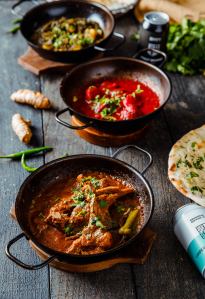
Balti curries, a beloved British dish, trace their origins to Birmingham in the 1970s. Though the word balti comes from the Urdu word for “bucket” or “pot,” referring to the round, flat-bottomed steel dish in which the curry is traditionally cooked and served, it wasn’t directly imported from the Indian subcontinent. Instead, balti was born out of culinary innovation by Pakistani and Bangladeshi immigrants who combined their traditional cooking methods with British ingredients and tastes.

As an undergrad Earth Sciences student in Birmingham during the 1980s, going for “a balti” on a Saturday night after few beers might just have been the highlight of the month. The hallmark of a balti curry is its quick cooking time over high heat, often with marinated meats, vegetables, and a spice mix of cumin, coriander, turmeric, and ginger. Everything is prepared in the same dish, intensifying the flavors. What sets it apart even more is the way it’s eaten; served with naan rather than rice, making the experience more communal and tactile, as diners scoop up the rich sauce directly from the cooking pot with the bread.

During my time at Aston, Birmingham’s Balti Triangle was the epicenter of this culinary explosion. Famous restaurants like Adil’s, often credited as the first Balti house, Shababs, and Imran’s became go-to spots for anyone seeking this aromatic, flavorful dish. These restaurants were pioneers, turning balti into a British institution. The unpretentious, communal style of eating and the vibrant, spice-laden dishes quickly captured the hearts of locals and students alike.

While balti curries have spread far beyond the West Midlands, I have fond memories of a uniquely British take on curry, which continues to thrive in UK food culture. With this latest discovery, I now have yet another opportunity to explore the sub-continent cuisine, right here in Ottawa.