The BRICS Strategy in 2025: From Dialogue to Direction

In July 2025, the BRICS nations – Brazil, Russia, India, China, South Africa, and an expanded circle now including Egypt, Ethiopia, Iran, Saudi Arabia, the UAE, and Indonesia, met in Rio de Janeiro for their 17th annual summit. The gathering marked a decisive shift from rhetorical ambition to institutional strategy, as the bloc attempts to redefine global governance, build financial alternatives to the West-led systems, and frame itself as the political voice of the Global South. While the summit was shaped by ongoing geopolitical crises and internal contradictions, it revealed a maturing vision that extends far beyond its original economic coordination mandate.

At the core of this year’s summit was a demand for structural reform in global governance. BRICS leaders called for the United Nations Security Council to be expanded and for the voting structure of institutions such as the International Monetary Fund (IMF) and World Bank to be reweighted to better reflect the global South’s demographic and economic realities. This long-standing frustration with Western-dominated institutions has now sharpened into a diplomatic agenda. What was once a diffuse critique has evolved into coordinated proposals, particularly on the economic front.

One of the summit’s central themes was the steady progress toward de-dollarization. While calls for a BRICS common currency were conspicuously downplayed in Rio, leaders focused instead on more pragmatic steps: local-currency trade settlements, expanded use of central bank digital currencies (CBDCs), and the interoperability of national payment systems through the still-developing BRICS Pay infrastructure. A new cross-border clearing and settlement framework, informally called BRICS CLEAR, was introduced to complement these efforts. These initiatives are designed not only to bypass the U.S. dollar in bilateral and multilateral trade, but also to shield BRICS economies from the volatility and political conditionality associated with Western sanctions and SWIFT-based systems.

To support these ambitions, the New Development Bank (NDB), already capitalized with billions of dollars from member states, is being repurposed. A guarantee facility is in development, modeled loosely on the World Bank’s Multilateral Investment Guarantee Agency (MIGA), to underwrite public and private projects across member states. This is particularly relevant for emerging markets seeking infrastructure finance without the governance conditions typically imposed by the IMF or World Bank. With these tools, the bloc seeks to develop its own version of Bretton Woods-style architecture, updated for multipolar geopolitics.

Climate and sustainability also featured heavily on the summit agenda. Brazil, as host, proposed the “Tropical Forest Forever Facility,” a $125 billion climate financing mechanism aimed at conserving rainforest regions across Latin America, Africa, and Asia. The proposal is a direct challenge to Western narratives that have often placed environmental responsibility solely on the shoulders of developing nations without matching financial commitments. The initiative also serves as a preview of the Global South’s priorities heading into COP30, which will also be hosted by Brazil.

Sustainable development received structural attention beyond climate. The BRICS Business Council and Women’s Business Alliance jointly launched a 2025–2030 action plan focused on strengthening small and medium-sized enterprises (SMEs) across member states. This includes access to digital markets, cross-border licensing, and gender-equity strategies in entrepreneurship. The bloc appears intent on grounding its geopolitical ambitions in concrete developmental outcomes at the community and enterprise level.

Notably, the summit also launched a framework for artificial intelligence governance. Although still in early stages, the agreement seeks to establish common principles around transparency, ethical use, and protection against algorithmic bias. This aligns with recent UN discussions and serves to position BRICS as a rule-setting body rather than just a rule-taking coalition. With China and India both advancing in AI development, and with Brazil and South Africa playing increasing roles in data regulation, this initiative represents an important test of cross-ideological cooperation in technology governance.

Despite these achievements, internal tensions were evident. Neither President Xi Jinping nor President Vladimir Putin attended in person. India’s leadership walked a diplomatic tightrope, supporting reformist language while resisting deeper integration that might conflict with its ties to the West. Brazil, under President Lula, tempered the bloc’s anti-Western tone, particularly around tariffs and NATO criticism, wary of provoking trade retaliation. These divergences underscore the coalition’s central contradiction: it is an alliance of ambition, not ideology.

Nonetheless, BRICS continues to expand. Indonesia became a full member in January 2025, joining Iran, Egypt, Ethiopia, and others admitted in the prior year. Observers note that the group’s size risks diminishing its coherence, yet the appeal of a multipolar forum remains strong. As the G7 struggles with internal disunity and the Western alliance faces political upheaval, BRICS offers a platform that aligns with the aspirations of many developing nations, even if it cannot yet match Western institutions in capacity or cohesion.

Looking ahead, the bloc’s short-term focus will be on operationalizing its financial and development tools, settlement systems, climate funds, SME supports, and asserting diplomatic pressure for reform in global governance bodies. Over the medium term, its success will depend on the extent to which it can balance economic pragmatism with political heterogeneity. While its vision of a multipolar world is not universally embraced, BRICS has matured into a serious force in global affairs, one increasingly capable of setting its own agenda.

Canada’s Strategic Shift: Weighing the Costs and Benefits of Joining Europe’s ReArm Program

Canada’s decision to signal its intention to join Europe’s ReArm initiative marks a significant pivot in its strategic and procurement priorities, with implications that extend well beyond the defense sector. This pan-European effort, catalyzed in the wake of Russia’s invasion of Ukraine and the shifting tenor of transatlantic politics, aims to coordinate defense procurement, scale industrial capacity, and strengthen European security autonomy. For Canada, a non-European NATO member with strong ties to both the U.S. and Europe, alignment with ReArm offers both substantial opportunity and strategic complexity.

At the forefront of the appeal is diversification. Canada has long relied on the United States for upwards of 75% of its military procurement. While the U.S. – Canada defense relationship, particularly through NORAD, remains indispensable, the risks of a politically volatile or inward-focused Washington have grown. Europe’s response, particularly Germany’s ramped-up defense commitments, and the €800 billion EU proposal to stimulate continental arms production, presents an alternative axis of reliability. Canada’s participation could signal to both NATO allies and global partners that it seeks greater resilience in its defense posture.

One of the most concrete areas of cooperation could lie in the domain of submarine procurement. The CBC reports that Canada is exploring options for the German-Norwegian Type 212CD submarine, a next-generation conventional submarine being co-developed by ThyssenKrupp Marine Systems and Kongsberg. This class boasts extended underwater endurance through air-independent propulsion and quiet operation ideal for Arctic patrols, long a capability gap in Canadian naval strategy. The possibility of Canada becoming a formal partner in the 212CD project would not only address its aging Victoria-class fleet but also create industrial synergies through potential domestic assembly and technology transfer agreements.

Beyond submarines, ReArm opens the door to collaborative fighter jet production. Canada’s inclusion in discussions around final assembly of Swedish Saab Gripen fighters suggests that Ottawa is seeking industrial offset opportunities beyond its existing Lockheed Martin F-35 commitments. These talks, while preliminary, reflect a desire to reassert domestic defense manufacturing after years of outsourcing.

Still, the risks are considerable. Aligning procurement strategies with European standards could create friction in interoperability with American systems, particularly relevant given NORAD modernization and Canada’s Arctic commitments. There is also the question of cost. Canada’s new defense policy promises to increase military spending to 1.76% of GDP by 2030, a notable jump, but still short of NATO’s 2% target. Adding ReArm investments could strain the federal budget, and force trade-offs in domestic priorities.

Geopolitically, joining a European initiative risks being interpreted in Washington as a soft decoupling. While this may be overstated, managing the optics with U.S. defense officials will require careful diplomacy. At the same time, any major procurement projects pursued under ReArm would need to be justified as both value-for-money, and strategically essential in a Canadian context.

ReArm represents a chance for Canada to assert greater agency in its defense strategy, while leveraging European innovation and industrial momentum, but this is no risk-free proposition. Ottawa will need to walk a careful line: embracing new partnerships without compromising old ones, and ensuring that each procurement project is grounded in long-term strategic logic, not simply in search of novelty.

The New Silk Spine: How the INSTC Is Redrawing Global Trade Maps

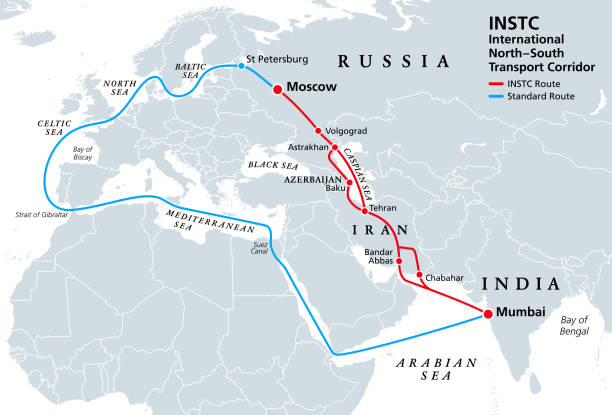
A quiet revolution in global logistics is underway, and it’s not coming from Beijing or Washington. It’s emerging from the heart of Eurasia, led by a consortium of countries who have historically occupied the margins of global trade narratives. The International North-South Transport Corridor (INSTC), a sprawling multimodal freight route linking India to Northwest Europe via Iran, Azerbaijan, and Russia, is reshaping both the geography and politics of trade.

The INSTC is more than just a 7,200-kilometre link between Mumbai and St. Petersburg. It’s a strategic recalibration, a corridor of asphalt, rails, and sea routes that bypasses the traditional maritime choke points like the Suez Canaland offers a faster, cheaper, and more resilient alternative. Cargo that once took 40 days to traverse via Suez may now move in under 25 days, with costs slashed by up to 40%. For countries like India, long constrained by maritime dependency and geopolitical roadblocks like Pakistan, the INSTC represents autonomy, reach, and leverage. By anchoring investments in Iran’s Chabahar Port and pushing road and rail links through the Caucasus into Russia, India is not just moving goods, it’s asserting presence.

Russia, reeling from Western sanctions, views the corridor as a vital artery to keep its economy tethered to global markets. With access to Europe constrained and pipelines of trade to Asia opening up, Moscow is embracing the INSTC as part of a broader pivot eastward. Iran, too, has seized its role as a key junction with zeal, positioning its territory as the bridge between warm water ports and the heart of Eurasia. Though battered by sanctions, Tehran is pushing infrastructure upgrades with a clear eye toward regional transit supremacy.

Europe is beginning to take notice. Countries like Germany and Finland are assessing the corridor’s potential to stabilize and diversify their supply chains, especially as global shipping lanes grow riskier and more expensive. Yet as enthusiasm grows in Eurasia, apprehension is mounting in the United States. The INSTC threatens U.S. strategic control over global commerce by undermining the relevance of the Panama and Suez canals, long cornerstones of American naval and economic dominance. It also boosts BRICS, a grouping increasingly seen as a challenger to the Western-led order.

Washington’s response has been twofold: diplomatic containment and competitive investment. The India-Middle East-Europe Corridor (IMEC), announced as part of the G7’s Build Back Better World initiative, is in part a direct counterweight to the INSTC. At the same time, U.S. policymakers are pressuring allies to tread carefully around Iran and Russia’s involvement, while watching closely how India—a key U.S. partner—manages its balancing act between the West and BRICS.

What is unfolding is not just a redrawing of trade routes, but a redrawing of power. The INSTC may not have the headline flash of China’s Belt and Road Initiative, but it is modular, strategic, and increasingly influential. It marks the emergence of a new Eurasian logic, one that connects the Indian Ocean to Northern Europe, not through blue-water naval lanes, but across land and short-sea corridors, driven by the very nations that were once bypassed. If the remaining gaps in infrastructure and policy can be bridged, this corridor will be more than a route, it will be a lasting statement.

The Dragon at the Gate: China’s Quiet Reversal of the Peking Accord

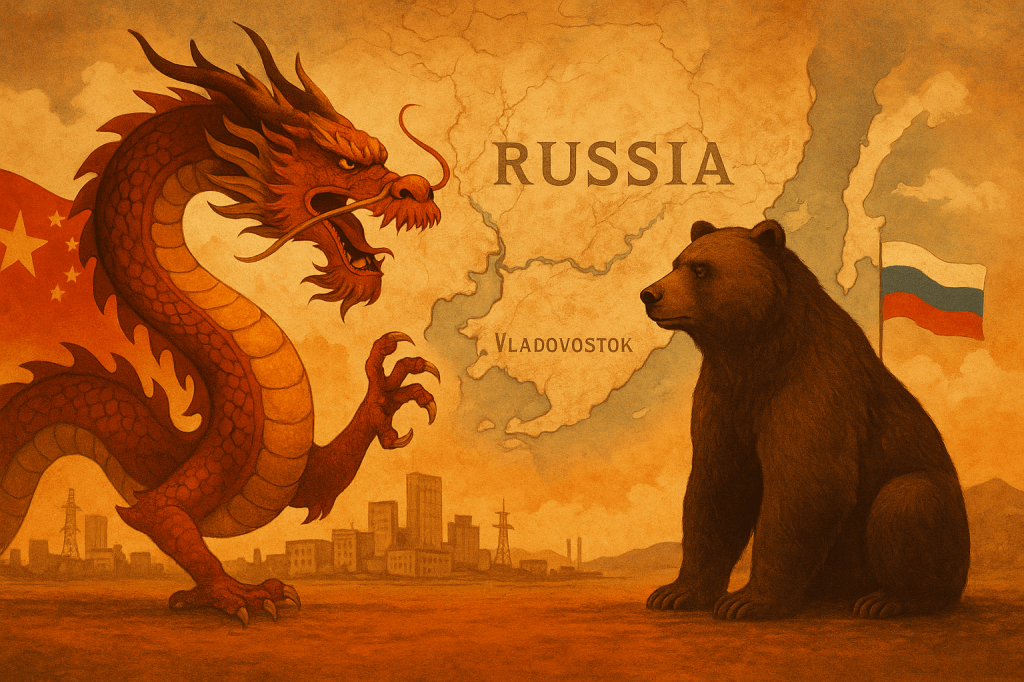
It’s a strange sight to behold – the old bear, once feared across continents, now leaning heavily on the dragon, who circles with a slow, calculating grace. Russia, once the hammer of the East, has been brought to heel by a grinding war in Ukraine, and while the West cuts ties and imposes sanctions, China, with the patience of a millennia-old civilization, sees opportunity, not just to profit, but perhaps to reshape history.

There’s a sense of irony that hangs over this moment. In 1860, the Qing dynasty signed the Peking Accord under duress, ceding vast swathes of land to the Russian Empire. That territory, now known as the Russian Far East, includes strategic regions like Vladivostok and the Amur Basin, lands that had once been part of China’s imperial periphery. The Chinese state, pragmatic in diplomacy, but deeply historical in self-conception, has never fully forgotten these losses. While official maps no longer lay claim to those regions, nationalist narratives in China occasionally whisper about redrawing what was once erased.

Fast forward to today, and the tables have turned. The war in Ukraine has battered Russia’s economy, and severed its connections to Europe. In desperation, Moscow has tilted eastward, selling gas, oil, and influence to Beijing at discount prices. This is not a partnership of equals. Russia needs Chinese markets, Chinese currency, and Chinese technology. China, meanwhile, gains leverage with every shipment of discounted crude, and every signed memorandum that ties the Russian economy tighter to the yuan. Where once they competed in Central Asia and the Arctic, now Russia finds itself the junior partner in a relationship it once dominated.

But China’s strategy isn’t conquest, it’s saturation. In the underpopulated stretches of Siberia and the Russian Far East, Chinese traders, laborers, and companies are embedding themselves quietly, but firmly. Towns along the border increasingly do their business in yuan, and many look more to Harbin or Heihe, cities in China’s Heilongjiang Province, than to Moscow. Infrastructure projects, often funded with Chinese capital, and executed by Chinese firms, are weaving a new economic fabric, one that binds these regions more to Beijing than to the Kremlin.

This isn’t a territorial war. China doesn’t need tanks to reverse the Peking Accord. It just needs time, capital, and a weakened Russia with few other friends. What we may be witnessing is not the formal return of lost lands, but something more subtle and enduring; a slow-motion annexation by way of economy, trade, and cultural seepage. A kind of imperial inversion, done not with gunboats, but with invoices and supply chains.

In geopolitics, history never dies, it just waits for the moment when the balance tilts. With every sanctioned ruble, and every Chinese-funded deal, the echoes of the 19th century grow louder. Russia may not yet realize it, but the dragon is already at the gates. Not to conquer, but to reclaim, softly, surely, and without ever having to fire a shot.

BRICS Rising: The Challenge to Western Dominance in a Multipolar World

BRICS has evolved from an economic alliance into a geopolitical force challenging Western dominance. Originally conceived as a framework for cooperation among emerging markets, the bloc now pursues a strategic agenda that threatens the global order long shaped by Europe and North America. By fostering economic interdependence, promoting financial independence, and expanding its diplomatic influence, BRICS is positioning itself as a counterweight to Western-led institutions like the IMF, World Bank, and NATO. Its rise signals a shift toward a multipolar world where U.S. and European dominance is no longer assured.

At the core of BRICS’ strategy is economic cooperation aimed at reducing reliance on Western markets and financial institutions. Trade agreements and joint investment projects among Brazil, Russia, India, China, and South Africa strengthen internal resilience while offering developing nations an alternative to the West’s economic model. The New Development Bank (NDB) plays a key role, financing infrastructure and sustainability projects without the political conditions often attached to Western aid. This economic realignment is further reinforced by BRICS’ push to de-dollarize global trade, insulating its members from U.S. financial influence and sanctions. By increasing the use of local currencies and developing alternatives to SWIFT, BRICS is actively undermining the dollar’s global dominance. If oil-producing nations like Saudi Arabia shift toward BRICS’ financial system, the petrodollar system could face serious disruption, weakening the U.S. economy and limiting Washington’s ability to leverage economic power as a foreign policy tool.

For Europe, BRICS represents a different kind of challenge. While not as dependent on the dollar, the EU’s economic model relies on stable access to global markets, raw materials, and energy. BRICS’ growing control over critical resources—such as rare earth minerals, oil, and food supplies—poses risks to European industry. Russia and China have already demonstrated a willingness to use trade as a geopolitical weapon, and as BRICS strengthens its economic ties, European access to these resources could become more costly and politically conditional. Additionally, BRICS’ growing influence in Africa, Latin America, and the Middle East threatens Europe’s traditional soft power approach in these regions. By providing loans and investments without Western-style conditions, BRICS is offering an appealing alternative to nations wary of IMF-imposed austerity. This shift weakens Europe’s ability to shape international policies and erodes its influence in regions it has long considered strategic.

Beyond economics, BRICS is reshaping global diplomacy by advocating for a multipolar world. The bloc frequently aligns its positions in the UN, G20, and WTO, pushing for reforms that reduce Western dominance. By expanding its membership to include emerging economies across the Global South, BRICS is creating a parallel alliance network that enables countries to resist Western pressure. The potential inclusion of Iran and other anti-Western regimes raises concerns about a new axis of influence that could counterbalance NATO and other Western-led security alliances. While BRICS is not yet a military pact, growing defense cooperation—particularly between Russia and China—suggests that security coordination could become more structured over time.

Technology is another battleground where BRICS threatens Western leadership. China and India are emerging as global tech powerhouses, while Russia excels in cybersecurity and artificial intelligence. If BRICS nations successfully develop independent digital ecosystems—ranging from payment systems to semiconductor industries—Western tech companies may lose access to key markets. The push for BRICS-led internet infrastructure could also fragment global digital governance, reducing the West’s ability to shape online policies and monitor cyber threats. Meanwhile, BRICS’ emphasis on state sovereignty and non-interference in domestic affairs provides an ideological alternative to the Western model of governance. As more nations align with this approach, the ability of the U.S. and Europe to promote democracy, human rights, and free-market policies could diminish.

BRICS is not just an economic alliance, but a structural challenge to the Western-led world order. By advancing financial independence, expanding geopolitical influence, and fostering technological self-sufficiency, the bloc is steadily eroding the dominance of Western institutions. While internal divisions and logistical hurdles remain, BRICS’ trajectory suggests that Europe and North America must adapt to a world where their influence is no longer guaranteed. Whether the West engages with BRICS on more equal terms or resists and risks further global fragmentation will determine the shape of international relations in the years to come.