The Jade Tree and Carl Jung’s Synchronicity

I hadn’t thought about her in over a year. No particular reason. No emotional weight behind it. She just drifted across my mind, calmly, clearly, and I noted it, then moved on.

Half an hour later, my phone buzzed. A message from her. No small talk, no explanation. Just a photo of a jade tree I’d given her a while back. It looked healthy. Thriving, actually. She thought I’d like to see how well it was doing.

I thanked her for the photo, wished her well, and left it at that. I didn’t feel any great pull to re-engage, but the moment stayed with me, not because of her, but because of the timing. The randomness. The feeling that something just lined up.

Carl Jung had a name for this kind of thing: synchronicity. He defined it as a “meaningful coincidence”. Two or more events connected not by cause and effect, but by meaning. They happen together, seemingly by chance, but resonate with something deeper. He saw it as a sign that there’s more to reality than we can see or measure. That sometimes, our inner world and the outer world speak to each other. Quietly. Precisely.

I’m not someone who needs to romanticize everything. People reach out. Thoughts come and go. But there was something clean about this particular moment; no buildup, no emotional noise. Just the sense of a thread that hadn’t fully frayed. A small echo between two people, delivered through a jade tree and a phone screen.

There’s no need to dig into it more than that. I wasn’t longing for her. I wasn’t unresolved, but when synchronicity shows up like this, I pay attention. Not because I think it means something I need to act on, but because it reminds me I’m connected to more than just what’s in front of me.

Jung believed these moments reflected the presence of a collective unconscious, a shared field of symbolic meaning, memory, and emotion. A psychic network we’re all tuned into, whether we realize it or not. Maybe that’s true. Maybe it’s simpler than that. Maybe we just carry people with us in subtle ways, and now and then, something stirs.

What I know is this: there was no reason for her to reach out when she did. And no reason for me to be thinking of her right before. But she did. And I was. And I’m glad I noticed.

The jade tree is still growing. That’s enough.

On the Illusion of Self-Discovery 

In an age where “finding yourself” has become a lifestyle brand, it’s hard not to notice, gently, how strange it all is.

You see it everywhere: bright, hopeful faces on “healing journeys,” framed against sunsets in Bali; corporate executives burning out in glass towers only to reappear months later as “authentic living” coaches after a $12,000 retreat in the Andes. Suburban families decluttering their closets in search of inner peace, as if enlightenment might be hidden somewhere between last season’s jackets and the yoga mats.

Modern self-discovery, especially among the comfortable and educated classes, has become an elaborate ritual. The tools vary: yoga teacher trainings, digital detox camps, van life road trips, artisanal workshops on gratitude, but the impulse remains deeply human: the yearning to feel whole, to understand oneself beyond the blur of obligations.

And yet, with a kind of quiet sadness, you realize that much of this restless effort misses the heart of what older wisdom traditions have long tried to say: that the self you are chasing cannot be caught like a butterfly. The ego, the needy, striving “I”, is not a puzzle to be solved or a prize to be won. It is an illusion to be gently seen through, a dream to wake up from.

In this softer light, it’s clear that modern self-discovery often becomes a new form of grasping. A gentler grasping, perhaps, dressed in mindfulness retreats and ayahuasca ceremonies, but grasping nonetheless. Transformation is packaged, marketed, and sold, with self-actualization offered for a price. It’s not that these experiences are without value; many carry glimpses of beauty and honesty, but when the pursuit becomes a new identity, a new project of consumption, it quietly reinforces the very suffering people hope to leave behind.

Meanwhile, the genuine work, the real, hard, simple work, remains overlooked. It doesn’t glitter. It looks like sweeping a floor without resentment, holding silence without needing to fill it, sitting with discomfort without demanding it change. It looks like living, fully and without drama, in the plainness of an unremarkable day.

Ancient teachings, whether whispered under the Bodhi tree, scribbled in the margins of Stoic letters, or passed hand-to-hand among Sufi poets, point always to the same difficult kindness: You do not find yourself by changing scenery. You find yourself by changing how you see.

And sometimes, by realizing, with a soft sigh, not a harsh judgment, that there was no fixed, shining “self” to find after all.

This truth is not meant to mock anyone’s search. It is not meant to diminish the sincere longing behind every yoga mat, every travel blog, every self-help journal. Longing is sacred. The path is sacred. It is only that the destination, in the end, may be smaller and quieter than expected, not a place to arrive at, but a way of being already waiting inside the life you have.

And that, perhaps, is enough.

When Stillness Meets Flow

When the masculine rests in awareness, and the feminine moves in devotion – the universe finds its perfect geometry”

This quote by Kaivalyapadama is a poetic distillation of ancient tantric and yogic philosophy, weaving together the metaphysical, psychological, and relational dimensions of existence.

Archetypal Masculine and Feminine Energies

This isn’t about gender, but about principles found in all beings and in all systems:

  • The Masculine symbolizes stillness, presence, consciousness, structure, and witnessing. It is the container.
  • The Feminine symbolizes movement, feeling, intuition, energy, creation, and love. It is the flow within the container.

In tantric traditions (Shiva-Shakti, for example), Shiva (masculine) is pure consciousness — unmoving, eternal — while Shakti (feminine) is the energy that dances creation into being. Without awareness, devotion flails. Without devotion, awareness stagnates.

“Rests in Awareness” – The Role of the Masculine

To rest in awareness is not to dominate, judge, or fix — but to simply be. It is radical presence. In individuals, this is the quiet, centered part of the self that holds space for chaos, change, and emotion without becoming reactive.

In relationships, the masculine partner who embodies awareness becomes a sanctuary — their stillness creates trust, safety, and depth. In society, a culture rooted in awareness promotes wisdom over reaction, and long-term vision over short-term gain.

“Moves in Devotion” – The Role of the Feminine

To move in devotion is to surrender into flow with love, beauty, and purpose. The feminine principle here is not passive, but deeply powerful — dancing, birthing, transforming. Devotion doesn’t mean subservience, but alignment: the feminine energy knows that movement without love becomes frenzy, while love without movement becomes longing.

In a person, when your emotions, desires, and creative forces move from a place of devotion — to truth, to a cause, to spirit — they become transformational rather than chaotic.

“The Universe Finds Its Perfect Geometry”

Geometry, especially in spiritual traditions, signifies order, balance, symmetry, and harmony. Sacred geometry underpins everything from atomic structure to the golden ratio in sunflowers to cathedral design.

So when these energies align:

  • Awareness holds space,
  • Devotion flows through it,
  • The resulting dance is not random, but exquisitely structured — a mandala of being.

This is not just esoteric metaphor: many relational therapists, somatic practitioners, and spiritual teachers use this lens. It’s evident in sexual polarity dynamics, in leadership and support systems, in artistic creation, even in neural science where calm awareness (prefrontal cortex) holds space for emotional movement (limbic system).

Application and Practice

This quote calls us toward balance:

  • In ourselves: Can I cultivate still presence and loving movement?
  • In our relationships: Do we create dynamics where one can witness, and the other can offer energy?
  • In society: Are we building systems that balance structure with flow, logic with empathy, clarity with creativity?

Meditation (awareness) and prayer (devotion) are often seen as two wings of the same bird. Stillness invites movement; movement is anchored by stillness.

Conclusion

This quote is less a prescription than a profound invitation — to align the inner masculine and feminine, to dance with our own nature, and to trust that when these polarities are rightly placed, life doesn’t just function — it harmonizes. Geometry isn’t merely about lines and angles; it’s about relationships — and when awareness and devotion relate well, the pattern they create is nothing less than sacred.

A Universe Without Time: Physics, Consciousness, and the Nature of Existence

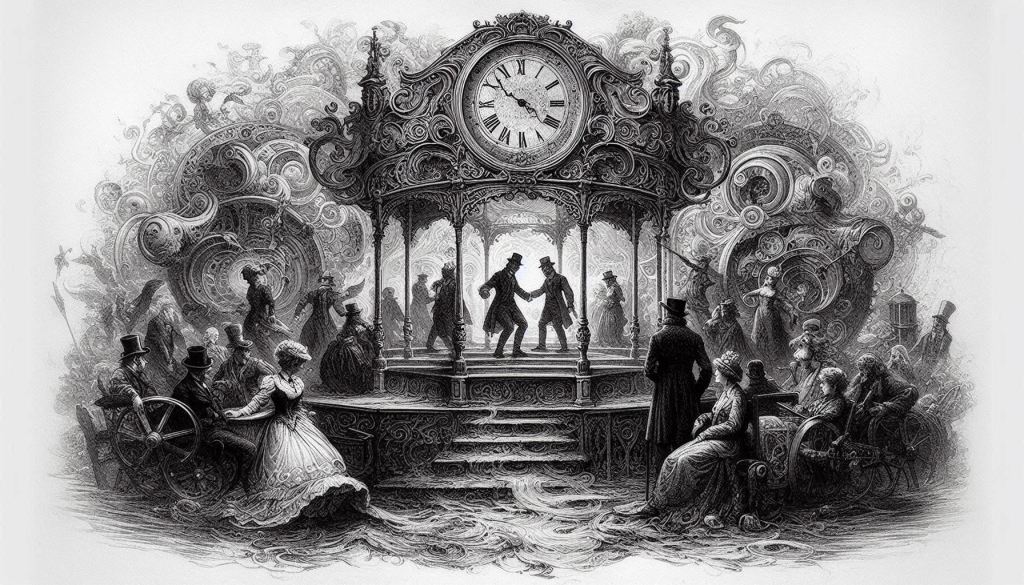
If time were to happen all at once – where past, present, and future coexisted simultaneously – it would upend our understanding of reality, causality, and even consciousness itself. Our perception of time as a flowing sequence of events is deeply ingrained in both our experience and our scientific models, but what if that flow was an illusion? What if every moment simply existed, with no distinction between before and after?

One of the most immediate consequences of such a reality would be the breakdown of cause and effect. Our world operates on the principle that actions have consequences, that the past influences the present, which in turn shapes the future. If time were simultaneous, there would be no before or after – everything would simply be. In such a reality, would it even make sense to speak of events “happening”? Without sequence, there is no causality, and without causality, the entire structure of our decision-making and agency becomes questionable. Could free will exist in a reality where all choices have already unfolded in every possible way?

Our perception of time is not just a philosophical construct, but a deeply embedded feature of human consciousness. We process the world sequentially because our brains are wired to do so. If time were happening all at once, would we experience our entire lives simultaneously? Would we be both a newborn and an elderly person at the same time, fully aware of every moment we have ever lived? If that were the case, then identity itself might become meaningless, dissolving into an incomprehensible blur of every possible experience. Alternatively, it is possible that our consciousness would still only access one “slice” at a time, navigating an eternal landscape without truly perceiving its timeless nature.

This idea is not entirely foreign to physics. The “block universe” model in relativity suggests that time is a fixed, four-dimensional structure where the past, present, and future all exist equally. In this view, time does not “flow”; rather, it is a static dimension much like space, with our perception of movement through it being an emergent phenomenon. If this were true, the notion of “now” would be subjective, merely a point of reference chosen by an observer rather than a fundamental feature of the universe. This model sounds similar to how the fictional wormhole aliens in Star Trek: Deep Space 9 live, as they have no understanding of linear time, and the concept of consequences. 

Another major implication of a timeless reality is how it would affect the laws of physics themselves. Much of modern science relies on the assumption that time allows for entropy, the increase of disorder in a system. This principle explains why we remember the past but not the future and why systems evolve rather than remaining frozen in place. If time did not progress, but instead existed as a complete whole, then entropy might be an illusion, or at the very least, an incomplete way of understanding change. Could it be that what we perceive as time’s passage is simply our consciousness moving through an already-existent structure?

If time truly happened all at once, it would redefine the very nature of reality. Perhaps we are already living in such a universe but are unable to perceive its full nature due to the limitations of human cognition. What we call “the present” might just be a thin veil over a vast, timeless structure, one that we are only beginning to understand.