Why Can’t the Replicator Just Scan the Damn Cake?”: A Senior Trekker’s Rant, Expanded Edition

In the grand pantheon of Star Trek mysteries; why redshirts never survive, why Klingon foreheads changed mid-century, why nobody uses seatbelts on the bridge, one lesser-discussed, but utterly maddening question remains: Why is programming new food into the replicator such a colossal pain in the nacelles?

I mean, come on. This is a civilization that can fold space, beam people across hostile terrain, and host full Victorian murder mysteries in the holodeck with better lighting than a BBC costume drama. And yet, when someone wants to add their grandmother’s secret tomato sauce recipe to the replicator, it’s a whole saga. Suddenly you need a molecular biologist, a culinary technician, and probably Counselor Troi to help you process your feelings about spice levels.

Let’s break this down. Replicators are based on the same matter-energy conversion technology that powers transporters. They take raw matter, usually stored in massive energy buffers, and rearrange it into whatever pattern you’ve requested, be it a banana, a baseball bat, or a bust of Kahless the Unforgettable. On paper, it’s magical. Infinite possibilities. Want a rare Ferengi dessert that was outlawed in six systems? No problem, if it’s in the database.

But here’s the catch: the database. That’s the real villain of the piece. Everything has to be pre-programmed. And programming something new isn’t as simple as chucking a muffin into the transporter and yelling “Make it so.” Why not? Because food is astonishingly complex.
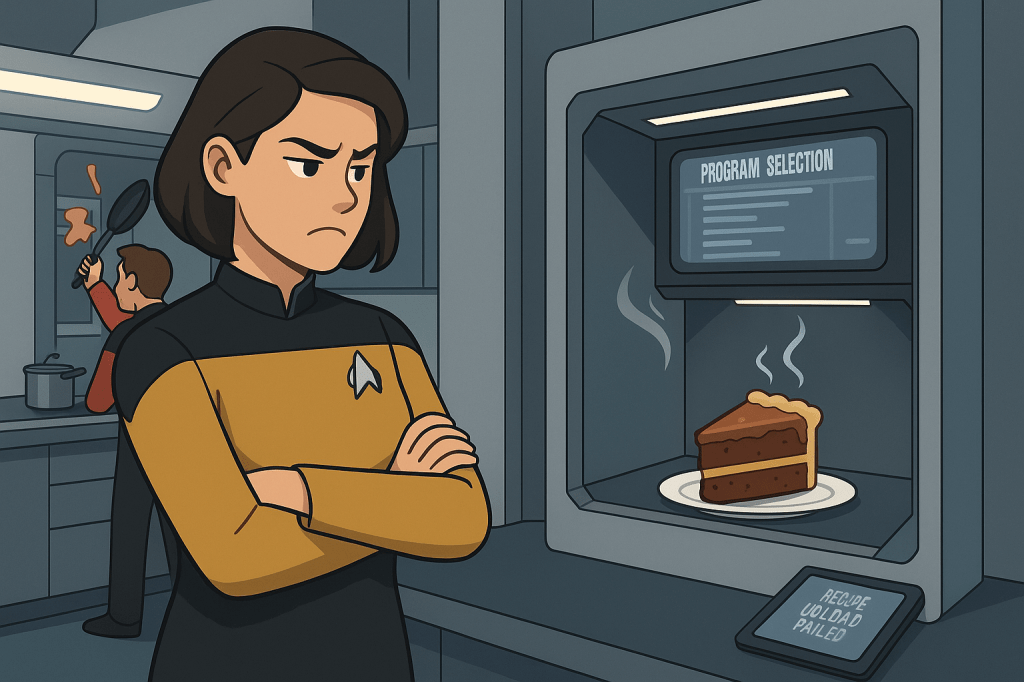
Sure, from a chemical standpoint, you can break a slice of chocolate cake down into carbon, hydrogen, oxygen, and nitrogen, the same building blocks the replicator can access, but that’s like saying Shakespeare’s Hamlet is just twenty-six letters arranged in a particular order. The cake is more than its ingredients. It’s texture, mouthfeel, flavor balance, aroma. It’s how the icing melts just slightly faster than the sponge in your mouth. It’s memory, emotion – it’s nostalgia on a fork.

And the replicator, bless it, just doesn’t do nuance.

In-universe, we’ve seen Starfleet crews struggle with this time and again. Captain Sisko flatly refuses to eat replicated food, relying instead on traditional cooking, partly because he loves the craft, but also because the replicator’s version of jambalaya “tastes like it was programmed by someone who’s never even seen a shrimp.” Over on Voyager, Neelix throws himself into galley work precisely because replicated food gets old fast, especially when you’re lost in the Delta Quadrant with no fresh supplies, and morale hanging by a thread.

Programming a new recipe means getting the proportions right, inputting molecular structures, and testing the end result, again and again, for taste, safety, and cultural appropriateness. You want Klingon bloodwine that doesn’t melt the replicator coils? Better spend a few days in the ship’s chem lab. There’s no “scan dish” function, because full transporter-level molecular scans are expensive, dangerous, and, frankly, overkill for your aunt’s chicken pot pie.

Not to mention the ethical implications. Transporters work by disassembling matter at the subatomic level and reassembling it elsewhere. That’s fine when you’re moving Lieutenant Barclay to Engineering (again), but doing a transporter-level scan of organic matter for replication purposes raises thorny questions: if you scan and replicate a living steak, is it alive? Is it conscious? Does it have legal rights under Federation bioethics law? You laugh, but remember, this is the same universe where holograms occasionally demand civil liberties.

So Starfleet plays it safe. Replicators are deliberately limited to lower-resolution blueprints, safe patterns, and tried-and-tested food profiles. They’re designed to be efficient, not perfect. And while that keeps the ship’s energy budget in check and prevents any Frankensteinian chowder accidents, it also means the food sometimes tastes like packing peanuts soaked in nostalgia.

Yet, maybe that’s the beauty of it. In a post-scarcity world where you can have anything at the touch of a button, authenticity becomes the rare commodity. Cooking, real cooking, becomes an act of love, tradition, identity. When Picard orders “tea, Earl Grey, hot,” he’s not looking for a proper British brew; he’s summoning comfort, consistency, something almost ritual. When Riker burns an omelet trying to impress a crewmate, it’s not because he lacks tech, it’s because he values the experience, the attempt.

So no, the replicator can’t just scan the damn cake. And maybe that’s a good thing. Because in a galaxy of warp drives and wormholes, the things that make us human: taste, culture, connection, still require effort. A pinch of spice. A dash of imperfection, and maybe, just maybe, a reminder that sometimes the best things can’t be replicated.

At least not without a food fight in the galley.

Elim Garak: The Enigmatic Thread of Deep Space Nine

Elim Garak, the exiled Cardassian spy-turned-tailor, is one of Star Trek: Deep Space Nine’s most compelling characters. Portrayed masterfully by Andrew Robinson, Garak’s role in the series transcends mere espionage or political intrigue – he embodies the moral complexity of DS9, offering a unique perspective on war, loyalty, and redemption. Throughout the series, Garak’s shifting allegiances and cryptic motivations make him a wildcard whose actions often shape the larger conflicts at play.

Garak is introduced as a seemingly harmless tailor on the space station, a remnant of Cardassia’s former occupation of Bajor. His past as an operative for the infamous Obsidian Order is hinted at, but never fully revealed, a mystery he cultivates with half-truths and deflections. His interactions with Dr. Julian Bashir, in particular, serve as an early means of peeling back his layers. Through their friendship, Garak becomes a guide for Bashir’s, and the audience’s, understanding of the murky realities of espionage, politics, and morality. While Bashir initially sees the world in stark terms of good and evil, Garak teaches him that survival often requires moral compromise.

As the series progresses, Garak’s importance in the DS9 arc deepens. His role in the war against the Dominion, particularly in shaping the Federation’s alliance with the Romulans, is one of the show’s defining moments. In “In the Pale Moonlight”, Captain Sisko turns to Garak to forge a deception that will bring the Romulans into the war. Garak, understanding that manipulation and subterfuge are sometimes necessary, orchestrates the murder of a Romulan senator and plants fabricated evidence to implicate the Dominion. His chilling pragmatism, accepting assassination as the necessary price of victory, forces Sisko to confront the harsh realities of wartime leadership.

Garak’s return to Cardassia in the series’ final arc is equally pivotal. Once a pariah, he finds himself in the heart of a resistance movement against the Dominion and the puppet Cardassian government. His knowledge of covert operations, combined with his deep (if complicated) love for his people, makes him instrumental in the fall of the Dominion-aligned regime. However, Garak’s triumph is bittersweet – by the war’s end, Cardassia is devastated, its cities in ruins, and its people broken. In “What You Leave Behind”, Garak acknowledges that while he fought to liberate his homeworld, he may never truly belong there again.

Garak’s arc is one of self-discovery and tragic inevitability. He begins as an outcast and ends as a reluctant hero, yet he remains a man without a home. His story reflects DS9’s larger themes; gray morality, the cost of war, and the weight of history. Whether acting as a loyalist, a dissident, or an ally of convenience, Garak remains true to himself: a survivor who understands that sometimes, the dirtiest work must be done for the greater good.

The Problematic Legacy of Geordi La Forge and Leah Brahms in Star Trek: The Next Generation

The dynamic between Geordi La Forge and Dr. Leah Brahms in “Star Trek: The Next Generation” (TNG) serves as an uncomfortable reflection of deeper issues surrounding privacy, consent, and the portrayal of male-female relationships in media. Examining the episodes “Booby Trap” and “Galaxy’s Child” reveals not just problematic interactions, but also the limitations of the show’s ethical imagination.

In “Booby Trap”, Geordi creates a holographic version of Leah Brahms to solve a crisis aboard the USS Enterprise. What begins as a technical necessity quickly veers into murky territory when Geordi develops personal feelings for the hologram. This digital Leah, designed to assist with engineering challenges, is imbued with enough personality to simulate human connection, but she’s still a tool, incapable of true agency or consent. Geordi’s affection for the hologram reflects an unsettling fantasy: a world where one can mold a perfect partner without regard for the autonomy of the real person behind the likeness.

This tension explodes in “Galaxy’s Child”, when the actual Dr. Brahms arrives on the Enterprise. Geordi, buoyed by his prior “relationship” with the hologram, anticipates a warm connection. Instead, Leah discovers the simulation, sparking an understandable sense of violation. The holographic version was created – and romanticized – without her consent, raising significant ethical concerns. The show sidesteps the gravity of Leah’s discomfort by centering on Geordi’s good intentions and admiration for her work, failing to grapple with the invasive nature of his actions.

This storyline taps into a broader cultural trope: the “nice guy” who feels entitled to affection because his intentions are pure. Geordi’s well-meaning persona becomes a shield against accountability, excusing behaviors that breach personal boundaries. Meanwhile, Leah’s autonomy and emotional response are marginalized, her discomfort framed as an obstacle to Geordi’s emotional growth.

Even the resolution falls flat. Leah’s justified anger dissipates far too quickly, subsumed by a focus on professional collaboration. The narrative ultimately suggests that personal boundaries are secondary to technical expertise, a troubling message that undermines the importance of respect and accountability in relationships.

The implications extend beyond TNG. Later portrayals of Geordi in “Star Trek: Picard” position him as a family man, with daughters Sidney and Alandra. While the identity of his wife is left ambiguous, non-canon sources such as “Engines of Destiny” imagine Geordi and Leah eventually marrying, a conclusion that feels jarring given the unresolved ethical breaches in their earlier interactions. The novels frame their relationship as one of mutual respect and shared passion for engineering, but this idealized progression sidesteps the critical flaws in its foundation.

The Geordi-Leah dynamic exemplifies a recurring issue in media: the prioritization of male character arcs over the agency of female characters. TNG’s treatment of their interactions reflects outdated attitudes about privacy, consent, and the consequences of male entitlement. It’s a narrative that not only diminishes Leah’s humanity but also leaves viewers with unresolved questions about the ethics of their bond.

If Star Trek is to live up to its ideals of exploration and progress, it must interrogate these missteps, offering more nuanced and respectful portrayals of relationships. Only then can it boldly go where it’s never gone before: toward a future of genuine equality and respect.

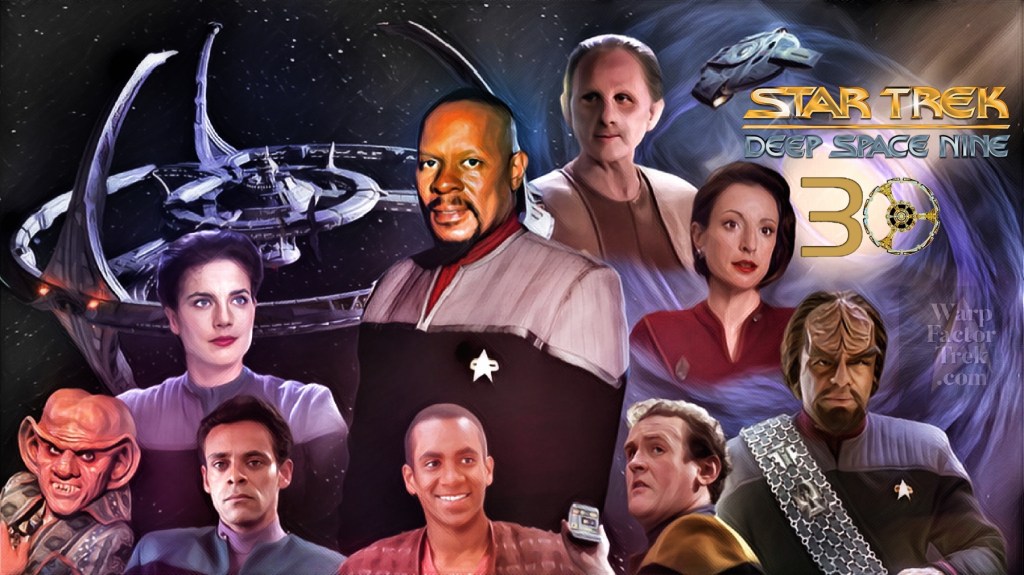
DS9 is Simply the Best Star Trek to Date

Star Trek: Deep Space Nine (DS9) is widely regarded as the most complex and compelling series in the Star Trek franchise, setting itself apart through its intricate storytelling, morally gray characters, and bold exploration of themes that challenge traditional Star Trek optimism. Unlike the more episodic nature of The Original Series and The Next Generation, DS9 adopts a serialized approach, allowing for deeply interconnected story arcs that resonate on a larger scale. The Dominion War, a centerpiece of the series, stands as a testament to this approach, offering a gritty, multi-season exploration of warfare, diplomacy, and the ethical dilemmas faced by individuals and governments during times of crisis.

One of DS9’s greatest strengths is its cast of richly developed characters. Benjamin Sisko, played masterfully by Avery Brooks, is a layered protagonist who balances the responsibilities of a Starfleet officer with his personal struggles as a father, widower, and religious figure to the Bajoran people. Sisko’s arc as the Emissary of the Prophets adds a spiritual dimension to his leadership, making him one of the most complex captains in the franchise. Characters like Kira Nerys, a former Bajoran resistance fighter, and Garak, a Cardassian tailor and ex-spy, further highlight DS9’s ability to delve into morally ambiguous territories. Kira’s journey from hardened freedom fighter to a diplomat striving for peace underscores the personal cost of resistance and rebuilding, while Garak’s layers of deceit and loyalty make him one of the most fascinating secondary characters in Star Trek history.

The series also excels in its exploration of darker and more controversial themes. For instance, the occupation of Bajor by the Cardassians serves as a thinly veiled allegory for real-world historical atrocities, such as colonialism and genocide. Episodes like “Duet” and “The Siege of AR-558” confront the horrors of war and occupation head-on, forcing both the characters and viewers to grapple with uncomfortable truths about morality and justice. The Dominion War arc, spanning multiple seasons, brings these themes to a head, portraying the Federation in its most vulnerable state. Through this, DS9 challenges the idealism that defined earlier Star Trek series, asking whether the Federation’s values can endure in the face of existential threats.

DS9’s stationary setting on a space station near a strategic wormhole allows it to explore interpersonal dynamics and long-term political relationships more deeply than its predecessors. The station serves as a cultural melting pot, fostering interaction between species like the Bajorans, Cardassians, Ferengi, and Dominion. This unique setup creates a backdrop for stories that delve into diplomacy, trade, and cultural tensions. Episodes such as “In the Pale Moonlight”, where Sisko manipulates events to bring the Romulans into the Dominion War, exemplify the show’s willingness to confront moral ambiguity.

Moreover, DS9 embraces diversity and representation. It features one of the first Black leads in sci-fi television and presents LGBTQ+ themes subtly through characters like Jadzia Dax, whose experiences challenge traditional notions of identity and love.

By combining rich storytelling, profound character arcs, and a willingness to push boundaries, Deep Space Nine remains not only the best Star Trek series, but also one of the most thoughtful and impactful sci-fi shows ever created.

I wrote this piece almost two years ago, and I have been holding off publishing. Why? Strange New Worlds, that’s why! I have been totally taken with this series, and yet for me, it’s needs a little more longevity before I am going to change my mind – just saying! 

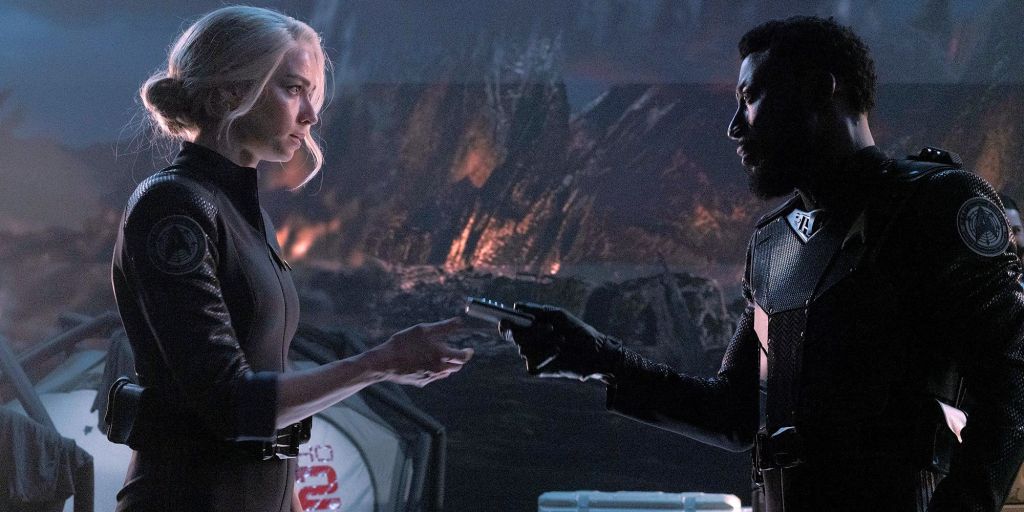
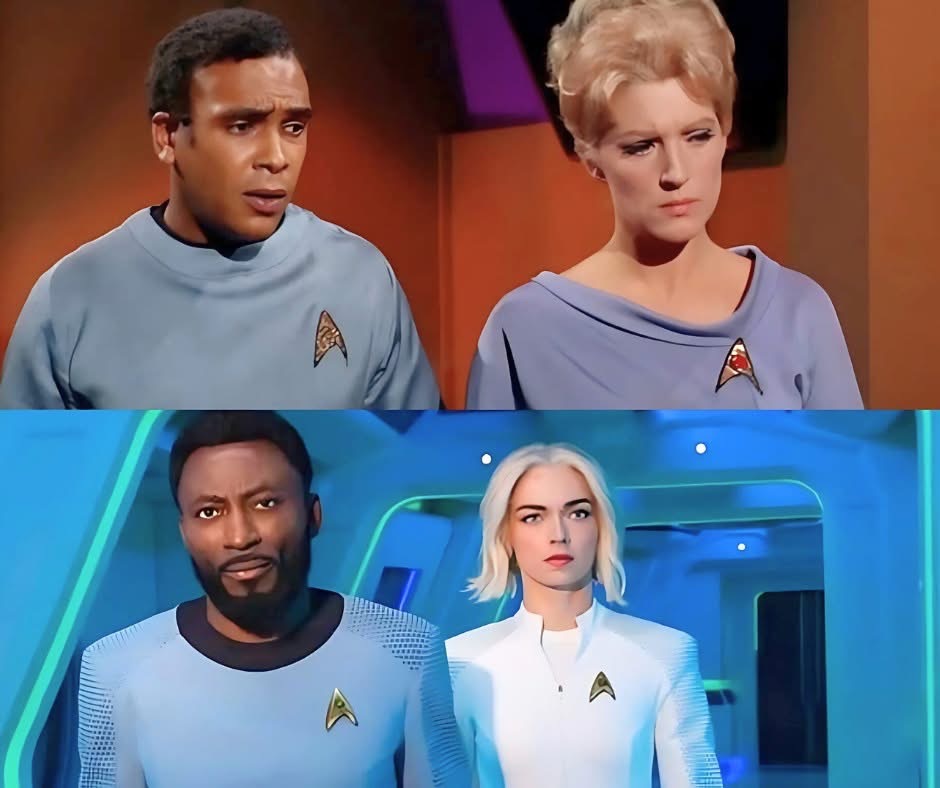
The Duality of Dr Joseph M’Benga 

I’ve noticed a recurring theme in my posts about Star Trek: the pivotal role of the ship’s doctors. These characters aren’t merely healers; they are often the moral compass of the crew, embodying the Federation’s ideals while wrestling with their own internal conflicts. Among these remarkable figures, Dr. Joseph M’Benga stands out as one of the most compelling. His story is one of contrasts – a brilliant healer haunted by the scars of war, a scientist navigating the grey areas of survival, and a father whose love transcends the boundaries of science.

M’Benga’s medical expertise, especially his unparalleled understanding of Vulcan physiology, was forged during his internship on Vulcan; a testament to his dedication and intellect. As one of Starfleet’s most capable physicians, he saved countless lives aboard the USS Enterprise. But beneath this exterior of clinical precision lay a darker, more complex history. During the Klingon War, M’Benga served as a covert operative. His prowess in combat earned him the chilling nickname “the Ghost,” reflecting a lethal efficiency that starkly contrasted with his mission to preserve life. The brutal Battle of J’Gal left him grappling with the weight of his actions, and the moral compromises he was forced to make.

Amid his wartime trauma, M’Benga faced a deeply personal battle: his daughter Rukiya’s terminal illness. In a desperate bid to save her, he used the transporter buffer to hold her in stasis, preserving her life while searching for a cure. This act was not just an expression of his medical ingenuity, but also of his boundless love as a father. When the time came to release her into the care of a sentient nebula being, a decision that symbolized profound sacrifice, it underscored the depth of his humanity. M’Benga’s choice was not merely a scientific solution, but an emotional resolution, allowing Rukiya to transcend her suffering in a way that was both heartbreaking and hopeful.

Aboard the USS Enterprise, M’Benga’s dual roles as healer and soldier were constantly at play. Under Captain Pike’s leadership, and later Captain Kirk’s, he treated everything from routine injuries to the aftermath of violent battles. Whether guiding Spock through the complexities of Vulcan healing trances or wrestling with the moral dilemmas of triage in wartime, M’Benga embodied resilience and compassion. His quiet strength anchored the crew during moments of crisis, even as his personal burdens weighed heavily on him.

Though eventually succeeded by the iconic Dr. Leonard McCoy as Chief Medical Officer, M’Benga remained a vital figure in Starfleet’s medical corps throughout the 2260s. His later years saw him move to Stanford Medical Center, where he continued his medical practice before retiring to Vulcan. On the tranquil Vulcan plains, far from the chaos of starships and battles, M’Benga embraced a simpler existence as a plomeek farmer. This peaceful conclusion to his journey provided a stark contrast to his earlier life, symbolizing his desire to heal not only others but also himself.

Dr. Joseph M’Benga’s legacy in Star Trek is a testament to the duality of the human experience. Healer and warrior, scientist and survivor, his story is one of navigating trauma, moral ambiguity, and the unyielding tension between the preservation of life and the necessity of taking it. In the vast expanse of the Star Trek universe, M’Benga stands as a nuanced and deeply human reminder of the struggles and sacrifices that define us all – both on Earth and among the stars.

The Politics and Culture of the United Federation of Planets

The United Federation of Planets (UFP) in Star Trek is more than just a fictional interstellar government, it’s a lens through which we can explore the complexities of governance, culture, and morality. As an amalgamation of over 150 member planets, each with distinct identities, the Federation represents humanity’s highest aspirations: unity, cooperation, and progress. However, beneath its utopian veneer lies a tapestry of contradictions, challenges, and ethical dilemmas that reflect the very nature of politics and society.

Culturally, the Federation embodies a post-scarcity society where poverty, hunger, and economic inequality have been eradicated. This transformation, driven by technologies like replicators, allows individuals to pursue self-fulfillment rather than survival. Captain Picard famously encapsulates this ethos in Star Trek: First Contact, stating that humanity works to “better ourselves and the rest of humanity.” Yet, this idealism is not without critique. Characters like Quark, the ever-pragmatic Ferengi bartender from Deep Space Nine (DS9), often mock Federation citizens as naive and soft, sheltered by their comfortable post-scarcity lives, and ignorant of the struggles faced by more commerce-driven cultures, or from living within the hierarchical Dominion. 

The Federation’s diversity and multiculturalism are central to its identity. As a multi-species alliance, it strives to respect and integrate a variety of cultural traditions. Vulcan logic, Klingon honor, Bajoran spirituality – these are just a few examples of the unique perspectives that coexist within the Federation. Yet, this inclusivity is not without tension. The Next Generation episode “The Measure of a Man” highlights the Federation’s struggle to define universal principles in a diverse galaxy, as it debates whether the android Data qualifies as a sentient being. Similarly, DS9 delves into the cultural friction between the Federation’s secular humanism and Bajoran spiritualism, particularly during Bajor’s efforts to join the Federation. While the Federation promotes unity, it sometimes risks imposing its ideals, creating an undercurrent of what some might call “soft imperialism.”

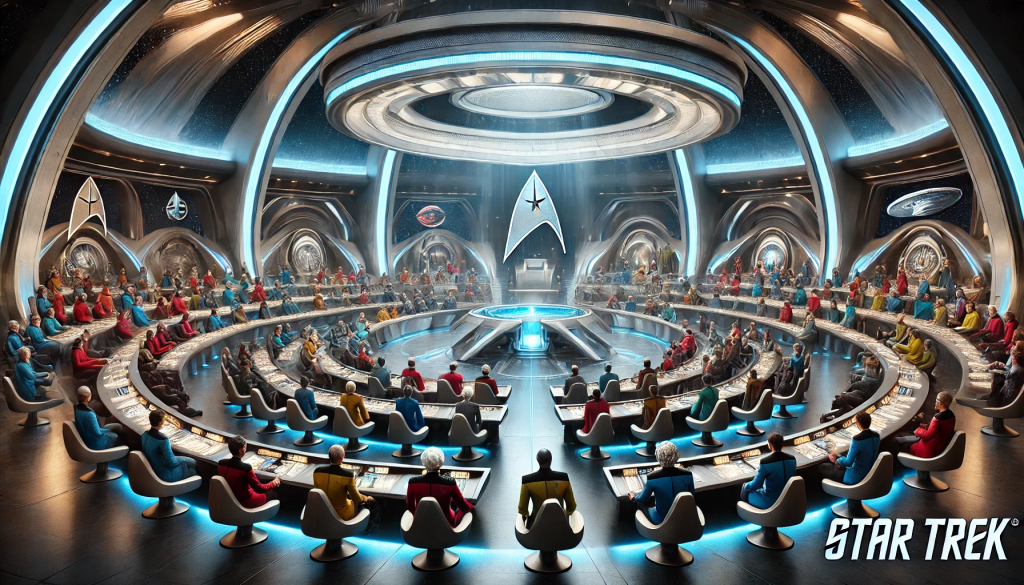
Politically, the Federation operates as a parliamentary democracy, with the Federation Council serving as its legislative body. Member planets retain autonomy over their internal affairs, while the Council oversees interplanetary law and diplomacy. The President, based in Paris on Earth, functions as the head of state. This balance between centralized governance and local autonomy is a strength, but it also leads to conflict. In Deep Space Nine, Bajor’s hesitation to join the Federation stems from fears of losing cultural identity to Earth-centric norms, a recurring critique that the Federation, despite its claims of equality, often reflects Earth’s values more than those of its alien members.

Ethics play a central role in Federation politics, often taking precedence over realpolitik. The Prime Directive, which prohibits interference with the natural development of pre-warp civilizations, exemplifies this commitment to morality. However, its strict application frequently leads to moral quandaries. In the Next Generation episode “Pen Pals,” Captain Picard grapples with whether to save a planet facing natural destruction, knowing that intervention would violate the Directive. These dilemmas reveal the challenges of maintaining an ethical stance in an imperfect galaxy.

Yet, the Federation’s ideals are not invulnerable. Darker elements, such as Section 31, a covert intelligence agency introduced in DS9, operate outside the bounds of Federation law to protect its interests. This shadowy organization embodies the tension between the Federation’s noble aspirations and the harsh realities of interstellar politics. Similarly, the Dominion War in DS9 exposes the Federation’s capacity for militarization, challenging the perception of Starfleet as a purely exploratory and diplomatic force.

What makes the Federation compelling is its dual nature: it is both a beacon of hope and a reflection of humanity’s flaws. In Star Trek VI: The Undiscovered Country, the Federation negotiates peace with the Klingon Empire, showcasing its dedication to diplomacy even after decades of hostility. Yet, this same Federation harbors internal threats, as seen in the DS9 episodes “Homefront” and “Paradise Lost,” where a Starfleet admiral attempts a coup in response to Changeling infiltration. These stories remind us that even the most enlightened institutions are vulnerable to fear and corruption.

Ultimately, the Federation is not just a backdrop for Star Trek’s adventures; it is a character in its own right, embodying the complexities of governance, diversity, and ethical leadership. Its triumphs inspire us to imagine a better future, while its flaws remind us that such a future is not achieved without struggle. By exploring these themes, Star Trek offers not just escapism, but a profound commentary on the challenges and possibilities of building a just and inclusive society.

Comedy Meets Legacy: Why Lower Decks Is Star Trek’s Most Endearing Spin-Off

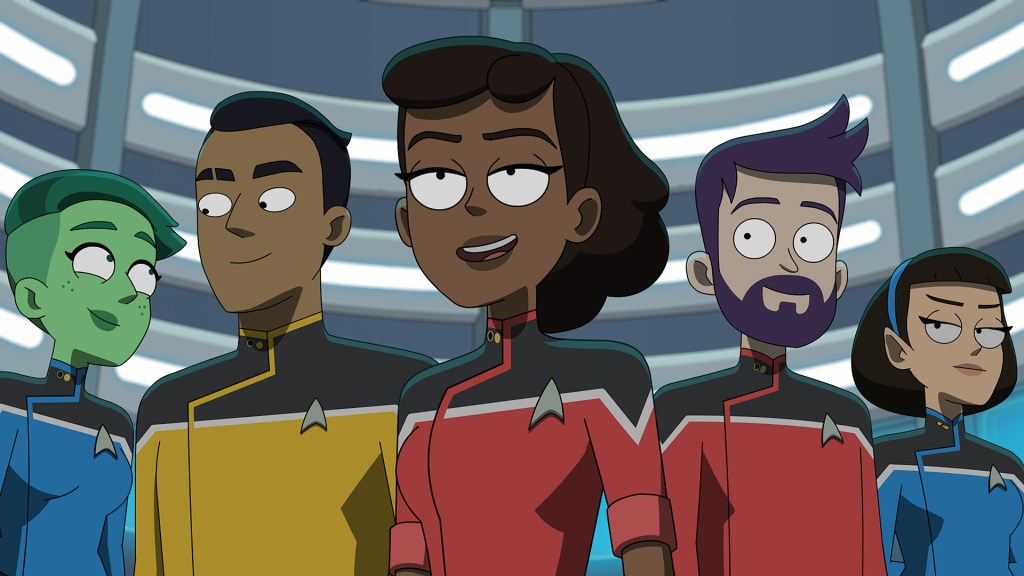
Star Trek: Lower Decks is a delightfully refreshing addition to the Star Trek franchise, masterfully blending humor, heart, and reverence for its source material. Created by Mike McMahan, this animated series shifts the spotlight to the junior officers aboard the USS Cerritos, offering a comedic, yet affectionate, exploration of the daily lives and misadventures of Starfleet’s unsung heroes.

The show centers on ensigns Mariner, Boimler, Tendi, and Rutherford, whose quirks and chemistry drive the narrative. Mariner’s rebellious streak and Boimler’s neurotic ambition create a dynamic that is both hilarious and heartfelt, while Tendi’s boundless enthusiasm and Rutherford’s tech-savvy charm add layers of warmth and relatability. Together, they navigate everything from mundane maintenance tasks to chaotic alien encounters, showcasing the humor in the often-overlooked corners of Starfleet life.

The series doesn’t just celebrate Star Trek’s legacy, it revels in it. Packed with clever references and Easter eggs, Lower Decks is a treasure trove for longtime fans, while remaining accessible to newcomers. Its vibrant animation and fast-paced humor offer a fresh aesthetic that feels innovative yet unmistakably Star Trek.

A standout moment in the series is its crossover with Star Trek: Strange New Worlds, where the animated chaos of Boimler and Mariner collides with the live-action gravitas of Captain Pike and his crew. The episode brilliantly bridges the tonal and stylistic gap between the two shows, resulting in a celebration of Starfleet’s shared values that is as nostalgic as it is original.

Beneath the laughs, Lower Decks delivers heartfelt storytelling about teamwork, growth, and the unsung heroes of the Federation. It proves that Star Trek’s optimistic vision of the future remains as compelling and adaptable as ever.

The series culminated this week in a heartfelt and triumphant final episode, delivering a perfect blend of humor, nostalgia, and emotional closure that leaves fans both satisfied and longing for more. Star Trek: Lower Decks will undoubtedly be missed, but its legacy as a bold and joyful chapter in the Star Trek universe will live long and prosper.

Dr. Phlox – The Polyamorous, Nuanced, Enterprising Physician

In my humble opinion, Dr. Phlox from Star Trek: Enterprise is one of the greatest characters in the Star Trek franchise due to his unique perspective, compassionate nature, and nuanced approach to ethics and culture. As a Denobulan, Phlox’s background adds richness to the series, offering insights into alien cultures while serving as a mirror for humanity’s struggles and growth.

Phlox’s unflinching optimism and humour are essential in balancing the darker, more perilous tone of Enterprise. In “Dear Doctor,” his moral dilemma about whether to cure a pre-warp civilization’s genetic condition highlights his deep commitment to the principles of non-interference, even at great personal cost. His reasoning forces Captain Archer and the audience to grapple with the complexities of the Prime Directive, even before it was formally established.

In “Doctor’s Orders,” Phlox’s resilience and ingenuity shine as he singlehandedly pilots the Enterprise through a dangerous region of space. The episode showcases his resourcefulness and unyielding commitment to his crewmates, even when isolation and stress threaten his sanity.

Phlox’s open-mindedness about relationships and culture provides a refreshing counterpoint to the often-rigid human norms. His polyamorous family life, discussed in episodes like “Stigma,” challenges human biases and promotes acceptance, underscoring the franchise’s core values of diversity and understanding.

Dr. Phlox embodies compassion, intellect, and moral courage, qualities that resonate with Star Trek’s aspirational vision of the future. His distinctive personality and profound contributions to Enterprise make him a standout character in the Star Trek universe.