
Food Security Is Canada’s Next National Imperative

Canada has long built its agri-food reputation on food safety and quality. Rigorous inspection systems, traceability protocols, and high sanitation standards have made Canadian products trusted both domestically and on the global market. But while these strengths remain critical, they are no longer sufficient. In an era of accelerating climate disruption, geopolitical instability, supply chain fragility, and rising inequality, Canada must now turn its focus to food security – the guarantee that all people, at all times, have reliable access to enough affordable, nutritious food.

Food safety ensures that the food we consume is free from contamination. Food quality ensures it meets certain standards of freshness, nutrition, and presentation. These are the cornerstones of consumer trust. Yet, neither concept addresses the structural risks facing our food system today. Food security asks a different set of questions: Can Canadian households afford the food they need? Can our food system withstand climate shocks, trade disputes, and infrastructure breakdowns? Are our supply chains inclusive, decentralized, and flexible enough to adapt to major disruptions?
Recent events have underscored the fragility of our current system. During the COVID-19 pandemic, disruptions to cross-border trucking and meat processing plants exposed just how centralized and brittle key segments of Canada’s food supply have become. In British Columbia, floods in 2021 cut off rail and road access to Vancouver, leading to supermarket shortages within days. In the North and many Indigenous communities, chronic underinvestment has made access to affordable, fresh food unreliable at the best of times, and catastrophic during crises.

Moreover, food insecurity is rising, not falling. In 2023, over 18 percent of Canadian households reported some level of food insecurity, with that number climbing higher among single mothers, racialized Canadians, and people on fixed incomes. Food banks, once seen as emergency stopgaps, are now regular institutions in Canadian life. This is not a failure of food safety or quality. It is a failure of access and equity – core dimensions of food security.

Part of the problem lies in how Canada conceptualizes its agri-food system. At the federal level, agriculture is still often framed as an export sector rather than a foundational pillar of domestic well-being. Policy is shaped by trade metrics, not food sovereignty. We excel at producing wheat, pork, and canola for overseas markets, but remain heavily reliant on imports for fruits, vegetables, and processed goods. Controlled-environment agriculture remains underdeveloped in most provinces, leaving the country vulnerable to droughts, supply chain blockages, and foreign policy flare-ups.

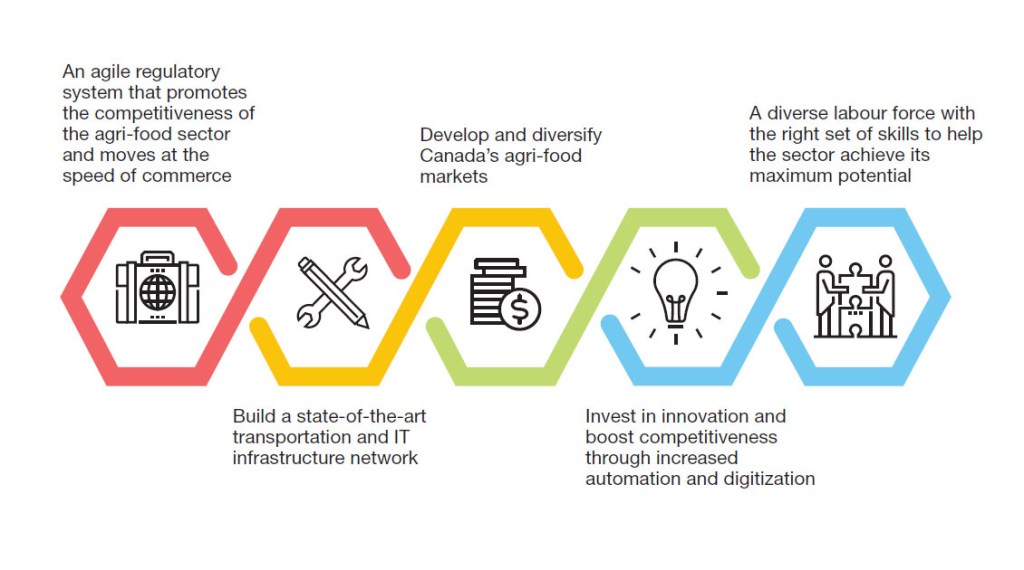
To move toward food security, Canada must first reframe its priorities. This means investing in local and regional food systems that shorten supply chains and embed resilience close to where people live. It means modernizing food infrastructure: cold storage, processing capacity, and distribution networks, particularly in underserved rural and northern communities. It means supporting small and medium-scale producers who can provide diversified, adaptive supply within regional ecosystems. It also means integrating food policy with social policy. Income supports, housing, health, and food access are intertwined. Any serious food security strategy must address affordability alongside production.

Several provinces have begun to lead. Quebec has developed a coordinated framework focused on food autonomy, greenhouse expansion, regional processing, and public education. British Columbia is experimenting with local procurement strategies and urban farming initiatives. But the federal government has not yet articulated a cohesive national food security agenda. The 2019 Food Policy for Canada set out promising goals, but lacked the legislative weight and funding to shift the structure of the system itself.

Now is the time to act. Climate events will increase in frequency and severity. Global trade dynamics are growing more volatile. Technological transformation and consumer expectations are evolving rapidly. A resilient, secure food system cannot be improvised in moments of crisis. It must be designed, invested in, and governed intentionally.

Canada’s record on food safety and quality is a strength to build on. But it is not enough. Food security is the challenge of this decade. Meeting it will require a new policy imagination, one that centres equity, redundancy, and sustainability as the foundations of a food system truly built to serve all Canadians.
Quebec’s Agrifood Strategy: A National Lesson in Food Security

Quebec has quietly become a national leader in agrifood planning and food security. At a time when global food systems are increasingly fragile, the province offers a clear and pragmatic model for how public policy, local investment, and social equity can combine to build a more resilient, sustainable food system. The rest of Canada would do well to take note.

Central to Quebec’s approach is its comprehensive provincial framework, Politique bioalimentaire 2018–2025: Alimenter notre monde. This policy articulates a long-term vision for food sovereignty and ecological stewardship. It promotes value-added processing, regional production, and stronger local supply chains. What sets Quebec apart is not simply the breadth of the strategy, but the coordination behind it. Provincial and federal funds are deployed in tandem, targeting greenhouse expansion, food transformation infrastructure, agri-environmental practices, and innovation. In 2023, Quebec committed $175 million toward increasing regional food self-sufficiency, a move that signaled a shift away from dependence on volatile global supply chains.

This funding strategy has been reinforced by the Canada–Quebec Sustainable Canadian Agricultural Partnership agreement, which committed $955 million over five years to support producers across the province. The agreement includes enhanced compensation under AgriStability, infrastructure renewal programs, and expanded support for environmental and climate-smart practices. With a 25 percent increase over the previous five-year framework, this is one of the most ambitious agrifood investments in the country.

Quebec’s focus on food processing has also paid dividends. In Saguenay–Lac-Saint-Jean, for example, Céréales Normandin received over $3.5 million in combined provincial and federal support to expand its grain-processing capacity. By transforming local cereals into flour, semolina, and plant-based protein concentrates, the facility strengthens Quebec’s ability to retain value within the province. It also reduces dependency on long-haul transportation and foreign inputs. This kind of investment represents a structural shift toward field-to-fork sovereignty.

But production and processing are only part of the story. Quebec integrates food security into its broader public health and education agenda. The province supports farm-to-school programs that connect children directly with local farms, using classroom engagement and institutional procurement to build food literacy and sustainable eating habits. Programs like AgrÉcoles and Farm to School Québec are designed not as symbolic gestures, but as long-term educational investments. They are complemented by robust health policy measures, including proposed front-of-package nutrition labels and consideration of a sugary drinks tax. While other provinces rely on voluntary industry commitments, Quebec has shown a willingness to legislate for public health.

Climate adaptation is another defining element. Quebec has made significant advances in controlled-environment agriculture, particularly hydro-powered greenhouses. These facilities now supply roughly half of the province’s fruits and vegetables year-round. This model aligns well with Quebec’s decarbonization goals and offers a buffer against supply chain disruptions caused by weather, wildfires, or border issues. The greenhouse sector also creates jobs in rural regions, adding social and economic depth to what might otherwise be seen as technical infrastructure.

Quebec’s broader social policy reinforces its food security efforts. The province maintains Canada’s most generous child benefits and has indexed income supports to inflation, resulting in lower levels of food insecurity compared to most other provinces. By recognizing that hunger is not just a supply issue but a matter of income and social policy, Quebec links its agrifood system to social resilience. This integrated approach provides not only food, but dignity and stability.

Cultural identity plays a role as well. Quebec has long embraced supply management in sectors like dairy and maple syrup, not as a form of protectionism, but as a tool for supporting regional producers and maintaining quality standards. This model may not translate directly across all of Canada, but it offers a reminder that local economies thrive when policy reflects place-based values.

Perhaps the most compelling lesson from Quebec is its refusal to silo food policy. Instead, it has created a system where agriculture, health, education, environment, and social equity intersect. The result is not just a stronger food system, but a stronger society. In an era of climate disruption, geopolitical instability, and growing inequality, Quebec is showing how to build something that is local, resilient, and future-ready.

Canada as a whole will face increasing pressure in the years ahead to secure its food systems. If policy-makers are serious about ensuring affordability, sustainability, and sovereignty, they would be wise to study what Quebec has already built.

Sources
• Government of Canada. “Canada and Quebec sign a new $955 million agreement over five years to support Quebec’s agricultural sector.” March 2023. https://www.canada.ca/en/agriculture-agri-food/news/2023/03/canada-and-quebec-sign-a-new-955-million-agreement-over-5-years-to-support-quebecs-agricultural-sector.html
• Government of Canada. “Over $3.5 million for Céréales Normandin to expand its product range.” March 2024. https://www.canada.ca/en/economic-development-quebec-regions/news/2024/03/increasing-quebecs-food-selfsufficiency-over-35m-for-cereales-normandin-to-expand-its-product-range.html
• Equiterre. “Farm to School Québec.” https://www.equiterre.org/en/articles/project-local-food-procurement-farm-to-school-quebec
• The 14. “Reinforcing policies to improve Quebec’s food supply.” https://the-14.com/reinforcing-policies-to-improve-quebecs-food-supply
• West Quebec Post. “Quebec to invest $175 million over five years to increase food self-sufficiency.” https://www.westquebecpost.com/quebec-to-invest-175-million-over-five-years-to-increase-food-self-sufficiency

The Global Food Supply Chain Is Shifting – And Canada Must Be Ready

The global food supply chain is undergoing a period of extraordinary change, driven by a volatile blend of climate instability, geopolitical realignment, digital transformation, and shifting consumer expectations. For Canada, a country both reliant on agricultural exports and dependent on imports to feed its population, these changes represent both a serious threat and a historic opportunity.

The most immediate and destabilizing force is climate change. Across the globe, extreme weather events are disrupting food production and transportation infrastructure. Prolonged droughts in the United States and Brazil, floods in South Asia, and wildfires across the Mediterranean have all contributed to rising food prices and shortages of staple goods. In 2024 and early 2025, the prices of cocoa, coffee, and vegetable oils more than doubled in global markets, illustrating how climate-linked shocks in one region can rapidly ripple across supply networks. Analysts expect this volatility to become the new normal, not an exception.

Geopolitical tensions are compounding these risks. The ongoing consequences of the Russia–Ukraine war continue to affect global grain and seed oil availability, particularly in Africa and the Middle East. Meanwhile, China’s imposition of new tariffs on Canadian agricultural products – part of a tit-for-tat trade war triggered by Canadian duties on Chinese electric vehicles and steel, has jeopardized billions in exports. Canadian pork and canola producers are among the hardest hit. In a trade landscape increasingly shaped by protectionism, food is becoming both a diplomatic tool and a strategic vulnerability.

At the same time, the global food system is entering a period of accelerated digitalization. Technologies such as blockchain, artificial intelligence, and real-time logistics platforms are now being deployed to manage traceability, reduce waste, and predict bottlenecks. From major logistics hubs in Rotterdam and Singapore to field trials in Alberta and Manitoba, data is becoming as essential as soil and seed. For Canada, which has long relied on traditional supply chain models and seasonal rhythms, there is growing pressure to integrate these tools more aggressively.

This digital shift is mirrored by a rising emphasis on sustainability. Multinational retailers and food companies are increasingly turning to regenerative agriculture and eco-friendly logistics. In North America, McDonald’s has begun pilot programs supporting rotational grazing and soil health restoration across its supply network, including with Canadian producers. Meanwhile, packaging waste, energy usage, and transportation emissions are now key metrics for investors, regulators, and consumers alike.

All of these shifts have profound implications for Canada’s agri-food sector. In the face of increasingly fragile international supply routes, there is a renewed focus on domestic resilience. A recent report from KPMG Canada recommends a more self-sufficient food system built around regional logistics hubs, shared storage infrastructure, and enhanced collaboration between producers, distributors, and retailers. The goal is not isolationism, but redundancy – a system better able to absorb shocks without collapsing.

This necessity for resilience also aligns with an emerging opportunity. As supply routes between Asia and the United States become less predictable, Canadian ports, particularly in British Columbia and Atlantic Canada, stand to gain. Shipping rerouted to avoid U.S. tariffs or congestion may open new pathways for Canadian grain, seafood, and value-added agri-food exports. However, capitalizing on this requires investment in cold chain logistics, port capacity, and integrated digital customs processes.

There is also a growing consensus that Canada must move up the value chain. For too long, the country has exported raw commodities – wheat, canola, pulses, only to buy back processed goods at higher prices. In a more competitive and unstable global market, the future lies in branding, processing, and differentiated products. Whether it is high-protein pasta made from prairie durum or oat beverages from Manitoba, value-added agri-food is increasingly seen as the path to long-term competitiveness and economic security.

Another critical challenge is food waste. Canada loses an estimated 35 million tonnes of food annually, roughly 58 percent of all produced, with a combined value of $21 billion. Much of this is the result of poor cold chain management, especially in the face of climate disruption. Heatwaves and floods damage infrastructure, interrupt power supply, and compromise the safety of perishable goods. Strengthening the cold chain, from rural harvest sites to urban distribution centres, will be essential in adapting to a warming climate and preventing unnecessary losses.

At the consumer level, expectations are changing quickly. Demand for traceable, ethically produced, and environmentally sustainable food is no longer limited to niche markets. From compostable packaging to plant-based proteins, Canadian shoppers are pushing producers and retailers to adopt new standards. In response, supply chain managers are planning major shifts toward sustainable logistics, predictive inventory systems, and just-in-time models that minimize waste and maximize transparency.

Taken together, these global supply chain shifts mark a turning point. Canada can either cling to legacy systems and find itself squeezed by rising volatility, or it can invest boldly in infrastructure, innovation, and regional self-sufficiency. The case for action is clear. A resilient, technologically advanced, and sustainable food system is not only possible, it is becoming necessary for the country’s economic and social well-being.

Sources:
• KPMG Canada, Building a More Resilient Food System in Canada (June 2025): https://kpmg.com/ca/en/home/insights/2025/06/building-a-more-resilient-food-system-in-canada.html
The Guardian, “Extreme Weather to Cause Further Food Price Volatility,” (Feb 2025): https://www.theguardian.com/environment/2025/feb/15/extreme-weather-likely-to-cause-further-food-price-volatility-analysts-say
Business Insider, “Fresh Chinese Tariffs on Canadian Agricultural Products,” (Mar 2025): https://www.businessinsider.com/fresh-chinese-tariffs-canada-open-new-front-trade-war-2025-3
Reuters, “McDonald’s Shifts to Regenerative Agriculture,” (Apr 2025): https://www.reuters.com/sustainability/land-use-biodiversity/no-lettuce-no-big-mac-why-beth-hart-is-steering-mcdonalds-towards-regenerative-2025-04-14
• National Collaborating Centre for Environmental Health, Climate Change Impacts on Canada’s Food Cold Chain: https://ncceh.ca/resources/evidence-reviews/climate-change-impacts-canadas-food-supply-cold-chain
• Eastern College, “Supply Chain Trends in 2025”: https://easterncollege.ca/blog/supply-chain-trends-in-2025-what-canada-needs-to-know

Analyzing Canada’s Supply Management System Amidst USMCA Renegotiations

With Donald Trump hinting at renegotiating the USMCA, the Bloc Québécois (BQ)’s preemptive demand to shield Canada’s supply-managed agricultural sectors seems like a calculated play. By insisting on taking these industries off the negotiating table, the BQ underscores the strategic importance of supply management—not just as economic protectionism, but as a cornerstone of national food security, quality, and safety.

At its core, supply management is more than a regulatory framework; it’s a defense mechanism against market forces that could devastate domestic agriculture. Take Wisconsin, for example: its dairy production alone eclipses Canada’s entire industry and could flood the Canadian market with cheaper, lower-standard products. This wouldn’t just undercut prices; it could dismantle the domestic sector entirely. Ironically, Wisconsin’s overproduction creates its own woes, driving down prices, shrinking herd sizes, and perpetuating a vicious cycle of instability.

Such risks aren’t hypothetical. In Latin America, we’ve seen nations struggle as free-market producers prioritize export profits over feeding local populations. Meanwhile, neighboring countries flooding markets with cheap imports have obliterated subsistence farming. The BQ isn’t just safeguarding Quebec’s dairy industry but advocating for all “feather” producers—chicken, turkey, ducks, and eggs. So, how does Canada’s supply management system stack up?

The Case for Supply Management
Supply management ensures Canadian farmers enjoy stable, predictable incomes, shielding them from global market volatility. This financial security allows small family farms to invest confidently, fostering sustainability. For consumers, it means consistent prices for essentials like milk and eggs, steering clear of drastic price swings.

Canada’s system enforces stringent safety and environmental standards, ensuring high-quality products. By prioritizing local production, it strengthens food security, keeping supply chains domestic and reliable. The system also promotes production diversity, mitigating risks like disease outbreaks in large industrial operations.

By controlling production, supply management prevents market gluts that can tank prices. This is a lifeline for small and medium farms, which form the backbone of rural economies. Without these protections, small farms might collapse under pressure from industrialized mega-farms or cheap imports, eroding Canada’s agricultural landscape.

The Critiques of Supply Management
The most frequent criticism is higher prices. Supply management fixes prices above global market levels, meaning Canadians pay more for staples like dairy and eggs. These costs hit low-income households hardest, intensifying inequality in access to basic foods.

Canada’s import controls complicate international trade negotiations. Concessions made during CETA and USMCA talks—allowing limited foreign access to Canadian dairy markets—highlight the friction. These restrictions may limit Canada’s leverage in future trade deals, potentially hindering economic growth.

Critics argue that supply management’s guaranteed income structure discourages competition and innovation. Farmers have little incentive to improve efficiency or diversify, unlike in competitive markets where survival hinges on adaptability. This lack of dynamism could leave Canadian agriculture trailing behind global advancements.

Balancing Tradition and Change
Canada’s supply management system has achieved much: protecting farmers, ensuring food security, and sustaining rural economies. Yet, it faces mounting pressure to adapt. Rising consumer demands for affordability, evolving trade landscapes, and the push for innovation all challenge the status quo.

The Bloc Québécois’ stance reflects a broader debate about how Canada defines the future of its agriculture. Can we strike a balance between protecting domestic producers, ensuring our food security, and embracing global trade? The answer will shape not just the nation’s economy, but its food systems for generations to come.

Lets Grow Cooperative Food Stores

As food prices at national supermarket chains continue to rise, local cooperative food stores offer a traditional, yet innovative alternative. Member-owned co-ops blend economic participation with social and environmental values, prioritizing community needs over profits. This model, which began in Canada in 1861 with coal miners in Nova Scotia, has grown steadily, with 435 food co-ops operating nationwide by 2022—a 12% increase since 2017.

Cooperative food stores operate democratically, with members sharing decision-making power. Each member has an equal vote on store policies, product selection, and profit distribution, ensuring decisions align with community priorities. According to the Canadian Co-operative Association (CCA), co-ops reinvest profits into infrastructure, local sourcing, and expanded services, creating direct economic benefits for members. In some cases, profits are distributed as member dividends, fostering further local investment.

These stores emphasize sustainability and local sourcing, reducing the carbon footprint associated with long-distance food transportation. A 2020 study by the Co-operative Housing Federation of Canada found that co-ops frequently engage in sustainable practices, supporting regional food security and small-scale farmers. The National Farmers Union of Canada reported in 2021 that 25% of local farmers primarily sell through co-ops or farmers’ markets, helping small producers compete in a market dominated by corporate chains.

Co-ops also strengthen community ties. Many host educational programs, cooking classes, and partnerships with local farmers, promoting food sustainability while fostering social cohesion. By prioritizing ethical sourcing and environmental practices, co-ops encourage responsible consumption and sustainable lifestyles. Examples such as Toronto’s Karma Co-op, founded in 1972, demonstrate the success of this model. With over 3,000 members, it provides organic, local, and sustainably sourced products while serving as a hub for community engagement.

Despite their benefits, co-ops face challenges. Start-up costs and membership fees can be barriers for low-income communities, while reliance on loans adds financial pressure. Decision-making in larger co-ops can be slow, as democratic processes require consensus. Additionally, their focus on local and organic goods may limit product variety and occasionally drive up prices compared to large grocery chains.

Nonetheless, the advantages of co-ops—community ownership, support for local economies, sustainability, and affordability—make them a compelling alternative to for-profit supermarket chains. With 65% of Canadians prioritizing local and organic food, the cooperative movement aligns with consumer preferences and offers a path toward more resilient, equitable food systems.

By empowering communities to take control of their food supply, co-ops address concerns around food security and environmental sustainability. As demand for ethical and community-driven food systems grows, the cooperative model is poised for continued success in Canada, offering a viable solution to rising food costs and corporate domination of the grocery industry.