Canada and Mexico Forge Strategic Partnership: Implications for North America

On September 18, 2025, Canadian Prime Minister Mark Carney and Mexican President Claudia Sheinbaum signed a comprehensive strategic partnership in Mexico City. This agreement, covering 2025–2028, aims to deepen economic, security, and environmental collaboration between Canada and Mexico, explicitly anticipating the 2026 review of the United States-Mexico-Canada Agreement (USMCA). While the immediate bilateral effects are evident, the agreement also carries broader implications for the three major North American economies: Canada, Mexico, and the United States.

Scope and Focus of the Agreement
At its core, the agreement establishes a four-year bilateral action plan encompassing four pillars: prosperity, mobility and social inclusion, security, and environmental sustainability. Economically, it focuses on expanding trade and investment in infrastructure, energy, agriculture, and health, while jointly developing critical infrastructure such as ports, rail links, and energy corridors. In security, it aims to strengthen border control and combat transnational crime. The environmental and sustainability component is particularly notable, signaling both countries’ intent to collaborate on climate mitigation and resource management.

Strategic Context
The timing of this agreement is significant. Earlier in 2025, both Canada and Mexico faced tariffs and trade frictions with the United States, creating a strategic impetus to solidify bilateral cooperation. This partnership may serve as a hedge against future unilateral U.S. trade measures and positions both nations more strongly for upcoming negotiations surrounding the USMCA review in 2026. By consolidating economic, security, and environmental frameworks bilaterally, Canada and Mexico signal that they can act decisively and collaboratively independent of U.S. alignment, while still committing to trilateral engagement.

Implications for Canada
For Canada, the agreement represents a proactive diversification of trade and investment partnerships within North America. Beyond the U.S., Mexico is an increasingly significant market for Canadian goods and services, particularly in energy and infrastructure. By reinforcing bilateral economic ties, Canada gains leverage in upcoming USMCA discussions and reduces its vulnerability to unilateral U.S. trade policy shifts. Moreover, collaboration on climate and sustainability initiatives positions Canada as a leader in cross-border environmental governance, complementing its domestic commitments.

Implications for Mexico
For Mexico, the agreement strengthens its economic and geopolitical options. Mexico has historically balanced trade and diplomatic relationships with the United States while seeking alternative partners. Formalizing a strategic partnership with Canada enhances Mexico’s negotiating position with the U.S., particularly as the USMCA review approaches. Joint infrastructure projects and investment commitments also promise to accelerate Mexico’s industrial and energy development, potentially boosting domestic employment and technology transfer.

Implications for the United States
For the United States, the Canada-Mexico agreement presents both opportunities and challenges. On one hand, stronger integration between Canada and Mexico may facilitate smoother trilateral cooperation, reducing friction in cross-border commerce and security. On the other hand, it could limit U.S. leverage in bilateral negotiations with either country if Canada and Mexico present unified positions during the USMCA review. The U.S. may need to consider the strategic consequences of any unilateral trade actions in light of this growing North American solidarity.

The Canada-Mexico strategic partnership represents a calculated, forward-looking approach to regional stability and prosperity. While the agreement strengthens bilateral ties, it also reshapes the dynamics of North American relations, providing both Canada and Mexico with enhanced economic and strategic agency. For the United States, it signals a more integrated northern and southern neighbor bloc, emphasizing the importance of collaborative rather than confrontational engagement. As the 2026 USMCA review approaches, all three nations will likely navigate a more complex and interdependent landscape, where trilateral cooperation becomes not only beneficial but essential.

Sources:
• Reuters. Canada and Mexico committed to shared partnership with US, Carney says. September 18, 2025. link
• Politico. Mexico and Canada make nice ahead of high-stakes trade talks. September 18, 2025. link
• Global News. Carney, Sheinbaum sign strategic partnership to boost trade, security, environment. September 18, 2025. link

Elbows Up: How Canada’s Cooling Ties With America Expose U.S. Insecurity

With Canadian travel, spending, and goodwill toward the United States in steep decline, Washington’s defensive tone reveals a superpower under pressure and struggling to cope.

In recent months, the cross-border relationship between Canada and the United States has come under an unusual strain. What was once seen as one of the closest, most dependable partnerships in the world is now marked by tensions over trade, culture, and public perception. Data shows Canadians are spending less on American goods, traveling less often to the U.S., and expressing rising skepticism about their southern neighbor. Against this backdrop, the American response has been marked not by calm confidence, but by a defensive edge: an insecurity that suggests Washington is feeling the pressure and coping badly.

The tone was set when U.S. Ambassador Pete Hoekstra accused Canadians of harboring an “elbows up” attitude toward his country. Speaking to reporters, Hoekstra complained that Canadian leaders and the media were fanning what he called “anti-American sentiment” and warned against framing ongoing trade disputes as a “war.” His words revealed just how sensitive U.S. officials have become about Canada’s growing assertiveness. Where past American diplomats might have dismissed Canadian criticism as the grumblings of a junior partner, Hoekstra’s defensive language betrayed a sense of vulnerability.

If the rhetoric sounded strained, the economic numbers were even more alarming for Washington. Canadian travel to the United States, long a reliable driver of border-state economies, has fallen sharply. According to industry data, cross-border car trips by Canadians dropped by more than a third year-over-year in August 2025, with similar declines in road travel overall. Air bookings are also down, as Canadians increasingly avoid American destinations. Analysts warn that even a 10 percent fall in Canadian travel represents a loss of over US$2 billion in U.S. tourism spending, affecting thousands of jobs in hotels, restaurants, and retail along the border.

Nor is the pullback limited to tourism. Surveys indicate Canadians are choosing to buy fewer American goods, opting instead for domestic or third-country alternatives whenever possible. Retailers and importers report declining sales of U.S. products in sectors ranging from consumer electronics to clothing. The “buy Canadian” mood, once a marginal theme, has gone mainstream. These choices, multiplied across millions of households, amount to a quiet but powerful act of economic resistance, one that chips away at America’s largest export market.

For the United States, the twin shocks of declining Canadian tourism and shrinking demand for U.S. goods are more than economic nuisances. They strike at the heart of America’s self-image as Canada’s indispensable partner. When Canadians spend less, travel less, and look elsewhere for their needs, it signals a cultural cooling that U.S. officials have little experience confronting. Historically, American policymakers could take for granted that Canadians would continue to flow across the border for shopping trips, vacations, or work, while Canadian governments would swallow irritants in the name of preserving harmony. That assumption no longer holds.

The American response, however, has been reactive rather than reflective. Instead of acknowledging Canadian frustrations, whether over tariffs, trade disputes, or political rhetoric, U.S. officials have scolded Ottawa for being too combative. By objecting to the term “trade war,” by lecturing Canadians about their “attitude,” Washington has reinforced the perception that it neither understands nor respects Canada’s grievances. The tone has become one of deflection: the problem, U.S. diplomats suggest, is not American policy, but Canadian sensitivity.

This defensiveness has left Washington exposed. It reveals that, beneath the rhetoric of confidence, U.S. officials recognize that Canada’s resistance carries real consequences. With fewer Canadians traveling south, U.S. border states lose billions in revenue. With Canadian households buying less from U.S. suppliers, American exporters face measurable losses. And with Canadian leaders willing to frame disputes in sharp terms, U.S. diplomats find themselves on the back foot, struggling to preserve an image of partnership.

For Canada, this shift represents a moment of self-assertion. By spending less in the U.S. and leaning into domestic pride, Canadians are signaling that friendship with America cannot be assumed, it must be earned and respected. For the United States, it represents an uncomfortable reality: even its closest ally is no longer willing to automatically defer.

In the end, the story is less about Canadian hostility than about American fragility. A confident superpower would shrug off criticism, listen carefully, and adjust course. What we see instead is irritation, defensiveness, and rhetorical overreach. By lashing out at Canada’s “elbows up” attitude, Washington has confirmed what the numbers already show: it is under pressure, it is losing ground, and it is coping badly.

Nation-Building by Design: The Strategic Nature of Carney’s Infrastructure Agenda

Canada is entering a new phase of nation-building, one that blends urgent economic needs with longer-term structural transformation. Under Prime Minister Mark Carney, the government has moved decisively to put infrastructure back at the centre of Canadian economic policy. The legislative and programmatic architecture that has been put in place in 2025 reveals not only a desire to build quickly, but also a strategy to re-shape the foundations of trade, energy, housing, and Arctic sovereignty. The pattern of investment and institution-building shows a layered approach: short-term relief to pressing bottlenecks, medium-term positioning of Canada as a reliable trading partner and energy supplier, and long-term steps to reinforce sovereignty, climate resilience, and competitiveness.

At the core lies the One Canadian Economy Act, passed in June 2025, which dismantles federal barriers to interprovincial trade while creating the Building Canada Act. This framework enshrines the ability to designate projects of “national interest” for streamlined approval. The intent is clear: Canada cannot afford to have critical transmission lines, export terminals, or transportation corridors stalled indefinitely in regulatory gridlock. To operationalize this authority, the government launched a Major Projects Office (MPO), with an Indigenous Advisory Council integrated into its structure. The MPO serves as a single-window permitting and financing hub, designed to shepherd nation-building projects through approvals in under two years. The short-term gain is administrative clarity and accelerated approvals; the medium-term payoff is a pipeline of projects that directly enhance trade capacity and energy reliability.

Housing has been treated with equal urgency. The creation of Build Canada Homes, announced in the May Throne Speech and detailed in August, signals a willingness to intervene directly in housing supply. Paired with CMHC’s Housing Design Catalogue, which offers standardized blueprints for gentle density from accessory units to six-plexes, the federal role is shifting from passive funding to active delivery. Short-term gains include faster project approvals and cost savings for small-scale builders. In the medium term, Build Canada Homes intends to scale modular and prefabricated construction to double housing output, stabilizing affordability while anchoring domestic supply chains in Canadian lumber and inputs. The long-term structural effect would be the normalization of higher building rates across the country, a prerequisite for sustaining workforce mobility and economic competitiveness.

Trade and corridor infrastructure forms the third pillar. The Trade Diversification Corridor Fund, budgeted at five billion dollars, is designed to expand port and rail capacity and reduce Canada’s overreliance on U.S. gateways. The High Frequency Rail (HFR) project between Toronto, Ottawa, Montreal, and Quebec City is continuing, promising transformative improvements to the most densely populated corridor. In the short run, HFR stimulates engineering and pre-construction employment. Medium-term gains will appear in reduced congestion, faster business travel, and increased regional integration. The long-term dividends include lower emissions and globally competitive connectivity between Canada’s political and financial capitals.

The expansion of the Port of Churchill in northern Manitoba illustrates how the government is aligning regional development with national strategy. With over $175 million in new federal funding, $36 million from Manitoba, and parallel commitments from Saskatchewan, Churchill is being re-equipped as a trade-enabling Arctic gateway. Recent investments in rail reliability, storage capacity for minerals, and new wharf facilities are positioning it as a potential hub for agricultural exports and critical minerals. The short-term impact is the stabilization of Hudson Bay Railway service, critical for northern communities. The medium-term benefit is expanded shipping capacity during the navigable season. The long-term prize lies in climate-extended Arctic navigation, which could turn Churchill into a permanent transatlantic container port, reshaping Canada’s role in global shipping.

Energy and clean industrial infrastructure represent another strategic frontier. Through the Canada Growth Fund (CGF), Ottawa is deploying $15 billion to de-risk large low-carbon projects, with seven billion earmarked for carbon contracts for difference. This mechanism gives investors certainty that carbon pricing will not collapse, unlocking private capital for carbon capture, hydrogen, and industrial decarbonization. Short-term benefits include early project commitments, such as waste-to-energy facilities in Alberta. Medium-term, these contracts build a domestic market for clean technologies and expand Canada’s share in global green supply chains. Long-term, CGF instruments lay the foundation for a carbon-competitive industrial economy, ensuring Canadian heavy industry remains viable under international climate rules.

The Arctic and defence agenda provides a parallel set of strategic investments. NORAD modernization, including the joint development of over-the-horizon radar with Australia, directly strengthens northern surveillance. The Canadian Patrol Submarine Project, with three bidders shortlisted, will anchor significant industrial activity in Canadian shipyards. In the short run, these procurements inject capital into defence industries. Medium-term gains include jobs, technology transfer, and new capacity in coastal infrastructure. The long-term effect is reinforcement of Arctic sovereignty and continental security at a time of intensifying geopolitical competition.

Underlying all of this is continuity through existing transfers such as the Canada Community-Building Fund, which locks in $26.7 billion for local water, transit, and road projects through 2034. These represent the essential backbone investments that ensure communities can absorb population growth and remain livable, complementing the marquee projects at the national level.

Taken together, these initiatives reveal a strategy that is both defensive and offensive. In the short term, Canadians will see more housing starts, more shovels in the ground for rail and port expansions, and more certainty for clean-tech investors. Over the medium term, the country will gain diversified trade routes, a more mobile workforce, and scaled-up housing supply that cools inflationary pressures. In the long run, the institutional innovations of 2025, the One Canadian Economy Act, the Major Projects Office, and the Canada Growth Fund, may be remembered as the architecture that enabled Canada to hold its ground as a sovereign, competitive, and sustainable economy in a fracturing world.

Feeding Ourselves Together: Why Community Co‑op Food Stores Belong in a Barrier-Free Canada

I have written before about why we need to see cooperative food stores in communities across Canada. With the recent reduction or removal of trade barriers, now is the time to make this happen.  

Across Canada, there is a growing hunger – not only for better food, but for better ways of feeding our communities. The conventional supermarket model, dominated by multinational chains and long supply chains, has left many rural and urban neighbourhoods underserved, overpriced, or entirely cut off from fresh, affordable produce. In this landscape, community-based food cooperatives offer a compelling alternative. They prioritize local sourcing, democratic ownership, and keeping profits within the community. With momentum building to eliminate interprovincial trade barriers in Canada, the conditions are finally aligning to help co‑ops move from niche to necessary.

Historically, Canada’s internal trade system has been surprisingly fragmented. Despite a national economy and federal structure, provinces have operated with distinct sets of rules on everything from food labeling to trucking routes. These non-tariff barriers have acted like an invisible tax on internal trade – estimated by economists to be equivalent to a 21 percent tariff. The consequences have been far-reaching: regional producers face steep compliance costs just to sell across a provincial border; small grocers and co‑ops encounter shipping delays and complex regulations; and ultimately, consumers pay more at the till, with one estimate suggesting Canadians lose up to $200 to $250 per year on food costs due to internal barriers.

This disjointed regulatory landscape has been particularly tough on community co‑ops, which often rely on smaller suppliers who can’t afford to navigate provincial red tape. A co‑op in Saskatchewan wanting to feature artisanal Quebec cheese, or a Northern Ontario store hoping to offer Nova Scotia apples, may find themselves tangled in transportation rules, inspection standards, or product packaging requirements that vary from one province to the next. For organizations founded on values of local empowerment and food access, these barriers have long undermined their ability to operate efficiently and expand.

But change is in the air. A concerted effort, led by federal and provincial governments in response to longstanding calls from economists, producers, and consumers, is finally dismantling these internal walls. The Canadian Free Trade Agreement (CFTA), adopted in 2017, was a foundational shift. It moved from a restrictive “positive list” approach, where only specified goods could cross provincial lines freely, to a “negative list,” where everything is presumed tradeable unless specifically excluded. Further momentum arrived in 2025 with the introduction of the One Canadian Economy Act, which enshrined mutual recognition of many provincial regulations and expanded labour mobility agreements. Recent cooperation between provinces like Alberta, British Columbia, and Nova Scotia has also smoothed trade in alcohol and agri-food products, and Ontario is now joining these efforts.

For food co‑ops, these developments are transformative. Reduced regulatory duplication and harmonized standards mean a broader, more diverse pool of suppliers is accessible. A co‑op in Winnipeg can now stock free-range eggs from a Manitoba farm alongside preserves from Prince Edward Island without needing a legal team to ensure compliance. With fewer restrictions on trucking and packaging, costs are lowered and logistics are simplified. This makes it more feasible for new co‑ops to start up, for existing ones to expand, and for regional partnerships to flourish.

Communities stand to gain tremendously from this shift. Food cooperatives can now tap into a more diverse national supply while staying true to their commitment to local and sustainable sources. Access to different growing zones and seasonal products across the country helps stabilize supply, especially for regions prone to climate disruptions. In Indigenous and Northern communities, where reliable food access remains a challenge, co‑ops empowered by seamless interprovincial trade could offer life-changing improvements.

There is also a broader economic story here. With fewer trade restrictions, small- and medium-sized farms and food businesses gain new markets. Many of these enterprises are community-owned or family-run. Selling into co‑ops in other provinces can help them grow sustainably without abandoning their values. The revenue generated stays local, supporting jobs, infrastructure, and innovation. Over time, this creates a virtuous cycle of local food systems supporting each other across provincial lines – a true pan-Canadian cooperative economy.

The benefits are not only economic. Food co‑ops build social capital. They encourage civic participation, give members a voice in decision-making, and often support education, nutrition, and sustainability initiatives. By breaking down provincial barriers, Canada is not just enabling trade; it is strengthening the social fabric of its communities.

Still, vigilance is needed. Some of the most entrenched barriers, particularly in supply-managed sectors like dairy and poultry, remain in place. Continued advocacy will be necessary to ensure reforms are fully implemented and that smaller players, including co‑ops, are not overlooked in favour of large industrial producers. But the path forward is clearer than it has ever been.

The vision of a Canada where every town and neighbourhood can nourish itself through a thriving, cooperative food economy is no longer idealistic – it is within reach. The removal of internal trade barriers is more than just a policy win; it is a catalyst for community renewal. It allows cooperatives to be what they were always meant to be: rooted in the local, connected across regions, and working together to feed a stronger, fairer nation.

Sources:
Retail Insider (2025). “Interprovincial Trade Barriers Impact Canada’s Food and Beverage Sector.” https://retail-insider.com/retail-insider/2025/01/interprovincial-trade-barriers-impact-canadas-food-and-beverage-sector
Canada Regulatory Review (2025). “The Impact of Lower Interprovincial Trade Barriers on Canada’s Agriculture and Agri-Food Sector.” https://www.canadaregulatoryreview.com/the-impact-of-lower-interprovincial-trade-barriers-on-canadas-agriculture-and-agri-food-sector
Financial Times (2024). “Internal Canadian Trade Costs More Than You Think.” https://www.ft.com/content/90d68648-1905-48f9-906c-301ff047ca56
Canadian Grocer (2025). “Breaking Down Interprovincial Trade Barriers: What’s at Stake for the Food Sector?” https://canadiangrocer.com/breaking-down-interprovincial-trade-barriers-whats-it-food-sector
Reuters (2025). “Carney Says Canada Aims to Have Free Internal Trade by July 1.” https://www.reuters.com/world/americas/carney-says-canada-aims-have-free-internal-trade-by-july-1-amid-us-tariffs-2025-03-21/

When the Bully Yells, He’s Losing: What Navarro’s Rhetoric Really Means for Canada

When Peter Navarro, former White House trade adviser and Trump loyalist, publicly urged Canadians to pressure their government into “negotiating fairly” before U.S. tariffs hit on August 1, the message wasn’t strength, it was panic. Navarro’s over-the-top rhetoric, painting Canada as an obstinate, underpowered negotiator, is less about truth and more about fear. If the United States were truly in control of the trade talks, it wouldn’t need to bluster. It wouldn’t need to insult. And it certainly wouldn’t be begging Canadians to do its dirty work.

Let’s be clear: Canada is not on its knees. We’re not some brittle middle power gasping for access to American markets. We’re a G7 economy with sophisticated supply chains, deep global trade ties, and a well-earned reputation for playing the long game. When Washington starts lashing out with threats and playground-level taunts, it’s a sign we’ve landed a punch.

Navarro’s claim that Canada is being “very challenging” at the negotiating table is revealing. It means our team is doing its job. Canadian trade officials, seasoned, careful, and resolute, have held their ground in defense of fair access, environmental standards, and domestic protections. That makes the Americans nervous. And when Americans get nervous in a Trump-style administration, they yell louder, not smarter.

The proposed 35% tariffs, to be imposed on Canadian goods not covered by the USMCA, are intended as a hammer. But even a hammer needs a target that won’t hit back. And this time, Canada has alternatives: deepening trade with the EU and Asia-Pacific, strengthening regional innovation hubs, and leveraging our vast resources in climate-sensitive sectors that the U.S. increasingly needs but doesn’t yet control.

Navarro also made a critical tactical error. By calling on Canadian citizens to push back against their own government, he misunderstands our national character. Canadians don’t take kindly to being told what to do, especially not by foreign officials acting like economic schoolyard bullies. The effect will likely be the opposite: renewed support for Ottawa’s position and a strengthening of political will across party lines to resist being steamrolled.

Historically, Canada has negotiated from the shadows, careful to avoid open confrontation. But this isn’t 1987. Today’s Canada is assertive, strategically patient, and unafraid of outlasting American tantrums. Navarro’s comments, while aggressive on the surface, are deeply revealing underneath. They betray a U.S. trade team that’s frustrated, boxed in, and afraid of losing leverage.

So yes, when the U.S. starts yelling, Canada should listen, but not to obey. To smile, stand tall, and quietly note: we’ve got them worried.

Sources:
• Bloomberg Law, “Navarro Urges Canada to ‘Negotiate Fairly’ Before August Tariff Deadline,” July 11, 2025.
• AInvest, “Trump Announces 35% Tariff on Canadian Goods,” July 11, 2025.
• Government of Canada, Global Affairs briefings on trade diversification (2023–2025).

Why Canada’s Digital Services Tax Is Poking the Bear – And Why Australia and New Zealand Are Still Holding the Stick

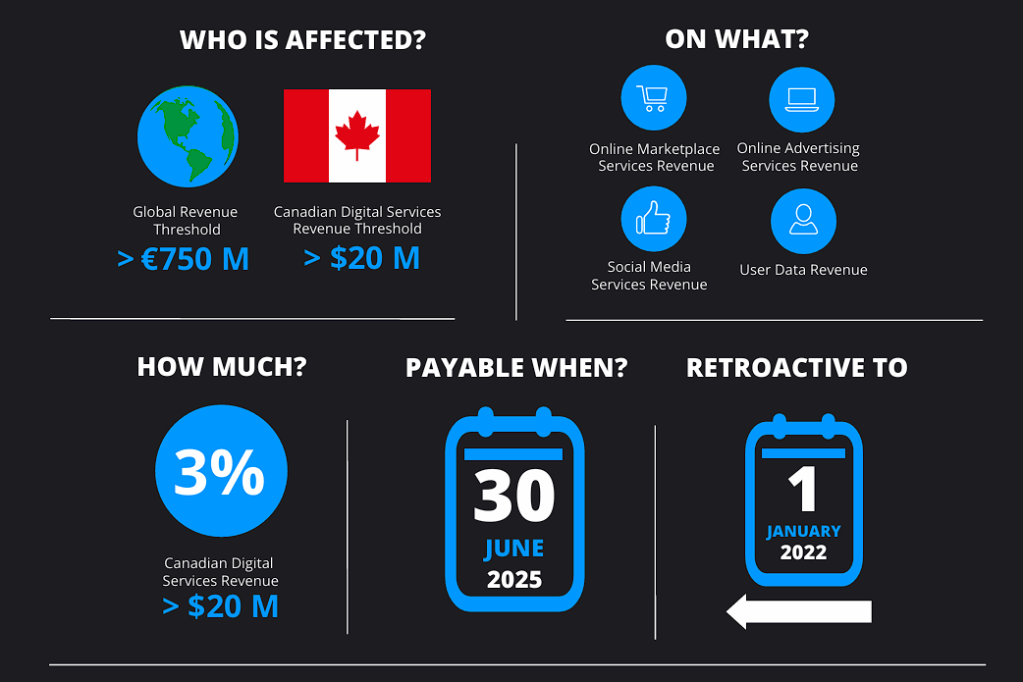
It was only a matter of time before Canada threw its toque into the ring on the global debate over taxing tech giants. After years of polite patience, Ottawa finally said enough is enough and committed to implementing a Digital Services Tax (DST), retroactively, no less, dating back to January 1, 2022. The goal? To make Big Tech pay its fair share for the billions they earn from Canadians’ online clicks, swipes, and searches. Predictably, this move hasn’t exactly gone down well south of the border, especially with Donald Trump, who’s already threatening retaliatory tariffs faster than you can say “Google it.”

Canada’s DST is a 3% levy on revenues from digital services; think online marketplaces, advertising platforms, and social media, that target Canadian users. The tax only kicks in for companies making over €750 million globally and more than $20 million in Canadian digital revenues. So, yes, this is about Amazon, Google, Meta, and Apple. Not your cousin’s Shopify side hustle.

The reasoning behind the move is, frankly, hard to argue with. For years, digital multinationals have made huge profits in countries where they have lots of users but no physical offices. Since our tax codes were written in the days of rotary phones, these companies have legally side-stepped corporate taxes in places like Canada while hoovering up data and ad dollars with industrial-grade efficiency. The DST is intended as a band-aid solution until a global fix comes together, though that band-aid is now being applied with an increasingly firm hand.

In truth, the global tide may finally be turning on Silicon Valley’s long, tax-free world tour. For over a decade, Big Tech has surfed a wave of international growth, scaling into nearly every market on Earth without paying local dues. Armed with sophisticated tax avoidance schemes, usually routed through Ireland or the Netherlands, the giants of the digital economy have profited handsomely while governments watched domestic retailers struggle to compete. But now, faced with growing public backlash and creaking public coffers, countries from France to India to Canada are drawing a line. The message is clear: if you make money off our citizens, you’re going to help fund the roads, schools, and social programs that keep them clicking.

The global fix in question is the OECD’s “Two-Pillar” solution, a diplomatic marathon attempting to modernize international tax rules. Pillar One aims to reallocate taxing rights to market countries (like Canada), while Pillar Two would establish a global minimum corporate tax of 15%. Canada has said it would delay DST collection if the OECD deal is implemented, but with the U.S. dragging its heels on ratification, Ottawa is preparing to go it alone.

That’s where Trump comes in. Never one to let a perceived slight slide, he’s treating Canada’s DST as a direct assault on U.S. interests. After all, the companies getting dinged are almost entirely American. Trump’s threats to slap retaliatory tariffs on Canadian exports are classic “America First” bluster, but they’re not without precedent. The U.S. already opened Section 301 investigations into several other countries’ DSTs, accusing them of unfairly targeting American firms. Biden’s administration cooled the rhetoric, but the sentiment remains.

Of course, Canada isn’t the only country to stick its neck out on this. France was the pioneer, pushing ahead with a 3% DST despite fierce U.S. pushback. Italy, Spain, and the UK followed suit. Even India got into the act with its “equalisation levy,” predating many Western attempts. Each of these nations, like Canada, grew tired of waiting for multilateral action while Silicon Valley giants dodged their tax nets with Olympic-level agility.

Interestingly, not everyone in the Anglosphere has been quite so bold. Take Australia. A few years back, it flirted with a DST, there were consultations, white papers, and worried glances toward Washington. But ultimately, Canberra decided to give the OECD process a shot and beefed up its anti-avoidance laws instead. Its Multinational Anti-Avoidance Law and Diverted Profits Tax now let the tax office go after digital firms that try to shuffle profits offshore. It’s the equivalent of hiring a tough new accountant rather than inventing a new tax altogether.

New Zealand, meanwhile, has taken a “just in case” approach. Legislation for a 3% DST was passed in 2023, but it’s sitting in a drawer for now, ready to go if the OECD talks collapse. The Kiwis have been clear they don’t want to pull the trigger unless absolutely necessary, probably because they’d prefer not to find themselves on the receiving end of a tweetstorm or tariff tantrum from the next American administration.

So here we are: Canada, gloves off and calculator in hand, is forging ahead, determined to claw back a fair share from the tech titans. Australia and New Zealand, pragmatic as ever, are hedging their bets and keeping trade relationships intact, at least for now. But even their patience has limits. The longer the OECD deal stalls, the more tempting it becomes to follow Canada’s lead.

In the end, this is a fight not about code or commerce, but about fairness in the digital age. The world’s tax systems were built for an era of railroads and oil refineries, not cloud storage and influencer revenue. Until the global rules catch up, expect more countries to test their own digital tax solutions. Whether that means poking the American bear or just poking around in policy drawers remains to be seen. But one thing’s certain: tech giants might finally be running out of places to hide.

Five Things We Learned This Week

Here is the latest edition of “Five Things We Learned This Week” for May 3–9, 2025, highlighting significant global developments across various sectors.

🌋 1. Volcanic Eruption in Iceland Disrupts Tourism

The Sundhnúkur volcanic system in Iceland erupted this week, leading to increased seismic activity near Grindavík. The Icelandic Meteorological Office reported the eruption and registered accompanying earthquakes. As a precaution, popular tourist destinations like the Blue Lagoon were evacuated, impacting the country’s tourism sector.  

💰 2. India’s Forex Reserves Decline After Eight Weeks of Gains

India’s foreign exchange reserves fell by $2.07 billion to $686.06 billion as of May 2, 2025, ending an eight-week streak of gains. The decline was primarily due to a decrease in gold reserves, which dropped from $84.37 billion to $81.82 billion. During the same week, the Indian rupee experienced volatility, appreciating by about 1% due to increased foreign inflows and optimism surrounding a potential U.S.-India trade agreement, but later depreciated by 0.9% amid geopolitical tensions between India and Pakistan.  

🧪 3. Scientists Develop Method to Generate Electricity from Rainwater

Researchers have reported a new method of generating electricity from falling rainwater using plug flow in vertical tubes. This technique converts over 10% of the water’s energy into electricity, producing enough power to light 12 LEDs. The innovation holds promise for sustainable energy solutions, especially in regions with high rainfall.  

📉 4. Consumer Goods Prices Expected to Rise Amid Tariff Pressures

Following President Trump’s introduction of steep tariffs on imports, notably a 145% tariff on Chinese goods, major consumer goods companies like Procter & Gamble, Nestlé, and Unilever anticipate raising prices. These increases add to consumer strain after three years of inflation and declining confidence, especially in the U.S., where shoppers face job uncertainty and potential recession. While some companies are attempting to pass costs to consumers, retailers and supermarkets are pushing back, warning that consumers are reaching their financial limits.  

⚔️ 5. Escalation in South China Sea Territorial Disputes

China has seized the disputed Sandy Cay Reef in the Spratly Islands of the South China Sea, intensifying territorial disputes in the region. The move has raised concerns among neighboring countries and the international community about escalating tensions and the potential for conflict in the strategically important area.  

Stay tuned for next week’s edition as we continue to explore pivotal global developments.

Folly at the Border: Why War with Canada is a Losing Game

The idea of the United States invading Canada is pure fantasy – fiction that resurfaces when political tensions rise. History has seen conflict between the two nations, notably the War of 1812, but in modern times, such an invasion is not just improbable – it’s impossible. The recent escalation of trade tensions, triggered by the U.S. threat of 25% tariffs on Canadian imports in February 2025, has renewed debate over the state of relations. But let’s be clear: trade disputes don’t lead to tanks rolling across borders.

Canada and the U.S. share the world’s longest peaceful border (8,890 km) and a deeply intertwined economy. Canada is the U.S.’s second-largest trading partner, with trade worth hundreds of billions annually. A military invasion would shatter this economic relationship, triggering global market chaos, retaliatory tariffs, and crippling sanctions. The U.S.-Mexico-Canada Agreement (USMCA) would collapse, devastating American industries and consumers. Even the mere suggestion of aggression would spook markets and alienate key allies, making it a non-starter for even the most hardline economic nationalists.

Yes, the U.S. has the world’s most powerful military. No, that doesn’t mean invading Canada is feasible. Geography alone makes occupation nearly impossible. Vast forests, prairies, and the Rocky Mountains would bog down any invading force. Even during the War of 1812, when Canada was smaller and less industrialized, American forces struggled to maintain supply lines. Today, with modern infrastructure and a well-equipped Canadian military, the challenge would be exponentially greater.

Canada’s armed forces, though smaller than the U.S. military, are highly professional, technologically advanced, and well-integrated into NATO. The moment American troops crossed the border, global condemnation would be swift, and allies, including European powers, would not tolerate such an egregious violation of international law. The U.S. would find itself isolated and facing retaliatory action.

Invading Canada wouldn’t just be a military disaster, it would make the U.S. a global pariah. Canada is one of the world’s most respected nations, known for diplomacy, peacekeeping, and strong alliances. An unprovoked attack would trigger severe sanctions from the EU, UK, and other key trading partners, crippling U.S. banks and multinational corporations. The diplomatic fallout could even fracture NATO.

At home, the American public would reject such a reckless move. Canadians, fiercely proud of their independence, would mount an unyielding resistance. Any occupying force would face guerrilla warfare, sabotage, and mass civil disobedience – turning Canada into another unwinnable quagmire, like Vietnam or Iraq. The political backlash within the U.S. would be massive, with protests and upheaval against a war that serves no legitimate purpose.

Beyond all this, a war with Canada would be a direct threat to North American security. The U.S. and Canada work together through NORAD, jointly protecting the continent. Disrupting this alliance would leave both nations vulnerable to adversaries like China and Russia. In today’s world, power is determined by cybersecurity, economic influence, and technological dominance – not outdated military conquest.

Even in the heat of a 2025 trade war, where tensions are high, the leap from tariffs to military action is absurd. Trade disputes are fought with economic measures, not invasions. The fact that some even entertain this notion is more a reflection of political hyperbole than any serious strategic consideration.

A U.S. invasion of Canada isn’t just impractical – it’s impossible. The economic fallout, military challenges, guaranteed international backlash, and fierce Canadian resistance make it a non-option. The U.S. and Canada have their disagreements, but history has shown that their relationship is built on cooperation, shared values, and mutual benefit. The current trade war will eventually be resolved through negotiation, not war.

So, let’s put this nonsense to rest. Canada isn’t going anywhere. And if anyone thinks otherwise – think again.

The Power of AgriFood Supply Management: Protecting Canadian Grocery Costs

Canada’s supply management system for dairy, poultry, and eggs is about to prove its worth as U.S. tariffs threaten to drive up food prices across the country. Unlike the free-market volatility seen in other parts of the grocery sector, supply-managed goods benefit from a carefully controlled production and pricing system that shields both farmers and consumers from external shocks. While some food categories, particularly those reliant on global trade, are expected to see price hikes due to shifting tariff policies, supply management will help ensure that Canadian shoppers don’t feel the full brunt of these disruptions when it comes to staples like milk, cheese, chicken, and eggs. This is part of the reason why the Bloc Québécois has been fighting to protect Canadian agrifood supply management from future trade negotiations with the U.S. 

At the heart of this system is production control, which ensures that Canadian farmers produce only as much as the domestic market demands. This prevents overproduction, which can drive prices down unsustainably, and underproduction, which leads to shortages and skyrocketing costs. By maintaining a predictable balance between supply and demand, Canada avoids the kind of dramatic price swings that often plague food markets when international trade is disrupted. If American producers face steep tariffs on their agricultural exports to Canada and Mexico, they will likely respond by raising production or looking for alternative markets, creating instability in global food supply chains. However, because Canada’s system prioritizes production for domestic consumption, our supply-managed sectors will be largely insulated from this volatility.

Another key advantage of this system is import restrictions, which limit how much foreign dairy, poultry, and eggs can enter the Canadian market. These restrictions act as a buffer, shielding the domestic food supply from sudden external price shocks. If U.S. tariffs make it more expensive for American farmers to produce and export their goods—whether due to higher costs for feed, fertilizers, equipment, or transportation—the price of their products will rise accordingly. But because Canada strictly controls how much foreign dairy and poultry can enter the market, these increases won’t directly impact the availability or affordability of Canadian supply-managed goods. While consumers in the U.S. could see price hikes on essential groceries due to their country’s changing trade policies, Canadian shoppers will find more stability in their supply-managed products.

Perhaps the most critical component of Canada’s approach is price regulation at the farm level, which guarantees that producers receive a fair, cost-based price for their goods. This system prevents the kind of unpredictable swings that occur in unregulated markets, where external factors like trade wars, economic downturns, or climate disruptions can send food prices soaring overnight. By ensuring that Canadian farmers earn a predictable and stable income, the system also reduces the likelihood of sudden price hikes at the grocery store. Even as global food markets react to U.S. tariffs with rising costs, supply-managed products will remain steady, providing much-needed price relief for Canadian households.

That’s not to say that supply management is a perfect shield against inflation. Many inputs required for farming—such as animal feed, fuel, transportation, and packaging—are still subject to global market forces, meaning that rising costs in these areas could indirectly influence retail prices. Additionally, supply management does not cover all food categories. Sectors like beef, pork, grains, and processed foods remain more exposed to international price fluctuations, meaning that consumers will still feel some of the effects of U.S. tariff policies. However, compared to a fully unregulated system, Canada’s approach offers a crucial layer of protection for both farmers and consumers.

As the impact of U.S. tariffs unfolds, Canadians may start to appreciate the stability that supply management provides. While some critics argue that the system limits consumer choice and keeps prices higher than they would be in a fully open market, the reality is that it prevents the extreme price fluctuations that can wreak havoc on household budgets. In uncertain economic times, a reliable and predictable food supply isn’t just a convenience—it’s a necessity. Canada’s supply management system ensures that, at least when it comes to dairy, eggs, and poultry, Canadian shoppers can count on consistent pricing, regardless of what happens in the broader global economy.