
Back in 2010-2012, I was working with clients such as the Canadian Model Forest Network, Agriculture and Agri-Food Canada, and Natural Resources Canada to help define and develop this industry. I thought it was time to update myself on its progress.
When Canadians think of forests, they typically picture lumber, pulp, and paper. Yet, beyond the timber trade lies an equally vital and dramatically underdeveloped resource sector: non-timber forest products (NTFPs). These include wild mushrooms, berries, medicinal herbs, tree saps, florals, and natural resins; goods that have been harvested for centuries by Indigenous peoples and rural communities, but remain economically marginal in modern Canada. As the agrifood sector seeks to diversify income sources, adapt to climate risks, and respond to consumer demand for sustainable and culturally authentic products, NTFPs represent an untapped reservoir of opportunity.
Canada, after all, is one of the most forested countries on Earth, with over 347 million hectares of forest covering approximately 38% of its landmass. Within these ecosystems is a treasure trove of bioresources, many of which are already enjoying renewed interest in global markets: from functional foods and nutraceuticals to cosmetics and natural health products. The challenge is not whether Canada has the raw materials. It is whether the country can align policy, investment, and Indigenous partnerships to turn these undervalued goods into robust regional economies.
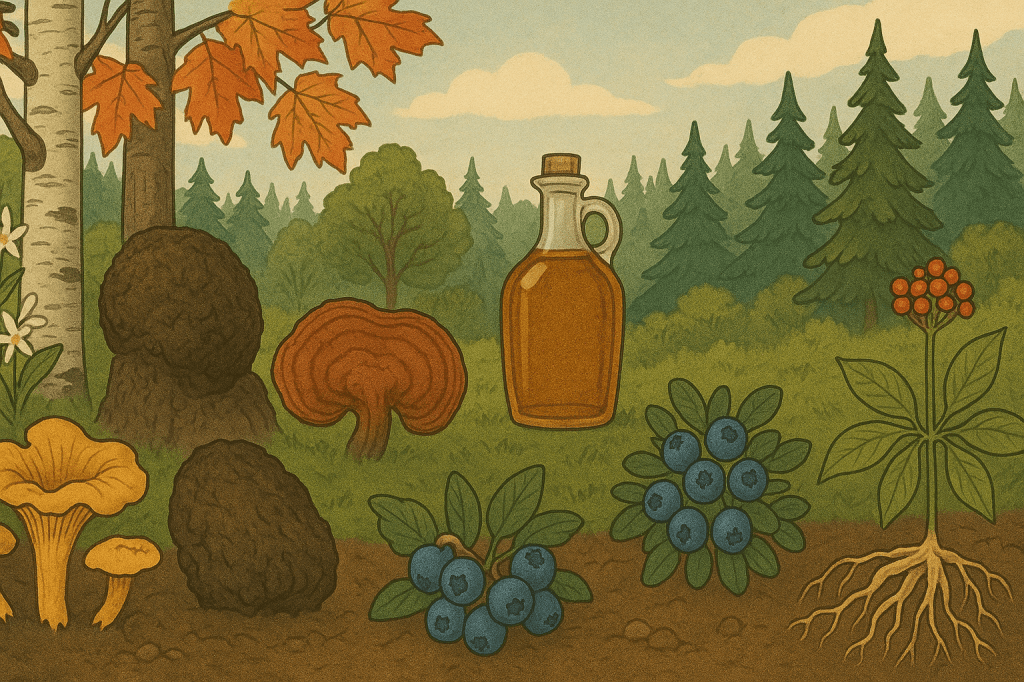
At present, the NTFP sector is dominated by one clear leader: maple syrup. Worth over $1 billion annually, and with Quebec supplying more than 70% of the world’s maple syrup, this industry is the flagship of Canada’s non-timber forest economy. Wild blueberries, predominantly from Quebec, Nova Scotia, and New Brunswick, form another lucrative market, with production values exceeding $300 million in 2023. Yet outside of these headline commodities, the remaining NTFP sector is diffuse, localized, and largely informal. Wild mushrooms like morels, chanterelles, and lobster mushrooms are harvested across British Columbia, Ontario, and the Maritimes, often exported to European and Asian buyers, but little coordinated infrastructure exists to support consistent volumes or traceable quality. Medicinal plants such as chaga, Labrador tea, and devil’s club are well known to Indigenous communities, but underutilized in formal markets.
The potential for growth in this sector is significant. Globally, the market for natural health and functional food products is expanding rapidly. Medicinal mushrooms, in particular, are on track to reach $19 billion by 2030, according to 2024 projections by Global Market Insights. Canada’s forests host many of these species, including chaga, reishi, lion’s mane, and turkey tail, all of which are in high demand in wellness and integrative medicine circles. Similarly, birch sap, a staple in parts of Eastern Europe and Russia, is beginning to attract attention in North America as a low-sugar, antioxidant-rich beverage. There is considerable room for Canadian producers to position their NTFPs in these emerging global niches, especially if backed by origin branding, sustainability certification, and cultural narratives that resonate with eco-conscious consumers.
Despite this promise, the NTFP sector remains constrained by structural barriers. Chief among these is the fragmented and often inconsistent regulatory environment across provinces. Many NTFPs fall outside the scope of forestry tenure agreements and agricultural marketing boards, leaving harvesters in a grey zone with unclear land access rights or commercialization protocols. In some provinces, the rules for harvesting and selling wild mushrooms or herbal plants vary from one jurisdiction to another, complicating efforts to build coordinated value chains. The lack of aggregation infrastructure and cold storage capacity further limits the ability of small-scale producers to move beyond seasonal, informal markets.
Another limiting factor is the scarcity of applied research and product development capacity tailored to NTFPs. Few Canadian universities or government research agencies have dedicated programs for wild plant or fungal product development, and even fewer link with Indigenous knowledge systems in ways that are respectful, reciprocal, and rights-based. Traditional knowledge about the ecological cycles, medicinal uses, and sustainable harvest of forest plants remains vastly underrecognized in Canada’s commercial landscape. Until this knowledge is better integrated and protected through co-management and intellectual property frameworks, the sector will remain vulnerable to exploitation and underperformance.
Equity and land tenure issues must also be addressed. Indigenous communities are among the most active stewards and knowledge-holders of NTFPs, yet they often face structural barriers to entering or scaling in commercial markets. The promise of NTFPs as a tool for Indigenous economic development is well documented, but to realize that potential, governments must ensure clear access rights, provide targeted funding for Indigenous-led enterprises, and support co-governance models that reflect Indigenous sovereignty over forest resources.
Looking ahead, the Canadian NTFP sector needs a concerted strategy. This means intergovernmental coordination to harmonize regulations, investment in processing and aggregation infrastructure, and the development of national standards for quality assurance. Just as importantly, there must be a storytelling effort, one that situates NTFPs not merely as exotic forest goods, but as emblematic of Canada’s commitment to sustainable agriculture, reconciliation, and regional resilience. Products like Labrador tea, spruce tips, and wild fiddleheads should not be relegated to niche farmers’ markets; they should be among Canada’s most proudly exported biocultural goods.
If Canada is to meet its agrifood diversification and climate adaptation goals, the time has come to give non-timber forest products their due. The market is maturing, the environmental case is strong, and the social and economic benefits, particularly for Indigenous and rural communities, are substantial. We must move beyond pilot projects and showcase stands. With vision and investment, Canada’s NTFP industry could blossom from a peripheral activity into a pillar of the national agrifood economy.
Sources
• Natural Resources Canada. (2021). Non-Timber Forest Products in Canada: An Overview. https://www.nrcan.gc.ca/
• Agriculture and Agri-Food Canada. (2023). Statistical Overview of the Canadian Fruit Industry 2023. https://agriculture.canada.ca/
• Global Market Insights. (2024). Medicinal Mushroom Market Size, Share & Trends Analysis. https://www.gminsights.com/
• Indigenous Forestry Initiative. (2023). Case Studies in Indigenous-Led NTFP Enterprises. https://www.canada.ca/en/environment-climate-change/services/indigenous-forestry-initiative.html
 The Rowanwood Chronicles