
Ottawa’s Confederation Line was meant to be the spine of a growing capital. Instead, it has become a case study in how complex systems fail slowly, publicly, and expensively when accountability is diluted and warning signs are treated as inconveniences rather than alarms.
The most recent episode is stark even by Line One standards. Roughly 70 percent of the train car fleet has been removed from service due to wheel bearing failures, leaving the system operating with dramatically reduced capacity. This is not a cosmetic defect or a comfort issue. Wheel bearing assemblies are fundamental safety components. When they degrade, trains are pulled not because service standards slip, but because continued operation becomes unsafe.
That distinction matters.
A Fleet Designed at the Margins
The Alstom Citadis Spirit trains operating on Line One were marketed as adaptable to Ottawa’s climate and operational demands. In practice, they appear to have been designed and procured with little margin for error. Investigations following earlier derailments already identified problems with wheel, axle, and bearing interactions under real-world conditions. The current bearing crisis suggests those lessons were not fully integrated into either design revisions or maintenance regimes.
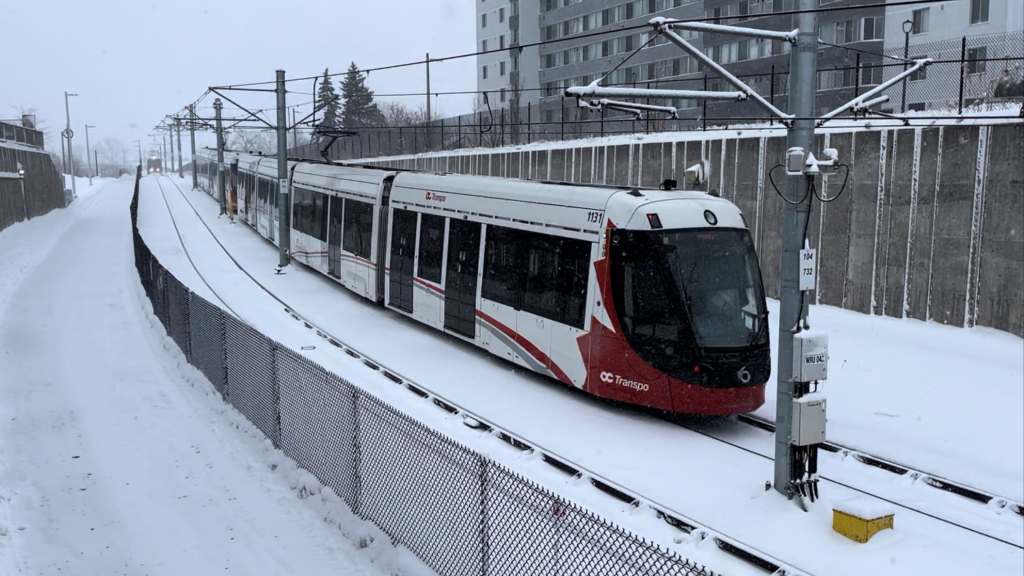
OC Transpo’s decision to remove all cars that have exceeded approximately 100,000 kilometres of service is telling. That threshold is not a natural lifecycle limit for modern rail equipment. It is an emergency line drawn after degradation was discovered, not a planned overhaul interval. When preventive maintenance becomes reactive withdrawal, the system is already in trouble.
When Reliability Becomes Optional
What riders experience as “unreliability” is, at the system level, something more troubling: normalized failure.
Short trains. Crowded platforms. Sudden slow orders. Unplanned single tracking. Bus bridges that appear with little notice. Each disruption is explained in isolation, yet they form a continuous pattern. The city has become accustomed to managing failure rather than preventing it.
This matters because transit is not a luxury service. It is civic infrastructure. When reliability drops below a certain threshold, riders do not simply complain. They adapt by abandoning the system where they can, which in turn undermines fare revenue, political support, and long-term mode shift goals. The system enters a feedback loop where declining confidence justifies lowered expectations.
Governance Without Ownership
One of Line One’s enduring problems is that responsibility is everywhere and nowhere at once. The public owner is the City of Ottawa. Operations are contracted. Vehicles were procured through a public-private partnership. Maintenance responsibilities are split. Oversight relies heavily on assurances rather than adversarial verification.
When failures occur, no single actor clearly owns the outcome. This is efficient for risk transfer on paper, but disastrous for learning. Complex systems improve when failures are interrogated deeply and uncomfortably. Ottawa’s LRT has instead produced a culture of incremental fixes and carefully worded briefings.
The wheel bearing crisis did not appear overnight. It emerged from cumulative stress, design assumptions, and operational realities interacting over time. That is precisely the kind of problem P3 governance structures are worst at confronting.
The Broader System Cost
The immediate impact is crowding and inconvenience. The deeper cost is strategic.
Ottawa is expanding Line One east and west while the core remains fragile. New track and stations extend a system whose reliability is still unresolved at its heart. Each extension increases operational complexity and maintenance demand, yet the base fleet is already struggling to meet existing service levels.
This is not an argument against rail. It is an argument against pretending that infrastructure can compensate for unresolved engineering and governance failures.
What Recovery Would Actually Require
Recovery will not come from communications plans or incremental tuning. It requires three uncomfortable shifts.
First, independent technical authority with the power to halt service, mandate redesigns, and override contractual niceties. Not advisory panels. Authority.
Second, transparent lifecycle accounting. Riders and taxpayers should know what these vehicles were expected to deliver, what they are delivering, and what it will cost to bring reality back into alignment with promises.
Third, political honesty. Reliability will not improve without sustained investment, possible fleet redesign, and service compromises during remediation. The public can handle bad news. What it cannot handle indefinitely is spin.
A Spine, or a Lesson
Ottawa’s Line One still has the potential to be what it was meant to be. The alignment is sound. The ridership demand exists. The city needs it.
But infrastructure does not fail because of a single bad component. It fails when systems tolerate weakness until weakness becomes normal. The wheel bearing crisis is not an anomaly. It is a signal.
The question now is whether Ottawa treats it as another incident to manage, or as the moment to finally confront the deeper architecture of failure that has defined Line One since its opening.
Sources:
CityNews Ottawa. “OC Transpo forced to remove trains from Line 1 due to wheel bearing issue.” January 2026.
https://ottawa.citynews.ca
Yahoo News Canada. “70% of Ottawa’s Line 1 trains out of service amid bearing problems.” January 2026.
https://ca.news.yahoo.com
Transportation Safety Board of Canada. “Rail transportation safety investigation reports related to Ottawa LRT derailments.” 2022–2024.
https://www.tsb.gc.ca
OC Transpo. “O-Train Line 1 service updates and maintenance notices.”
https://www.octranspo.com



 The Rowanwood Chronicles