From Vision to Momentum: Alto Enters Its Defining Phase

For years, Canada’s ambitious dream of linking its greatest cities with true high-speed rail has hovered in the realm of feasibility studies and future pipe dreams. Now, in the closing weeks of 2025, that dream has shifted decidedly toward reality; not because steel is yet being laid, but because the Alto high-speed rail initiative has crossed a crucial threshold from concept to concerted preparation and public engagement.

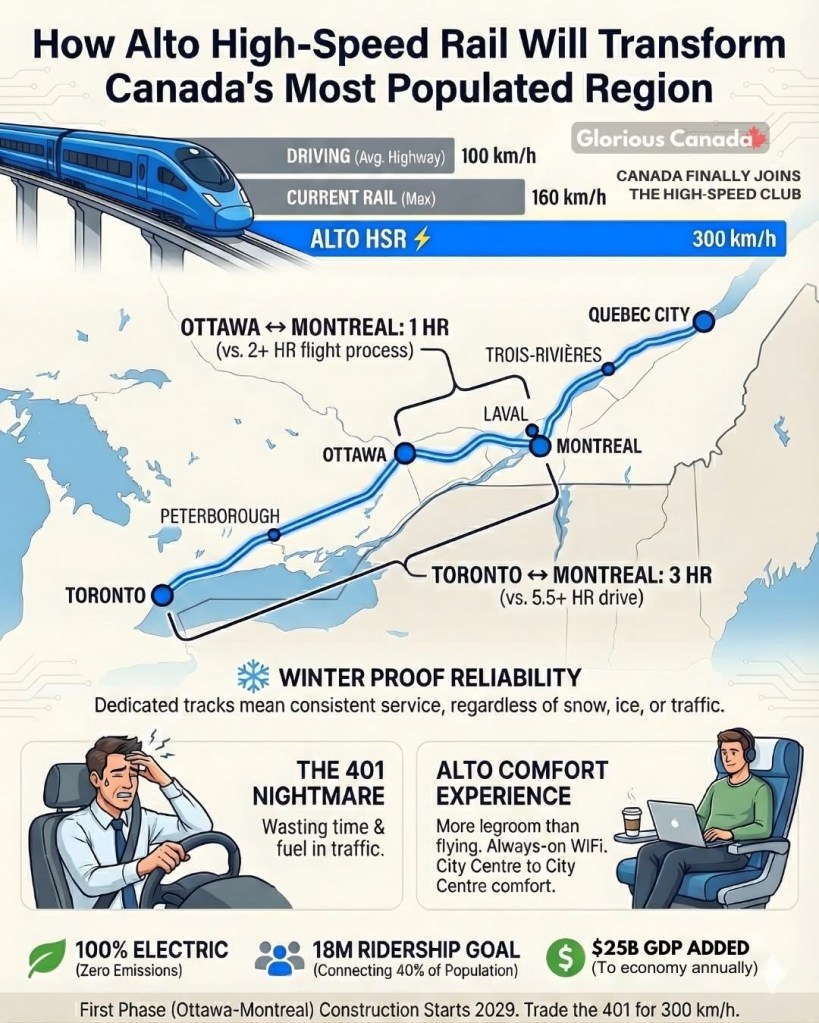
At its core, Alto is a transformative infrastructure vision: a 1,000-kilometre electrified passenger rail network connecting Toronto to Québec City with trains capable of 300 km/h speeds, slicing travel times compared to what today’s intercity rail offers and binding half the nation’s population into a single, rapid mobility corridor. The design phase, backed by a multi-billion-dollar co-development agreement with the Cadence consortium, is well underway, and the federal government has signaled its intent to see this project delivered as one of the largest infrastructure investments in decades.  

The most noteworthy milestone in recent weeks has been a strategic decision about where Alto will begin to take physical shape. On December 12, officials announced that the Ottawa–Montreal segment – roughly 200 km – will be the first portion of the network to advance toward construction, with work slated to begin in 2029. This choice reflects a practical staging strategy: by starting with a shorter, clearly defined corridor that spans two provinces, engineering and construction teams can mobilize simultaneously in Ontario and Québec and begin delivering economic and skills-development benefits sooner rather than later.  

This announcement isn’t just about geography; it marks a shift in Alto’s progression from broad planning to community-level engagement. Beginning in January 2026, Alto will launch a comprehensive three-month consultation process that includes open houses, virtual sessions, and online feedback opportunities for Canadians along the corridor. These sessions will inform critical decisions about alignment, station locations, and mitigation of environmental and community impacts. Indigenous communities, municipalities, and public institutions will be active participants in these discussions as part of Alto’s ongoing commitment to consultation and reconciliation, a recognition that this project’s success hinges not only on engineering prowess, but on thoughtful, inclusive planning.  

Beyond route planning, Alto and Cadence are also turning to Canada’s industrial capacity, particularly the steel sector, to gauge the domestic supply chain’s readiness for what will undeniably be a massive procurement exercise. With thousands of kilometres of rail and related infrastructure components needed, early outreach to the steel industry is intended not just to assess production capacity, but to maximize Canadian content and economic benefit from the outset.  

Yet not every question has a definitive answer. Strategic discussions continue over the optimal location for Alto’s eventual Toronto station, with the CEO publicly acknowledging that a direct connection to Union Station may not be guaranteed; a decision that could shape ridership patterns and integration with existing transit networks across the Greater Toronto Area.  

As the calendar turns toward 2026, the Alto project sits at an inflection point: one foot firmly planted in detailed design and consultation, the other inching closer to the realm of shovels and steel rails. Political support appears robust, and fiscal planning, including major project acceleration initiatives and supportive legislation, has built momentum. Yet, as any transportation planner will tell you, the distance between planning and construction is long, often winding, and frequently subject to political, economic, and community pressures.

Still, for advocates and observers alike, the significance of the latest developments cannot be overstated. Alto has graduated from “what if?” to “when and how,” and that alone marks a major step forward in Canada’s transportation evolution.

VIA Rail Misses the Train on Serving Canadians

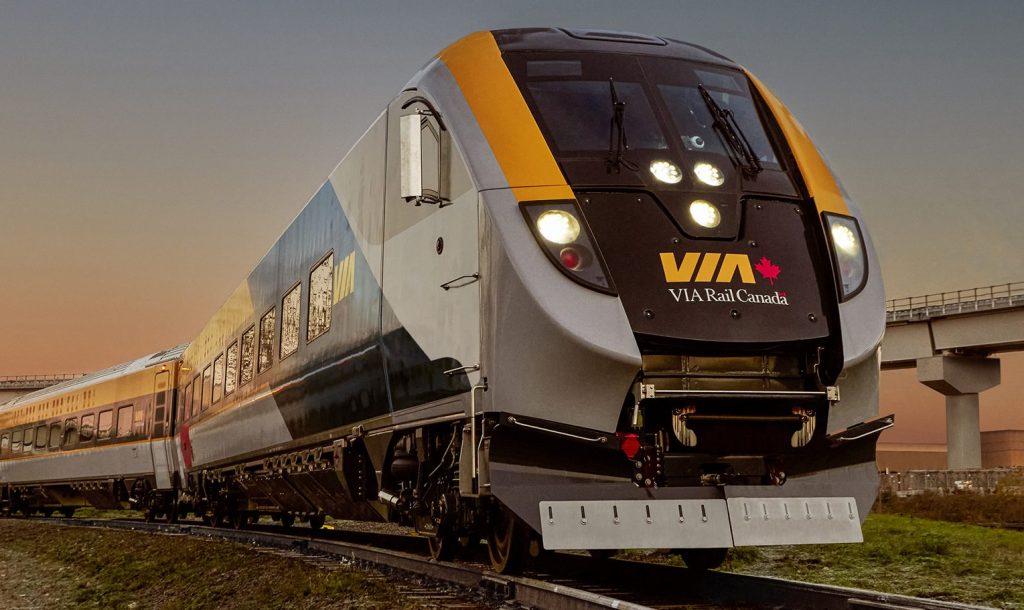
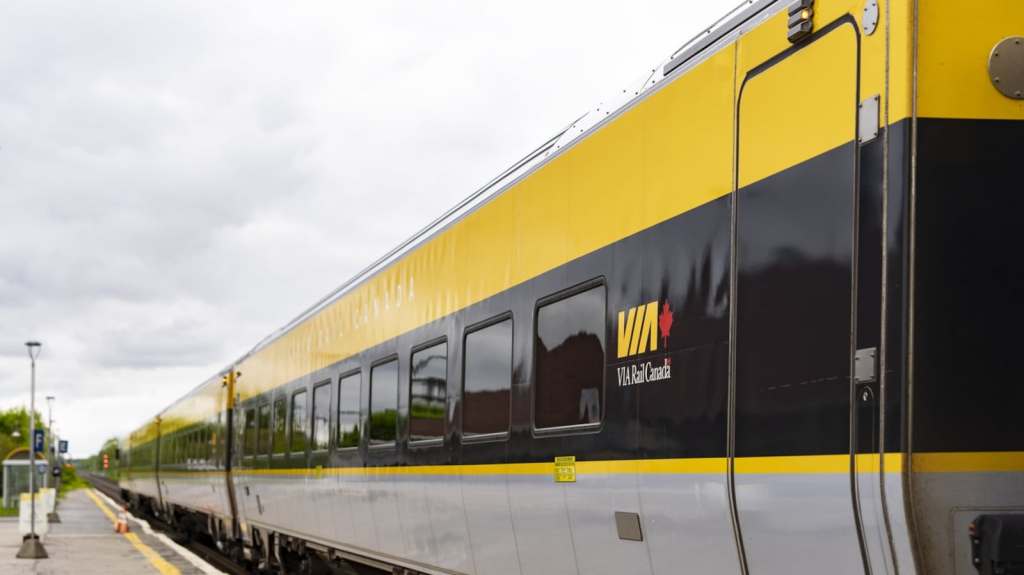
VIA Rail recently trumpeted a new “pilot project” meant to shave half an hour off the Montréal–Toronto run. The idea was to run nonstop trains between the two big cities, bypassing Cornwall, Brockville, Kingston, and Belleville. The announcement was pitched as a bold experiment in “efficiency,” a nod to the 70 percent of surveyed passengers who supposedly wanted quicker travel between downtown cores.

But almost immediately, the wheels came off. Citing “operational constraints” with their partner CN, VIA Rail suspended the project before it even left the station. On paper, this looks like a technical hiccup, another example of Canada’s fragile rail system bending to the priorities of freight traffic. But in reality, the plan itself was the problem. It was never about serving Canadians, it was about copying European or Japanese rail gloss without any of the context, backbone, or infrastructure investment those systems require.

For decades, communities along the corridor have depended on trains as lifelines. Students in Kingston, retirees in Belleville, families in Cornwall – these aren’t “optional” stops. They’re the heart of what passenger rail is supposed to do: connect Canadians, not just shuttle executives between two large metro centres. The whole point of a public Crown corporation like VIA Rail is to balance speed with accessibility, ensuring that smaller communities aren’t stranded in the name of shaving 30 minutes off a trip for a select few.

Even politicians, often slow to notice transit tweaks, raised red flags. Brockville’s mayor called the nonstop plan “concerning” and Conservative MP Michel Barrett branded it “unacceptable.” They weren’t wrong. Stripping out regional stops would have meant sidelining thousands of riders, effectively telling entire towns they were expendable in the rush to serve big-city commuters.

The irony is that the project was marketed as modernization. But modernization, in a Canadian context, should mean strengthening regional ties, upgrading track infrastructure, and finally breaking free of freight’s stranglehold on passenger rail, not copying a TGV fantasy while underfunding the very communities that give the corridor its economic and social weight.

Instead, VIA Rail now looks like it tried to leap forward without noticing the tracks were missing. Worse, its apology to passengers rings hollow. The real apology is owed to the communities it dismissed as speed bumps, to the Canadians who still believe public transportation is about more than corporate surveys and flashy PR lines.

In the end, the scrapped nonstop pilot is a lesson: if VIA Rail wants to serve Canadians, it needs to remember who those Canadians are. They’re not just the 70 percent who want to get to Bay Street faster. They’re also the people in eastern Ontario whose taxes help keep VIA afloat, and who deserve not to be treated as collateral damage in a misguided chase for efficiency.

Sometimes slowing down isn’t failure, it’s service. VIA Rail might want to remember that before the next “pilot project” takes off.

The Return of Britain’s Railways: A Justified Journey Back to Public Hands

Few issues in the United Kingdom’s domestic infrastructure provoke as much consistent frustration, and cautious optimism, as the performance of the national railway system. After more than three decades of privatized operation, mounting failures in service quality, rising costs, and structural inefficiencies have prompted a significant policy shift. The renationalization of Britain’s train services marks the gradual undoing of a deeply ideological experiment that has fallen short of its promises.

This shift is not driven by nostalgia, but by necessity.

Background and Rationale for Renationalization
The privatization of British Rail in the mid-1990s was framed as a path to modernity. Proponents argued that market competition would drive efficiency, reduce government spending, and improve customer service. Instead, the result was a fragmented system comprised of multiple Train Operating Companies (TOCs), overseen by various regulatory bodies, while infrastructure was handed to a separate private firm, Railtrack—an entity whose eventual failure and replacement by Network Rail in 2002 was an early indicator of deeper systemic flaws.

Despite significant taxpayer subsidies, performance metrics across the privatized rail network began to deteriorate by the 2010s. Delays, overcrowding, high fares, and poor coordination became routine issues. Government spending on the sector did not decline; instead, public funds increasingly subsidized private profits. By 2020, annual state support exceeded £7 billion.

The COVID-19 pandemic laid bare the system’s fragility. As passenger numbers collapsed, the government assumed emergency control over all franchises, effectively nationalizing operations under temporary measures. This moment of crisis exposed the private sector’s dependence on public backing and underscored the need for structural reform.

Recent Developments and Implementation
Renationalization in Britain has proceeded in stages, marked by pragmatism rather than ideological confrontation. Several poorly performing franchises, such as Northern, Southeastern, and the East Coast Main Line, were brought under the control of the government’s Operator of Last Resort (OLR). This allowed continuity of service while avoiding legal entanglements with private firms.

A formal framework was introduced with the Passenger Railway Services (Public Ownership) Act 2024, passed under the Labour government. This legislation allows passenger services to be brought under public control as contracts with private operators expire. In May 2025, South Western Railway (SWR) became the first operator transitioned under this new legal mechanism. Other operators, including Greater Anglia and c2c, are expected to follow before the end of the year.

This incremental approach avoids costly buyouts and is designed to be financially and administratively sustainable. Most passenger services in England are projected to return to public ownership by 2027.

The Role of Great British Railways
A central element of the reform effort is the establishment of Great British Railways (GBR), a single public entity that will unify track and train operations, long-term planning, fare structures, and accountability. The GBR model replaces the franchising system with a concession-based framework, where the state retains fare revenue and strategic control while outsourcing operations under tightly managed contracts.

GBR is not intended to replicate the British Rail of the past. It reflects modern best practices, taking cues from integrated public systems in Germany, Japan, and other high-performing countries. The goal is to streamline operations, enable through-ticketing, and restore strategic coherence to rail governance.

Implementation, however, has encountered delays. Structural changes, legislative hurdles, and coordination challenges have slowed GBR’s rollout. Industry stakeholders continue to press for greater clarity and faster progress.

Challenges and Caveats
While the rationale for public control is widely supported, several challenges remain. Technical difficulties have marred the rollout of SWR’s new Arterio fleet, due to manufacturing delays and labour disputes. Industrial relations require careful management to avoid disruption and foster long-term cooperation.

Fares remain a sensitive issue. Although public ownership may improve value for money, there is as yet no guarantee of fare reductions. Without visible improvements in affordability and service reliability, public support, though currently strong, may erode.

Operational excellence will be critical. Renationalization removes profit motives but does not in itself guarantee efficiency, innovation, or customer satisfaction. Robust governance, sustained investment, and clear performance targets are essential for long-term success.

Public and Political Sentiment
Public opinion has consistently favoured renationalization. A 2024 Ipsos poll found that 54% of Britons support the return of rail services to public ownership. The policy aligns with broader desires for a reliable, affordable, and accountable public transport system, particularly in the context of climate commitments and regional economic development.

Politically, the approach adopted avoids the pitfalls of abrupt, combative state intervention. By allowing contracts to expire and absorbing operations through established legal mechanisms, the process has proceeded with minimal disruption.

A Measured Return to Public Responsibility
The renationalization of Britain’s railways represents a strategic recalibration of transport policy. After decades of dysfunction under fragmented private control, the reassertion of public oversight is both justified and overdue.

This is not a reversal for its own sake, nor a rejection of innovation or partnership. It is a reassertion of the principle that essential public infrastructure should serve the common good, not the balance sheets of corporate shareholders.

The coming years will determine whether this vision can be translated into a rail system that is reliable, integrated, and equitable. If managed well, the return to public ownership may yet become one of the most important and popular infrastructure reforms in modern British history.

Sources:
• “New dawn for rail as South Western services return to public hands,” GOV.UK, May 25, 2025. Link
• “Great British Railways and the public ownership programme,” GOV.UK, May 25, 2025. Link
• “Passenger Railway Services (Public Ownership) Act 2024,” GOV.UK, November 28, 2024. Link
• “Public Attitudes towards rail nationalisation and strike action,” Ipsos, May 2, 2024. Link
• “SWR to be first train UK operator to be renationalised under Labour plan,” Reuters, December 4, 2024. Link
• “Great British Railways Takes Major Step Forward: 2025,” Rail Industry Connect, May 29, 2025. Link

Why Ottawa’s Merivale Amazon Warehouse is a Strategic Blunder

Ottawa’s approval of a massive Amazon warehouse on Merivale Road, a sprawling 3.1 million sq ft, 75‑acre facility, marks a strategic misstep in land-use planning. As the city’s largest such development yet, it will usher in heavy fleet operations directly into residential southern suburbs, undermining broader policy goals and community health.

🚚 Traffic Overload & Safety Impacts
Warehouses of this scale generate hundreds of heavy truck movements daily, estimated at around 500 trips, likely running 24/7. Local roads like Merivale and Fallowfield, designed for commuter cars and transit, cannot absorb this freight volume. Congestion, pavement deterioration, and heightened collision risks for pedestrians and cyclists will become daily realities. Safety margins shrink when trailers and semis share space with school buses and family vehicles.

🌬️ Air Quality & Environmental Inequity
Diesel trucks are major sources of PM2.5, nitrogen oxides, and greenhouse gases: pollutants strongly linked with respiratory and cardiovascular diseases. Locating such an operation mere hundreds of metres from homes, schools, and parks imposes environmental harm on vulnerable communities, violating the principles of environmental justice. Moreover, the warehouse’s massive rooflines and parking surfaces will intensify stormwater runoff, local flooding, and the urban heat-island effect, undermining efforts to green the suburbs.

🔊 Noise Pollution & Public Health
24/7 operations bring diesel engines, reverse beepers, dock doors, HVAC systems, and bright lighting, the sort of noises that erode sleep quality. The WHO has linked long-term noise exposure to stress-related illnesses, elevated blood pressure, and heart disease. Neighbouring communities have no indication this will be mitigated; Ottawa’s approvals lack clear buffers or acoustic controls.

🏙️ Contradiction of Ottawa’s “15-Minute Community” Vision
Ottawa’s Official Plan champions compact, walkable “15‑minute neighbourhoods,” minimizing reliance on cars. The Merivale warehouse is antithetical to that ambition. Its scale and related freight footprint impose highway-like impacts in areas meant for gentle suburban life. The contradiction runs deeper when paired with the city’s own Transportation Master Plan, which envisions pulling truck routes away from residential streets once new crossings are in place. This facility predates those crossings and will lock in freight patterns that degrade local mobility aspirations.

🌉 The Bridge under Discussion: Freight Over Neighbourhoods?
In parallel, federal planners are advancing a proposed eastern bridge – nicknamed the “sixth crossing”, between Aviation Parkway and Gatineau’s Montée Paiement. While billed as a transit and multimodal asset, this bridge is tailored to freight use. Approximately 3,500 heavy trucks currently traverse downtown each weekday, mostly over the Macdonald‑Cartier Bridge via sensitive King Edward and Rideau corridors. The new crossing aims to divert truck traffic, possibly 15% by 2050, though some analysts argue only a downtown bypass tunnel would deliver meaningful relief  .

That bridge will funnel freight to the very warehousing complexes like Merivale, entrenching heavy-traffic routes into suburbs and potentially accelerating new industrial developments near residential pockets. Existing policy suggests new freight corridors would better serve truly industrial zones, not communities striving to normalize suburban calm and accessibility.

🌍 Global Benchmarks in Logistics Zoning
Ottawa stands apart from leading planning cities:
Utrecht and Paris locate logistics hubs on disused rail corridors or city peripheries, banning heavy trucks from neighbourhood cores.
California municipalities such as Upland and Fontana enforce conditional-use permits that cap truck movements, define delivery windows, and mandate fleet electrification.
Surprise, Arizona funnels warehousing into designated “Railplex” industrial zones, away from homes.

These policies uphold spatial separation between living spaces and freight operations, a principle Ottawa has ignored in the Merivale decision.

🛠️ Remedying Policy Drift
To realign with its 15-minute community goals and transit ambitions, Ottawa must:
1. Designate logistics zones near transport infrastructure, highways, rail spurs, and existing industrial nodes, while rezoning suburban fringe away from heavy industrial uses.
2. Implement conditional-use frameworks with strict operational caps: truck movement limits, depot hours, landscaped acoustic buffers, fleet electrification mandates, and real-time monitoring.
3. Reassess the eastern bridge’s role, ensuring freight routing doesn’t reward encroachment into suburban or environmentally sensitive areas. A genuine local truck bypass tunnel could separate through-traveling freight from city and suburbs alike.
4. Embed community consultation in both warehouse and bridge planning, matching global best practices and committing to binding environmental and health protections.

🚨 Intersection of Land‑Use and Infrastructure
The Merivale Amazon warehouse exemplifies a policy failure: a freight mega-site allowed inside a suburban living zone, eroding air, noise, traffic, and trust in civic plans. Compounding this is the emerging freight-focused eastern bridge: infrastructure seemingly tailor-made to serve such warehouses while bypassing genuine solutions. Ottawa must resist a slippery slope toward suburban industrialization. Recommitment to the Official Plan, strategic rezoning, nuanced permitting, and freight-oriented infrastructure could offer a path forward, where warehouses belong beside highways, not homes. Without that, this warehouse and bridge duo risk cementing a future at odds with the healthy, sustainable city Ottawa says it wants.

OC Transpo: A Two-Decade Decline in Rider-Centric Service

As a long-time Ottawa resident and observer of our city’s public utilities, I’ve witnessed firsthand the transformation of OC Transpo from a model of efficient public transit to a system riddled with challenges. Over the past two decades, a series of missteps, underinvestment, and a departure from rider-focused planning have led to a decline in service quality, reliability, and public trust.

From Transitway Triumph to LRT Troubles
In the 1980s, Ottawa’s Transitway was lauded as a pioneering bus rapid transit system, setting a benchmark for cities worldwide. Its dedicated bus lanes and efficient service made public transit a viable option for many residents. However, the shift towards the Light Rail Transit (LRT) system, particularly the Confederation Line, marked the beginning of a tumultuous era. 

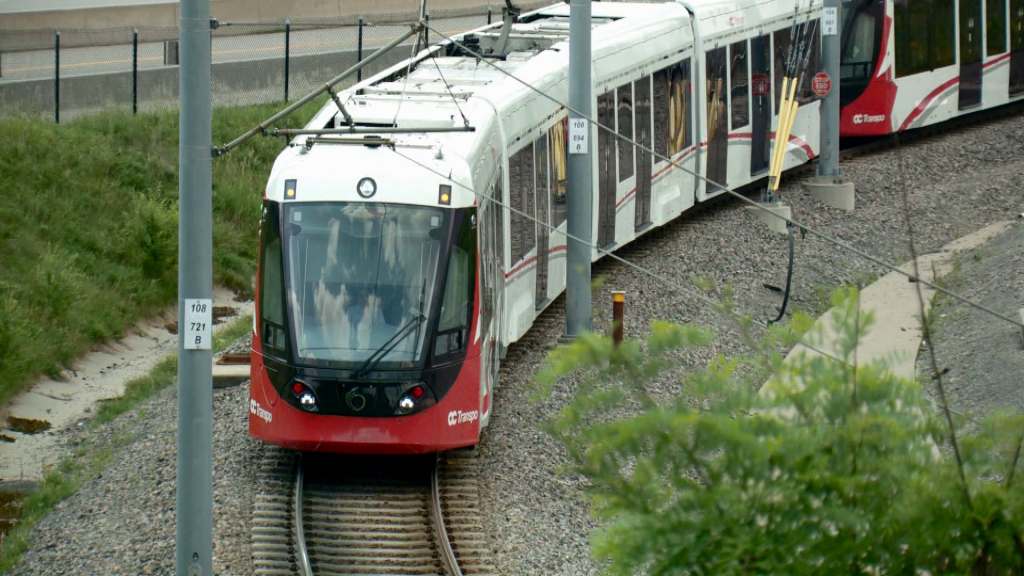
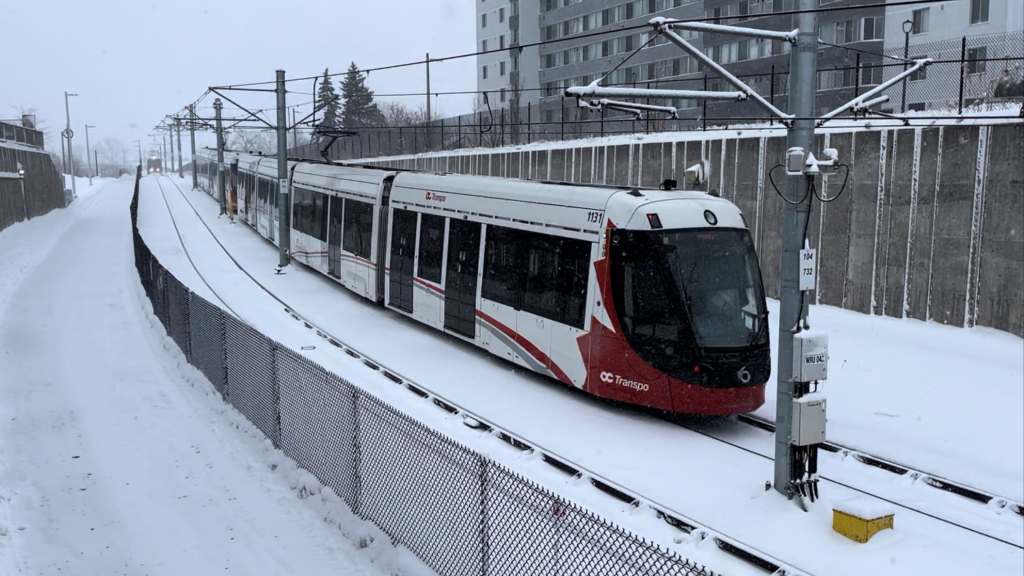
Launched in 2019, the Confederation Line was plagued with issues from the outset. Frequent service disruptions due to door malfunctions, electrical failures, and even derailments became commonplace. These problems not only inconvenienced riders but also necessitated the reallocation of buses to cover LRT routes, further straining the bus network .

Service Cuts and Declining Reliability
In recent years, OC Transpo has implemented significant service reductions, often without adequate public consultation. For instance, in 2021, the agency planned service cuts without seeking rider input, leading to widespread criticism . By 2024, the city had cut $47 million from OC Transpo’s capital budget, removing 117 aging buses without replacements, resulting in a 3.5% reduction in bus service hours . 

These cuts have had tangible impacts on riders. Students, for example, have reported overcrowded trains, erratic service, and high fares, leading to dissatisfaction and calls for meaningful reforms . Community feedback has consistently highlighted issues with reliability and a lack of focus on the city core .   

Financial Strains and Leadership Challenges
The COVID-19 pandemic exacerbated OC Transpo’s challenges. A 38% drop in ridership since 2019 led to a $36 million revenue shortfall . Despite these financial strains, the agency increased fares in 2024, disproportionately affecting seniors and youth riders .  

Leadership changes have also marked this period. The recent departure of General Manager Renée Amilcar underscores the need for a strategic reevaluation of OC Transpo’s direction. Transit advocates have called for a “serious, honest” review of the system to address its myriad issues . 

A Call for a Rider-Centric Vision
To restore public trust and improve service quality, OC Transpo must adopt a rider-centric approach. This includes engaging with the community to understand diverse transit needs, investing in infrastructure to ensure reliability, and providing transparent communication about service changes. Equitable access must be prioritized, ensuring that transit services are affordable and accessible for all demographics.

The challenges facing OC Transpo are significant, but not insurmountable. By focusing on the needs of riders and committing to transparency and accountability, Ottawa can rebuild a public transportation system that serves its citizens effectively and efficiently.

The Northlander Returns: A New Era for Rail in Northern Ontario

The vast majority of my readers know how enthusiastic I am about the continued development of public transportation capacity, and especially trains for regional services.  

After more than a decade of absence, the Ontario Northlander train is poised to make its triumphant return, and for many in Northern Ontario, it couldn’t come soon enough. This isn’t just a story about a train line being revived. It’s about equity, connectivity, environmental sustainability, and economic renewal. As someone who has spent the better part of my career analyzing and advocating for robust public transit solutions, I see the Northlander’s revival as a long-overdue correction to a critical transportation misstep.

The Ontario Northlander was first launched in 1976, operated by Ontario Northland Railway (ONR), as a passenger rail service running between Toronto and Cochrane. For decades, the train was a vital artery, an essential link between rural northern communities and the political, economic, and cultural hub of Southern Ontario. Students rode it to university. Seniors depended on it for healthcare visits in the city. Tourists boarded it in search of pristine lakes and forests. And entire communities built their sense of connection around it.

Then, in 2012, the service was cancelled. The provincial government at the time pointed to financial unsustainability and declining ridership, replacing the train with bus service. But buses, while useful, were never an adequate substitute for the comfort, reliability, and year-round stability of rail. For the people of the North, many of whom already feel excluded from Queen’s Park’s decision-making, the cancellation was a bitter pill. And so, for over a decade, the memory of the Northlander lived on not as a nostalgic curiosity, but as a symbol of something lost and needed again.

Fast-forward to 2021, when the Ontario government formally announced that it would restore Northlander rail service. The new plan is far more ambitious than a simple restart of the old route. This time, the train will run between Toronto and Timmins, with a continuation to Cochrane, and it will serve up to 16 stops along the way. North Bay, Temiskaming Shores, Kirkland Lake; these are not just waypoints, but communities that have long been underserved by modern transportation infrastructure. The revival is no half-measure. It’s a $139.5 million commitment, involving track upgrades, station refurbishments, and the acquisition of three brand-new Siemens Venture trainsets. These aren’t your grandfather’s rail cars. They’ll feature accessible washrooms, Wi-Fi, wider seating, power outlets, and onboard storage for mobility aids, meeting the full range of needs for modern travellers.

One of the most exciting aspects of the Northlander’s return is the attention being paid to operational timing and scheduling. Service is expected to begin by the end of 2026, with trains running between four and seven days per week, depending on demand and seasonal needs. The journey from Toronto to Timmins will take about 10 to 11 hours, and both daytime and overnight departures are being considered to best accommodate passengers. This scheduling approach reflects a deeper understanding of how people in the North actually travel, whether they’re making medical trips, visiting family, or commuting for work. It’s not just about frequency; it’s about relevance and reliability.

There are several layers of benefit to this project, each more meaningful than the last. First and foremost, it’s about connectivity. For too long, Northern Ontario has been left behind in the transportation conversation, despite its immense contributions to the provincial economy through mining, forestry, and tourism. Reconnecting the North to the South by train helps bridge not only physical distances but economic and cultural divides as well. Trains don’t just move people, they move opportunity.

Economically, this revival is a catalyst. Local businesses will benefit from improved mobility for both workers and customers. Tourism operators can expect a boost as more visitors opt for the scenic, stress-free route north. And for municipalities along the route, the return of passenger rail service is a magnet for investment in everything from hospitality to infrastructure. The Northlander isn’t just arriving—it’s bringing momentum with it.

There’s also a compelling environmental case. In a province increasingly focused on climate resilience, rail offers a significantly greener alternative to individual car travel and regional flights. Each trainload of passengers represents dozens of vehicles off the road, translating into measurable reductions in greenhouse gas emissions. For Ontario to meet its long-term sustainability goals, projects like the Northlander aren’t just helpful, they’re necessary.

Perhaps most importantly, though, this train is about accessibility and inclusion. Whether you’re a senior with limited mobility, a student on a tight budget, or a resident of a remote community without a driver’s license, the Northlander offers something invaluable: freedom. The freedom to travel without dependence on a car. The freedom to access services and opportunities that would otherwise be out of reach. And the freedom to feel seen and served by the systems meant to support you.

The Northlander’s return is not a silver bullet, and challenges will remain. Ridership must be cultivated through thoughtful marketing and community outreach. Service quality must be maintained. And long-term funding must remain a political priority, no matter who holds office. But none of these challenges are insurmountable. What matters most is that the train is coming back, new, improved, and loaded with promise.

For too long, the Northlander was a missing piece of the provincial puzzle. Its return is not only an act of restoration but of renewal. It affirms that every corner of this province matters, and that no community should be cut off from the future by virtue of its geography. So, all aboard. The North is on track once again.

Sources
Ontario Northland: The Northlander
Ontario Government Announcement: Passenger Rail in the North
BayToday: All Aboard for the New Era of the Northlander
Wikipedia: Ontario Northlander
Northern Policy Institute: Passenger Rail and Northern Access

Beyond Alto: The Ripple Effect of High-Speed Rail on Local Transit and Business

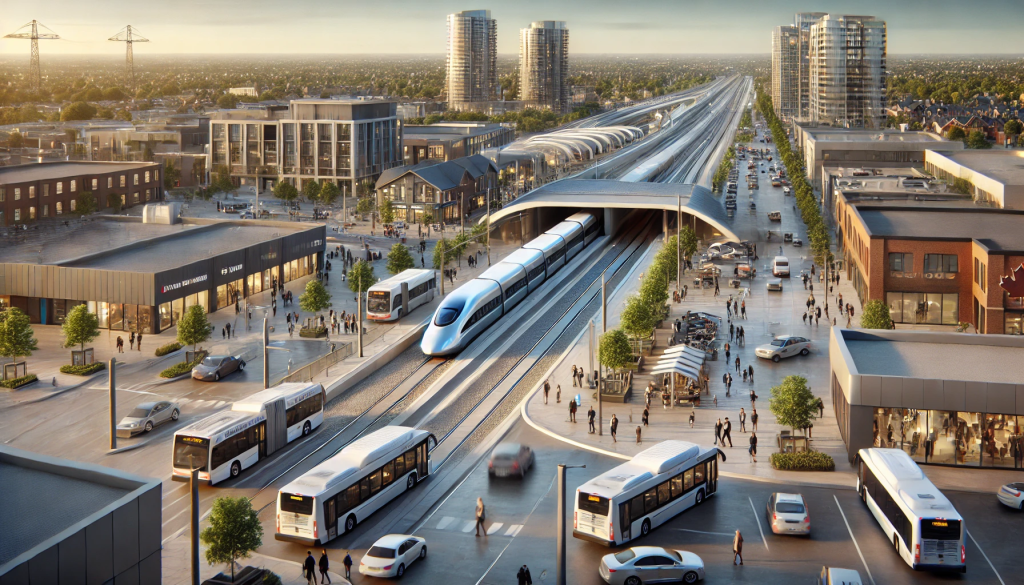
The Alto high-speed rail project is poised to do more than just transform intercity travel—it will also act as a catalyst for expanded local public transportation networks and economic growth in smaller communities along the corridor. High-speed rail doesn’t exist in isolation; it requires efficient first- and last-mile connections to ensure that travelers can seamlessly reach their final destinations. As Alto stations are developed in cities like Peterborough and Trois-Rivières, there will be a natural demand for increased bus services, light rail connections, and other forms of public transit to serve passengers arriving and departing from these hubs.

In cities like Ottawa and Montreal, where light rail transit (LRT) networks are already in place or under development, Alto will likely drive additional investment in urban transit expansion. Commuters traveling into these cities will need efficient ways to connect from high-speed rail stations to workplaces, universities, and residential areas. This could lead to the creation of new LRT lines, expanded bus routes, and improved transit hubs that integrate multiple modes of transportation under a single, seamless system. Toronto, for instance, may see an expansion of its GO Transit network or additional streetcar service to accommodate increased passenger flow from the high-speed rail station.

Smaller communities like Peterborough, which has long suffered from limited transit options, stand to benefit significantly. With an Alto station positioned in the city, businesses catering to travelers—hotels, restaurants, and retail establishments—will likely see increased activity. At the same time, local governments may prioritize the development of new transit services, such as regional bus routes that connect surrounding rural areas to the high-speed rail station. This increased connectivity could make Peterborough a more attractive destination for commuters who work in Toronto or Ottawa but prefer the affordability and quality of life found in a smaller city.

The economic ripple effects extend beyond just transit and business development. High-speed rail has been shown in other countries to attract new industries, create demand for office space near stations, and encourage residential development in previously overlooked areas. With Alto, towns along the route could see a surge in interest from businesses looking to take advantage of the improved connectivity. Real estate markets may also experience a boost as professionals and families consider relocating to these areas, knowing they can quickly access larger cities for work or leisure.

Ultimately, Alto is not just about linking major urban centers—it’s about reshaping the broader transportation ecosystem. By creating a high-speed backbone, it encourages cities and towns to rethink their own transit strategies, leading to improved local services that benefit both residents and visitors. If properly managed, this project has the potential to generate a more interconnected and accessible transportation network across Ontario and Quebec, fostering economic growth and enhanced mobility for generations to come.

The Alto Project: A New Era for Canadian Public Transportation

The Canadian government’s announcement of Alto, a new high-speed rail network linking Toronto and Quebec City, marks a watershed moment in the nation’s transportation history. This 1,000-kilometer electrified corridor will connect major urban centers while slashing travel times, with trains reaching speeds of up to 300 km/h. The journey from Toronto to Montreal, currently a grueling five-hour trip by rail, will be cut to just three hours, making it a direct competitor to short-haul flights. More than just a transportation project, Alto represents a long-overdue commitment to sustainable, efficient public infrastructure—one that could reshape how Canadians move between their largest cities.

Canada has been here before, at least in theory. The dream of high-speed rail has surfaced repeatedly over the decades, only to be shelved due to shifting political priorities, economic downturns, or a lack of public and private investment. In the 1960s, CN’s TurboTrain attempted to bring high-speed service to the Montreal-Toronto corridor, but despite its impressive top speed of 225 km/h, it was plagued by technical challenges and ultimately discontinued. Later, in the 1980s, Bombardier proposed a high-speed link between Quebec City and Windsor, but enthusiasm waned in the face of funding concerns and political inertia. Meanwhile, other nations surged ahead. France launched the TGV in 1981, Japan’s Shinkansen had already been running since 1964, and China rapidly built the world’s most extensive high-speed rail network. Canada, with its vast geography and car-dependent culture, lagged behind, leaving VIA Rail to struggle with aging rolling stock and shared freight tracks that made reliable service nearly impossible.

The Alto project signals a long-overdue course correction. The government has committed $3.9 billion over six years to develop the project, covering environmental assessments, land acquisition, Indigenous consultations, and detailed engineering work. The project’s scale makes it the largest infrastructure investment in Canadian history, with an estimated 51,000 jobs created during construction and a projected annual boost of $35 billion to the national GDP. The selected consortium, Cadence, brings together some of the most experienced transportation and infrastructure firms in the world, including CDPQ Infra, AtkinsRéalis, Keolis Canada, SYSTRA Canada, SNCF Voyageurs, and, notably, Air Canada. With SNCF’s involvement, Alto benefits from France’s decades of expertise operating one of the world’s most successful high-speed rail networks.

Air Canada’s participation in the Alto consortium is a strategic move that acknowledges the inevitable disruption high-speed rail will bring to the lucrative Toronto-Montreal air corridor. As one of the busiest short-haul routes in North America, this segment has long been a key profit driver for the airline, particularly in the premium business travel market. However, with Alto set to offer a three-hour city-center-to-city-center journey—eliminating the hassles of airport security, boarding delays, and weather disruptions—many travelers, especially corporate clients, may shift their loyalty to rail. Rather than resisting this change, Air Canada is positioning itself within the Alto project to maintain influence over intercity travel dynamics, potentially leveraging its expertise in ticketing, loyalty programs, and intermodal connectivity. By integrating rail service into its broader network, Air Canada can remain a key player in the evolving transportation landscape, offering seamless connections between domestic, international, and rail-based travel. This approach mirrors strategies seen in Europe and Asia, where major airlines partner with high-speed rail operators rather than compete head-on, ensuring they remain relevant as travel preferences evolve.

Beyond the economic and technical aspects, Alto represents a fundamental shift in how Canada approaches public transit. For decades, intercity travel has been dominated by cars and airplanes, both of which contribute heavily to congestion and carbon emissions. The Toronto-Ottawa-Montreal corridor is one of the busiest in North America, yet for years, travelers have been forced to endure overcrowded highways, unreliable train schedules, or expensive, inconvenient air travel. High-speed rail changes the equation. Electrified trains eliminate the carbon footprint of regional flights, reducing overall transportation emissions in line with Canada’s climate goals. At the same time, by shifting travelers from cars to rail, Alto can alleviate highway congestion, making regional mobility smoother for everyone.

Connectivity is another major advantage. The Alto corridor isn’t just about linking Toronto, Ottawa, Montreal, and Quebec City—it’s also about providing a reliable transit spine for smaller communities like Peterborough and Trois-Rivières. For decades, these towns have struggled with limited or non-existent rail service, forcing residents to rely on personal vehicles or slow, infrequent buses. With high-speed rail, these regions stand to gain new economic opportunities, easier access to larger job markets, and increased tourism. Countries like France, Spain, and Japan have seen firsthand how high-speed rail can transform regional economies, bringing prosperity to areas once considered too remote to thrive.

At its core, the Alto project is a declaration that public transit is not just an afterthought, but a national priority. Efficient, well-funded public transportation is a hallmark of modern, forward-thinking societies, reducing economic inequality by making mobility accessible to everyone, not just those who can afford cars or flights. It also offers a more comfortable, humane travel experience—one where passengers can relax, work, or enjoy the scenery instead of navigating traffic or enduring the frustrations of airport line ups, and security checks. 

Of course, the road ahead is not without obstacles. As my regular readers will know, I am not a fan of Public-Private Partnerships.  Large-scale infrastructure projects in Canada have a history of delays, cost overruns, and political roadblocks. Public support, political will, and careful management will be critical in ensuring that Alto doesn’t become another shelved idea. If the government and its private-sector partners can deliver on their promises, however, Alto has the potential to redefine travel in Canada for generations to come.

For too long, Canadians have watched as other countries invested in the kind of fast, efficient, and sustainable transportation systems that make daily life easier. Now, with Alto, Canada finally has the chance to catch up. If done right, this project could mark the beginning of a new era—one where public transportation is recognized not just as a necessity, but as an engine of economic growth, environmental responsibility, and national connectivity.

Why Metrolinx Should Run Ottawa’s Broken LRT

Those of you who regularly read my blog, know that I am a huge advocate of public transport, and a critic of the Public Private Partnership developing and operating the capital’s Light Rail Transit (LRT). 

Ottawa’s LRT system has been a profound disappointment, a fiasco of engineering failures, political mismanagement, and corporate negligence. Years after its launch, the system remains unreliable, its reputation tarnished by derailments, service disruptions, and public distrust. City officials, despite their best efforts, have failed to restore confidence or implement meaningful reforms. Given this ongoing dysfunction, it is time to consider a serious alternative: uploading the LRT to Metrolinx. A provincial takeover would bring in the expertise, resources, and oversight that Ottawa desperately needs while alleviating the financial strain on local taxpayers.

Metrolinx, despite its own challenges, has experience managing large-scale transit projects across Ontario. The agency has delivered rapid transit systems, expanded GO Transit, and led infrastructure projects that dwarf Ottawa’s troubled LRT. Unlike the City of Ottawa, which has been hamstrung by political infighting and bureaucratic inertia, Metrolinx operates with a broader provincial mandate and access to significantly greater funding. The province already has an interest in ensuring that Ottawa’s transit system is functional—after all, a well-run capital city benefits all Ontarians. Entrusting the LRT to Metrolinx would align Ottawa’s transit with the province’s long-term infrastructure planning, creating opportunities for better integration with intercity rail and bus services.

Financially, the benefits of provincial control are obvious. The LRT has drained Ottawa’s municipal budget, diverting funds away from other pressing priorities such as road maintenance, affordable housing, and social services. The city cannot afford to keep throwing money at a broken system while simultaneously planning for future expansions. If Metrolinx were to assume responsibility, the province would take on a greater share of the financial burden, allowing Ottawa to focus on local transit improvements that fall outside the LRT’s scope. This would not be an unprecedented move—Queen’s Park has already taken over major transit infrastructure in Toronto, such as the subway expansion projects, recognizing that municipal governments simply do not have the fiscal capacity to manage billion-dollar projects alone.

Of course, critics will argue that surrendering local control means sacrificing accountability. But let’s be honest: Ottawa’s local control has not served residents well. The city’s handling of the LRT has been defined by secrecy, questionable decision-making, and a lack of transparency. The provincial government, for all its faults, at least has the ability to intervene decisively when things go wrong. Under Metrolinx, operational standards would be enforced with greater rigor, and the pressure to deliver a functional transit system would be far greater than what we’ve seen from Ottawa City Hall. The public inquiry into the LRT debacle revealed a municipal government that was overwhelmed and, at times, complicit in its own failures. Perhaps it is time to let a more competent player take the lead.

This is not to say that Metrolinx is perfect. The agency has faced its own share of controversies, from cost overruns to delayed projects. But at least it has experience dealing with transit systems on a scale far larger than Ottawa’s. Unlike Ottawa’s municipal government, Metrolinx has the ability to negotiate directly with major infrastructure firms, access provincial funding streams, and bring in technical expertise that the city simply lacks. A takeover would not magically fix everything overnight, but it would place the LRT in the hands of those who at least know how to run a transit system.

The reality is that Ottawa’s LRT is beyond the city’s ability to fix on its own. Metrolinx, with its provincial backing and infrastructure expertise, offers the best hope for a reliable and efficient transit system. Ottawa residents deserve better than what they’ve been given. If that means surrendering local control to get a working train system, then so be it. The LRT was meant to be a transformative project for the city. If Ottawa cannot deliver on that promise, then it’s time to let Queen’s Park step in and do the job properly.

A Path to Sustainable and Inclusive Urban Living

The 15-minute city concept is redefining urban planning by creating neighborhoods where residents can access essential services and amenities—such as schools, grocery stores, healthcare, parks, and cultural hubs—within a short walk or bike ride from their homes. This approach enhances livability, promotes sustainability, and fosters vibrant communities. While cities like Montreal and Vancouver are often highlighted as Canadian pioneers of this model, the concept has significant potential to transform smaller cities and suburban areas as well.

Modern suburban developments, with their sprawling layout, lack of sidewalks, and reliance on car travel, often isolate families and increase stress. Parents find themselves spending hours shuttling children to school, sports, and activities, leaving less time for connection with neighbors or the community. By contrast, the 15-minute city offers a remedy: neighborhoods designed for convenience, where daily needs are within walking distance, eliminating the dependency on cars and fostering tighter-knit communities.

Montreal’s Plateau-Mont-Royal exemplifies the 15-minute city with its dense urban fabric and mixed land use. The neighborhood integrates residential spaces with vibrant local businesses, green parks, and pedestrian-friendly streets. Residents can easily walk or bike to markets, cafes, schools, and public transit, making car ownership unnecessary for most. The Plateau demonstrates how retrofitting existing neighborhoods with human-scale design can create thriving, sustainable communities.

While Vancouver’s downtown core is often cited as a model of accessibility and vibrancy, Victoria has also embraced the 15-minute city concept through its commitment to walkable neighborhoods and cycling infrastructure. Areas like Fernwood and James Bay offer compact communities where residents can access markets, local cafes, healthcare, and schools without needing a car. The city’s investment in bike lanes and mixed-use development showcases how smaller cities can lead the way in creating vibrant, sustainable urban environments.

Stratford, a small Ontario city known for its arts and theater scene, has leveraged its human-scale design to embody the principles of the 15-minute city. Residents of Stratford can easily walk to schools, grocery stores, parks, and cultural venues. The city’s focus on local businesses and accessible public transit demonstrates how smaller municipalities can create thriving, close-knit communities while reducing environmental impact.

Growing up in Newcastle-upon-Tyne, I experienced firsthand the benefits of a 15-minute city before the term existed. Everything we needed—food shopping, schools, parks, and even the local fish-and-chip shop—was within walking distance. Pubs and restaurants were truly “local,” and an affordable public transit system connected us to the wider city. This lifestyle fostered independence, social connections, and a sense of belonging—qualities that modern urban planning seeks to replicate.

The 15-minute city has sparked debate, with critics fearing it may restrict personal freedom or create isolated “bubbles.” However, proponents argue that the model enhances choice by making essential services more accessible while reducing reliance on cars. Rather than limiting mobility, it offers more options for transportation, including walking, cycling, and transit. This model also aligns with public health goals, reducing long commutes and encouraging active lifestyles.

Danish urbanist Jan Gehl emphasizes designing cities around people, not cars. His research underscores the economic, social, and environmental benefits of walkable neighborhoods, from improved mental health to strengthened community bonds. By investing in pedestrian infrastructure and mixed-use development, cities can become more sustainable and equitable.

As Canadian cities grow, the 15-minute city offers a roadmap for livable, sustainable urban living. By prioritizing human-scale design and reducing car dependency, communities of all sizes can embrace this transformative model. Whether in a bustling metropolis or a small city like Stratford, the principles of the 15-minute city promise a more inclusive, resilient future for urban living.