
Though it is a work of entertaining historical fiction, The Crown offers more than just dramatized biographical storytelling. Across its six seasons, the Netflix series paints a richly detailed, often unflattering portrait of the British monarchy as a rigid, emotionally repressed, and outdated institution; one that struggles to remain relevant in the face of a changing world. It invites audiences to reflect on the monarchy’s role in modern Britain, subtly but powerfully suggesting that the real problem may lie less in the figureheads of the royal family and more in the institution’s deeper structure, including the Royal Household itself.
A Portrait of Tradition in a Changing World
From its earliest episodes, The Crown juxtaposes the slow-moving, ceremonial nature of monarchy with the pace of 20th-century social, cultural, and political transformation. Queen Elizabeth II, portrayed across the series by Claire Foy (Seasons 1–2), Olivia Colman (Seasons 3–4), and Imelda Staunton (Seasons 5–6), emerges as both a stabilizing figure and a symbol of institutional rigidity. The episode “Aberfan” (Season 3), where the Queen delays visiting the Welsh village devastated by a coal tip disaster, exemplifies this tension. While based on historical fact, the dramatization underscores a monarchy paralyzed by protocol and unable to respond with the immediacy and empathy the public expects.
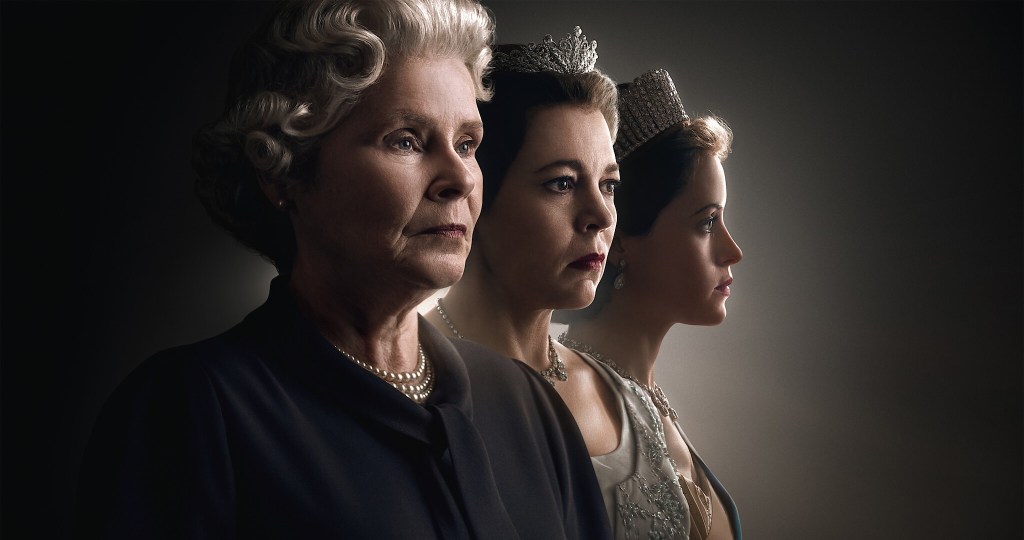
This is not simply a personal failing; it is an institutional one. As Robert Lacey, a historian and advisor to the show, notes, “stoicism and sense of duty,” once seen as virtues, have increasingly come to signify detachment and emotional neglect in the eyes of a modern audience (Lacey, The Crown Vol. 2, 2019).
Generational Conflict and Modern Expectations
As the show progresses into the 1970s, 80s, and 90s, it contrasts the older royals’ worldview with younger members like Princess Margaret (Vanessa Kirby, then Helena Bonham Carter), Prince Charles (Josh O’Connor, later Dominic West), and most poignantly, Princess Diana (Emma Corrin in Season 4, Elizabeth Debicki in Seasons 5–6). Diana is portrayed as a deeply human figure, full of emotional expressiveness and charisma, yet suffocated by an institution that neither understands nor values those traits.
The monarchy’s emotional repression and inability to adapt to changing norms is rendered in excruciating detail: Diana’s mental health struggles, bulimia, and sense of isolation are treated more as public relations risks than genuine causes for concern. The show frames her tragedy as systemic: an institution incapable of human warmth, not by design, but by entrenched culture. Historian David Cannadine argued similarly that the monarchy “requires personal sacrifice to maintain collective mystique” (The Monarchy and the British Nation, 1983).
Critics have echoed these themes. Lucy Mangan of The Guardian praised the series as “a glistening jewel of a drama that simultaneously reveres and dismantles the myth of monarchy,” offering both intimate character study and biting institutional critique (The Guardian, 2020).
Institutional Inflexibility and the Cost of Image
One of The Crown’s most powerful throughlines is its depiction of how the monarchy sacrifices individual identity for institutional continuity. This is particularly evident in its handling of marginalized or non-conforming figures within the family: Princess Margaret, denied marriage to Peter Townsend (played by Ben Miles); the hidden-away Bowes-Lyon cousins with intellectual disabilities; and later, Diana, who is crushed under the weight of ceremonial expectations and media manipulation.
The monarchy’s obsession with appearances, and fear of public disapproval, creates a dynamic in which personal expression is not only discouraged but dangerous. This dynamic reinforces The Crown’s critique: the monarchy is less a family than a mechanism of myth-maintenance, unable to evolve without destabilizing its very foundations.
As The Independent’s Sean O’Grady wrote, “The Palace’s biggest fear isn’t scandal, it’s irrelevance. And The Crown understands this perfectly. It shows the monarchy as trapped, hostage to its own symbols” (The Independent, 2020).
A Failure to Master the Age of Image
As the series moves into the age of television, tabloids, and paparazzi, it shows how poorly equipped the monarchy is to manage a media-savvy, emotionally expressive society. In dramatizations of Charles and Camilla’s (Emerald Fennell, then Olivia Williams) affair and Diana’s famous BBC interview, the royal family is depicted as reactive, rather than strategic, overwhelmed by the forces of modern celebrity culture that they helped unleash but cannot control.
This is not merely a crisis of individuals, but of an institution being overtaken by the very tools; myth, image, and ritual, that once made it untouchable. Biographer Hugo Vickers, while critical of the show’s dramatic liberties, conceded in a 2020 interview with BBC Radio 4 that “its deeper truth lies in how it captures the emotional distance between the Crown and the people.”
The Royal Household: Gatekeepers of Inertia
If The Crown holds the monarchy accountable for its failings, it is equally critical of the Royal Household; the network of private secretaries, courtiers, press officers, and bureaucrats who advise, filter, and often control the royals’ actions. These unelected officials, ostensibly there to serve the monarchy, are portrayed as powerful guardians of tradition with their own internal hierarchies and interests.
Historian Sir Anthony Seldon described the Royal Household as “the most conservative civil service in the world, operating under the illusion that preserving yesterday is the best way to serve tomorrow” (The Times, 2019). The Crown dramatizes this vividly: from blocking Princess Margaret’s marriage to Peter Townsend, to badly mishandling Diana’s public image, the courtiers often serve as the real source of strategic blunders.
Moreover, their motives are not always aligned with public service. Royal biographer Penny Junor argues that many senior courtiers are “jealous of their positions and status” and serve “a very specific idea of monarchy that benefits them” (The Firm, 2005). In The Crown, these behind-the-scenes figures appear less as loyal stewards of national tradition and more as self-preserving bureaucrats shielding the monarchy from the world, and the world from the monarchy.
This tension culminates in the show’s portrayal of the royal response to Diana’s death. The initial decision to remain silent and stay at Balmoral, while the nation grieved, was not driven solely by the Queen but heavily influenced by advisers such as Sir Robert Fellowes (played by Andrew Havill) and others. Only after intense public pressure, and the intervention of Prime Minister Tony Blair (Bertie Carvel), did the monarchy adapt its response. The Household’s instinct to retreat into protocol reveals a deep institutional inertia at odds with public sentiment.
As historian Caroline Harris notes, “The monarchy often takes the blame for decisions made by a hidden apparatus of career courtiers who prioritize continuity over transparency” (Maclean’s, 2021).
A Symbol of National Unity – or a Relic of Empire?
One of the monarchy’s foundational myths is that it provides national unity. Yet The Crown often reveals the opposite: the monarchy, especially as advised by the Household, is portrayed as unable to meaningfully engage with Britain’s increasingly diverse, post-imperial society.
Episodes focusing on the Commonwealth, Scottish nationalism, and the working class suggest a widening disconnect. A 2023 YouGov poll found that support for the monarchy among young Britons (18–24) had dropped to 31%, the lowest ever recorded, implying that the royal institution no longer speaks to the nation’s future (YouGov UK, April 2023).
A Fictional Mirror with Real-World Clarity
The Crown does not call for the abolition of the monarchy, but it does issue a quiet, persistent challenge: can this institution survive not only public scrutiny, but internal stasis? Through its dramatizations, it reveals the emotional cost of monarchy, the strategic failures of its leadership, and the conservatism of its hidden machinery.
It suggests that the problem is not just who wears the crown, but who holds the keys behind the palace walls.
Sources
• Lacey, Robert. The Crown: The Official Companion, Volume 2. Penguin Books, 2019.
• Cannadine, David. The Monarchy and the British Nation, 1780–1983. Cambridge University Press, 1983.
• Mangan, Lucy. “The Crown Review – this Royal Family Drama is a Glistening Jewel.” The Guardian, November 2020. [https://www.theguardian.com]
• O’Grady, Sean. “The Crown Shows the Monarchy is Trapped by its Own Myths.” The Independent, November 2020. [https://www.independent.co.uk]
• Vickers, Hugo. Interview on BBC Radio 4: The Media Show, December 2020.
• Seldon, Anthony. “The Real Power Behind the Palace Walls.” The Times, 2019. [https://www.thetimes.co.uk]
• Junor, Penny. The Firm: The Troubled Life of the House of Windsor. St. Martin’s Press, 2005.
• Harris, Caroline. “Behind the Scenes at the Palace: Who Really Calls the Shots?” Maclean’s, February 2021. [https://www.macleans.ca]
• YouGov UK. “Support for the Monarchy Falls to Historic Lows Among Young Britons.” April 2023. [https://yougov.co.uk]
 The Rowanwood Chronicles