Mr. Carney, Let’s Be Bold and Smart: A Revenue-Neutral Universal Basic Income Is Within Reach

The election of Mark Carney as Canada’s new Prime Minister marks more than a changing of the guard, it signals a chance to transform how we think about economic justice, social policy, and the role of government in a post-pandemic, post-carbon, AI-disrupted world. Yet, if this new Liberal administration wants to do more than manage decline or tinker at the edges, it must champion Universal Basic Income (UBI), and it must do so within this first term.

To skeptics, the usual pushback is cost. “We can’t afford it.” But what if I told you we can, without adding a cent to the deficit?

A bold, revenue-neutral UBI is not only possible, it’s the smart, responsible, and forward-thinking choice. It would simplify our bloated patchwork of social programs, reduce inequality, and stabilize the economy, all while respecting fiscal realities. Carney, with his reputation for monetary prudence and social conscience, is uniquely positioned to make this happen.

The Case for UBI, Now More Than Ever
We live in precarious times. AI and automation are displacing jobs once thought secure. The gig economy has redefined work for an entire generation, offering flexibility but no stability. Climate change is reshaping our industries, economies, and communities. And regional inequalities, from rural depopulation to urban housing crises, are deepening social division.

UBI provides a powerful, simple solution: a no-strings-attached income that ensures every Canadian can meet their basic needs, make real choices, and live with dignity. No complex eligibility criteria. No stigma. Just a stable foundation for all.
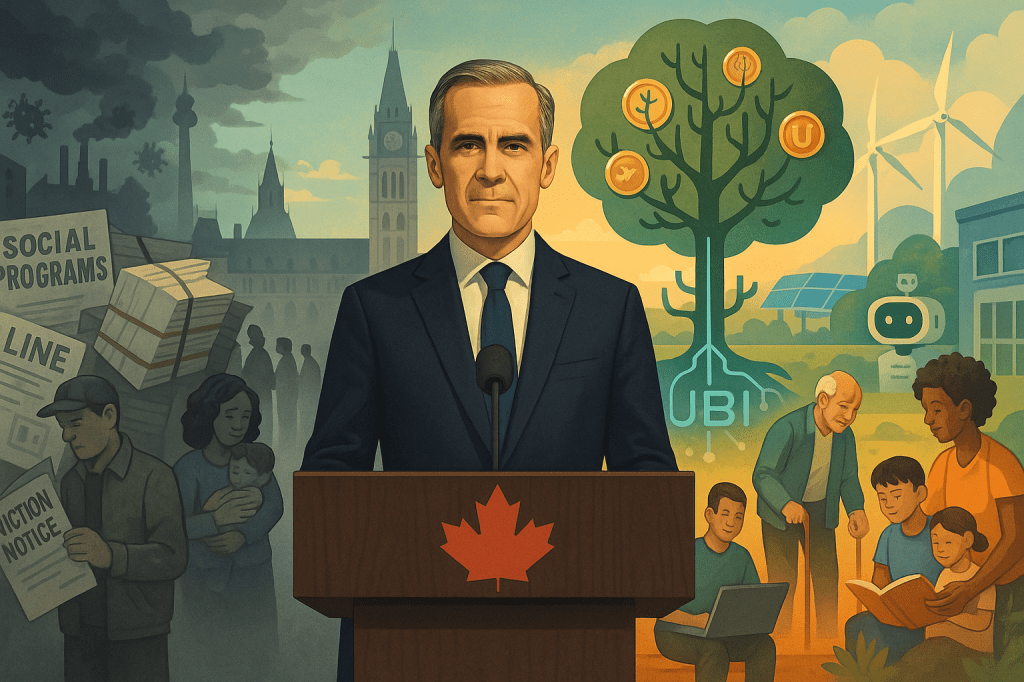
This isn’t a call for endless spending. This is a plan for smart reinvestment, one that replaces outdated, fragmented systems with a coherent, efficient, and humane approach.

Revenue-Neutral UBI: A Practical Path
The key to political and economic viability is fiscal neutrality. Here’s how we get there:

Streamline the Social Safety Net
Our current welfare architecture is costly, overlapping, and often punitive. We propose replacing core income support programs, provincial social assistance, EI for low-wage workers, and a range of targeted income-tested tax credits, with a single, universal UBI. This simplification reduces administrative duplication and restores dignity to recipients.

Rethink OAS and GIS
These seniors’ programs already operate as a basic income for the elderly. By integrating them into a universal model, with UBI replacing these benefits for most, but supplemented by needs-based top-ups for seniors with unique medical or housing costs, we ensure fairness without duplication.

Restructure (Not Eliminate) CPP
CPP remains essential as a pension earned through contribution, but some recalibration of contribution thresholds and benefit tiers, alongside UBI, can reduce reliance on inflated public pensions to cover basic needs, while preserving the contributory principle.

Modest, Targeted Tax Reform
To close the revenue loop, introduce a small surtax (e.g., 2%) on individual incomes over $150,000, and slightly increase capital gains inclusion rates. These are not radical measures, they simply ask the wealthiest Canadians to help ensure every citizen has a secure foundation. For 95% of taxpayers, no increase would be necessary.

Numerous economic models (including work by Evelyn Forget, UBC’s Kevin Milligan, and CCPA researchers) show that a well-designed UBI can be nearly or entirely self-funding when paired with smart policy adjustments like these.

Political Opportunity and Liberal Legacy
Prime Minister Carney doesn’t need to look far for historical inspiration. Universal healthcare, bilingualism, the Charter, these were all ambitious Liberal achievements once considered politically risky and fiscally daunting, yet they reshaped Canada.

UBI can be his legacy. It would resonate across voter blocs: rural Canadians seeking stability, urban millennials burdened by debt and housing costs, women and caregivers locked out of full-time work, and gig workers with no safety net. It’s a unifying policy in a fragmented nation.

Moreover, by leading with a revenue-neutral model, Carney can neutralize opposition from deficit hawks and centrists, while winning support from social democrats, Indigenous leaders, environmentalists, and the entrepreneurial class alike.

A Step-by-Step Roadmap

  • Launch a National UBI Task Force in the first 100 days, chaired by experts in economics, social policy, and Indigenous governance.
  • Table a UBI White Paper by the end of Year 1, outlining fiscal models, legal changes, and implementation scenarios.
  • Pilot the program in a representative region (e.g., Northern Ontario, Atlantic Canada, or an urban-rural mix) with independent evaluation.
  • Introduce legislation in Year 3, with phased implementation beginning before the 2029 election.

This is not pie-in-the-sky. This is responsible governance meeting bold vision.

The Values We Must Uphold
UBI is about more than money, it’s about modernizing our social contract. It says to every Canadian: you matter. You are not a cost, a case file, or a problem to manage. You are a citizen with rights, worth, and potential.

Mr. Carney, you’ve spoken eloquently about “values-based capitalism” and “inclusive transitions.” UBI is the policy vehicle that delivers on those values. And by designing it to be fiscally neutral, you can bring the skeptics along without compromising ambition.

Now is the time to lead not just with caution, but with courage. We can afford Universal Basic Income, not in spite of economic constraints, but because of them.

Let’s stop managing poverty. Let’s start guaranteeing security. Let’s build a Canada where no one is left behind.

Universal Basic Income – Managing Supply and Demand

Managing both the supply and demand sides of the economy is critical when considering the implementation of a Universal Basic Income (UBI). A well-structured UBI program has the potential to stimulate economic growth and reduce poverty but requires careful planning to avoid inflationary pressures or supply shortages that could undermine its benefits.

On the demand side, UBI directly increases people’s purchasing power by providing a fixed income, thereby boosting consumer spending. Households are better able to meet their basic needs, such as food, housing, and healthcare, while also increasing discretionary spending on non-essential goods and services, including entertainment, travel, and retail. This injection of purchasing power can invigorate various sectors of the economy and drive broader economic activity. However, this surge in demand poses risks. If supply chains cannot adjust to meet the increased demand, inflationary pressures may emerge, especially in sectors with limited capacity, such as housing. For example, stagnant housing supply coupled with heightened demand could lead to skyrocketing rents and property prices. Similarly, inadequate production in critical areas like groceries or energy could result in shortages, exacerbating economic instability. Without safeguards, landlords or businesses may exploit increased consumer spending by raising rents or essential costs like transportation, effectively eroding the benefits of UBI. Rental controls and stable public transportation costs are therefore essential to prevent the market from absorbing the additional income without improving overall living standards.

The supply side of the economy, therefore, plays a pivotal role in determining the success of UBI. Policies must be implemented to ensure that businesses and industries can scale up production to meet heightened demand. Investments in infrastructure, energy production, and manufacturing are necessary to expand capacity and prevent bottlenecks. Labor market dynamics must also be addressed, as UBI may lead some workers to leave low-paying or undesirable jobs, potentially causing shortages in essential industries. To counteract this, governments can support workforce adaptation through investments in automation, technological innovation, and targeted training programs. Additionally, UBI may encourage individuals to pursue entrepreneurial ventures or invest in their education, potentially fostering long-term productivity and economic growth.

Balancing these dynamics requires deliberate strategies. Sustainable funding mechanisms, such as taxes on wealth, corporate profits, or consumption, are essential to finance UBI without undermining fiscal stability. These taxation strategies can also help mitigate inequality by discouraging excessive accumulation or speculative practices that drive economic disparities. To address potential price spikes, temporary measures such as subsidies or price controls on essential goods may be necessary, particularly during the initial rollout of UBI. A phased introduction of UBI, starting with smaller-scale trials, allows supply chains and industries time to adjust, minimizing the risk of economic shocks.

Ultimately, a successful UBI policy requires coordination between the demand and supply sides of the economy. On the demand side, increased consumer spending has the potential to stimulate growth and alleviate poverty. On the supply side, proactive measures must ensure that production and labor markets can adapt to meet the new economic realities without triggering inflation or shortages. By managing these elements in tandem, and by instituting measures like rental control and stable transportation costs to protect consumers, UBI can create a more balanced and inclusive economy, fostering resilience and shared prosperity.

Universal Basic Income: A Catalyst for Equality and Economic Resilience

I was recently chatting with my youngest brother, who lives in a NE England coastal town, and he asked about Justin Trudeau’s resignation, and what was going to happen next. A Tory at heart, my sibling’s instincts are those of hard work, community service and fewer taxes.  We started to discuss “the next pandemic” and what could be done about the financial stress many people suffered during the COVID-19 event, and I mentioned Universal Basic Income (UBI) as a possible solution and long term game changer. He had never heard of UBI, and so I thought it was time for this post. This one’s for you, Bro! 

Universal Basic Income (UBI) represents one of the most transformative policy ideas of our time, offering a practical solution to poverty, inequality, and the economic challenges of the 21st century. More than just a tool to address immediate financial hardship, UBI is a blueprint for fostering fairness, stability, and shared prosperity.

At its core, UBI guarantees every citizen a regular, unconditional income, free from the inefficiencies and stigmatization of traditional welfare systems. This simple, yet revolutionary concept ensures that no one is left without the means to secure basic necessities such as food, housing, and healthcare. UBI lifts individuals out of poverty, empowering them to make choices that improve their well-being and build resilience against life’s uncertainties.

A Revenue-Neutral Model for UBI
Critics often argue that UBI is financially unsustainable, but innovative approaches like those proposed by UBI Works demonstrate that it can be funded in a revenue-neutral way. The UBI Works model suggests targeted taxation on sectors and activities that can contribute more to public welfare without burdening the average taxpayer. For example, the proposal includes a 4% tax on profits and a 3% tax on remuneration within the financial sector—an industry that benefits significantly from economic activities.

Additionally, UBI Works advocates for closing tax loopholes and tackling tax evasion, ensuring corporations and wealthy individuals contribute their fair share. This model not only provides a sustainable funding mechanism for UBI, but also reinforces principles of fairness in the tax system.

Stimulating Economic Growth and Jobs
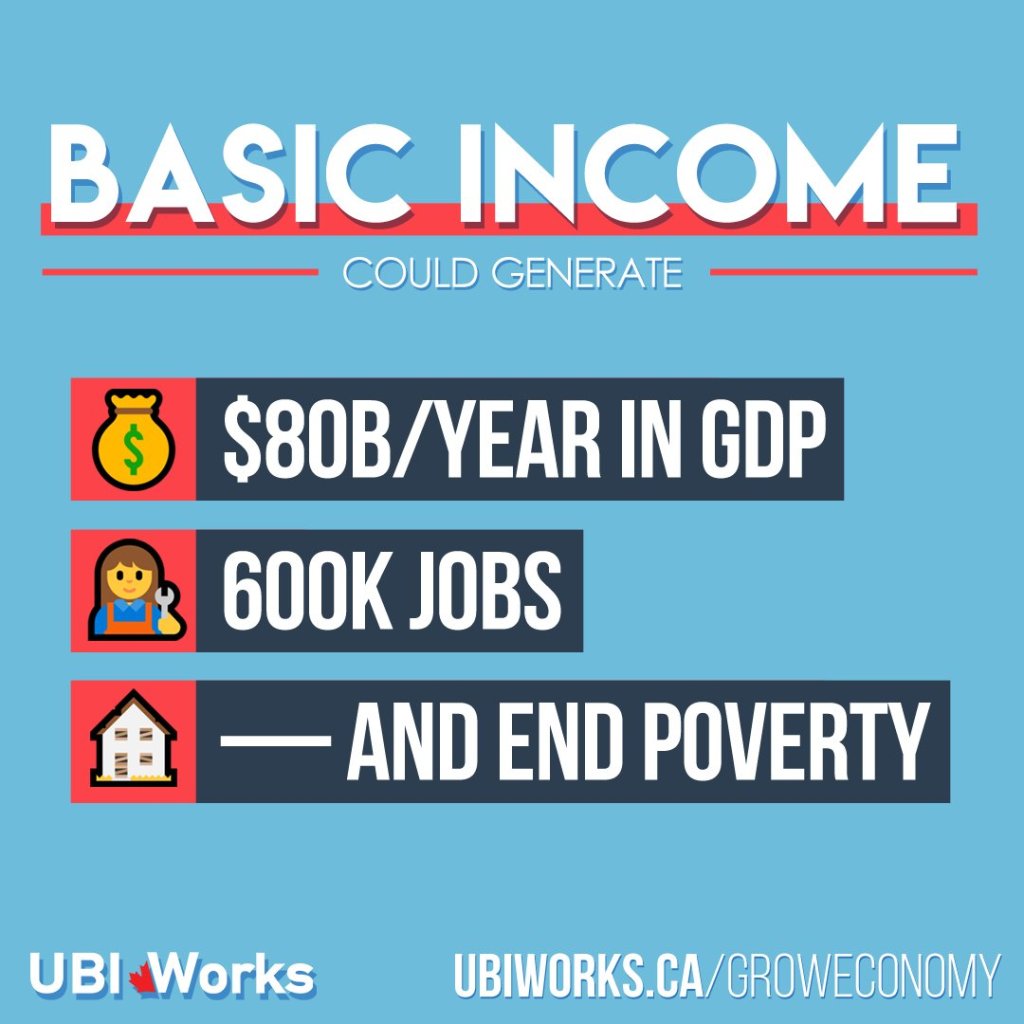
From a supply-and-demand perspective, UBI has the potential to be an economic game-changer. By boosting consumer purchasing power, UBI drives demand for goods and services, spurring business growth and job creation. Research by the Canadian Centre for Economic Analysis projects that a UBI program in Canada could grow the economy by $80 billion annually and add 600,000 jobs, all while eliminating poverty nationwide.

On the supply side, UBI offers workers the flexibility to pursue education, training, or entrepreneurial ventures, aligning their skills with roles they are passionate about rather than accepting exploitative or mismatched jobs out of financial desperation. This not only improves individual well-being but also enhances productivity across the economy.

A Tool for Equity and Resilience
As technological disruption, automation, and globalization continue to reshape labor markets, UBI provides a much-needed safety net. It equips individuals to navigate a rapidly changing economic landscape, enabling them to invest in themselves without the constant fear of financial ruin. At the same time, UBI reduces income inequality and promotes social cohesion by narrowing the wealth gap and fostering a more equitable distribution of resources.

Critically, UBI shifts the focus from reactive welfare systems to proactive empowerment. It eliminates the stigma and inefficiencies of means-tested programs while ensuring everyone benefits from a guaranteed income floor. This universal approach builds trust and unity within society, creating a stronger, more inclusive social fabric.

A Bold Vision for the Future
Universal Basic Income is more than an economic policy—it’s a statement of values. It asserts that every individual, regardless of circumstance, deserves dignity, security, and opportunity. By adopting a revenue-neutral model, UBI proves that fairness and sustainability can go hand in hand.

As the world grapples with inequality, economic volatility, and the social challenges of the 21st century, UBI offers a bold yet practical solution. It envisions a future where poverty is eliminated, opportunity is universal, and every citizen has the means to lead a secure and fulfilling life. UBI is not just a policy—it’s a pathway to a just and prosperous society.

Proposed Policy Shift: A Holistic, Equity-Focused Approach to Pandemic Management

Pandemics have traditionally been managed through isolation measures, and the prioritization of high-risk groups for vaccination. While this approach proved effective during the COVID-19 crisis in Canada, it also revealed significant shortcomings. Widespread isolation led to a surge in mental health issues, while many citizens faced severe financial hardship.

A shift in policy is necessary—one that treats citizens not merely as individuals or isolated households, but as members of interconnected communities. This proposal outlines a comprehensive strategy for pandemic management that prioritizes public health, social resilience, and economic security through three key measures: targeted vaccination by sorting codes, the formation of social pods, and the implementation of Universal Basic Income (UBI).

Targeted Vaccination by Sorting Code
Current vaccination efforts often fall short in addressing systemic inequities. A more effective strategy would prioritize vaccine distribution based on sorting codes (e.g., postal or area codes), focusing on communities most at risk. High-priority areas—those with elevated infection rates, limited healthcare access, or greater socioeconomic vulnerability—would receive vaccines first. This approach ensures resources are allocated efficiently and equitably, reducing disparities and safeguarding the most affected populations.

Development of Social Pods
Isolation has long been the cornerstone of pandemic response, but it often exacerbates mental health crises and social disconnection. An alternative approach is to encourage the creation of social pods—small, stable groups of 3 to 12 individuals who interact exclusively with one another. These pods allow for safe social interaction, fostering emotional and practical support while reducing the spread of infection. School children continue their education and social development, adults maintain their social interaction, while seniors get the support they need from family and friends, all of which greatly reduces pressure on the healthcare system. Social pods also facilitate easier contact tracing and containment efforts, providing a more community-oriented approach to public health.

Universal Basic Income (UBI)
Pandemics often expose and intensify economic inequities, leaving many people unable to comply with public health measures due to financial pressures. Implementing a Universal Basic Income ensures that all individuals, regardless of employment status, have access to basic financial resources. By alleviating economic stress, UBI allows people to adhere to isolation or quarantine guidelines without facing financial ruin, reducing unsafe behaviors driven by desperation and ultimately curbing virus transmission.

This proposed shift in policy emphasizes the importance of addressing the interconnected health, social, and economic challenges posed by pandemics. By adopting targeted vaccination, fostering social cohesion through pods, and ensuring financial stability with UBI, governments can build a more equitable and resilient framework for pandemic management. This approach not only safeguards public health, but also strengthens community bonds and ensures no one is left behind in times of crisis

Limitarianism – A Balanced Way Forward 

With the US oligarchy taking over the White House next year, it’s time to look at what we need to develop to counter the mess and the broken economy they will leave post-Trump’s presidency. Philosopher Ingrid Robeyns, a leading proponent of limitarianism, argues that beyond a certain threshold, wealth does not significantly improve individual well-being, and may cause harm to others by perpetuating inequality and reducing collective welfare. While not a new idea, with historical thinkers such as Plato and JP Morgan espousing similar concepts, perhaps it times to further explore limitarianism.

Limitarianism is a philosophical and political concept that advocates setting limits on individual/family wealth to promote social equality, reduce harm caused by extreme wealth accumulation, and ensure fair distribution of resources. It is rooted in ethical considerations about justice, sufficiency, human welfare, and a sustainable environment. 

The philosophy suggests that extreme wealth is morally problematic, especially in societies where poverty and inequality persist. Excess wealth could be better used to address social issues like hunger, education, or healthcare. The accumulation of excessive wealth can lead to an imbalance of power, undermining democratic institutions. Wealthy individuals may exert disproportionate influence over political systems, media, and public policies. How many times have we seen this in western-style G7 democracies in recent years, where the right do everything they can to protect their wealth and power, while working people can’t pay for the basics of housing, food and transportation? 

Supporters of limitarianism argue for changes in taxation on income, inheritance, and wealth to cap extreme fortunes, along with a redistribution of excess wealth to fund programs like Universal Basic Income (UBI), ensuring a safety net for all citizens. Critics argue that wealth limits could stifle innovation, entrepreneurship, and economic growth, while curtailing personal liberties, and especially the right to accumulate multi-generational wealth.

While enforcing wealth caps, and managing global disparities in wealth distribution can be challenging in practice, limitarianism is gaining traction in debates on wealth inequality, especially in light of growing disparities between the ultra-rich and the rest of society. Movements advocating for wealth taxes and income redistribution often draw from limitarian principles to challenge the concentration of wealth and power.

As a leading advocate for limitarianism, Robeyns argues that extreme wealth is both unethical and harmful to democracy. She proposes a wealth cap of approximately €10 million, emphasizing that any surplus beyond what is needed for a flourishing life could be redirected toward societal challenges like the climate crisis or inequality. Where do you stand on this issue? For me, it seems like one possible set of mechanisms to help rebalance the redistribution of resources, while still supporting a western-style capitalist growth economy.